
The Compendium of Mnemonics by Johann Ludwig Kluber
translated from Compendium der Mnemonik oder Erinnerungswissenschaft aus dem Anfange des siebzehnten Jahrhunderts

The Compendium of Mnemonics is an 1804 German translation of one of Martin Sommer’s books on mnemonics. It offers a deeper look at the eight lessons Sommer advertised in A Brief Outline on the Uses and Admirable Effects of the Art of Memory.
The Compendium of Mnemonics is the basic curriculum for the most popular mnemonics course taught during the early modern era.
This is a great handbook on mnemonics, full of interesting ideas. In my second digest, I speculated about what Schenkel’s 250,000-room technique might have been, and Sommer explains it in chapter six. It involves creating camps filled with houses, then multiplying those camps by painting them in different colors.
The technique reminds me a bit of Tony Buzan’s SEM3 Cube mnemonic, except on steroids. Buzan’s Cube can store 10,000 locations; Sommer’s system stores far more. The basic idea is that you build a camp with 25 houses, you create 100 rooms in each house, and then you divide each room so that it holds 100 places.
Sommer doesn’t go into much detail about how to divide a room into that many places. One possibility is that Sommer and Schenkel divided each wall using five quincunx patterns, giving a single room 100 places.
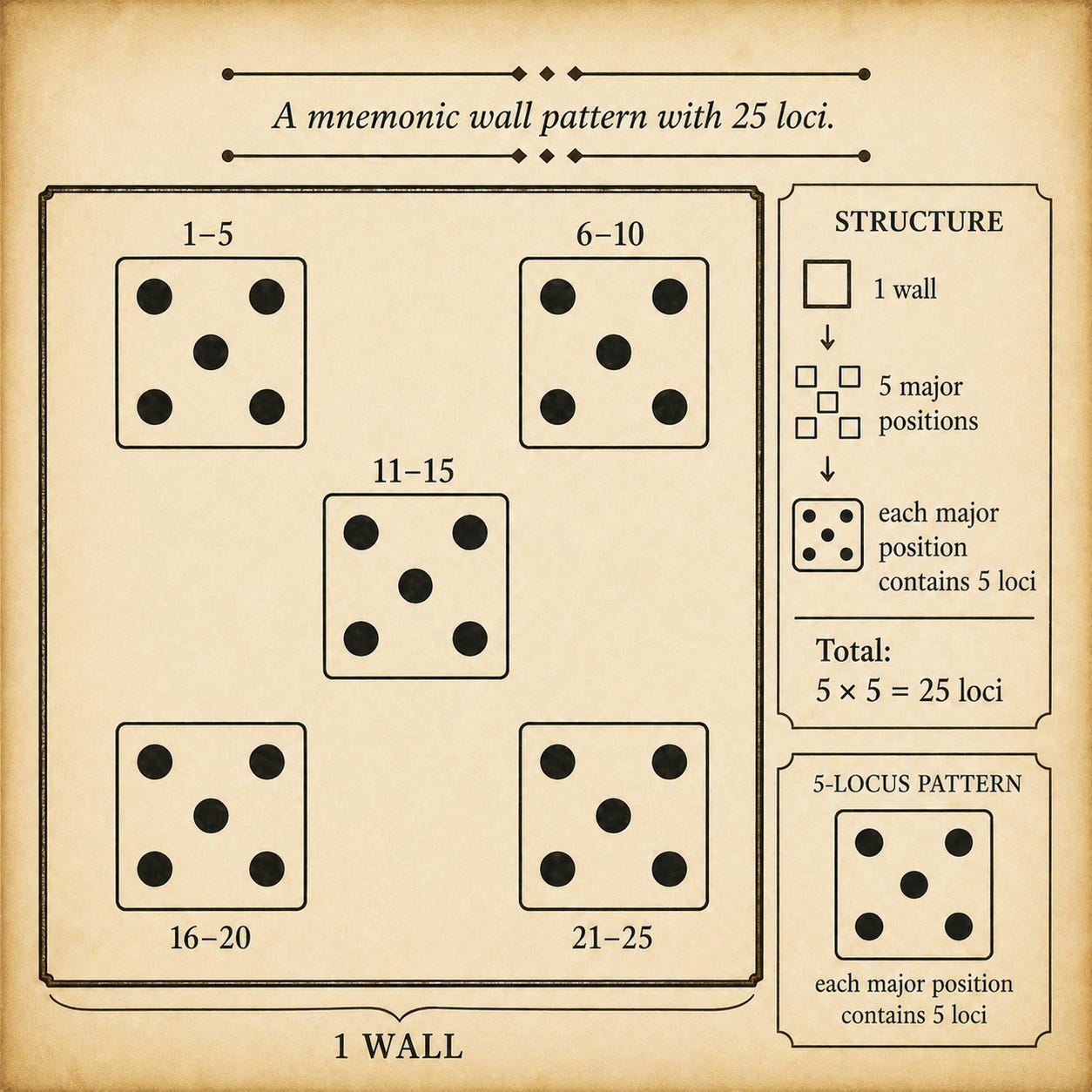
One reason I suspect this pattern over simpler wall divisions is that Sommer’s doesn’t actually tell the reader how he divides rooms. He seems to have saved that information for his real life classes. I doubt he would have done that for something simple like dividing a wall into five rows and five columns. Of course, it’s also possible he had some other system, one like LeLievre where door and corners were used, or maybe even ceilings and floors.
Still, the multi-quincunx patterns has my vote, and it’s the one Kluber also suspect Sommer’s used.
I doubt the 250,000-place camp was ever actually used by Sommer or Schenkel. My guess is that it was more of a sales pitch meant to hype up their courses than a technique they relied on in their own practice.
A smaller camp, with smaller houses and a saner division of places, would already be extremely powerful. And since the camps can be multiplied through colors, you’d never have to worry about running out of locations. It’s not my cup of tea, but it should work, and others may find it useful.
My favorite chapter was the third, where Sommer discusses abbreviating longer works. My own practice is focused on boiling books down to their chapter headings: I want to be able to evoke the contents of a chapter simply by recalling its title. Sommer’s explanation of how to summarize books mirrors my own approach, so it was satisfying to see that similar techniques were once taught by one of mnemonics’ greatest teachers.
Chapter eight is a close runner up for my favorite, since it shows how to use mnemonics to study the liberal arts. It’s a great chapter, and it fits nicely beside The Art of Topical Memory’s chapter on the same subject. I hope that, by the time I wrap up this newsletter, we’ll have a real buffet of books that teach people how to use the art of memory to study the trivium and quadrivium.
I’ve added graphic summaries to the end of each chapter to make the material easier to parse. These summaries don’t cover everything in the chapters, but they offer easy-to-read highlights that should add some stickiness to the material.
My biggest critique of Sommer and Schenkel’s method is that it doesn’t feel complete without some kind of peg system. The syllable method from that era is extremely powerful and should’ve been included. Modern mnemonists would also doubtlessly want to add the major system to the course framework.
Compendium of Mnemonics
From the beginning of the seventeenth century, by Lamprecht Schenckel and Martin Sommer. Translated from the Latin, with a preface and notes, by D. Johann Ludwig Kluber. Erlangen: by Johann Jakob Palm, 1804.
Bavarian State Library, Munich.
Preface
This little work was already, at the time of its first appearance nearly two centuries ago, an extremely remarkable, strange, and even secretive phenomenon; its contents were intelligible only to the initiated. It is therefore no wonder that the art itself, which it is meant to teach, is counted in our day among the lost arts, perhaps preserved only in a few monasteries by tradition, while the book itself is reckoned among the rarest.
As a manuscript intended only for his listeners, the author had it printed, and they received it, like the art itself, on no other condition than a promise of secrecy and the strictest silence.
At a time when the announcement made by Baron von Aretin is once again drawing attention to mnemonics, a rebirth of these few sheets, in German and in a modern dress, may not be unwelcome to a large part of the public. Even when Aretin’s invention has at last been publicly disclosed by its worthy author, it must still matter to the examiner and the bibliographer to know the point at which the older mnemonists stopped, and to compare it with the newer one from which we may hope for a far simpler and more accessible method. The mnemonic demonstrations recently given by Mr. Licentiate Duchet, to whom Mr. Oberhofbibliothekar von Aretin had entrusted his invention, in Munich, here in Erlangen, and in Leipzig, and which he now also intends to give in Berlin and Petersburg, justify that flattering hope.
The inventor of this mnemonics, Schenckel, and his pupil Sommer, caused extraordinary attention among their contemporaries in a large part of Europe through their art. Both made considerable journeys for this purpose and earned substantial profit. It will not be uninteresting to learn their history as far as the surviving historical data reach.
Lamprecht Schenckel was born in Herzogenbusch in 1547, where his father was a practicing physician and philologist. He studied at Louvain and Cologne, and in time became a teacher at several learned schools in the Netherlands, especially in Antwerp and Mechelen. He also taught for some time in Rouen and Paris. He wrote various Latin books on grammar, prosody, rhetoric, method, and history, as well as Latin poems.
Jocher, in his learned lexicon, provides a list of his writings. Among other things he says: “Two books De arte memoriae, under the name Martin Sommer; Gazophylacium artis memoriae.” Under the article Martin Sommer, Jocher refers back to the article Schenckel. But there is an error here. Sommer is not a disguised name behind which Schenckel concealed himself. This Sommer, a Silesian, was Schenckel’s pupil and successor in the teaching of mnemonics, as will be shown more fully below.
For many years Schenckel traveled through the Netherlands, Upper and Lower Germany, and France in order to teach mnemonics. He subjected his teaching method to the examination of many princes and universities and won great applause. Archbishops, bishops, dukes, princes, counts, and renowned scholars examined him and approved his art. In particular, the archbishops and bishops of Cologne, Antwerp, Wurzburg, Basel, and Arras, the academic senates of Louvain, Douai, and Wurzburg, tested him; and the rector of the University of Paris, after prior examination, granted him academic citizenship and permission to teach his art there. The chancellor of France had him examined in mnemonics by the master of requests Marillac, and then obtained for him an exclusive royal privilege. By this he was allowed to teach his art unhindered throughout the entire kingdom, while his listeners, under heavy monetary penalty, were forbidden to communicate the art to others, whether publicly or privately, without his consent.
As he grew older, traveling became burdensome to him. He therefore chose as his successor in the mnemonic chair his friend and pupil, the law student Martin Sommer of Silesia. He granted him a solemn diploma in which he allowed him to teach, under certain conditions, in Germany, France, Italy, Spain, and neighboring countries the art of memory he had learned from him.
Sommer wrote a Latin announcement of his art and teaching method, which he distributed on his travels in order to attract pupils. In it he gives a very brief account of Schenckel’s mnemonic efforts and merits. He praises the advantages of his art for every class of scholars and business people, especially for counselors, reporters, and advocates. “An advocate,” he says, “who at one time conducts 100 or more cases can, with the help of this art, imprint them all on memory in all their factual variety so thoroughly that he is able to answer each of his clients, no matter in what order they appear before him, as if he had the papers of each before him and were reading them; and if he has to plead, he can retain not only the factual and legal grounds of his own side, but also the grounds and objections of his opponent with exactness. Much that one has read in a library in various books can be so firmly fixed in memory that one is able to set it down at home on paper even after a few days.”
“Whoever understands this art,” Sommer continues, “can dictate to 10, 20, 30, and more scribes at the same time entirely different subjects. After three or four weeks of practice, he will be able to arrange 25,000 image-places during a single Paternoster; and to do this ten times and more in one day, without significant effort and labor, and more accurately than another person without this art can do in an entire year. He will be able to imprint the liberal arts and every branch of learning, sermons, and everything worth knowing so deeply that he will later seldom need to look into books; rather, he can retain everything for his whole life in memory if he applies repetition according to the rules of the art. The whole course of instruction, together with sufficient practice, can be completed in eight or nine days if one devotes only one hour a day to it. But once the rules have been grasped, one need only practice half an hour a day, or at most an hour, in order to gain ever greater skill.”
“A moderate fee,” Sommer adds, “will be paid in advance for the instruction; yet on the condition of repayment if, after learning the art and daily practicing for one hour, anyone can conscientiously assure himself that what has been learned is not worth far more, that he has not derived far greater benefit from it and will continue to do so, than the money paid amounts to; then he is left entirely free to pay as much as he pleases. The teacher of this art will not remain at any place for more than a month. He will, if requested, give demonstrations, produce testimonials from the most respected men, and, before even four, five, or six hours have been devoted to learning this art, prove by experience that this very art can produce, with astonishing ease, effects that seem unbelievable and astonishing to the uninformed.”
Sommer also adds four testimonials to his circular, concerning the truth, accessibility, and astonishing effects of his art, and that it accomplishes everything he promised in that sheet. The first three testimonials were issued in 1616, in Leipzig, Marburg, and Frankfurt an der Oder, and signed by nine, ten, and sixteen of his pupils respectively; the fourth, dated Rostock 1617, is adorned with five names and, besides these, with N. N. N. etc.
Schenckel’s work on the art of memory, as far as I know, first appeared in print in 1610. But Sommer’s edition of 1619 is more substantial and better suited to instruction, and the present translation appears from that rare edition. Here, however, not everything is translated word for word, and not everything is translated at all. The translator’s aim was to present the method as briefly, completely, and clearly as possible, in the taste of today’s public, while still leaving untouched the author’s deliberate obscurity. Even so, he believes he has penetrated the sense and the secrets of the original as deeply as is possible for someone who has not been initiated by the author himself through oral instruction.
Schenckel and Sommer seem to have reserved special advantages for this oral instruction, which others too may perhaps discover, at least in part, after careful study of this treatise and diligent practice. The withholding of those advantages may be inferred from the contents of the treatise. At the end of the first lesson the author indicates that the book is entrusted only to his pupils. Elsewhere, and in other places, he refers to his oral instruction, and especially to oral explanation through selected examples. He also hides the very foundations of his method behind sigla (for example, s.g.d.o., ss.gg., that is, locus, imago, ordo locorum, memoria, loci, imagines); and besides this he uses a large number of strange-sounding words that belong to no language. Some reflection and practice in the art of deciphering helped reveal the secret.
What is said in Morhof’s Polyhistor and, more recently, by Mr. KASTNER in his Mnemonics, p. 28 ff., that Schenckel tried to conceal the main advantages by omitting vowels, is incorrect. Far from it: the secret of the unintelligible words and sigla does not rest on that advantage.
I take this opportunity to note that several years ago I devised a new method of enciphering and deciphering, in which the advantage rests on a very small mechanical device. This secret writing is 1) extremely simple; 2) its use for both parties, the writer and the recipient, involves little effort; 3) it securely conceals the secret from anyone not initiated; and 4) it is reliable, that is, without ambiguity. On the device used for the demonstration there are, in a space that occupies less than three quarters of the surface area of two folio pages, no fewer than 288 entirely different keys, which could just as easily be increased to 576 and 864 if the space were enlarged a little. A very simple mechanism makes it possible to use a different cipher quickly for any one of 288, 576, or 864 words of a dispatch.
Unquestionably, mnemonics is an invention that promotes human education and all practical affairs. It is important not only in pedagogy but in every relation of human life. Even adults, therefore, should not shrink from devoting part of their leisure to it. “Even if I stood with one foot in the grave,” said a famous Roman, “still I should not regret learning something.”
Tachygraphy, especially stenography or shorthand, has probably not gained as much ground in our day as it deserves simply because adults rarely want to take the trouble to practice it, and because it is not made part of youth education. Yet that one can attain in it, without much time or effort, a truly astonishing skill is something I have seen demonstrated decisively, in part from my own prompting, in my lectures and elsewhere.
Every skill presupposes diligence and practice. The same is undoubtedly true of Schenckel-Sommer mnemonics. As with every other art, so with this one, the proverb applies: it must be learned. Whoever therefore imagines that with the help of this guide, or by a merely cursory reading of it, he can make himself into a mnemonist in a few hours, sets his expectations too high and will be disappointed. Let him read, test, and keep the best!
In any case the book is a remarkable phenomenon. Much is left to the reader’s reflection, much to practice. Even if the method were neither as easy nor as secure as the still unknown Aretin method is said to be, still from this little treatise one can extract many mnemonic advantages and many aids to retention even for someone who cannot or will not study it completely; and these, considered and used individually, can be of considerable benefit. This circumstance alone can well repay the effort spent on reading these few pages. Another main reason, besides the rarity and relative obscurity of the subject, together with the wish to awaken greater interest through this for the prompt publication of Aretin’s mnemonics by broad subscription, is why I decided to revive this antiquity. If Aretin’s method is one day made publicly known and satisfies the public’s expectations, then no lethognomic device will be needed to displace the Schenckel method.
As for the character of the Schenckel method, it is by no means based on a merely mechanical trick. It sets technical, symbolic, and logical memory in motion at the same time. It requires not mere mechanical memorizing, but ingenious and judicious memorizing. So far as it is not concerned with memorizing words that are not understood, it works psychologically to lay the sense and matter of what is said or heard into the soul. It works according to the law of association of ideas, which the imagination follows by linking the ideas to be retained either to similarities already known or immediately created, or by connecting them through the understanding, according to the rules of knowledge, with things already known and present; and, in memorizing connected matters, it seeks out and condenses the inner connection. In addition to natural memory, it also calls wit and imagination to its aid.
The history and literature of mnemonics, from Simonides, Cicero, and Quintilian up to the year 1747, may be found in Morhof, loc. cit. But various older writings are missing there, and several more recent ones have since been added.
September 20, 1804. D.
Contents of the Lessons
First lesson. Fundamental principles of the science of memory. Rule for understood words. Immediately illustrated in practice by 20 words, which some listeners recite on the spot forward, backward, and out of order; some so fluently that it seems as if they were reading them written on paper. Whoever has learned 1,000, 2,000, or 3,000 words in this way can, as soon as one names the number, say the word, or, if one names the word, say the number. One might think this unnatural. To avoid that suspicion, the author has often had to submit to examinations at the request of academic authorities.
Second lesson. Rule for memorizing connected speeches and sentences. Illustrated by 12 sentences, which the listeners repeat forward and backward, some in the same hour, others only after one, two, or three days of practice. On the following day 13 more sentences are assigned, which each listener applies the art to on his own and then repeats. It is indeed the hardest rule; however, anyone who practices it for 10, 12, or 15 days can recite 20, 30, to 40 sentences word for word and exactly. With the help of this rule one can retain the Bible, the Institutes, legal passages, aphorisms, academic textbooks, and the like word for word.
Third lesson. Locating things, for example striking examples, comparisons, stories, sermons, speeches in court, and the like. Test with 12 examples. The listeners convince themselves that one can just as easily retain not merely 12, but 20, 50, and 100, as the same number of words.
Fourth lesson. How to retain words that are not understood, for example adverbs, conjunctions, prepositions, interjections, and numerals, and how to mark persons.
Fifth lesson. Method for retaining one’s own and others’ sermons, speeches, and narratives. Locating chains of reasoning, and practice.
Sixth lesson. Places of images, real and imagined. How, after two to four weeks of practice, one can establish 200,000 image-places during a single Paternoster without further effort or labor; and can do this ten times and more in one day, so that after the preparatory practice has once been completed, one need never afterwards be at a loss on that account.
Seventh lesson. Locating books; a very easy method in which no listener has ever found difficulty or raised a doubt. Quotation; more difficult, especially when many quotations must be retained at once. Multiple dictation; how one can dictate 6, 8, 10, 20, 30, 40, 50, 60, 80, or 100 scribes as many different letters or subjects without confusion or interruption. A test is immediately given with 4, 6, 8, or, if requested, with 10 or 12 letters.
Eighth lesson. Ocean of practice. How the principles of mnemonics are to be applied to all major and minor branches of human knowledge, so that what has been properly learned is retained for a whole lifetime. Use of mnemonics for advocates, reporters, presidents, and envoys. The book closes with rules of conduct for the mnemonist. The compendium is handed to the listeners in printed form.
After the teacher’s departure (Sommer’s), the listeners are free to communicate their mnemonic doubts, observations, and inventions to one another; only they must first identify themselves to one another, as his listeners, by means of the password given to them. Anyone unable to do this must in no way be trusted.
Great progress cannot be made unless one practices for the proper length of time. Besides, 6 to 12 louis d’or would be too small a price; one could demand thousands, and buyers would still be found. As in all arts and sciences, so here too: one person makes faster, another slower, progress. Yet nothing is taught here in which one could not become skilled through moderate and well-directed practice. Charlatanism and empty display would, instead of fame and applause, produce only contempt and blame. Many unimpeachable testimonies from trustworthy men guarantee the truth of what is promised here.
First Lesson
Mnemonics has very small foundations. No one should be surprised at that. After all, all human knowledge can be written with twenty-four letters! And do not many keys and notes contain the elements of a fine art, music?
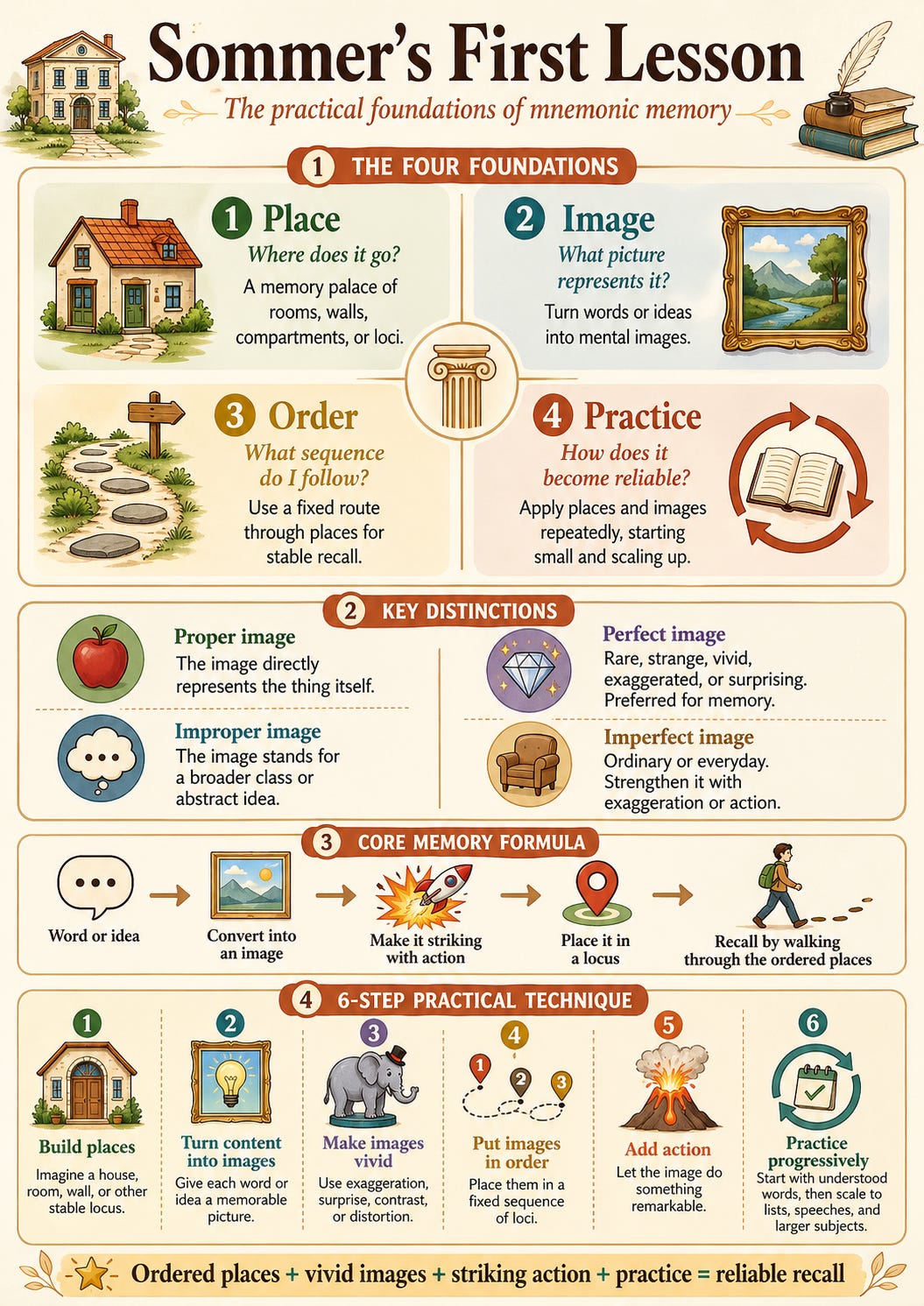
The science of memory rests on four foundations. These are:
Place (image-place, locus);
Image (memory image, imago);
Order of places (ordo locorum);
Practice, or the application of places and images (locorum et imaginum praxis, or actual exercise).
I) A place is a storage site, a specific compartment, in which one or more images may find room, and which one mentally assigns to that spot. In mnemonics one imagines houses with rooms and walls. The walls are arranged as follows: when entering the room, you turn your back to the door; then the first wall is on the left, followed by the second, third, and fourth, on which the door is located. On each wall one imagines, for the image-places, a figure of the twelfth letter.
II) An image is the figure under which one wishes to retain a thing. The images of things that fall within the senses are very easy. Harder are the images of things of another kind, ideal objects; yet the inventive spirit of man discovers a way by which one can obtain an image for every thing at once. Only one main rule for inventing images will be given below.
An image is proper when it denotes only the thing indicated by it; for example, one sets the image of Christ to represent Christ himself. It is otherwise when one chooses the image of Christ to denote a man, or a human being in general; here the image is improper. Thus an image is proper when the image of an individual is taken for the individual itself; improper, when it must serve as the image of a genus, a species, or a higher thing. One may sometimes use improper images, because they are sufficient to stimulate memory, as examples can show.
Moreover, images may be divided into perfect ones, by which rare, strange, and striking things are denoted, so that contrasts and distortions, or caricatures, often arise - for example Daniel among the lions, Jonah in the whale, the actions of Judith, Esther, Tobias, Joseph, and so forth; and imperfect ones, which refer to ordinary and everyday things and therefore have little interest for us, such as the rising and setting of the sun, which causes no surprise because it is observed daily; likewise rain, the blowing of the wind, and so on.
One should use only perfect images, for they arouse a greater interest in us. But, one may ask, how can one follow a speaker as quickly as the course of his speech if one is allowed to use only perfect images, and how can one find such images so quickly? Answer: such images arise on the spot when one adds some remarkable feature to any thing. For example: the wind blows - an imperfect image - but so violently that trees are uprooted and houses collapse, then the image is complete; it rains - imperfect - but so hard that all the villages are flooded and one cannot go anywhere dry-shod, then it is a complete image; the sun rises - imperfect - but very large, red, or green, then it is complete.
In this way one can never be at a loss to obtain what one seeks.
III) The order of the places. Much has already been said about this. I have only two words to add: one should observe decorum. It would be improper to represent Christ on the cross in such a way that Mary stood at his right hand, John at his left, and Mary Magdalene on his head.
IV) Practice or exercise is the fourth fundamental proposition. The fifth lesson will say what is necessary on this point; in the eighth we will sail the ocean of practice and show how mnemonics is to be applied to every art and science, and how people of every class can make use of it. In the meantime, here is something about practice, beginning with the smaller and moving gradually to the greater.
First, the rule for understood words (the rule for words not understood will come in the fourth lesson). Here I am showing a method for producing a test that no one could produce without the help of the art, even if he had practiced his memory without interruption for twenty years or more.
Understood words are retained in memory if one places their images in image-places, adding some distinguishing or striking action. This action can be borrowed from the Bible, from history, from poets, or from ordinary life; one may also invent it at will if nothing from those sources comes readily to mind. No word can occur for which one cannot immediately attach the idea of a remarkable action.
To illustrate: Plato once spoke, in his doctrine of ideas, of mensaity and cyathity. Aristotle and Diogenes, his pupils, did not understand him. The former smiled. The latter said: I see the table and the cup, but I do not see table-ness and cup-ness. “No wonder,” Plato replied, “you have eyes with which you see the table and the cup, but you lack understanding with which you should perceive table-ness and cup-ness.” From this it is clear that Plato had some knowledge of our art. It appears even more clearly from the dialogue in which he introduces Hippias as speaking, boasting of his great accomplishment that he could repeat fifty heard words in any order. No one can do that, I firmly maintain, without the help of the art. My listeners already achieve that feat in the first lecture, on the first day when they place themselves under my instruction. Whoever wishes, for one, two, or four weeks, twice a day for half an hour, to practice this rule, will be able to repeat 100, 200, 500, and still more words in whatever order he likes.
Moreover, it is worth considering that this art is so suited to nature that every person, even without ever having heard of it, uses it in a rough form. If, for example, someone wants to remember where he was born, in which town, village, house, or room, he immediately takes refuge in place or locale and so on. For one cannot remember even the smallest thing without place and image. God has imprinted the principles of all sciences and arts on the human being. If one wishes to use them and practice properly in them, one will make great progress. So it is also with this art. An unlearned peasant, guided only by nature, sometimes arrives at a syllogism or an enthymeme. Had he studied logic, he would have excelled in it. The same is true of all liberal and mechanical arts. Our art of memory corresponds to the nature of the matter itself; but it perfects that nature, and for that reason should not be neglected.
The rule has been set out clearly. Yet if it is not illustrated by examples, I fear my readers or listeners may not understand it sufficiently. I may not give examples here, however, so that those into whose hands this book might fall through negligence or the death of its owner will not be led to think that they can discover the teacher’s meaning without oral instruction and guidance; they would then become more indifferent to hearing me. Not everything must be entrusted to the pen. My listeners, if they are diligent, will easily retain the demonstration.
Second Lesson
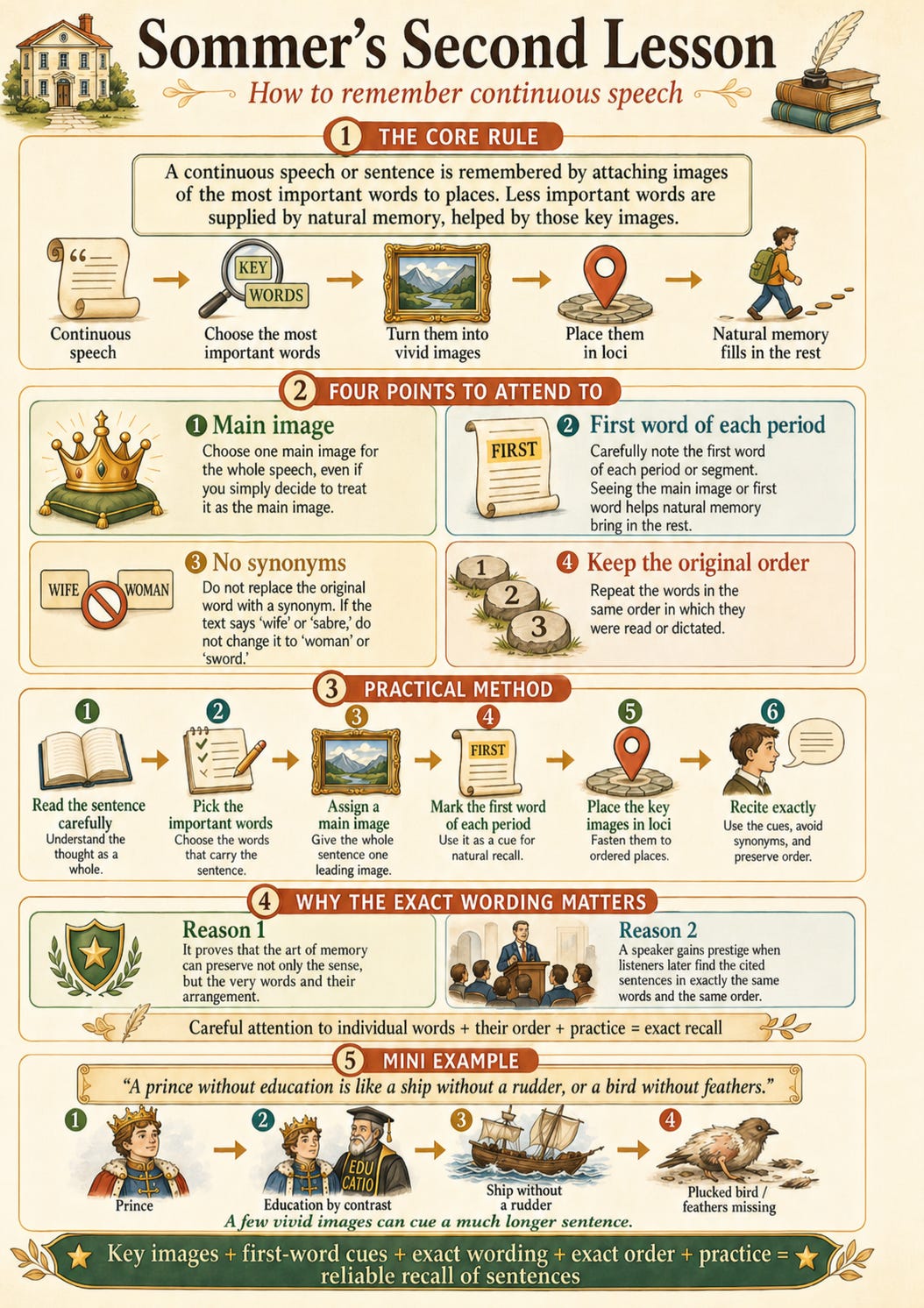
A continuous or connected speech, a sentence, is incorporated into memory and retained if one attaches the images of the most important words to places. For words of lesser importance, one should make use of natural memory in such a way that, with the help of the images of the important words, it retains the less important ones as well.
Here one should direct attention to four points:
1) to the main image of the entire continuous speech, whether or not it is really the main image of the speech, provided one only takes it to be so.
2) One should carefully note the first word of each period. For by turning in thought to the image-place and seeing either the main image or the first word of a period, natural memory easily brings in the rest. Just as in schools, when apprentices do not know their lesson exactly, yet have read it several times carefully. If they then see only the first word of each verse while the others are covered, they easily recite the whole.
3) One must not substitute one synonym for another synonym. This is a common source of error. If I say wife, sabre, and so on, you must not say woman, sword, and so on.
4) Finally, one should strive to repeat the individual words in the same order in which they were either read or dictated.
The rule has been set out clearly. Yet if it is not illustrated by examples, I fear my readers or listeners may not understand it well enough. I cannot give examples here, however, so that those into whose hands this book might fall through negligence or the death of its owner will not be led to think they could discover the teacher’s meaning without oral instruction and guidance; then they would become less willing to hear me. Not everything must be trusted to the pen. My listeners, if they are diligent, will easily keep the demonstration in mind.
A continuous speech, or a sentence, is fixed in memory if one fastens the images of the most important words to places. For less important words one should rely on natural memory in such a way that, with the help of the images of the important words, it retains the less important ones.
But why the rule: “substitute no synonym for a synonym, and change nothing in the order of the places”? If either or both were allowed, the speech would come out better and more elegant. For those who first delivered sentences were less concerned with the exact wording and arrangement than with expressing the sense well. Answer: the rule was established for two reasons. First, so that it may be shown that the same thing can be done by the art of memory. Second, because it gives a speaker great prestige if the listeners at home find the sentences in the authors cited with the very same words and in the same order. If they make this observation three, four, or more times, they will draw the conclusion that this speaker always gives his sentences with the same exactness.
Still, one will want to know the method by which one can satisfy both requirements. This is done by careful attention to the individual words and their order, and by practice. Only through this does one arrive so far that one is astonished at oneself. So much for the hardest of all rules. Even if it has now been explained here, I still believe its execution may seem difficult unless it is illustrated by examples.
Suppose, for instance, that the first period is this: “A prince without education is like a ship without a rudder, or a bird without feathers.” One applies our art as follows: one imagines a ship, and in it a prince, beside a man whose coat is covered with gold letters, while the prince’s own clothing is without such letters. In this way I read the first part of the period through contrast. Then I imagine a ship in which, where the rowers usually stand, no one can be seen, and the ship sails slowly and sideways; I think that this cannot happen without a sufficient reason, since otherwise the voyage would have to proceed faster and straighter. This is how I read the second part of the period. From the rudder to the mast hangs a plucked crane, or a stripped goose. Thus I read the third part.
A period that amounts in outward appearance to about eighty letters I can read in this way, in thought, with the help of no more than six images. It would take too much time to write out even twelve examples: but a demonstration of twenty-five examples in oral instruction is more than enough.
Third Lesson
Whoever walks in the sun is accompanied everywhere by the shadow of his body. In similar fashion, in this rule, images accompany things everywhere. It is also unnecessary here to bind oneself to the words. Both are of great use.
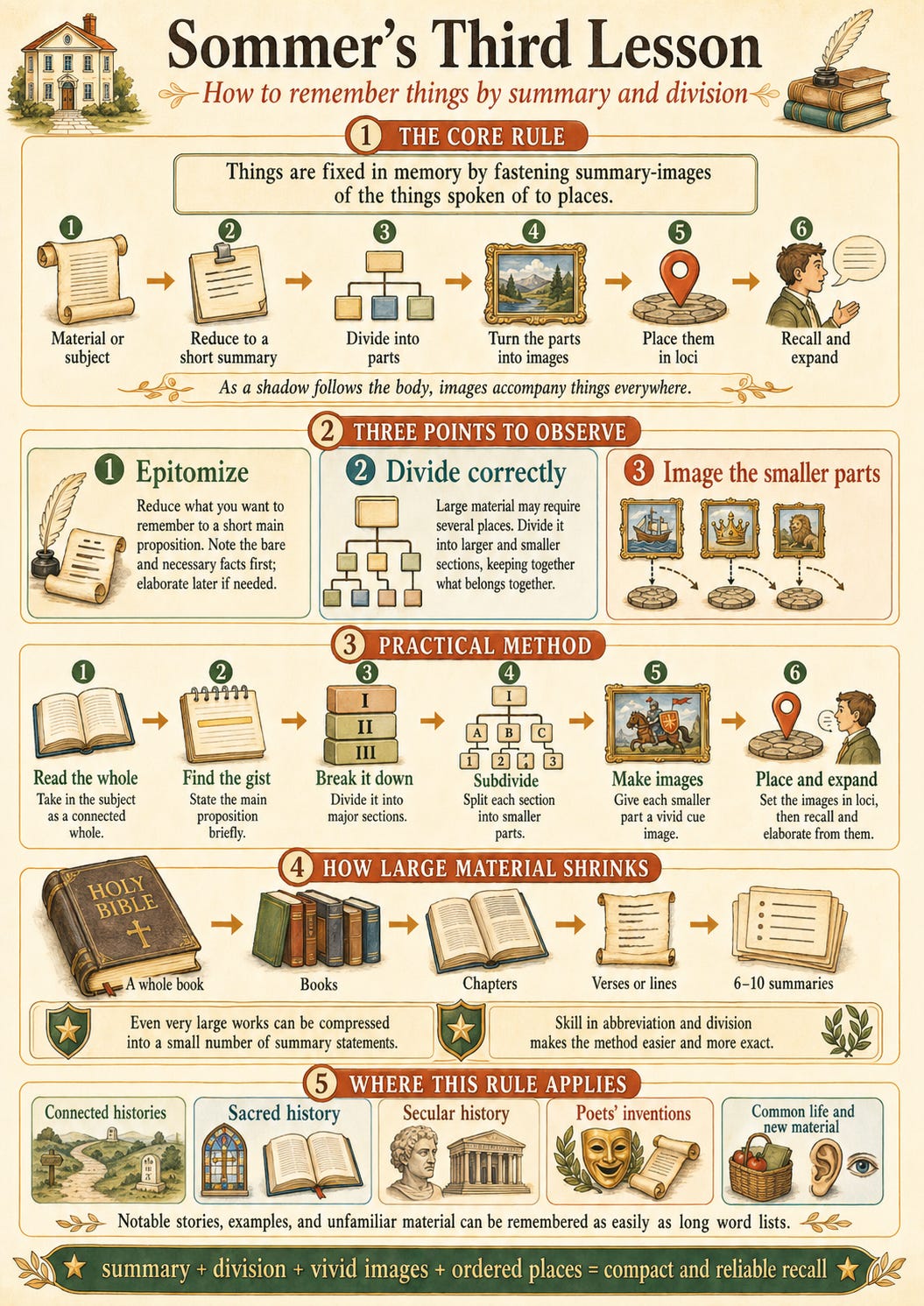
Rule: things are fixed in memory by arranging or fastening the images of the things spoken of, in summary form, to the places. Three points must be observed.
First. Everything one wishes to impress on memory must be reduced to a short main proposition, or epitomized. One does not need, for mnemonic purposes, to proceed as elaborately and ornamentally as a speaker does when shaping a speech to win applause. It is enough to note the bare and necessary facts. Later, if needed, one can reproduce them at length and in fine dress by one’s own expansion and elaboration.
Second. The abbreviated content may become so large that one place is not enough to hold it. If we reduce the Bible to summaries, we still have the separate books: the first, second, and so on of Moses, the Book of Judges, the Books of Kings, and so forth. Each book has several chapters. Each chapter again has fifty to a hundred lines, or verses. Yet according to the method of abbreviation one needs no more than six, eight, or ten summaries. In this way the whole content of the Bible can be compressed into a very small number of statements. The same is true of other writings. Thus the method of division naturally follows, into larger and smaller sections. Whoever has already acquired skill in drawing out the main content of treatises and dividing a lecture sharply into larger and smaller parts will find it very easy to put this rule into practice. Whoever lacks that skill must train himself in the arts of abbreviation and division. The exactness of a division rests on not separating what belongs together, and not joining what must be separated.
Third. One should grasp the images of the smaller parts and assign them places. I usually illustrate this rule with Joseph’s life, which is divided into 52 parts and forms one connected matter. On the following day I present 25 other striking examples that have no connection with one another: four from the Old Testament, the same number from the New, likewise from sacred and secular history, from the poets’ inventions, and from common life. On the third day I give twelve unfamiliar and unrelated examples, to prove that the rule is just as applicable to things read, seen, or heard for the first time as it is to other matters.
My listeners will be satisfied if I substantiate the rule for them with these fifteen examples: 1. Antiochus Soter. 2. The marvelous childbearing of the Countess of Holland. 3. Cleopatra’s evening meal. 4. The revenge of a servant. 5. The reward of a traitor. 6. Bessus accused by his own self-betrayal. 7. The Athenian ghost. 8. The folly of a ridiculous foreigner. 9. As you sow, so you reap. 10. Fratricide on a very trivial occasion. 11. A woman with a man’s mind. 12. A ridiculous childbirth. 13. Thieves are not easy to defend. 14. The largest number of physicians.
Twenty, thirty, forty, and more notable examples or stories can be retained just as easily by means of this rule as an equal number of words. Thus the rule is established.
Fourth Lesson
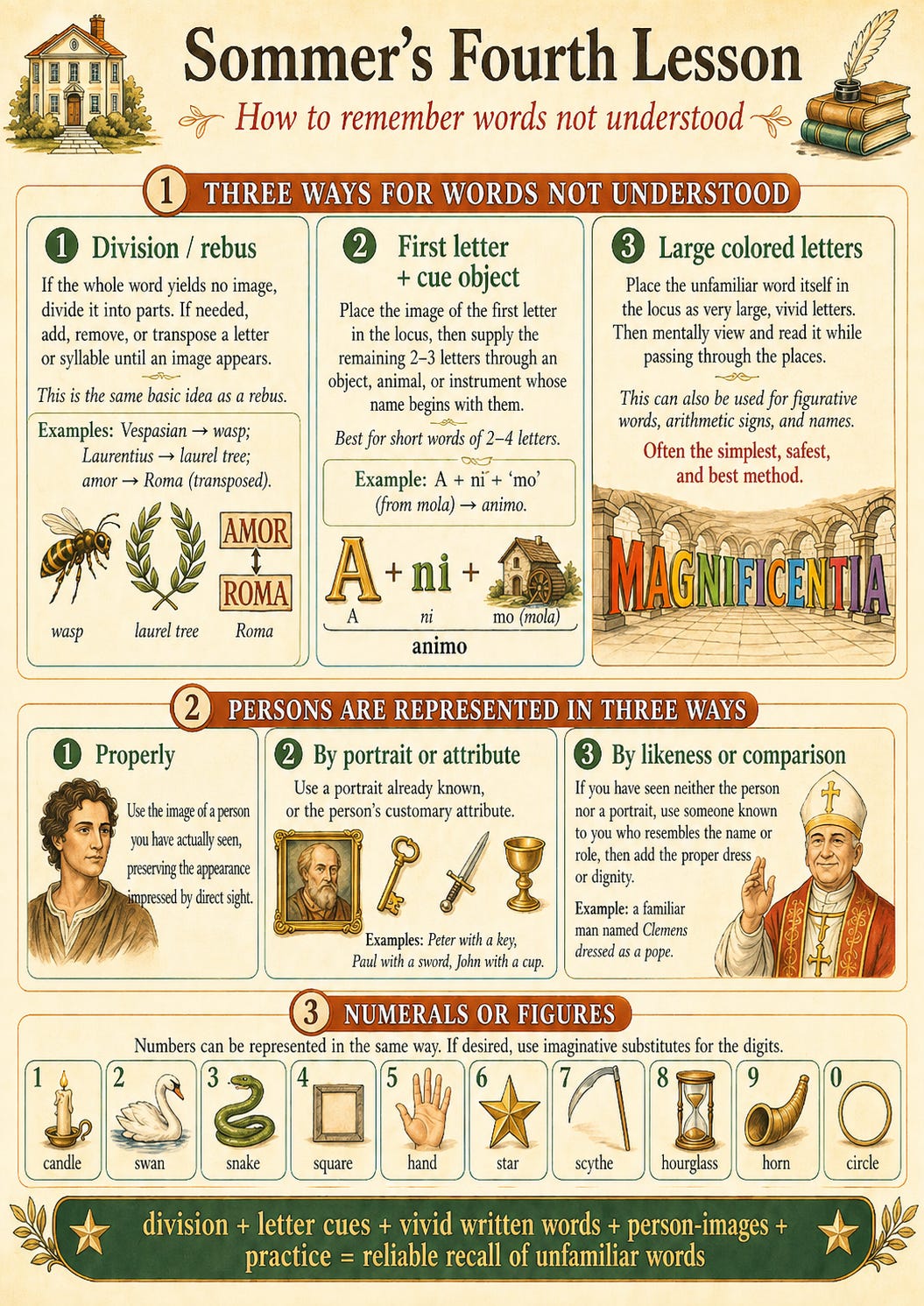
The fuller explanation of how to treat words not understood was reserved for this hour and lecture because it might seem harder, drier, and less fruitful than the other lessons. Yet as soon as anyone learns to apply even one principle from the whole lesson, that lesson alone will be valued as highly as all the others together. One can, however, reach that point through practice in a few days. People spend six, eight, ten, and even twelve months learning to read; why should one not devote just as many days or weeks to this far nobler and shorter method?
Words not understood are retained in memory in three ways.
First, by division. If the whole word does not yield an image, one divides it into two, three, or more parts and sees whether an image can be formed from one part or another. That will almost always succeed somehow. If not, one adds or removes a letter or syllable, whether at the beginning, in the middle, or at the end; or one transposes a letter or syllable. This is shown by examples.
This is the same operation that takes place with the so-called rebus, which are now found in many forms on fancy goods. If I want to write “Vespasian,” I place a man tormented by a wasp; that may suffice to recall the whole word. But if one wants more, one adds the syllable “si” in letters, and the image of an anus, that is, an old woman. For “Laurentius” one sets a man under a laurel tree.
Examples: from vis, when c is prefixed, comes clavis; from acies, when nac is inserted in the middle, comes acinaces; from anime, when l is added at the end, comes animal. From spes, if the first letter is removed, comes pes. From religio, if the syllable li is removed from the middle, comes regio; and so on with morbus and mors, annus and anus. If a letter is removed at the end, saga comes from sagax, nox from noxa. By transposition, and specifically backward transposition, amor yields Roma, aura yields arva; or metagrammatically, pudicus becomes cupidus. By changing some letter, mores becomes mares, deter becomes teter, virago becomes vorage, amantes becomes amentes. Likewise variabilis gives varia bilis. However, such combinations rarely offer a substantial advantage to memory.
Second, one places the image of the first letter in the place, and for the two or three remaining letters one adds to the action an instrument, animal, or similar thing in whose name those letters appear at the beginning. For example, if one wants to express Samos, one imagines the figure of the first letter, an O, or rather a man, Oliverius, pouring out or breaking a matula, that is, a chamber pot; one takes the syllable ma from matula, adds the figure of the first letter, and the word Samos results when read backward as an image. If one imagines Antonius driving a mola, that is, a mill, one takes the letter A from Antonius, adds ni with its letters, and the syllable mo from mola; thus the word animo results. Although this word is understood, I chose it for the sake of explanation. This method is suitable only for words of two, three, or four letters.
The third method, in my opinion the simplest, safest, and best, is this: one places the words not understood, in thought, in very large Latin letters, or partly Latin and partly German letters, with a striking color, in the places; then one views and reads them in thought while passing through the individual places. This can be applied not only to words not understood, but to all figurative words and to arithmetic signs, and sometimes even to understood words, for example when one wishes to retain names of men, women, cities, and the like.
All these methods can also be combined at will, so that one part of the word is represented by the first method and another by the second or third.
In this lesson there is also usually discussion of the arrangement of persons and of figures or numerals, which will be useful for the later lessons.
Persons are represented in three ways:
First, properly, that is, when the image of a person we have seen is mentally placed just as we have imprinted it through direct view of the original.
Second, through the person’s portrait, which we have seen. This is a very extensive mode of representation. In this way one can represent patriarchs, prophets, Christ, the apostles, and all saints, as well as all contemporaries whom we have not known personally. In this way we can recognize most saints, popes, emperors, kings, and famous men as soon as their portraits or the attributes associated with them come into view. Peter carries a key, Paul a sword, John a cup, and so on.
Third, if neither of these methods can be used because one has never seen the person nor any portrait of him, then one should use a likeness or comparison. If, for example, one wishes to express a gracious pope, one places a man known to us whose name is Clemens; we recognize him by his familiar face, and then imagine him in papal dress, so that the face stands for the name and the clothing for his dignity. Some prefer to express this by the third method of words not understood.
Numerals or figures can be represented by the same method. If one does not wish to use the figures themselves but an imaginative representation of them, then one may take for 1 a candle or an ell; for 2 a goose or a swan; for 3 a curved eel, a snake, or a triangle; for 4 a square or a priest’s hat; for 5 a hand; for 6 a star; for 7 an angle measure or a scythe; for 8 a chalice, an hourglass, or eyeglasses; for 9 a hunting horn; and for 0 a circle, a willow wreath, or a snake biting its tail. From these ten figures one then composes all numbers, just as is done in arithmetic.
Fifth Lesson
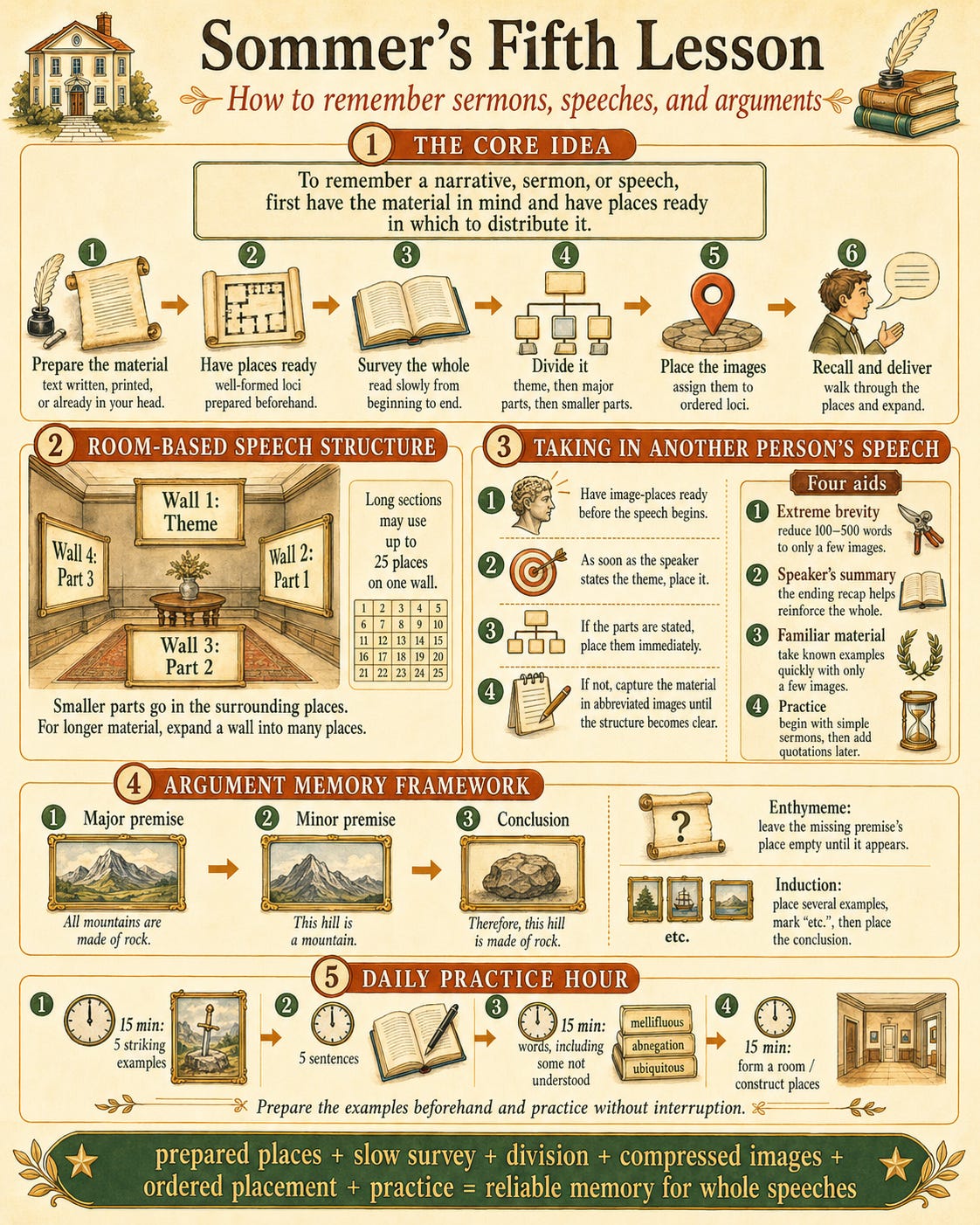
When one wishes to deliver a narrative, sermon, or speech, a twofold operation is necessary. First, it must be printed or written, or one must have it in one’s head. Second, one must have places ready in which to distribute everything.
Given this, the first rule is to read the speech or sermon slowly and thoughtfully from beginning to end so as to survey the whole content.
Second, divide it into larger parts: first the theme, then the first, second, and so on part. Place the theme in the middle of the first wall, the first part in the middle of the second, the second part in the middle of the third, the third part in the middle of the fourth wall. The larger parts are then divided again into smaller ones, as the matter allows.
Third, the images of the smaller parts, which are never lacking, are placed in the four surrounding places; and if these are not sufficient, one takes the third figure, which through subdivision contains 25 places on one wall, and these are sufficient even for the longest speech. What is already prepared from the theme is placed, according to the rule for things, in the four or in the twenty surrounding places; and similarly on the second, third, and fourth wall what one has prepared from the first, second, and third part, as is shown in practice by example.
If one wants to deliver the speech, the work is very easy. If one reading is not enough, one reads it two or three times at different times, morning, noon, and evening. If the arrangement of the images does not proceed quickly enough, one stays with it longer; one must not rush.
It seems more difficult when one wants to take in another person’s speech. One does not know what he will say. Only one thing must be ready: very well-formed image-places, so that one need not worry about the main work. As soon as the speaker states his theme, one places it in the proper spot. If he immediately states the parts, one puts each of them at once in its place. If, however, he goes straight to the execution of the theme without indicating the parts, one takes everything in abbreviated form through images, according to the rule for things. If, after dealing with the theme, he gives the division, one places the first part in the proper place; and likewise the second. If he then turns to the treatment of the first part, one places what has been heard, as stated, on the four or twenty image-places, and so on.
But how can one take in everything as quickly as the speech, which may perhaps be intentionally rapid, is delivered? Four aids serve this purpose.
First, in this art of taking in by images, one must proceed with extreme brevity in practice. What in a speech is expressed in 100, 200, or 500 words must be represented by two or three images, or by as few as possible. No one can speak two words at once; consequently more time remains for arranging a few images than is needed. This single observation, if joined to practice, would suffice.
But there is also a second advantage. Skilled speakers repeat the main content of their speech at the end so as to leave the listeners, as it were, a sting when they depart, so that even if they do not take the whole speech with them, they at least take a brief overview.
Third, there is no speech and no sermon in which one does not hear much that one already knew beforehand. Whenever something of this kind appears, one can get ahead of the speaker, so that one receives far more quickly than he speaks, even if he strives to speak rapidly. For when he begins to present a striking example or a familiar story that we already know, one takes it in with only a few images before he has uttered 10, 15, or 20 words. Then one waits until something unfamiliar occurs, so that one can add that too. This happens several times in a speech.
For example, the speaker says, among other things, that clergymen, even by the most distinguished men, must be greatly honored; a certain king taught this by his example. Two monks met him on the street, and so on. Here I imagine a king honoring the monks and reproaching his brother; a trumpeter before the palace of the king’s brother, approaching the king, speaking with him, pale of face, trembling in his limbs; then going away. I am finished; the speaker has scarcely spoken twenty words, and so on.
But what if the speaker presents familiar things; must I not repeat what has been said somewhat by rote? Some have advised me to do so. Yet I think it better to listen attentively and patiently, even if the matter is quite familiar. If I were to begin a repetition, the speaker might perhaps say something else before that repetition was finished, and I would have to break it off; confusion could result.
The fourth aid is practice itself. Once one has grasped the theory above, one should begin applying it to a simple and not too long sermon. At first one should leave out all quotations from biblical texts until one has reached the point where one can take in a sermon adequately without quotations. Then one should try it with quotations. At first one should place only about five notable ones in the places; later eight. One should be content with that. For if one retains five to eight texts from every sermon, after one, two, or three years one will know by heart the most important passages of the Old and New Testaments and of the Church Fathers.
But what if the preacher neither gives an orderly exposition nor divides his material, but only reads the Gospel or Epistle and then interprets it? Then one follows him from beginning to end and locates from the first to the second, third, fourth, fifth, sixth, and so on place. If he speaks very quickly and one does not yet have enough skill, one leaves two or three places empty and tells oneself that this or that ought to have been set in that place. When one later, in thought, performs a repetition and comes to those empty places, that very emptiness and the preceding lesson will help the fitting matter to come to mind as well as what had been written down by images.
There is still another method of retaining a sermon, though it is not as comprehensive as the one just described. Before the sermon one keeps image-places ready, well impressed on the mind. One says to oneself: from this sermon I want to retain twenty, and especially the most important, things; I will place each of them in one spot, without image and without letters, relying only on division. By using the places according to their order I will help memory. In this way one will retain what has been heard ten times more easily than without the method. This method is useful for women and for the unlearned.
Things seem quite different with a speech. A speech sometimes has seven, eight, or nine major parts; a sermon has only four or at most five. One may also find an introduction, a proposition, a division, a narrative, and so on. Some recommend proceeding in a straight line through the fourth form, starting with the first place and setting something into it, then continuing with the second and so on. I prefer here the third form (see the supplement to the sixth lesson), so that a larger part is always set into the middle of the wall, and then the remainder into the twenty surrounding places according to the rule for things. Even if a room cannot contain everything, that does no harm; within a short time one can have an unlimited number of places, without effort or diligence, provided only that proper preparation has been made beforehand.
I still commonly discuss here the method for taking in arguments during disputation, not because of similarity of matter but because of arrangement. There are chiefly four kinds of argumentation: syllogism, enthymeme, induction, and example. The syllogism is the most perfect. It consists of three propositions: major, minor, and conclusion. The major is placed in the middle of the first wall, and in the four surrounding places everything worth retaining from it; the minor likewise at the second wall; the conclusion at the third. If it is an enthymeme and the major is missing, its place remains empty; likewise if the minor is missing, until either of them appears in the argument, when one places that one in the proper spot. If it is an induction and I put forward three statements, I add to the third a mark indicating “and so on” (etc.), and the conclusion comes into the fourth place. Since in an induction several members may occur, it would be too lengthy to locate them all; for example: every human being is mortal, every animal is mortal, every bird is mortal, etc.; therefore every living creature is mortal. From this one can easily see how a sorites, a dilemma, or any other argument form should be handled.
Finally, as promised, I will now show some forms of practice. For by now one can begin to practice what has been said so far.
Divide the hour into four equal parts. Choose, according to preference and convenience, from the 4th, 5th, 6th, and 7th hour in the morning the first quarter-hour, and devote it to five striking examples; the second to five sentences; the third to 3, 4, 5, 10, or 20 words, of which 6, 9, 12, 15, 18 may be not understood, so that this rule is practiced at the same time; in the last quarter form a room, which according to the first or third form is so easy that one can construct twelve more rapidly than one can form one, two, or three by the method of others.
Two things must be observed here. First, from suitable books one should note down in spare moments striking examples, sentences, and words, and put numbers before them so that it is clear what is to be retained and in what order. Otherwise, when the hour strikes and selection and marking would first have to be done, the quarter-hour would be over before the exercise itself could take place. Second, begin with the stroke of the bell and work without the slightest interruption until the quarter-hour is over. Anyone who practices in this way for three months will acquire enough skill to retain everything; at the same time he will gain a treasure that will adorn him for his whole life. He will know by heart about 400 striking examples, just as many sentences, and 1,000 words. If the selection has been well made, one will be able to contribute something pleasant or useful to any conversation or gathering. Moreover, a thousand words for things that must sometimes be mentioned will greatly enrich any language.
Sixth Lesson
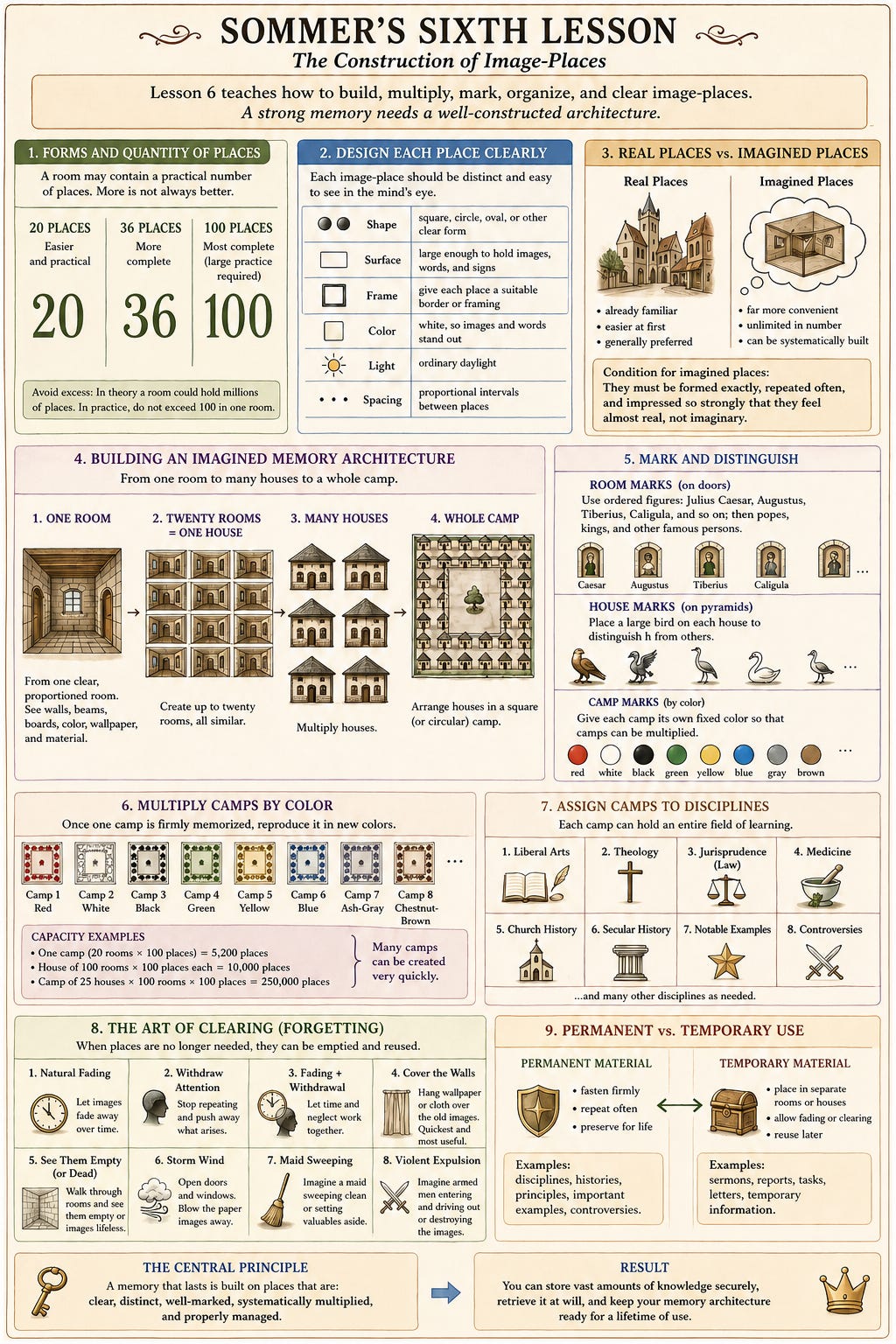
Here on the image-places. To the four forms mentioned above, another can be added. Draw ten perpendicular lines and cut them by as many horizontal lines on one wall. That makes 100 places on one wall and 400 in a room. If they are large, each of them can again admit the first, second, third, or fourth form. But whoever follows my advice will never exceed the number 100 in one room, according to the fourth form. Not without reason; otherwise a single room could contain up to four million places, which would be more imaginary than practical.
Kluber’s Supplement
The important doctrine about the forms of places, which Cicero also touches on in Ad Herennium III. 39 and 41, seems to have been treated by Sommer on purpose in a dark manner, in order to hide it from the reader. He speaks of four forms mentioned above, but these have not really been described above. Only the third and fourth forms are mentioned, in the fifth lesson. Of the third it is said that by subdivision it has 25 places on each wall. But that is actually the case with the fourth form; so perhaps a printer’s error has written “third” where “fourth” should stand. Compare also items I and IV of the first lesson. I will try to clarify this matter from the older edition of Schenckel’s work, p. 110 ff.
First form of image-places: five on each wall, in the following order.
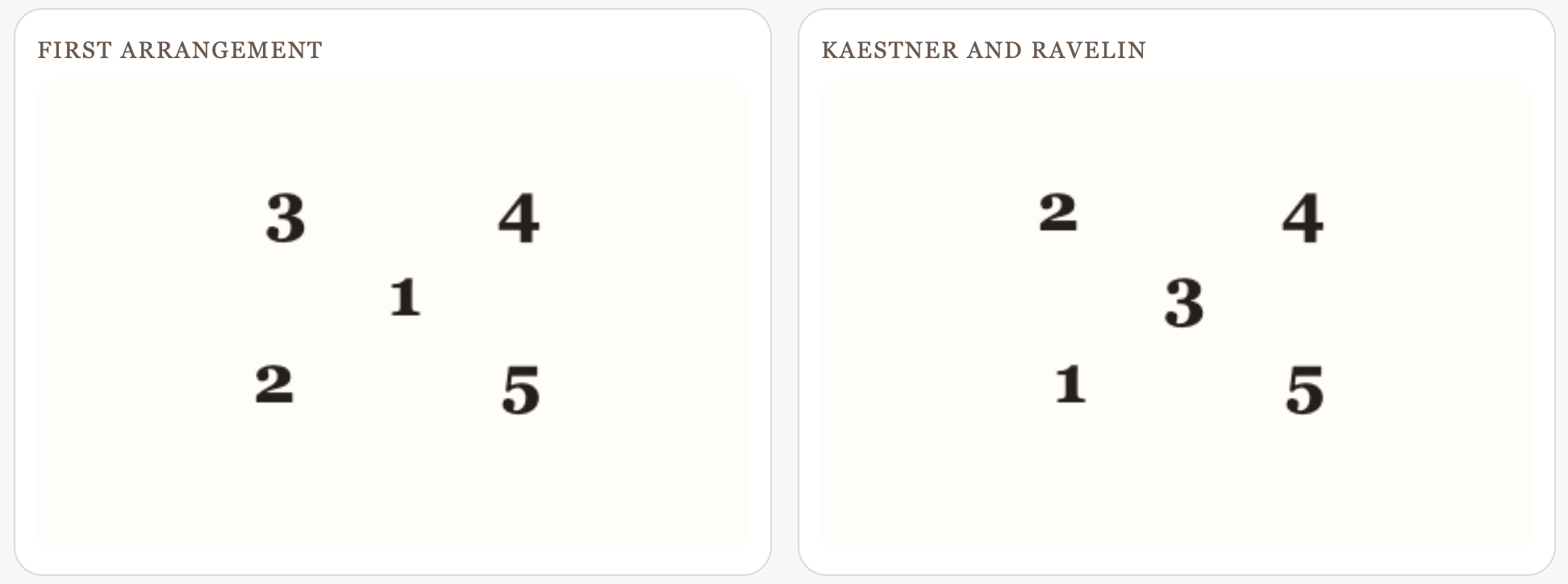
Kaestner thinks Schenckel and Ravelin recommended the following order, which he himself most often followed, though he found that, at least for him, things at the middle place did not hold very well, probably because they stood too isolated there. That inconvenience disappears if one locates the first place in the middle, according to the scheme above, which seems to accord with Sommer’s intention, though Schenckel (in the 1610 edition, p. 67) indicates the scheme as Kaestner gives it, namely with the first place low down near the floor.
Kaestner’s own proposal seems to me even less convenient:
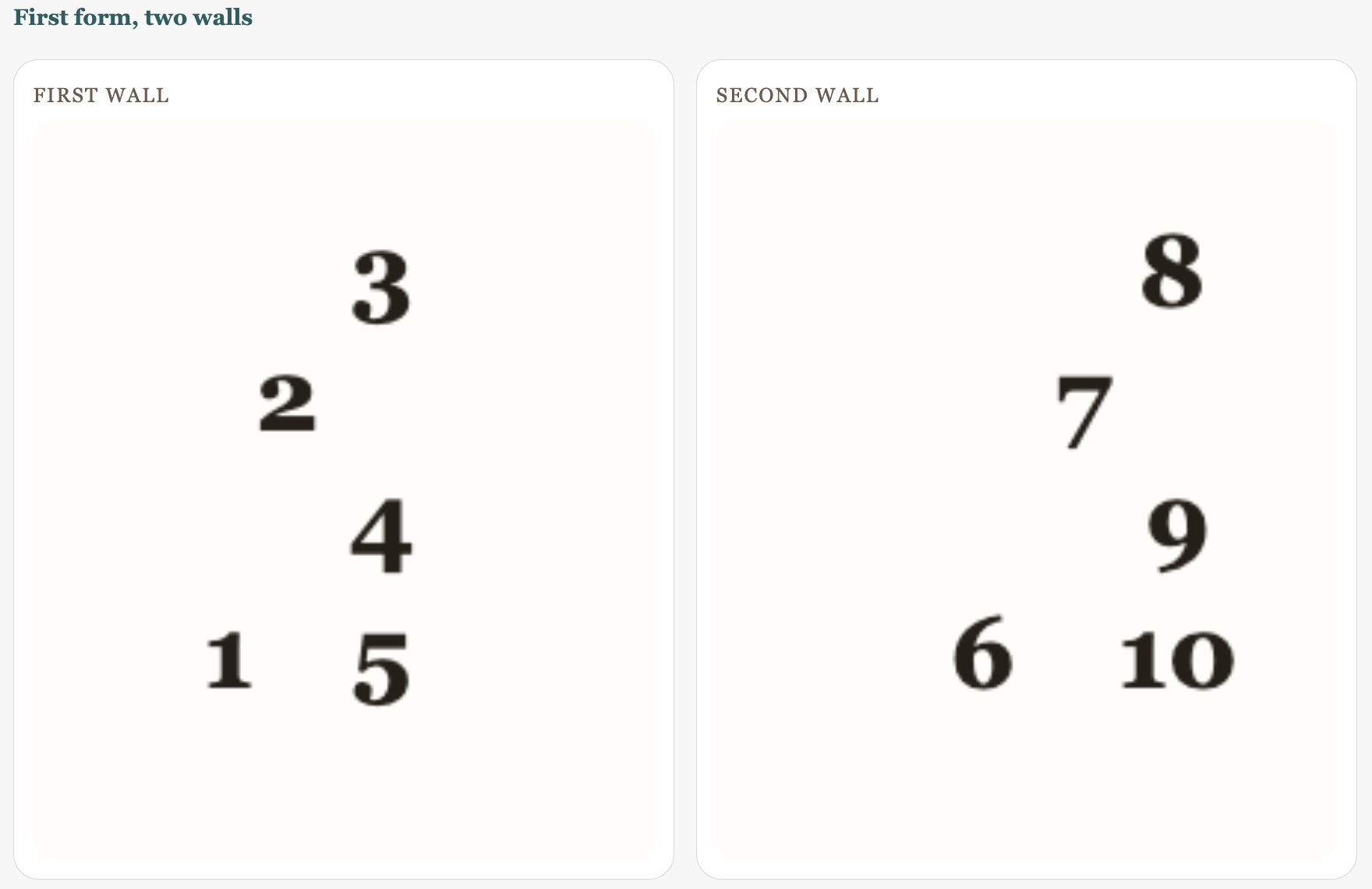
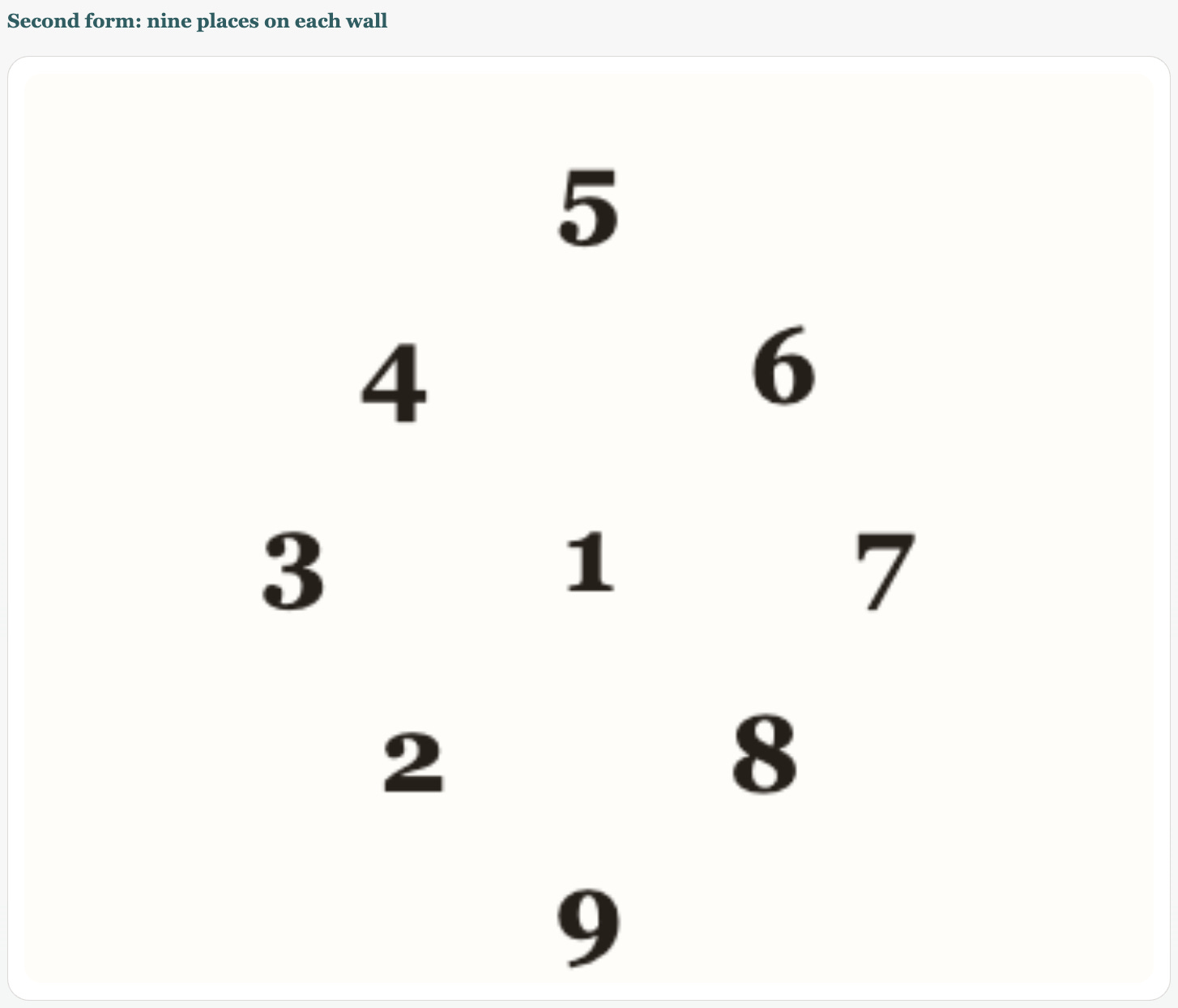
Second form: nine places on each wall. Schenckel does not describe their order. One might choose the following:
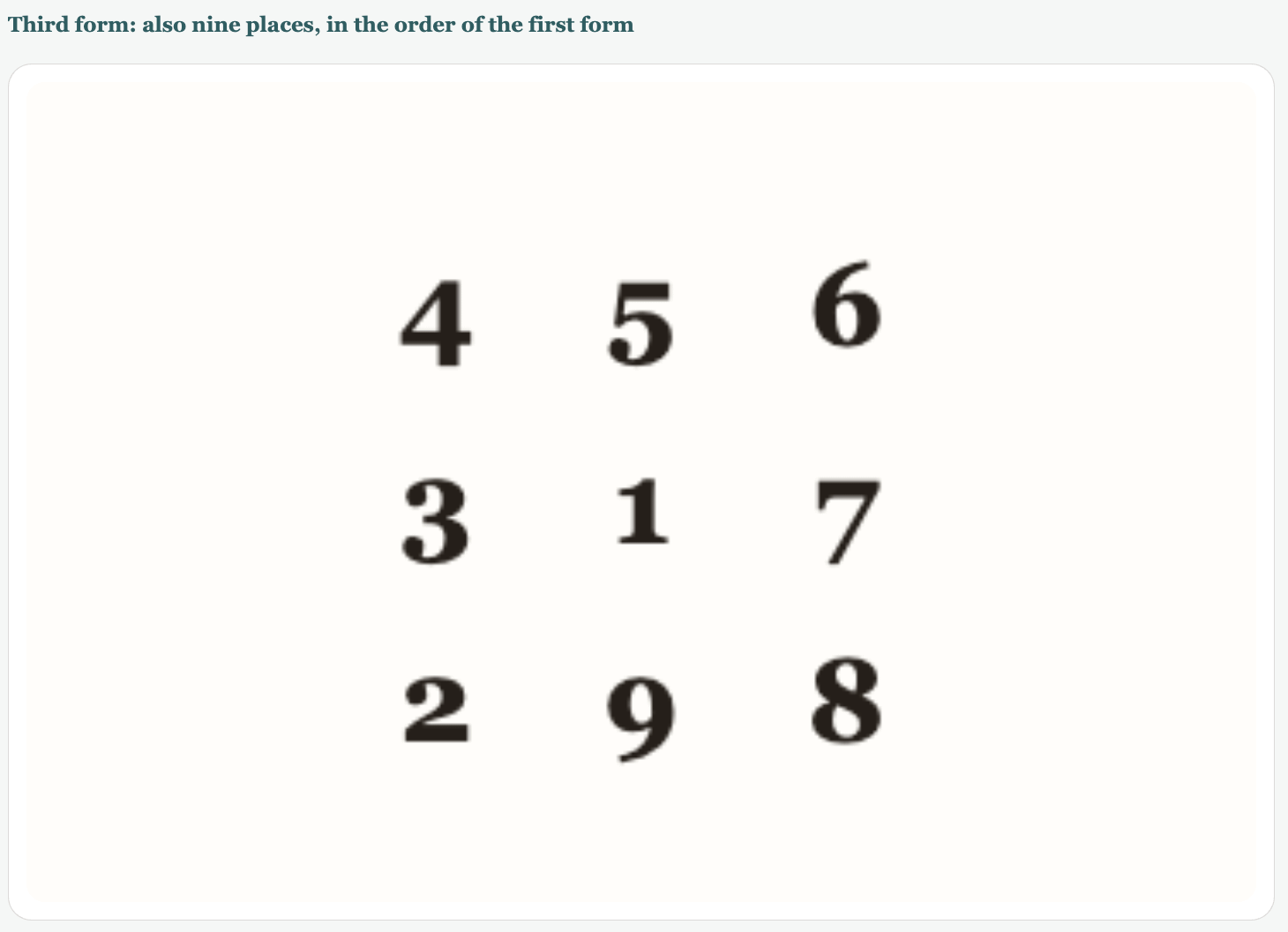
Third form: likewise nine places, but in the order of the first form. Probably the following location is meant:
Fourth form: twenty-five places on each wall. Probably one sets the first form five times on each wall, once in the middle and four times in the four corners. According to this form one has 100 places in each room.
According to these four forms, each room contains either 20 places, or 36 places, or 100 places, the last number requiring great practice and a strong imagination.
Beyond that, it will be useful, and by the laws of visualization even necessary, to come to the aid of fantasy through the character of the places, and through that of memory. One should therefore give each place on a wall its own form, for example square, circle, oval, and so forth, but chosen so that the figure has enough surface area to hold images and words without difficulty and to be recognized with the bare eye. Some people may prefer it if all places have the same form and size. If the size is not to be the same for all, it should be proportioned to the objects that are to be placed there. Each place should be given a suitable framing, as best suits each person’s imagination. The color of each place should be white, and the place should be properly lit by ordinary daylight. Between the individual places there should be a proportional interval; how large? That may fairly be left to each person’s taste.
Some place image-spots on the front side of neat houses; others on large houses. The choice is left to everyone, though one should not easily depart from my advice. In my opinion no better places can be assigned than those given in the first and fifth lesson, even if others may think about the matter at great length.
Kluber’s note. Others have proposed still different ways of choosing places: for example, on painted cities, such as Cologne, with the Rhine on one side and the gates, towers, churches, and other prominent features on the other; on the signs of the zodiac; on the planets and fixed stars; on illuminated maps, especially detailed maps; on the numbered pages of books, each page representing a wall; on the parts of the human body, such as vertebrae, forehead, back of the head, eyes, cheeks, ears, mouth, beard, throat, and so on; on animals, such as a lion, ox, or large birds with spread wings, or large fish; on mountains, valleys, gardens, rivers, forests, rocks, trees; or on the elements.
Only one question remains: should one use real places, or imagined places created by our fantasy? Everyone prefers the former. I too consider this true in general, though not without qualification. For if one devotes as much effort and diligence to the formation of these places as reason and the matter require, then in two or three months, if one spends only half an hour a day on it, one can complete this part without difficulty. Then, without further effort or diligence, one has unlimited places, enough to receive all the more important disciplines, the liberal arts, history, and so forth.
This is one of the most important conquests made by the art; and if I wished to keep something secret from my listeners, this could be done here without exposing myself to the slightest suspicion of trying to mislead them. For imagined places are far more convenient than real ones. Yet the condition is this, and anyone unable to fulfill it should not use them: one must form the places so exactly, strain oneself in doing so so much, imprint them so firmly, and repeat them so often, that they seem to cease being works of the imagination.
To do this properly, one must first choose a proportioned room; one must see it clearly before one and almost grasp it with the hands. In this the senses seem not to deceive. One believes one sees the stone walls, the wooden beams and boards, the color, wallpaper, and so forth. Beside this room there should be another, entirely similar, made of the same material. Then follow the third, fourth, fifth, up to the twentieth room, and one already has a compound house. In thought one then creates a second, third, fourth, fifth, up to thirteenth house. In proper order these houses form a camp in a circular, or better, square shape. On the front side of a room door one sets the figure of Julius Caesar, and the room bears his name; on the second door the figure of Augustus; on the third that of Tiberius; on the fourth that of Caligula, and so through all the emperors, popes, kings of France, England, Scotland, Spain, and so on, in order. If one wished to place one of these at the door and four others in the four corners of the room, that would be even more useful, though it would require more effort and diligence.
These marks or distinguishing signs have not been discussed before, yet they too are useful. For while one is occupied with something else, one can thereby imprint useful things on memory, namely popes, emperors, kings, and so forth, so that one can repeat them in any order, at any time, just as easily as words.
If one has imprinted a camp on memory as completely as the alphabet, one must keep very striking colors ready in a fixed order. Given these two things, one can create as many camps as one wants by the time someone has recited a Paternoster. For I imagine another camp similar to the first, but with a different distinguishing color. Let this be red in the first camp, white in the second, black in the third, green in the fourth, yellow in the fifth, blue in the sixth, ash-gray in the seventh, chestnut-brown in the eighth, and so on. Then I have in each camp just as many places as in the first, namely 5200. But if one prefers to form a house of 100 rooms, and in each room 100 places according to the third figure, then the whole camp has 250,000 places. Such a camp can be formed just as easily and quickly as another, only more preparation is required.
Each house should bear, in the proper place on a pyramid, the figure of a larger bird, for example an eagle, griffin, ostrich, crane, swan, stork, pelican, peacock, guinea fowl, parrot, dove, goose, and the like, so that one may distinguish one from the other.
As soon as one has incorporated a single camp, with all its circumstances, into memory, one is relieved of the labor of making places every day for a quarter-hour, a task that had previously had to continue throughout life.
If someone has eight camps ready, let him assign material to each, for example: 1. the liberal arts; 2. theology; 3. jurisprudence; 4. medicine; 5. church history; 6. secular history; 7. notable examples; 8. controversies. Then one makes subdivisions by means of houses, rooms, walls, and so on, of which more below, in the eighth lesson.
Kluber’s Supplement
An important question remains: can one remove the image-writing again from the occupied places and then use those places for new mnemonic purposes? According to Mr. Duchet’s oral assurance, Aretin’s method grants a similar advantage; by means of it one can free memory again from what has been memorized. That is indeed a major advantage! Who would want to keep in mind for life all the sermons, all the judicial reports one has heard or given, and everything memorized for merely temporary purposes?
Sommer does not address that question; perhaps because he trusted too much in natural forgetfulness. In fact we see it making such powerful progress every day that a method for promoting it might seem unnecessary. Still, that does not satisfy everyone, and already Themistocles wished for an art of forgetting.
For the Schenckel mnemonist in particular, a method of forgetting must be important. The houses and rooms have been built once and for all with much effort. The places within them are filled with images that one may no longer need. If one could clear the occupied places of their now useless stock, wipe away the old picture-writing that has become obsolete, as if from a blackboard written on with chalk, and so unload memory of its surplus, then the old houses, rooms, and walls would still be good for new use. One could even keep a special transit camp for temporary matters, in which broom and sponge would be the only, but indispensable, household tools.
But Sommer, not Schenckel, passed over the art of forgetting in silence. Schenckel teaches it in the older edition of 1610, p. 123 ff., in the following terms:
“In eight ways one can empty occupied places of their contents and make them fit for new use. 1) Let the images fade away by themselves over time. 2) Withdraw attention from them, stop repeating them, and displace them if they present themselves of their own accord. 3) Combine the two methods just mentioned. 4) The quickest, most useful, and most effective way is this: mentally hang wallpaper or cloth on the walls; then the images covered in this way are not troublesome when one wishes to place new places and images on the wallpaper. This also has the advantage that the images attached to the walls themselves remain, though covered, and one may regard them at will as erased or not erased. 5) Walk mentally through the rooms often and imagine the places empty, as they were at first, or the images dead and motionless. Yet one must then worry that, after new images have been placed there, doubts may arise during repetition. 6) Open all doors and windows, imagine the images to be of paper and lightly attached, and let a strong storm wind arise that carries them all away. 7) Let the maid sweep out the rooms; she removes the images invisible to her, or sets them aside as things of value so that they do not suffer from the dust. 8) Let a raging man, accompanied by a troop of armed men, take possession of the houses and rooms, kill many images, pierce many others; others, fearing him, have fled through the doors or jumped down through the windows, and whoever enters finds none left.”
“What one always wants to keep must be fastened to images from which it never disappears, and memory must be strengthened by repetition. On the other hand, for things one wishes to keep only one day or a few days, one should keep separate rooms and houses. One uses them one after another until the last. If later the turn comes again to the first, and the images previously placed there have not yet disappeared entirely, one turns to the second, third, or some following room in which the images have meanwhile been lost. If that is not yet the case anywhere, one should use the fourth method of clearing. The last three methods of evacuation may seem playful; nonetheless great mnemonists have recommended them, and they can, depending on the individual character of the imagination, certainly be useful.”
Seventh Lesson
Now for locating books, for quotation, and for multiple dictation.
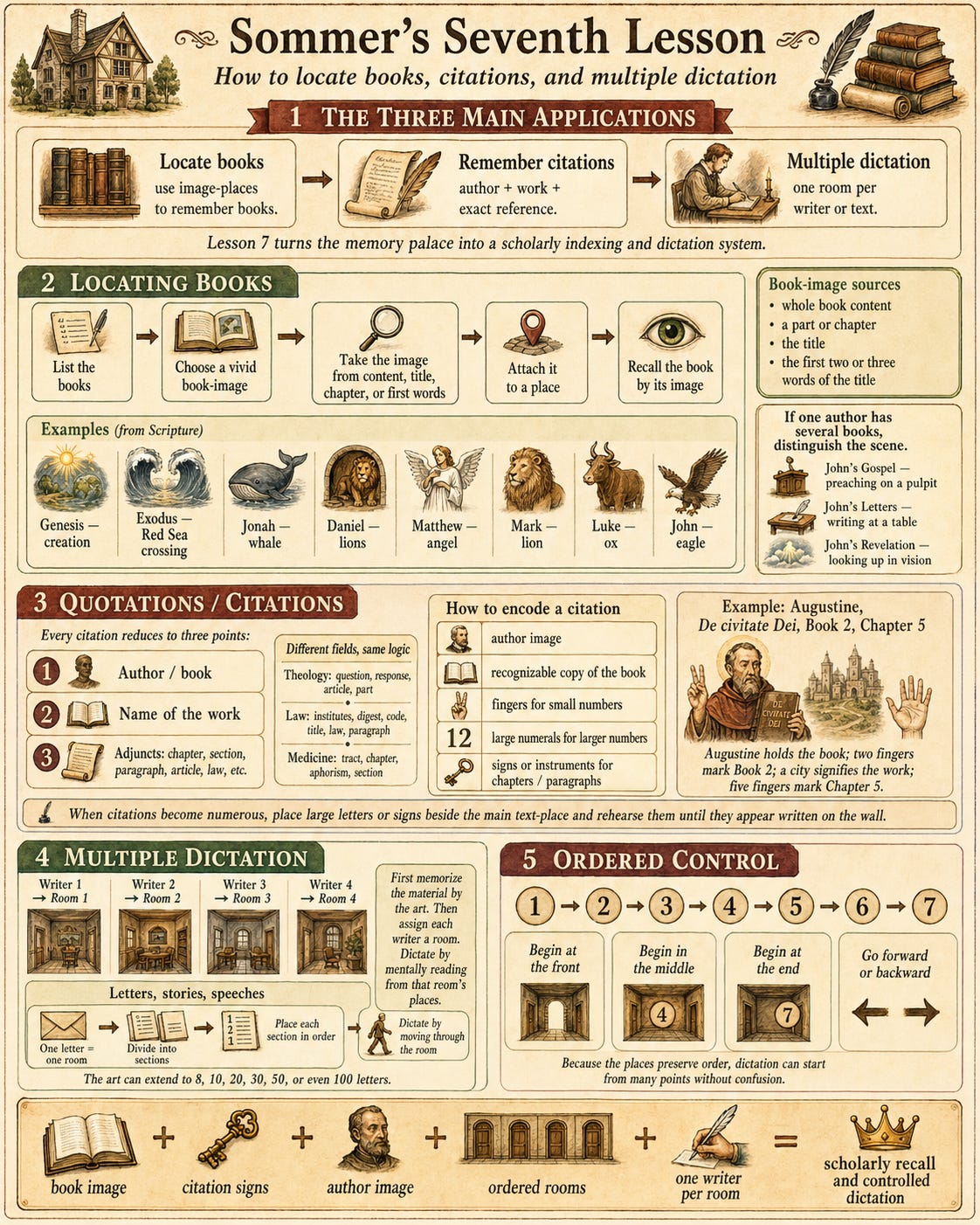
I) If one wishes to locate books, one must have their images ready. For that purpose note the following. First, list all the books one thinks one may have to name. Second, seek an image or several images to represent the book. The image should be taken from the content of the whole book, or of a part, or of a chapter, or from the title, or from the first two or three words of the title. For example, if one wants to represent the first book of Moses from the Bible, one imagines on the surface of the book God creating heaven and earth and everything in them. On the second book of Moses, Moses holds a book crosswise, on which the children of Israel cross the Red Sea dry-shod while Pharaoh and his people drown. On the third book Moses holds a book whose outer front cover bears his image together with a Levite. On the fourth book Moses holds a book on which ten numerals stand. On the fifth he holds the tablets of the law, which he explains to the people. The first book of Kings: Saul, the first king of the Israelites, holds a book in his hand. The second: David holds a book. The third: Solomon likewise. The fourth: Jehu likewise. One represents Tobias with the angel; Judith with Holofernes; Jonah in the belly of the whale; Daniel in the lions’ den; Matthew with the angel; Luke with the ox; Mark with the lion; John with the eagle. If someone has written several books, one distinguishes them somewhat. John, as he writes the Gospel, should stand on a pulpit from which he proclaims it; as he writes the letters, he should sit writing at a table; as he writes the Revelation, he should stand with eyes raised to heaven, as if seeing new and wonderful things.
Justinian should stand on the first book of the Institutes, holding a small book in his hand marked with the numeral 1; on the second book with the numeral 2, and so on. If he holds a large book in his hand, then it is the Pandects, on which numerals designate the first through the fiftieth book. The same applies to the Code and the Novels.
Virgil’s Eclogues are represented by Virgil holding a book on which a herd of cattle is pictured; the Georgics by a book bearing images of many farmers, and so on. Ovid’s Tristia are represented by Ovid, with a very sorrowful face, holding a book in his hand. His letters from Pontus show Ovid standing on a bridge. In the Metamorphoses, Daphne is turned into a laurel tree, or Actaeon into a stag, and so on.
II) Quotations, or citations, are somewhat harder to find. The theologian cites according to quaest., resp., art., membr., part.; the jurist according to inst., dig., cod., nov., tit., leg., parag.; the physician according to sen., tract., cap., aphor., sect., and so on. Yet every citation reduces to three points: the book, the name of the book, and the adjuncta, that is, the sections, chapters, paragraphs, and so on.
How books are represented has already been shown. But something more may be added. A book can be indicated by the image of the copy one actually owns, provided it is sufficiently distinguished from other books by outward marks. For example, if I want to express “Justus Lipsius, lib. 5, Polit.,” I place Lipsius’s image and put into his hand my own copy of his Politics, which I recognize well by its outward marks.
If one wants to cite “Augustinus, lib. 2, De civitate Dei, cap. 5,” Augustine stands holding a book, with two raised fingers indicating the second book; behind him on the wall a city, on whose highest hill stands a tower as the pillar of God; and his other hand, beside his head, has five spread fingers, signifying the fifth chapter.
If the number of books is greater than five, and the fingers therefore do not suffice, one indicates them with large numerals on the surface of the book, or by figures that represent the numerals; and the author holds in his other hand, beside his head, simple or compound instruments that signify the number of the chapter or paragraph.
If the same book is cited often, or if the citations are so numerous that they fill half or even full pages, the work becomes very difficult; no writer on the art of memory has yet satisfied me on this point. Some have therefore proposed square rooms with four doors in the corners, leading into four other rooms, in which two walls would be assigned to the citations of the first book and the other two to those of the second book, and so on. Truly a rich apparatus for citation, but still difficult to use and requiring great practice. Even so, a full half-page of citations would probably not be easy to retain in this way.
After long reflection, I am of the opinion that one should place the citations in thought with large letters or signs beside the place where the text is fastened, and then impress them by effort and repeated remembrance upon the eyes and memory so that afterward they are seen in thought on the wall and can be repeated. This method seems very clear to me, and its execution does not appear difficult. Whoever does not like it should imprint the citations in the usual way on natural memory. Nothing is so difficult that it cannot be worked through gradually.
III) Now to multiple dictation. What one wishes to dictate to another must first be firmly held in one’s own memory, not in the ordinary way, but according to the rules of the art. In thought one assigns the first writer the first room, the second the second room, the third the third room, and so on. Then one dictates to each from the room assigned to him, reading in thought the words, sentences, and letters on the various places of the room. The matter is made very vivid by examples.
For words one proceeds here with such confidence that there can be no hesitation or mistake if someone asks that dictation begin from the front, in the middle, or at the end of the sequence, or that it be done backward or forward.
With letters, stories, speeches, and the like, one dictates just as was shown above in the second lesson. One divides the letter into larger parts or sections, each of one, one and a half, two, or three lines, and locates each part according to the instructions already given. For each letter one needs one room. If one has properly distributed 8, 10, 20, 30, 50, or 100 letters, for the art extends that far, one dictates to each writer from his room and its places, changing writers as often as one has dictated a section.
Eighth Lesson
Now it is to be shown how mnemonics is to be applied to the seven liberal arts, then to theology, jurisprudence, and medicine; and how advocates, counselors, presidents, envoys, and everyone else may use it in their profession.
It is most difficult to apply it to grammar, rhetoric, and dialectic; easier to arithmetic, music, geometry, and astronomy, because these offer suitable images that in the former are found only with great effort.
One should take a concise grammar and divide it into four parts: rudiments, syntax, prosody, and annotations. One house of the camp is assigned to each part. In the first room of the first house one locates the definition and what belongs to it, the letters, their classification, and what is formed from them, the eight parts of speech, down to the noun. In the four following rooms goes everything relating to the noun; in the sixth room the pronoun; in the four following rooms the verb; in the eleventh room the participle, and so on. In the first room of the second house come the definition, division, purpose, and so on of syntax. In the second and following rooms come government of the nominative through the ablative, then the infinitive, participle, adverb, conjunction, preposition, and interjection. The third house is designated for prosody, which can be contained in very few rooms; it does no harm if a few remain empty. The fourth house is reserved for the necessary annotations. One should divide rhetoric, dialectic, and all the remaining subjects in the same way into four equal parts and proceed as just described.
Everything can be expressed in four ways. One should choose the one most suited to one’s inclination and mental capacity. The first is the hardest, namely when everything is represented by images. The second pleases me especially, namely when one expresses the things to be retained by means of large letters of striking color. In this way one places on each spot a definition or something else that fills one, two, or three lines. This method is appropriate wherever one cannot immediately find suitable images. The third way is to transfer six, eight, or ten printed lines from a book to the proper place on the wall; in this way much can be located in one room. The fourth: one divides grammar, or any other science, into smaller parts and fastens something to each place without images or letters; for example, to the first place the definition; to the second this: “it has its name from letters, which the Greeks call grammata”; to the third the classification of letters; to the fourth what is formed from letters, syllables, and words; to the fifth the eight parts of speech, and so on. In this way memory is supported only by the places, the order, and the division. If practice is added, the effect is striking.
In theology the Bible is especially to be located. Here the various editions of the picture Bible are very useful. If one compares them, almost the whole Bible is already expressed pictorially. But because the authors of mnemonics were not expert, much can be improved by additions, transpositions, deletions, and the like, and more adapted to the art. Anyone devoted to the knowledge of God does well to prepare a small picture Bible arranged mnemonically, so that by daily practice of one hour he may within two months obtain a summary knowledge of the Bible. A theologian wants to retain sermons. He locates them in the sermon camp according to the rules already given in the fifth lesson; with proper repetition he will retain each of them in memory. And if he has to speak extemporaneously on a subject, it will provide him with such material that he will find the beginning sooner than the end. If he wants to retain a compendium of dogmatics, he should arrange it, divided into small parts, according to houses, rooms, and places. The same with controversies.
I would advise a student of law, as preparatory work, to arrange mnemonically the titles of the Corpus Juris, which can be done in two months, as well as the titles De regulis juris and De verborum significatione, so that he can recite them forward, backward, and out of order. Then he should locate in the camp of jurisprudence, in one house the first book of the Institutes, in another house the second book, and so on; likewise in one house every four books of the Pandects; the same with the twelve books of the Code, with the Novels, with the commentators, and with especially notable elementary books. All this can be done in two ways: 1) one locates the first title according to a summary note in the middle of the first wall of the first room, and everything else notable belonging to it on the surrounding places; then likewise the second title in the middle of the second wall, the third in the middle of the third, the fourth in the middle of the fourth wall, and so on. 2) Or one takes as many places as there are titles and locates only the title at each place, according to the first or third form of the places.
An advocate should mnemonically arrange what he wishes to say, and he will present it successfully; what his opponent has put forward orally, he should take in according to the rules of the art; what he wishes to reply, he should arrange properly. He should keep rooms opposite one another. In one goes what he has put forward, in the opposite one what his adversary has said against his client. If clients ask him about their cases, he should mentally turn to the room in which the matter of the questioner has been fastened, and he will be able to answer each person as if he had everything written before him, provided he has done his duty and has not neglected repetition.
A counselor should arrange his official business and reports, and he will administer his office with greater confidence. At votes he should keep places ready and arrange everything the others say according to the rule for things; with that in mind he should frame his own vote and receive the votes of those following; and he will be able to present what he may have to add to his own in a skillful way.
A president can quickly take in a whole case argued by both sides, then arrange the votes of the counselors, and from this draw a more complete result. Admittedly, good natural memory, after long practice, can also do this: but one will observe that with the help of the art everything proceeds far more successfully and perfectly.
A student of medicine should, as preparatory work, arrange all simple remedies and their powers in four, five, or more rooms; then medical textbooks, and the works of Galen, Hippocrates, and others. It will be especially useful to locate the aphorisms of Hippocrates. It is also advisable that he locate diseases according to their symptoms and complications, together with treatment and remedies, each for example on a wall, in the same way indicated above for the titles of the Corpus Juris.
An envoy can likewise arrange mnemonically the business entrusted to him, together with the knowledge he needs or finds useful. With the help of the art he can, in oral, especially lengthy and complicated negotiations, not only work safely and easily, but also shine and attract attention.
Mnemonics is also useful in audiences and other oral negotiations, embassies, and so on. But everywhere much depends on the insight and scholarly formation of the subject. Not every wood makes a Mercury.
At the end, a few rules whose observance serves to exercise the art of memory with greater propriety and success.
1) One should give the images actions suited to their circumstances. The action of a woodcutter does not fit a preacher, and vice versa. In reciting a mnemonically memorized speech, sermon, and so on, one should avoid improper gestures and bodily movements that betray excessive internal strain.
2) One should give the images motion. If the thing is in itself motionless, one adds a person who supplies motion by a fitting action.
3) Idle images are not appropriate; they do not sufficiently excite memory. For example, if I locate a horse, it must kick; a wolf must eat sheep. Compare above the rule for understood words.
4) If the thing is living but small, like a mite or a flea, one must give it a larger image, yet keep its form, for example a flea as large as a dove, a mite as large as a sheep.
5) The images, in their dimensions, must be proportionate to the place, and thus not too large.
6) The persons located in the places should be large, lively, and as much as possible in action. Thus they stimulate memory all the more.
7) The place assigned to a thing should not be its usual one; for example, a chair that usually stands where one must locate it should be turned upside down or hung in an unusual manner.
8) If one must locate quickly, it is enough to fasten only one image to the place. But if one has leisure, one can quite well fasten several clearly distinct images that present themselves easily to the eye.
9) One should give the images ugly, ridiculous, strange, but not immoral actions. Such things excite memory more.
10) Cicero rightly advises giving the images force and life. New, rare, admirable, pleasant, ridiculous, ugly, terrible, monstrous, exceptionally beautiful, and also noble and very lowly things, for example a pope, emperor, king, then a beggar in tattered clothes, scabby, and so on, arouse more interest.
11) In locating the images, some repetition is necessary. Once one has completed five words, four or five sentences, or a period, one should repeat before moving on. This repetition and attentive viewing strongly reinforce memory.
12) If one has used a thing as an image today, one should not use the same thing tomorrow as the image of something else; for example, if I have today used a lamb as the image of a lamb, I must not tomorrow use it to signify innocence, unless it is distinguished by attributes and additions.
13) If one wishes to memorize a speech or period word for word, one should first read it two or three times slowly and thoughtfully, then divide it into larger parts, and those again into smaller ones, whose images are located in places according to the above instructions.
14) In locating words, the genus is indicated by the gender. If I wish to express divitias, wealth, I set a rich woman. If I wish to represent librum, a book, pictorially, I set a man performing an action with the book.
15) If one wants to retain from a speech or period 10 or 12 words that one does not think need to be fastened all to places, especially if one does not wish to keep them long, it would be superfluous to give each a separate image; one notes only a main image, which recalls the others to memory.
16) One should give the figures and images a proportionate height, so that the eye need neither rise too much nor lower itself too much. One should also beware that one figure does not cover another.
17) In sketching images one should not rush too much unless necessity requires it. For if later one finds a more suitable image, it is hard to locate it while discarding the previous one, and yet one would not willingly dispense with it.
18) Above all one should choose images of the most familiar things, and avoid all images of invented or unknown things so long as true and familiar ones are available.
19) The similarity of places is very obstructive in their formation. The same holds for the similarity of images. One should therefore secure variety so that no confusion is caused. This can be found in attributes, actions, and other incidental features, for example three popes, one with a key, another with an anchor, the third with a horn in his hand; likewise three men, one dancing, another fencing, the third playing cards.
20) One should also take account of synonymous and related expressions. For the dog star, do not place a household dog; for a cliff, not a stone.
21) If several images are to be expressed in one place, one should vary the persons, for example place several small persons next to one or two large ones, so that too many places are not filled and the occupied ones become more effective through their diversity.
22) If one takes words and concepts from the paper and places them on sites, one should not transfer the paper itself to the place, nor imprint it on memory, but fasten only the words themselves to the place. Otherwise confusion and wavering would arise.
23) One should not use the art in all matters, but only in those that are somewhat difficult to retain, for example judicial speeches, disputations, sermons, and so forth. Yet one may later apply it to harder and more serious matters.
24) For mnemonic work to succeed, one must be free from other occupations and from distraction.
25) Complete calm of mind and absence of emotion must prevail.
26) Sobriety is also necessary.
27) The most suitable time is the morning; however, an exercise of half an hour toward evening will also be beneficial.
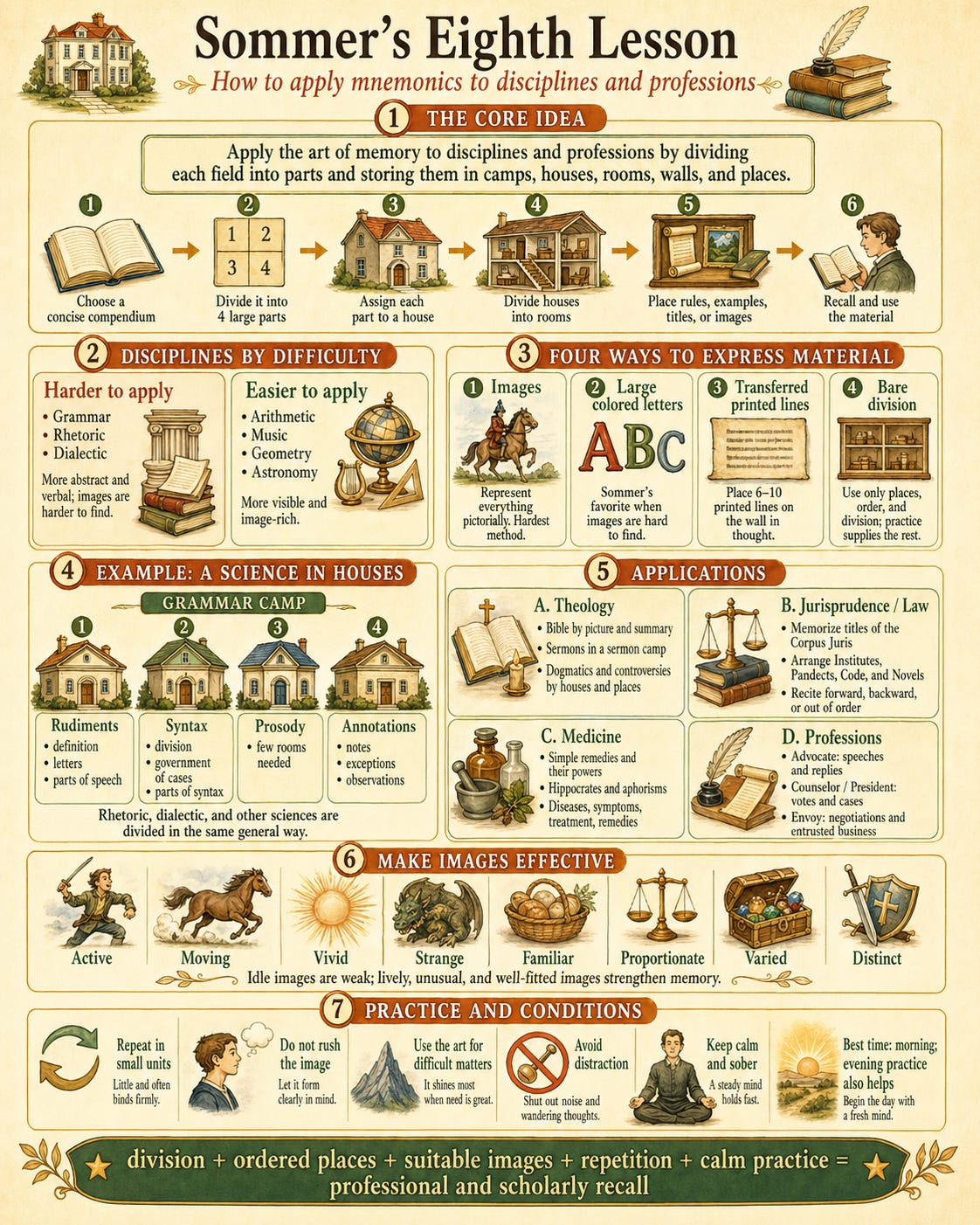
Closing Reminder
Finally, a note for my listeners: one should not immediately apply everything said above to practice. All striving should be directed toward entering the spirit of the art, that is, toward appropriating what is essential. Only those achieve this goal who, content with a few principles, acquire a certain skill through untiring reflection and practice. Then no one should be surprised that I have hidden the art behind secret writing; I followed the example of the wise, and even of God, who revealed much clearly and some things hidden in darkness to the Jewish people. Did not the ancients conceal teachings of wisdom under the garment of fable? Are pearls not thrown before swine? Excellent secrets are not entrusted to the incapable. Unable to penetrate the inner essence of the art, they despise it and only turn others away from it.
So much for the science of memory brought to a high degree of perfection!