
A Brief Work on Artificial Memory by Jacobi Colinei Campani
translated from the original latin.

Table of Contents
Elder’s Notes
Translating rare latin texts on the art of memory is one of the goals behind my memory diner newsletter. These are rough translations, though. First drafts brought over to English with the help of some robot friends that may include mistranslations due to bad OCR scans, and misinterpretations owing to cultural differences (the past is a foreign country, after all).
So, what does that mean?
Certain terms in latin texts can require a more robust understanding of the context in which they were written before we can bring out their full meaning.
It’s kind of like how the phrase “who let the dogs out” means something very different to a kid who grew up in America during the nineties then it would to a viking a thousand years ago.
Context matters.
Sometimes translations are like paintless greek statues.
That’s why I think A Brief Work on Artificial Memory is the perfect fit for our first translated work: the author spends chapter six criticizing Raphael Regius’s translation of Quintilian, showing us just how difficult it is to bring the past into the present.
Chapter six, incidentally, was the trickiest to translate 😑
It’s a… worthy first effort, I guess 🤷♂️
Who Was Jacques Colin?
Jacques Colin, also known as Jacobi Colinei Campani or Jacobus Colineus, was a French humanist and cleric. He was born near Auxerre in France sometime around 1485, and was eventually appointed as the Abbot of Saint-Ambroise de Bourges.
In 1515 he published a small tract on memory, which you can read read below.
It’s a breezy, easy introduction to the mnemonic arts. In addition to sharing the method of loci, an ancient number peg system, and advice on the use of imagery. Colins also shares 15 rules for memory inspired by Cicero, Quintilian, and St-Thomas.
Everything you need to get started with mnemonics is covered in this 500 year old booklet. 📚🎉
Key Ideas
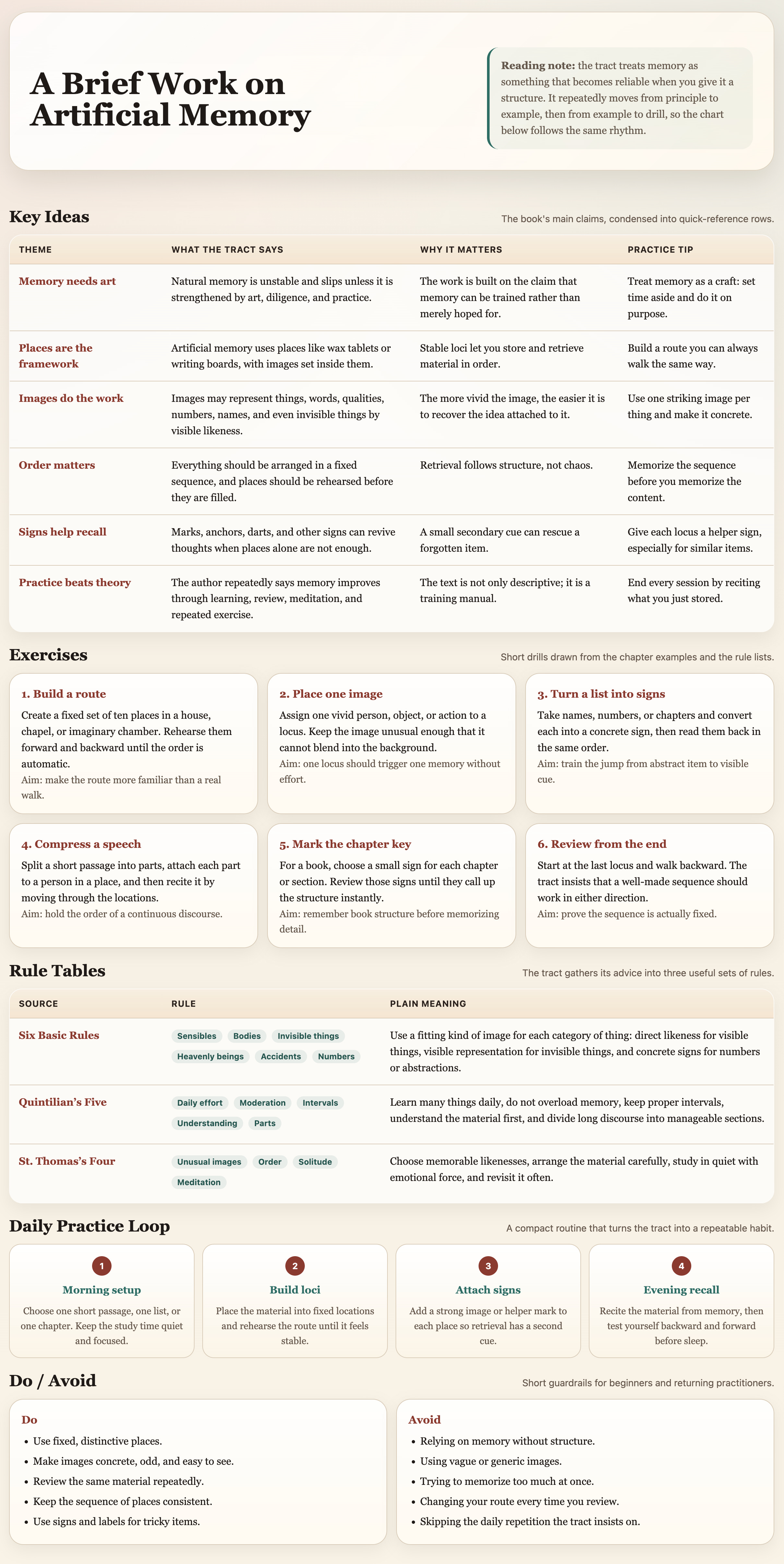
A Brief Work on Artificial Memory
Jacobi Colinei Campani, A Brief Work on Artificial Memory, compiled partly from Cicero and Quintilian, and partly from Saint Thomas Aquinas.
Whoever wishes to win the sacred Muses and bind them to himself in lasting union, here is, under a favorable sign, an easy means to do so: behold the native mother, and the art by which she may be grasped.
For in this matter, trust is not secure enough when it is fixed only on the surface. Memory is wandering and not altogether reliable as a companion. It scarcely remains firm unless it is strengthened by art. Without art it often fails; with art as its guide it often prevails. Under that guidance it holds in faithful arms all that has been entrusted to it; without that guidance, everything slips away.
Memory shows itself as fickle, like Proteus with his changing face, and at times, sluggish as it is, is stirred by the slightest sound. Unstable, it is sometimes damaged by the smallest disturbance. It slips away and can hardly be restored after sudden fear. At once the clouds of forgetfulness seize the stricken mind, and what had been entrusted to it flees off in panic.
The Muses are nimble, and their mother is slippery; the daughters take care not to degenerate from their source. Wherever their mother goes, her offspring too break loose. Therefore you must use this art if you want to hold such winged creatures fast.
So come, whoever you are: set your household in order and make it secure. Build, establish, and fix in place locations that are clear and distinctive. And once you have marked them out, I advise you to set a guard over them, coming dutifully to the back of your head. Let this appointed guardian keep watch and not fall asleep; let there be no confusion, and let him be well recognized.
Thus the help you seek from this art will be in your hands, and nothing will be able to break that bond. In this way the sisters, together with their mother Memory, will be present to you, and no path will fail to produce them. If, believe me, you are well furnished with this art, even obscure Quintilian will become clear.
Although, according to Quintilian, the greatest and indeed the chief art of memory is practice and effort—learning many things by heart, reflecting on many things, and, if possible, doing so daily—many of the most learned men have nevertheless not doubted that there is also something that can assist natural memory.
Foremost among them is Marcus Cicero, the standard-bearer and leader, the mightiest and most unconquerable force of eloquence, and by far the prince of orators. In his books On the Orator, in the dialogue on the Partition of Oratory, and also in the new Rhetoric—if indeed that work does not wrongly claim the Ciceronian style—he discusses this matter in such a way that we cannot deny he had experience of what he teaches.
Yet I see that many desire a fuller explanation of this art, while others, pursuing slanderous criticism, make so little of what remains of it as though it were nearly worthless. For that reason, I wish, so far as I am able, to be of service to both parties in this matter. As for these detractors, I would not mind answering them too, if leisure allowed; perhaps that may be done more fully another time.
For now, I shall think I have done more than enough if I do not withhold from the public good of letters what I have on this subject, while taking from no one the freer liberty of teaching more and better things. I think I may all the more rightly be pardoned, then, if I do not satisfy everyone. We are not all made with such stomachs that we can receive everything with equal pleasure and digest it with equal ease.
But this above all was my aim: that, if not everyone, then at least the better part of my readers might benefit—or failing that, at least I myself and my friends—while harming no one.
So I undertook the task, though almost unwillingly—indeed, compelled, one might say, by the nearly daily reproaches of close friends—to draw up in as concise a form as possible certain precepts of artificial memory, relevant to some passages not only of Cicero but also of Quintilian.
Above all, I took care not to enter upon so contentious a task relying, as the saying goes, on “deaf” witnesses. For that reason I thought it worthwhile, at the outset, to produce the weightiest testimony of several most weighty authors, so that it might plainly be established that there truly is such a thing as artificial memory.
Otherwise, some detractor might have denounced me as a trifling peddler of nonsense or a common impostor. I have also said something about the origin of this art, and in a single section I have said enough about those who, from time to time, have been celebrated for extraordinary powers of memory.
Then, so that you may not be ignorant of my method of teaching this art, I explained its precepts one by one, prefacing them with a description of the thing under discussion. If, by pressing your thumb for me, as the saying goes, you approve these preliminary efforts, you will certainly encourage me, excellent reader, to gird myself hereafter for work more difficult and much more extensive.
🎨 Chapter One:
That Memory is an Art
Marcus Antonius, in Cicero’s On the Orator, book two, bears witness that memory has something of art in it, speaking in words nearly to this effect:
“I am not of such great ability as Themistocles was, that I should want an art of forgetting, which memory displeases me; yet I am grateful to Simonides of Ceos, whom they say first brought forth the art of memory.”
And a little further on:
“Nor is it true, as idle people say, that memory is weighed down by the burden of images, and that what nature might have retained on its own is thereby obscured.”
Then he continues:
“For I myself have seen men of the highest distinction and almost divine memory: at Athens, Carneades, and in Asia, Metrodorus of Scepsis, who, they say, is still alive today. Each of them said that, just as letters are inscribed in wax, so by means of images they could inscribe in the places they had in mind the things they wished to remember.”
To this also belong the things written in the dialogue On the Partition of Oratory.
The son says, “Does anything still remain for you to say from The Orator itself?”
The father replies, “Nothing, certainly, except memory, which is in a sense the twin of writing, and though it belongs to a different kind of thing, is very much like it. For just as writing consists of the marks of letters and of the material in which those marks are impressed, so the construction of memory uses places as though they were wax, and in them sets images as though they were letters.”
This is Cicero. And some likewise attribute the following words to the third book of the new Rhetoric:
“As to whether memory contains something of art, or proceeds wholly from nature, a more fitting occasion will be given for discussing that. For the present, since it is agreed that art and instruction have great power in this matter, let us speak accordingly.”
And he adds:
“For it is our view that there is an art of memory.”
Likewise Blessed Thomas—passing over for the moment Quintilian and the other authorities already mentioned—in the Secunda Secundae, question 49, article 1, reply to the second objection, not only gives testimony on this point but also sets down instructions, placing memory among the parts of prudence:
“Just as prudence has a certain natural aptitude, but reaches its completion through practice or grace, so also memory, as Tully says in his Rhetoric, is not perfected by nature alone, but depends greatly upon art and diligence.”
But what need is there for more witnesses? Marcus Cicero, Doctor Aquinas, and before him Quintilian—all of whom I have cited as most trustworthy witnesses—left instructions to posterity concerning this art of memory.
And even if no one had ever believed that memory is an art, I myself, having tested it, would still confidently and firmly assert that it is so. Therefore I shall draw out the precepts from their writings and, as the matter itself requires, I shall remove whatever seems blemished in Quintilian, at least in my own judgment, while still leaving every reader free to judge for himself.
But first, as intended, let us speak of the origin of this art.
🐣 Chapter Two:
The Origin of the Art of Memory
Simonides of Ceos is believed to have been the first to discover the art of memory. He was the lyric poet whom Pliny, in book seven, calls a melic poet.
For, as Cicero writes in book two of On the Orator—and as Quintilian repeats in the Institutes—when Simonides was dining with Scopas at Crannon, a town in Thessaly (according to Valerius Maximus, book 1, chapter on marvels), a messenger called him out, saying that two horsemen urgently wished to see him.
But Simonides had scarcely stepped out of the dining room where Scopas was feasting, and while no one at all appeared outside, at that very moment the room collapsed. The ruin crushed and mangled all the guests so completely that their relatives could not identify them in any way. Simonides, however, remembered the order in which each man had reclined at table, and so restored the bodies to their own people for burial.
From this event Simonides observed that memory is helped by fixed places marked out in the mind. And that, plainly, was the first conception of the art of memory, which he afterward developed by practice and taught to others. Indeed, as may be gathered from the first book of Philostratus’s Life of Apollonius, he even commended it in a hymn, where he writes that all things are consumed and wither away through time, but that time itself neither grows old nor perishes where memory is concerned.
Moreover, it is easy enough to infer that this art, like all other things, began from small beginnings and grew larger through the persistent efforts of men. It is therefore believable—indeed likely—that with Simonides it began in this infant form.
Metrodorus of Scepsis, however, developed it further and brought it to such a point that, in the twelve signs through which the sun passes, he found 360 places in them.
Philostratus likewise reports that the Pythagorean Apollonius had so great a memory that he was believed even to have surpassed Simonides.
But what is the point now of recounting how great Themistocles was in memory, or Carneades, or Caesar the dictator, or Hortensius, or certain others highly praised by historians, such as Cineas of Epirus—Cineas, envoy at Rome of Pyrrhus, king of Epirus, of whom they say that on the day after he entered Rome he greeted both the equestrian order and the senate, each man by his proper name—or Mithridates, king of Pontus, who administered justice in person to the twenty-two different nations under his rule, speaking to each in its own language?
Indeed, later ages also were not without men who, if they did not surpass these earlier examples, at least came very near to equaling them. Among these—unless those who wrote about him mislead us—Giovanni Pico della Mirandola, a man almost divine, quite deservedly holds first place. For they say that after hearing poems recited only once, he could, to the astonishment of all, repeat them both forward and backward, and retain them in a most tenacious memory.
Marcus Antonius Sabellicus also, in book ten of his Examples, chapter nine, reports that Antonius of Ravenna was accustomed to take in many thousands of items with his mind steady and attentive, and then reproduce them from memory in the very order in which he had received them. Since Sabellicus’s words also bear on this subject, it is fitting to quote them:
“To these examples of memory should be added that faculty than which, rightly considered, the gods have given man nothing more sacred, nothing more useful, and nothing better suited to learning. It is the treasury of all disciplines and arts acquired by study and labor, and their most faithful guardian.
Surely the wise poet saw something when he called Memory the mother of the Muses; nor was he less wise who placed Lethe, which is contrary to memory, among the dead below.
It is agreed that this good comes by nature’s gift; yet it is increased and refined by art. And in this kind our own age has seen one singular and outstanding example in Antonius of Ravenna, who, standing with his mind attentive, took in many thousands of things and repeated them from memory in the order in which he had received them.
But these things belong to art, not to nature.”
Nor did I think it should be passed over in silence what Crinitus noted, following Plato’s teaching, in book one of De honesta disciplina, chapter six: namely, that those who are easily stirred to anger and intensity have the stronger memory, while those who display moderation and gravity are generally slower and more prone to forgetfulness.
But because I am here inquiring only into what belongs to art, not what belongs to nature, I pass over the question—fit for wiser men to discuss—of whether that divine gift may admit of some added endowment. I am content to explain, not to adorn, what belongs to the present subject.
🗣 Chapter Three:
Describing Artificial Memory
And, to begin with a definition: artificial memory is, according to Cicero, that which is strengthened by a certain diligence and a method of training.
It may also be described more plainly as follows: artificial memory is an arrangement of certain sensible things formed in the mind, toward which natural memory turns back upon itself, and by which it is stirred, roused, and assisted to remember more easily and more distinctly.
This art consists chiefly of two things: places and images.
Now places, as Cicero says, are very much like wax or paper; images are like letters; the arrangement and placing of images are like writing; and recollection is like reading.
But now we must speak of places.
🗺 Chapter Four:
On Places
“I call places,” he says, “things which are completed in a brief, definite, and distinctive way, whether by nature or by human workmanship, so that we can easily grasp and embrace them with natural memory—for example, a house, an intercolumniation, a corner, an arch, and other things like these.”
But so that this passage of Cicero may become somewhat clearer to readers, and so that it may be understood that Cicero and Quintilian speak somewhat loosely about places, it will be useful to distinguish places themselves—since it is well established that they are manifold—into their proper kinds.
Nor do I wish it to seem strange if, in doing so, I use words not perhaps as refined as the over-delicate ears of many might prefer, but as plain and stripped-down as possible. For my purpose is to uncover the truth without rhetorical ornament; nor do I either wish or am able to toy with anyone’s credulity. Indeed, even if I could, I ought not.
For my constant preference has been, with head uncovered after the custom of the ancients, to revere Saturn, the father of truth, and to lay open the truth so far as it concerns our present subject.
Places, then, are threefold. Some are greatest, some greater, and the rest—until more suitable terms are found—we shall call simple.
The greatest contain the greater, and the smaller are contained within the greater.
By the greatest are meant complete structures of whatever kind, such as temples, houses, or monasteries. The greater are the individual square rooms within them. The smaller, however, are the walls of these greater places, together with their corners and the door.
In any greater place, ten smaller places should be found. This will be very easy to arrange if the door, set between two walls, is counted as the first place. For then there will be five walls, four corners, and the door itself, making ten in all.
It is also worth noting that no more than ten places ought to be established in each greater place. These should be distinguished in such a way that, in direct order, one proceeds from left to right, and in reverse order from right to left.
From this it follows—if you have not already seen it—that whatever you have fixed in memory by this art in direct order, you will be able, without fresh effort or further study, to run through again in either order.
For this reason Cicero rightly says, speaking from experience:
“Therefore, if we wish to remember many things, we must prepare many places for ourselves, so that in many places we may be able to set many images.”
And he continues:
“Likewise, I think that these places ought to be arranged in order, so that we may not, through confusion of order, be prevented from reading off the images from whatever place we please, whether from the top or from the bottom, and so from bringing forth and producing the things entrusted to the places. For if we see several well-known persons standing in order, it makes no difference to us whether we begin naming them from the top or from the bottom.”
Therefore, if we wish to remember many things, many places must be established for us, and they must be of such a sort as to be very well known and kept in order. They must also, through long familiarity and meditation, be rehearsed before they are filled with images, and run through so thoroughly in both directions that, if one asks what number in the sequence a place is, the answer may be given at once and without hesitation.
After that, such places should be revisited rarely, or not at all. For if, after images have been placed in them, one goes through them too often anew, that fresh visitation may intrude upon the memory and afterward cause one to stick or hesitate in the course of recollection.
Hence Cicero says:
“It is more convenient to prepare places in a deserted than in a crowded region, because the throng and passage of people confuse and weaken the marks of the images.”
Solitude preserves the forms of the images intact.
Moreover, the places should be unlike one another in character, lest their similarity confuse the memory. For if, as Cicero says, someone has chosen many intercolumniations, he will be thrown into confusion by their likeness and will not know what he placed in each location.
Furthermore, they should be neither too brightly lit nor excessively dark, lest the images be obscured by darkness or washed out by too much brilliance. They should also be moderate in size. For, as he says, places that are too large make the images wander, while places that are too cramped often seem unable to contain them.
The intervals between places—both the greater and the smaller, of which I am speaking—should likewise be moderate, so that a greater place may comprise roughly thirty feet, while a smaller one should be large enough to contain the images to be placed there, always in proportion to the larger place.
For, as Cicero also testifies, thought, like sight, is less effective whether you place the object too far away or bring too close what ought to be seen. Therefore the places should be neither sprawling nor excessively narrow, but moderate according to the judgment of the eye, so that whatever has been placed in them may be distinguished by the eye without difficulty.
But because fictitious places also have some role in this art, readers should briefly be advised about them as well.
📚 Chapter Five:
On Fictitious Places
There are, then, places that can be imagined at each person’s discretion; and these, though less secure than real places physically made, nevertheless provide some assistance to memory.
These must be fashioned in the mind and architecturally arranged after the pattern and form of real, constructed places. And this is not especially difficult. For thought, as Cicero says, can embrace whatever region it wishes, and within it can fashion and construct the site of some place according to its own choice.
These places too, like the former ones, must be rehearsed in the mind for a long time and run through in their proper order by prolonged meditation. Nor will it be useless for them to be marked in the mind with certain signs.
For example, if I wished to assign the first square chamber to some known person, I might imagine that person busily engaged outside at its threshold. In the second, third, and fourth chambers, it will likewise be useful to do the same. We may observe something similar in large lodging houses, stables, and inns, where rooms are marked by small images or servants that indicate the people admitted there.
But enough about places. Now we must speak about images.
🖼 Chapter Six:
On Images
Nothing is more certain than that an image is something abstracted from a thing, while not being the thing itself.
But images are of more than one kind. One image is of a thing actually seen. Another is of a thing not seen, but which could have been seen in its own place and time. A third is of something that has neither been seen nor can be directly apprehended in itself, but is represented through the image of some visible thing.
Images are also either of things or of words.
Images of things—or, to speak with Cicero, likenesses—are formed when we represent in summary form the matters themselves. Images of words, by contrast, are formed when the memory of each particular name or word is marked by an image.
The memory of an entire matter, however, is often grasped by a single sign and a simple image. Cicero gives an example of this in the third book of the new Rhetoric, in the case of a man killed by poison by an accused person for the sake of an inheritance.
Quintilian also mentions the same point in book eleven, saying:
“What they have written down they grasp in thought and mark with some sign by which they may be reminded. That sign may be drawn either from the matter as a whole, as in the case of sailing or warfare, or from some single word. For even things that have slipped away are restored to memory by the prompting of a single word.”
And since we have now come upon a passage of Quintilian which is, more than most others, defective and mutilated, and even now still little understood, it will not be out of place—just as I promised—to restore the words that follow, by no irrelevant digression, to something like their proper integrity.
For this is how all the copies I have seen give the passage:
“Let the sign of navigation be, for example, an anchor; of warfare, something from arms. These things, therefore, he will first choose by judgment and discernment—”
So reads the corrupted text.
Then follows, in the faulty copies, something like this:
“—then they assign, as it were, to the vestibule the second, for example to the atrium; then they go around the impluvium, and not only through bedrooms or exedrae, but also pass in order through couches and similar things.”
But as to what sense these words can bear, Raphael Regius alone is witness—and he frankly admits that, in the form in which he read them, no sense can be extracted from them.
I think, however, that the passage should be read differently: that they choose the first meaning, then assign the second, as it were, to the vestibule, then to the atrium, and afterward pass around further places, and so on. For what could “to go around the impluvia” even mean?
Here Quintilian is speaking according to his own conception, not Cicero’s, as one who mingles together confused notions about places. Nor should it seem strange if, in this part where he treats memory, he appears to depart from Cicero’s account, since Cicero himself also seems to speak rather confusedly about places.
Nor is it unworthy of note that in the earlier words of Fabius, secundum is not an ordinal term, but a preposition—a meaning obvious enough to all. And anyone who has weighed these remarks of mine with closer care will readily understand what he intends to suggest.
But how could I excuse myself if I passed over what follows a little later—something certainly no less deserving of notice?
For he says:
“It is not useless, in order that they may cling more easily, to add certain marks, whose recollection may remind one and, as it were, stir up the memory. For almost no one is so unfortunate that he does not know what sign he has assigned to each place; so that, if it should be referred to this, it still uses the remedy, that the marks themselves. Hence, in that art, it is not useless, with careful regard to the thoughts that slip away, an anchor, as he placed above, if one had to speak of a ship; a dart, if of a battle.”
That is how we found it in the copies, corruptly.
But, passing over disputes for the moment, lest I become too diffuse in so brief a work, no one even slightly trained in this art can fail to see that the passage ought to be read otherwise: not “if it should be referred to this” (si erit tradendus ad hoc), but “if it should be thrown into confusion by this” (si erit turbatus ab hoc); not “the remedy” (remedium), but “by means of the remedy” (remedio). And as for what Regius reports having seen in certain copies—namely, that “may stir up” (excitent) should be written after “that the marks themselves” (ut ipsae notae), and that “more carefully” (attentius) should be written for “carefully” (attentus), and “to be placed” (poni) for “he placed” (posuit)—
—the sense would then be approximately this:
“No one is so unfortunate or so deficient in natural ability that he does not remember the mark he has assigned to each place, so that, if he is thrown off by that very place, he still has this remedy available: that the marks themselves attached to the place may stir up the memory. Hence it is not useless to place an anchor there more carefully, as was said above, if one had to speak of a ship; or a dart, if of a battle.”
But I would prefer that it be read like this instead:
“If he is thrown into confusion at this point, let him still use that remedy: that the marks themselves may call back the thoughts that have slipped away. Hence, in that art, it is not useless to place an anchor more carefully, as above, if one were to speak of a ship; or a dart, if of a battle.”
Let others think what they please; I bind no one to this opinion, nor do I take away anyone’s own judgment.
But attend to what has been said about places, and to what will shortly be said about images, and you will understand easily.
🏆 Chapter Seven:
On the Quality of Images
Let us return, then, from this byway to the main road.
In forming images, nature must be imitated, for she will teach what ought to be done. For, according to Cicero, if the things we see in life are small, ordinary, and everyday, we are not accustomed to remember them, because the mind is stirred only by what is new or remarkable.
But if we see or hear something exceptional, shameful or honorable, unbelievable, great, or ridiculous, we tend to remember it for a long time. So it is that we usually forget the things before our eyes, yet often remember very well things that happened in childhood. This can only be because familiar things slip easily from memory, while striking and novel things remain in the mind for a long time.
From these words it is entirely clear that all likenesses—whether of things actually seen by us, or not seen but capable of being seen, or even of incorporeal things represented through certain notable persons—ought to be presented to memory by being placed in the locations we have described.
And by notable persons I mean not low or contemptible ones, but distinguished and famous persons, never idle, but always either doing something or suffering something. Let them also be, according to the matter to be remembered, either exceedingly beautiful or exceedingly ugly, terrifying or ridiculous.
As for the actual formation of images, however, no fixed rules can be given.
And there are no fewer than a thousand kinds of people, and an even greater variety of things. Each person also has his own preference; not all are moved by the same inclination.
But so that we may at least leave some point of entry into the matter, and, as they say, break the ice, let us attach a few examples to these rules concerning the things to be remembered.
💭 Six Basic Rules For Memory
1️⃣ First Rule: Sensible Things
Things that we call sensible are to be remembered by means of their own images, placed in fixed locations of the kind already described. Thus a man is remembered by the likeness of a man, a lion by the image of a lion.
2️⃣ Second Rule: Bodily and Inanimate Substances
Bodily and inanimate substances, such as clothing, a hat, or a book, are to be represented to memory through known persons established in their own locations, and through whatever those persons are doing there. For example, a book may be represented through a young man known to us, turning it over at the door of a real or fictive square chamber. Clothing may be represented through a tailor mending it.
3️⃣ Third Rule: Invisible Substances
An invisible substance must be remembered through some visible thing representing it to us. Hence Doctor Aquinas also, for this reason, considers likenesses or images necessary for discovery, because simple and, to use his own word, spiritual conceptions slip away from the mind more easily unless they are bound to certain bodily likenesses.
Thus, if one wished to retain the memory of an angel, one should imagine a young man known to oneself, placed in some definite location in the form in which painters are accustomed to represent angels.
4️⃣ Fourth Rule: Heavenly Beings
Heavenly beings, whom we commonly call saints, as well as dignities, magistracies, and crafts, may all be called back to mind by art if we beforehand place in fixed locations known persons who bear those same names, or who represent them through their insignia or tools.
For example, Saint Peter may be represented by a man named Peter carrying a key in his hand. Pope Leo may be represented by some distinguished man of that name, adorned with keys and the other insignia of the supreme pontiff. Francis, king of the Franks, may be represented by a man of the same name, furnished with a lily-bearing scepter and royal diadem. A blacksmith may be represented by a known person blackened with soot and handling some smith’s tool.
5️⃣ Fifth Rule: Accidents
Accidents belonging properly to bodies, and perceptible by the eyes—such as whiteness or brightness, redness, and paleness—are to be remembered through known and notable persons in whom such qualities especially inhere.
These, however, are to be placed in such a way that not the substance itself, but the accident, comes chiefly before the mind. This will happen clearly enough if the accident to be remembered, while inhering in its own subject, is attached to another.
For example, blackness may be represented through a known person to whom it especially belongs, while that same person is supported by another—or in whatever way seems best.
But accidents that belong neither to body nor can properly be presented to outward sight—such as heat, cold, the operations of the mind, and virtues inhering in it, such as courage, justice, temperance, and the like—are to be represented through the outward actions of known persons, or through comparisons already familiar to us.
For example, justice may be represented by a known person whom we know for certain to be just, holding a balance and a sword, in the manner in which Justice is commonly portrayed. The same principle must be observed in the remaining cases.
But since, as is in fact the case, to work out all the rest in such detail in a brief compendium would be too scrupulous and the mark of a man overly busy with trifles, I leave those things to be worked out according to each person’s own judgment.
And all the more so because scarcely anyone is born with such poor and wretched ability that, once the doors are opened and the road laid out under his feet, he cannot enter into a thousand such little fields of instruction.
I shall add, however, since it occurs to me, something on numbers, letters, and the recollection from memory of the chapters of books; and finally I shall append Quintilian’s precept, not omitting what the holy Doctor Aquinas has left written on this matter.
6️⃣ Sixth Rule: Numbers
Although almost nothing helps memory more than a well-ordered numerical sequence of things to be remembered, yet in almost no matter is memory usually less reliable than in numbers. And I should think this so plain from ordinary experience that it needs no testimony.
Unless perhaps someone should wish, like schoolboys, to cite the Thracian peoples as an example—of whom it is reported that they were accustomed to count only as far as four, and could not carry their reckoning any further, because whenever they wished to count beyond that, the earlier numbers slipped away from them. So slight, in their case, was the power of remembering.
But since, as I have said, memory for numbers is absolutely necessary—especially for those whose work requires them to cite both books and chapters—it will be neither irrelevant nor useless to explain here a method by which numerical figures, and likewise the chapters of books, may be recalled in the mind or faithfully retained.
I shall speak, moreover, according to the method I myself generally use.
First of all, I shall set down the numerical figures, so far as my ability allows, adding the examples we are accustomed to use until someone discovers better ones.
Thus the number 1, commonly written as a single stroke, may be represented in memory by a straight rod used to level off a measure of grain. Jovianus Pontanus calls this implement a hostorium, from its use in smoothing and leveling; others call it a small shovel or scraper. The point is simply to assign the numeral a concrete object whose shape resembles it.
This should, however, be understood as being handled by some distinguished person well known to us whose name begins with L, if the question is which book is meant; or by someone whose name begins with C, if the question concerns which chapter of the book is meant. The same method may also be used to advantage in divisions and sums of money.
The number 2 may be represented by some similar thing—for example, by a goose lying down—placed in its own location according to the rule already given, and in such a way that it represents only the number to the one remembering it, and nothing else.
The number 3 may be represented by a dog rearing itself up on its forelegs, so that it signifies nothing to us but the number itself; or by some other figure very like the arithmetical symbol.
The number 4 may be represented by a sausage or a little blood-pudding crossed over.
The number 5 may be represented by a wooden spit , or something similar.
The number 6 may be represented by a tortoise putting forth horns, or by anything else that seems suitable.
The number 7 may be represented by a hoe .
The number 8 may be represented by a man standing with his arms crossed.
The number 9 may be represented by a club.
As for 0, since that figure, as arithmeticians teach, signifies nothing in itself but causes the following figure to signify, it should be represented by something spherical or circular—for example, a coin or a ring.
These figures must then be increased or diminished according to the rules of arithmetic.
Letters as well, and many different sorts of things, may likewise be recited in the order in which they were first set down, or by proceeding through them in either direction. This is done by assigning a distinct person to each letter, whose name begins with the same letter that is to be remembered. Thus A may be represented by someone called Adrian, C by one called Claudius, and so forth. The things themselves, of course, will be indicated by the known person.
These are plainly certain preliminary exercises and first rehearsals of the art of memory. At the beginning, such playful and almost game-like devices may profitably be used beforehand to train novices who are still unpracticed in this art.
But let us proceed to the remaining points—things much more to the purpose here, and less open to the charge of over-scrupulousness.
🏛 Quintilian’s Five Rules For Memory
Quintilian, a writer by no means lacking in authority, does not deny that the observations on places and images which we have recommended after Cicero are useful for certain purposes. But in learning things that belong to continuous discourse, he does not admit that they achieve very much; though he does not plainly deny it either, neither does he openly affirm it.
“For my part,” he says, “I would not deny that these devices are useful for certain things: for example, if many names of things, heard in sequence, have to be repeated. In such cases they place those things in the places they have learned: a table, for instance, in the vestibule, a cushion in the atrium, and so on. Then, by going back over the places, they find where they had placed them.”
But he goes on:
“The same device will be less useful in learning matters that belong to continuous speech. For thoughts do not have the same sort of image that things do.”
And a little later:
“I pass over the fact that some things cannot be signified by any image at all, such as certain conjunctions.”
For this reason, let us turn our attention to the sounder and more serious precepts of our Quintilian, asking kind readers not to reproach us for not having wished to pass over in silence these very small things—almost, one might say, trifles—which Cicero himself, prince of orators, also mentions. Let them not meanwhile taunt us, as though we had lowered our style to childish absurdities, if they choose to call them so. Had it been possible, I would certainly have turned at once to more substantial matters.
1️⃣ First Rule
Since, as he says in book two, nothing is not either increased by care or lost through negligence, anyone who strives both to grasp things quickly and to retain faithfully what has been grasped must learn many things, think on many things, and, if possible, do so daily.
2️⃣ Second Rule
Yet one must proceed in such a way that we do not overload our memory with thoughts that are too many or too intense. For, as Ovid says, what lacks alternating rest does not endure.
Memory must, however, be trained by more difficult things and by those further removed from ordinary use. And all the more because, as the same Fabius says, the exercises ought to be harder, so that the very task for which we are training may become easier—just as athletes accustom their hands with leaden weights, though in the contest they must use them empty and unencumbered.
3️⃣ Third Rule
No less carefully, we must avoid the weariness and satiety that come from excessive reading. Regard must also be had for time, so that both reading and thought may each have their proper intervals, and whatever has been interrupted may be resumed in its due season.
4️⃣ Fourth Rule
Where memory is strong enough, and suitable time is available, Quintilian wished material to be learned word for word. In other cases, however, it is enough for memory to grasp the force and order of the discourse.
From this it is clear that the art of memory is of no use at all to someone who lacks understanding of the things themselves.
5️⃣ Fifth Rule
If the speech to be committed to memory is somewhat long, it will help to learn it in parts—but parts not too small. Otherwise they will become too numerous.
Certain fixed stopping-points must therefore be assigned, so that the sequence of words, which is the most difficult thing of all, may be held together by repeated practice. Then, by repeated order, the parts themselves are to be joined one after another.
This is roughly Quintilian’s teaching. But let us add something concise and useful: namely, that the distinct parts of a speech should be assigned to known and notable persons, so that they may come more readily to memory—yet in such a way that not only the memory of the parts, but also the memory of the matters themselves, is supplied to us.
Thus, let the first clause of a speech, or its first detached section, be assigned to some distinguished man or woman, as the matter itself may require; and let that person be placed at the door, which we said was the first place in the sequence. Let the second part likewise be assigned to some known person at the first wall on the left, whether seated or standing, but by no means idle. The third part, and those that follow, are to be placed in the same way.
And if there are more than ten parts, another little chamber must be filled with other images.
Believe me: there is no speech so great or so long that it cannot, by this method, be faithfully retained in memory and then safely recited by the orator. Indeed, this is even more effective in verse than in prose.
Nor should it be passed over in silence that single persons need not always represent only single clauses. Sometimes one image may stand for several clauses, and sometimes only for part of one clause, if the matter calls for such compression. At other times, on the contrary, a whole portion of the speech, according to the nature of the material, will be presented to the one remembering through several images.
From this it necessarily follows that it becomes just as easy to run back from the last part to the first in reverse order through the same sequence as it is to proceed forward from the first to the last. This is easier in all poetry, but easiest and most pleasing in elegiac verse, where individual couplets may be assigned to each place and person, as the matter requires.
Examples I have set down elsewhere would prove the truth of this point, if I did not think it already sufficiently clear to attentive readers.
Besides all this, the speech must be expanded to its proper length.
But I would warn those who are inexperienced in this art—speaking as one who has tested it himself—not to imagine that, after hearing something only once, they will be able to recite it by this art alone. Nor, once they have marked the sequence of thought and emotional force well by means of images, should they shrink from running through it again and again, as if reading from the images themselves.
If they do this carefully, they will come to seem as though they were reading from wax tablets or writing boards.
Quintilian appears to have had this in view in the passage which I emended in chapter six of this little work:
“It is not useless, in order that things may stick more easily, to add certain marks, the recollection of which may remind and, as it were, rouse the memory. For almost no one is so unfortunate as not to know what sign he has assigned to each place; so that if he is confused at that point, he still uses this remedy: that the signs themselves may call back the thoughts which are slipping away. Hence, in that art, it is not useless to place an anchor somewhat carefully, as was said above, if one has to speak about a ship; or a dart, if about a battle.”
And there is good reason for this. Signs do much, and one memory may arise from another, just as a shifted ring, or one tied onto the finger, reminds us why we put it there in the first place.
Moreover, this division of the sequence and marking by images is especially useful to anyone who must memorize. For, as the same author says, one who has divided correctly will never go wrong in the order of things.
And since every speech consists of things and words—where in things invention must be considered, in words expression, and in both arrangement or disposition—memory embraces all these, while delivery or pronunciation gives them effect.
The same author also says this in the proem to book eight. And here, I say in passing, I marvel that Raphael Regius was so bewildered that he claimed no sense could be extracted from the passage I cited unless almost all the words were altered, though even a glance ought to have shown that the text could be corrected without any such violent inversion.
So too scrupulously did he read it.
For he says:
“The passage is so corrupt and confused that it seems to require not only the shining sun, but even an asterisk. For absolutely no sense can be drawn from it unless it is corrected; and I do not see how that can be done without changing almost all the words.”
But who does not see that once a single word has been restored to its proper place, the sense stands firm and everything is in good order? Who would not perceive that it should be read thus, more clearly than the sun itself:
“Every speech consists of things and words: in things, invention must be considered; in words, expression; in both, arrangement—which memory embraces and delivery commends.”
Who could be so lacking in wit that, if he had even the slightest understanding of the parts of rhetoric, he would fail to draw a perfectly clear meaning from this passage?
But I have lingered too long over a matter outside my main purpose. Let the instructions of Saint Thomas Aquinas on memory now have their place.
Blessed Thomas, the doctor surnamed Holy, says in the Secunda Secundae, question 49, article 1, reply to the second objection:
“Just as prudence indeed has an aptitude from nature, but its completion comes from practice or grace, so too, as Tully says in his Rhetoric, memory is not perfected by nature alone, but also depends greatly on art and diligence.”
And there are four things by which a person advances in remembering well.
🙏 St. Thomas’s Four Rules For Memory
1️⃣ First Rule
The first is that, for the things he wishes to remember, he should adopt suitable likenesses, yet not ones altogether commonplace. For things that are unusual are remembered more strongly, and thus the mind is held upon them more intensely. Hence it happens that we remember more vividly the things we saw in childhood.
For this reason the invention of such likenesses or images is necessary: because simple and spiritual conceptions slip more easily from the mind unless they are, as it were, bound to certain bodily likenesses. Human cognition is stronger with respect to sensible things; hence the memorative power is placed in the sensitive part of the soul.
2️⃣ Second Rule
Second, a person should arrange in an orderly way, within his own consideration, the things he wishes to hold in memory, so that he may easily proceed from one remembered thing to another.
Hence the Philosopher says in On Memory:
“We seem sometimes to recollect from places,”
and the reason is that we pass quickly from one thing to another.
3️⃣ Third Rule
Third, a person should apply solitude and emotional force to the things he wishes to remember. For the more deeply something has been impressed upon the mind, the less easily it slips away.
Hence Tully also says in his Rhetoric that solitude preserves the forms of the images intact.
4️⃣ Fourth Rule
Fourth, we should frequently meditate upon the things we wish to remember. Hence the Philosopher says in On Memory that repeated meditation preserves memory. For, as is said in the same book, habit is like a second nature.
Therefore we quickly recollect things we have often understood, proceeding as though by a kind of natural order from one thing to another.
Conclusion 🔚
These, kindly reader, are the things which, reduced into a concise little work, I have endeavored to set before you in full. As you read them, interpret them generously.
Farewell.
📚 To the Reader
If there is nothing in this little book to make you marvel, good reader, there is at least something in it to move your kindly sympathy.
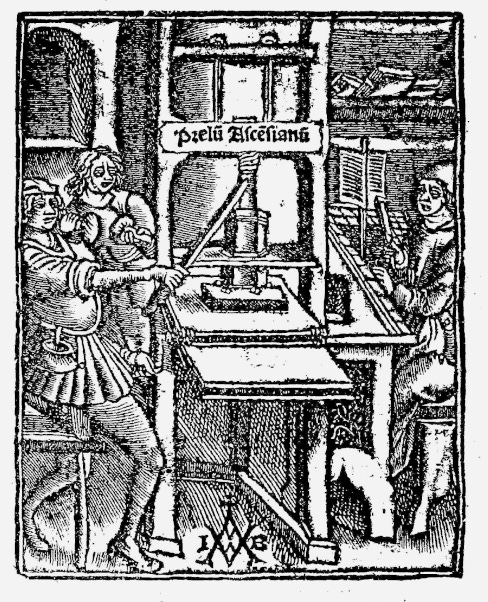
Printed by Ascensius, and completed on the fifth day before the Ides of November, 1515.