
A Consolatory Speech by Giordano Bruno
translated from Oratio consolatoria

Elder’s Notes
This speech was given by Bruno following the death of the Duke of Brunswick.
The world Bruno inhabited is almost alien to our own. As you read this speech, imagine yourself at a funeral where someone delivered a similar oration: one that moved from grief, to the nature of death, to consolation, before finally settling into a deep cosmological meditation on life.
Bruno was the consummate Renaissance man, and his way of engaging with the world feels foreign to how most of us experience life today.
He also uses this speech to reflect on the welcoming environment the Duke had created, one that gave him the freedom to engage with the Muses on his own terms. Eleven years after this speech, Bruno would be burned at the stake. Intellectual freedom did not come easily to him. The Duke’s patronage offered Bruno refuge and protection in a world that was deeply hostile to his ideas.
The oration ends with Bruno transforming the Duke’s life into a celestial map, with the northern constellations offering us a guide to his virtues, and the southern constellations showing us the vices that he overcame. The Duke’s life is translated into a heavenly scene that is, frankly, awesome.
This is a touching oration by a brilliant wordsmith, and it shows how different Bruno’s world was from the one we live in now.
A Consolatory Speech
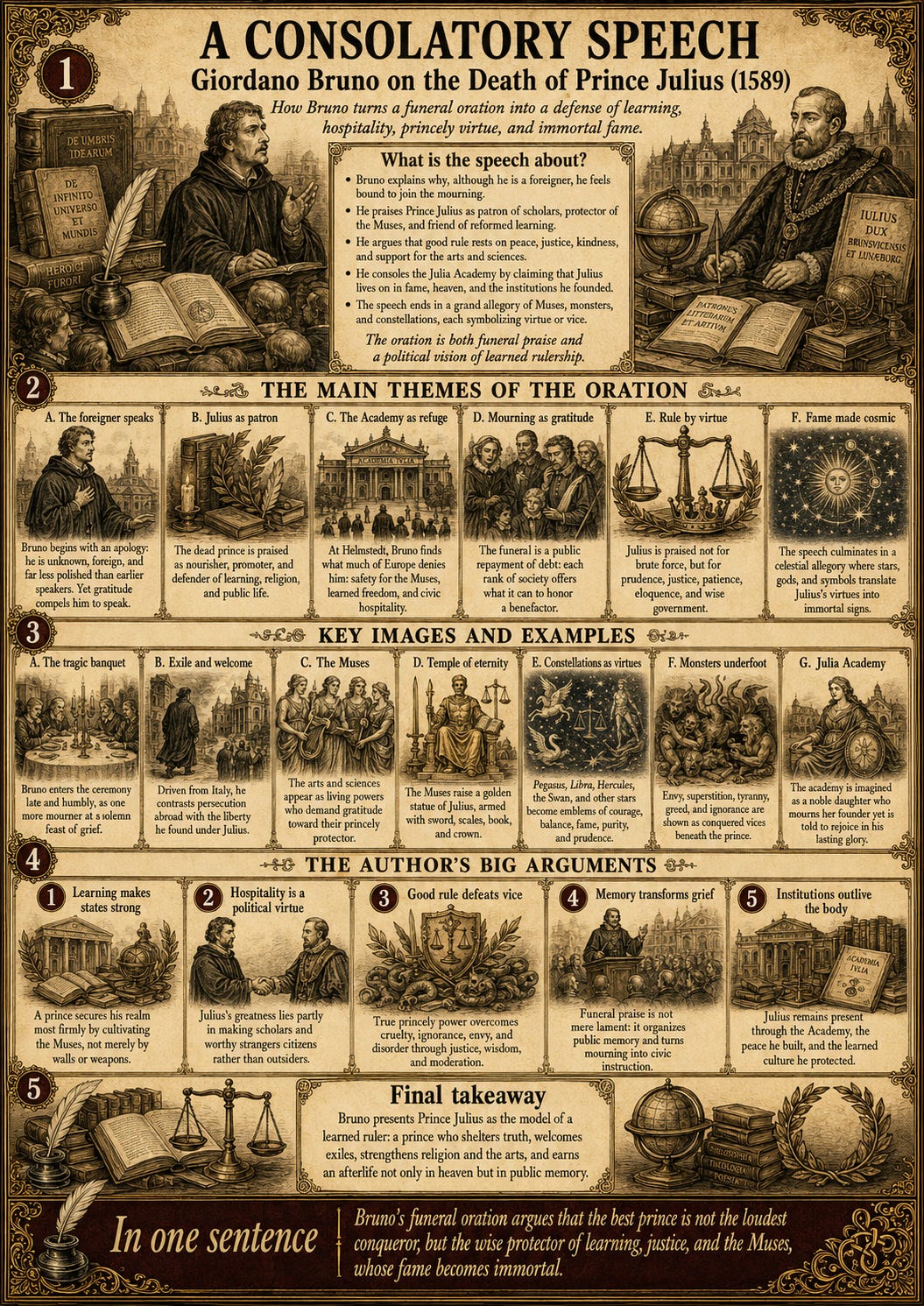
A consolatory speech by Giordano Bruno of Nola, an Italian, delivered in the famous and very distinguished Julia Academy, at the close of the very solemn funeral rites for the death of the most illustrious and powerful Prince Julius, Duke of Brunswick and Luneburg, and so on.
The first day of July, in the year 1589.
Printed at Helmstedt by Jacob Lucius.
At the very start, most splendid, most reverend, and most excellent Pro-Rector; most distinguished council of doctors and masters, marked by every kind of virtue and learning; and you noble, brilliant, and highly cultivated circle of students, one thing troubles me deeply and makes me anxious.
I am very much afraid that someone who does not really know the freedom and plainness of my character, weighing this matter on too light a scale, may take it badly that I, a foreigner, unknown, and a man whose main purpose in staying among you is to remain out of sight, should, entirely on my own initiative, invited or urged by no one so far as anyone can see, mix myself into your mourning and step uncalled into what is almost a tragic banquet.
And then I worry that you may suspect this is a symptom and result of boldness and rashness: after speakers so very eloquent and so outstanding in the art of speaking; after hearing, I say, such a charming and sweet harmony, however mournful, as if to add a final flourish, I push myself in with this raw and undigested style of speaking, likely to upset ears and palates more refined than mine.
Really, after you had tasted those streams of German and Latin eloquence, whose golden currents you heard flowing so abundantly from the springs of powerful minds, and whose hearts I would readily call dining rooms of the Graces, it would have been fitting for some noble Cicero to rise again from Italy and come, whether at a good time or a bad one, as orator for so great a funeral ceremony.
Instead, when you might have expected the fathers of eloquence themselves, dead in Italy, Greece, and Egypt, and living here in this Academy, you see me arrive: a man completely foreign to the practice of polished speech, stammering in this rough, unpleasant, thin, and graceless style. You seem to be asking me: where am I coming from, what new thing am I bringing, and what role am I going to play? If you would like to hear my excuse, my reason, my starting point, and my end, then please listen.
To take up the matter from the beginning, famous listeners, I believe it happened not by chance but by a kind of providence that I was driven, by some wind or storm, to this region on these very days, so that I might attend the funeral of your most exalted, powerful, and famous prince.
I saw every rank of human society weighed down in mourning clothes, with sorrowful faces, slow steps, and signs of bowed and humbled spirits: princes, counts, barons, gentlemen, nobles, senators, citizens, and common people.
Then I saw all the arts, the celebrated disciplines, and the virtues: Religion, divine law, Theology, Civil Law, Medicine, Poetry, Oratory, and the other studies thought to contribute greatly to the cultivation of the mind and the perfection of human society. All of these, every one of them, had been left widowed of the sweetest and most longed-for presence of that most illustrious Prince Julius, called up to heaven: their producer, nourisher, promoter, and defender, and a man famous throughout all Europe, the most cultivated part of the world.
Here I could see or hear nothing that was alien to the human condition. Indeed, I also noticed the wonderful devotion of this people, remarkable beyond what foreigners would believe, toward its own Prince and Lord: their reverence, respect, and signs of the most obedient affection. I heard the very weighty reasons for this duty confirmed by the most learned theologians and historians, not only from the ancient custom of more cultivated nations and peoples, but also from the usage and sanction of ancient religion, approved in a certain way by God, and supported from both Testaments.
It was amazing how well everyone performed, each according to the strength available to him, with the greatest care in carrying out his role. Then, while thinking things over with myself, I do not know whether I said it myself or whether some foreign spirit whispered it into my inner ears:
“Look, Italian newcomer, at how every sort of person benefited by this excellent Prince is pouring out the last of his own strength, as part of the ceremony and as the final possible duty he is bound to offer him. What are you dreaming about? Why are you idle? Why are you dull? Why delay, instead of considerina vour own position too and recognizing how much this task belongs to you no less than to anyone else, and is in fact demanded of you by every argument among the chief duties, when you see what others have done and still must do?”
You say, “I am a foreigner and an outsider.” Why so, man of Nola? In fact, this business is required of you here by every law precisely for that reason: because you are an outsider, because you are a foreigner, and because you belong to no order and no faction.
Do you not know that among the other virtues of the most illustrious Prince Julius, the brilliance of his most noble and almost superhuman kindness was so great that he decreed, ordered, and enacted that in the Julia Academy there should not only not be regarded as foreigners and outsiders, but not even be such, those who are capable of honorable conversation and whose profession or study is concerned with the Muses and the finest disciplines? Did he not take the greatest care that every good art and science, anything that might be useful to the human race and might serve as a step toward the knowledge and worship of God, or at least not lead away from it, should recognize itself in this place as a citizen, a native, and a member of the household?
In this place he wanted nothing to be understood as foreign and alien, and he deeply wished it to be kept far away and banished, except ugly ignorance, savage barbarism, and that Cyclopean lack of hospitality. May God grant that his wish succeed here more fully forever, so that nowhere may that Getic harshness be sold as seriousness, or the look of yawning ignorance under the title of learning.
So bring back to mind, Italian, bring back to mind that, though driven from your homeland by your honorable principles and your studies for truth, here you are a citizen. There you were exposed to the throat and greed of the Roman wolf; here you are free. There you were bound to superstitious and utterly deranged worship; here you have been encouraged toward more reformed rites. There you were dead under the violence of tyrants; here, through the kindness and justice of the best of princes, you are alive and, insofar as you make and show yourself capable, even enriched with offices and honors, at least according to his wishes and intention.
For those Muses, rightly free by the order of nature, the law of nations, and civil laws, are trampled under the feet of low priests in Italy and Spain; in France they suffer extreme dangers from civil war; in Belgium they are shaken by constant waves; and in certain regions of Germany they lie miserably sluggish. But here they are strengthened, raised up, live in deep peace, and flourish very well with their students under the prince’s judgment. So you owe him duties of gratitude as your true prince, protector, and patron. Under him you live not as an exile, not under compulsion, not pierced and stabbed by the stings of hellish fear, but as a citizen, free and safe. So carry out, carry out with energy and with the greatest diligence and effectiveness you can, the task that falls to you. If you neglect it, the foreign Muses lay it on you, a foreigner, under the very serious and very shameful mark of ingratitude: that here, in the name of them all, at least in funeral respect toward their dearest Prince, you should match, if not what you owe on their behalf and his, at least what you can.
They want you to be completely sure of this: whatever your duty turns out to be, and however much it is, if it comes from a good affection of the heart, it will be received with deepest gratitude by the immortal and divine spirit of that great-souled Prince, when he sees and recognizes that his wish, his character, and his support are being received gratefully by outsiders, just as they were most graciously offered and granted by His Highness to them and to all others. From this, learned listeners, you can more clearly infer why I, a foreigner, was not only moved, but even driven and compelled, to add myself for my part, not as though I were a real part of the whole, but as something placed beside it from outside.
Now, as for the point that really presses on me, and is fairly brought up against my very humble and uncultivated against my very manner of speaking: since such eloquent rhetoricians and orators have gone before me, and I, very slow in wit, thin in learning and in language, voluntarily offer myself up in my roughness, please, listeners, do not take it too badly. Do not, I say, put it down to rashness, arrogance, or insolence of spirit.
I have not been driven to such stupidity that I do not know the truth: namely, that nothing can be brought forward by me that is better than, equal to, or even like your most pure and brilliant Muses. For that reason I have not dared to mix my foolishness with their cultivation and splendor, or make it their partner.
Indeed, you can easily see that now, at the tomb of this divine Daphnis, just as long ago at the tomb of the one remembered by the Mantuan poet, “the slow herdsmen came.” So, after the chariots of Jove, the breaths of Juno, the lamps of Phoebus, the Muses of Pallas, the eloquent Mercuries, the loveliest Graces, in short the heavenly powers, have performed their own ranks, rites, ceremonies, and acts of final piety and service, please allow allow the way to open, and allow the last ones to come, apart and alone: from the mountains, woods, and deserted with whatever fields, the rustic, shaggy, rough Fauns, Silvans, and Satyrs, with whatever language, idiom, and ceremonies they have, offered from a sincere affection of the heart.
They declare that they are present not according to the majesty and dignity of the occasion, but according to the duty and reverence of their own task and grateful mind.
For so great a brightness of the most illustrious Julius could shine not only on heaven but also on the all-bearing earth; not only on the great gods, but also on sacred and good household spirits and heroes of every kind; not only on those at home, citizens, and townsmen, but also on outsiders, foreigners, and barbarians. Therefore I, who love the muses as much as anyone, and for their sake despised, gave up, and lost my homeland, home, property, honors, and anything else outside them that could be loved, sought, or desired, could not now be said to love them truly and from a pure heart if I did not honor the most illustrious Prince, so great and such a patron, guardian, and defender of them, and if I lazily stood back and kept away from this final act, the one customarily and rightly consecrated to the mortal part.
So let the foreigner too not be missing, if the Muses have completed their home duties. If they have appeared with heavenly and starry honors, let them appear also with these field-like and rustic ones. For God made great things and small, and from all, according to their own ability and understanding, he demands first fruits and tithes of reverence and honor.
We are here then as Satyrs, Fauns, and Silvans by night and as if at an unusual hour, although we pour out and display no tears and no grief beyond this most noble funeral. For if tears are required over your tomb, and if your most sacred ashes thirst for tears to be sprinkled on them, best of princes, they were not lacking for you: tears not few, not fake, not theatrical, not hypocritical, such as even the bodies of tyrants are washed with, but tears shaken loose by the fire of the most sacred love.
The eyes of your most illustrious first-born son and successor, Henry Julius, and of your other most illustrious children, your heroic wife, your blood relatives and kinsmen by marriage, the heroes of your household nobility, your most noble court, ministers, peoples, and finally heaven itself poured them out. From the time when you gave your soul back to the gods above and were joined to the great and immortal heroes, until this final limit of funeral honors and beyond, heaven has mixed its tears with the tears of your peoples.
For what else, by the immortal God, can we believe those unseasonable and unusual rains, winds, and thunder have been from that very day, except tears, sighs, and laments, which each single day has offered in uninterrupted turns while celebrating your funeral? So, rather, to put some limit on your tears, if we can, we come in the person of rustic divinities without tears, and we bring to the height of this tomb the smoke of Sabaean spices.
We scatter flowers, roses, violets, leaves, the sweet-smelling gifts of mother nature, since these are customary and pleasing to a grave. These are the things which our goddesses of the fields and mountains, the Nymphs, Naiads, Dryads, Hamadryads, and Napeae, have handed over through reverence, and respect, before a quieter time is given to them, since they shrink from the crush of the crowd, to approach and gather together.
Then they may add to these gifts, for the crowning of the tomb, little garlands woven by their own hands: not from gloomy yew or cypress, for they think these less fitting for so great an immortal hero, whom you ought to believe has not died, but has departed from you. Rather, they bring crowns and tiaras from flowering rosemary, myrtle, ivy, vine leaves, palm, olive, and laurel, emblems of Prudence, Wisdom, Faith, Patience, Victory, Peace, and Triumph.
And soon we wish you to understand this on their behalf: just as they cannot disapprove of the tears you have shed in the performance and fulfillment of piety, tears in which you had heaven itself not only as an approving witness, but also as a sharer and companion.
Yet, lest these tears allow room for some more desperate and excessive sorrow, and lest signs of immoderate grief, set beyond proper measure, seem to be displayed in the eyes and faces of the wise, they wish this thought to be placed before everyone’s mind: that, once these solemn funeral duties have been completed, we should all live with tranquil hearts in pious and most blessed remembrance of the most illustrious Duke Julius.
For no doorway ought to stand open to that troubled grief, once it is perceived by the eyes of understanding that, if any field for weeping should remain after these rites have been performed, that very field must be referred to one of three causes: either to the person of the most illustrious Duke Julius, or to the misfortune of this most ample duchy, or finally to your own loss, Julia Academy.
But, learned and wise listeners, what room can there be for the first kind of grief? This best of princes has completed everything under the highest blessing and the special favor of heaven; with his measure full, he has escaped from the hands of Fortune and the Fates. From this valley of tears he has flown to that mountain of blessedness; from this infernal Egypt to that heavenly Jerusalem; from the blind abyss of darkness to the fullness of unapproachable light; from the rushing flood of disasters to the rivers of immense consolation; from the prison of time into the wide embrace of eternity; from a changing and almost momentary rule to possession of that eternal kingdom whose heir Almighty God made him.
So, now that you have shed the tears owed to his absence, for a natural and human law of blood allows and orders such happiest condition has tears, and now that his happiest condition has been set before your eyes, there should be no more place for sorrow among you. Who, after all, has a right to weep for a parent, friend, benefactor, or lord, when he has finished the terribly rough voyage of this life and has reached the harbor of salvation and rest, carrying the wages, prize, and crown of his own labors?
But as for the second point, whether there is any reason to grieve on behalf of all the peoples who flourished under his leadership and government, I leave that for us, and for everyone concerned, to consider more carefully. Did this most illustrious and farsighted duke not make provision long ago, so that no sadness would fall on his dearly loved
And is it not absolutely clear how brightly divine power and mercy stood by him to the end? God once rescued him from thousands of attacks by envy, malice, and fortune; raised him to this height of rank; preserved him happily in it for some time; and then, when the course of this life was finished and his departure was near, made it possible for him to entrust his peoples to the Highness of his firstborn and successor, the most illustrious Henry Julius.
He is endowed with such brilliance of spirit, prudence, courage, learning, and greatness of soul, and has so well earned the place of father of the fatherland. The shining excellence of his virtue was already seen in his administration of the bishopric of Halberstadt, the rectorship of this illustrious Academy, and other offices, which he carried out as a young man, while his most illustrious father was still alive, with the highest praise and to everyone’s satisfaction. Now, with his age firmly established, under a wider and greater realm and government, that brilliance will certainly shine out, grow clearer, and spread more and more. So you can surely see that this was done by the most prudent care of the most illustrious Duke Julius, so that for many centuries after his funeral you may recognize his presence among you more and more clearly.
I pass over any full account of how carefully he had his most illustrious children educated for the advantage, use, favor, and gratitude of his peoples. One thing alone no age and no forgetfulness will ever erase from my memory: I was allowed to see with these eyes and hear with these ears those two heroic boys, the princely sons entrusted to your lap and your education. At fixed times they were bound to the strictest examination; they were entirely removed from, and averse to, ordinary weddings, carnival revels, and drinking parties. No one ever saw them aiming at savagery by chasing after the slaughter of fleeing hares and deer. Instead, they were present constantly at school and church gatherings.
And this especially deserves to be remembered for ages: we know how magnificently, spiritedly, and, as far as their age allowed, learnedly both of them met the theses debated under the great jurist Borcholt, opposing them with weighty arguments. Good God, how my heart leapt then with all kinds of feeling! How intensely I wished all the princes of Europe, and princes’ sons, had been there as witnesses! Surely many of them would have been ashamed that, while they themselves, supposedly more grown-up, sat silent in dull stupidity and carried all their talent in their ears, these tender boys in their place could think, speak, and be heard. They would have learned how this has not always been true, and is not everywhere true even in our own miserable age: that princes think, take counsel, and speak only with another person’s talent, judgment, and tongue.
With no less care and zeal, it is fully known and plainly evident that the Highness of the most illustrious Prince Henry Julius was educated according to the nature of a firstborn son. As his age grew, he had already gained mature judgment long before the proper time, and was able to reach the summit in every language, every branch of learning, and every virtue, as much as any excellent prince and ruler needs.
So if you lift the eyes of your mind upward, what sadness will you think can arise for the peoples from the cause just mentioned? His soul, now happily placed among the heroes and holding heaven, looks back down to earth. On one side, in the most illustrious Duke Henry Julius, he sees a wonderful sign of gratitude and love in the celebration of his funeral, and also, for the government of the peoples, those outstanding virtues of soul, mind, and body that are so often lacking in many princes. On the other side, by heavenly grace and with divine favor assisting him, he sees that under so great and such a duke, everything has remained as he left it: peaceful, calm, and safe. Because of the reformed religion, justice, kindness, and gratitude, the obedience of the peoples is firm, as though bound by the strongest chains.
Whether, finally, you yourself should grieve, and how you ought to feel at this time toward your most illustrious founder, most noble Academy, I shall recount not in my words, but in his own; indeed, in his deeds. So recognize his most blessed Highness as present before you, and listen as he strikes the deepest part of your soul with the voice, face, and feeling with which he used to address you:
"That Julius Caesar reached a high degree of fortune which I could not rise beyond, because I never would have wanted, and never would want, to use violence against my country’s own body or to exercise that cruel tyranny. Yet I tried to equal his spirit and his famous virtues, and, if our native customs had allowed it, to surpass them, so that in some special way and by my actions I might be compared with him, as I was already his match in my own name and in the splendor of ancestral kings. Still, I think I have done everything, and perhaps more, by heaven’s help: for the man who did all he could left nothing undone.
When Caesar escaped from the hands of the Pharian tyrant, not without wonderful divine favor and through the virtue of his own diligence and skill, and when his life was in the utmost danger, in that nearly hopeless, indeed truly desperate crisis, he remembered not only himself but also his Muses, his little books:
“ Pressed into a tiny space with weapons crowding him,
the Roman leader is suddenly hemmed in by all the terror of war.
On one side thick fleets line the shore;
behind him foot soldiers attack. There is no path to safety:
no flight, no valor, hardly even hope of an honorable death.
Trapped by the place, he hangs there unsure
whether to fear or to wish for death. Fate forbids it.
Fortune herself shows the path to safety. Then, leaving the ship,
he leaps into the sea; in his left hand he carries his books dry,
with his right he cuts through the waves; and at last, unharmed,
he is welcomed by the friendly applause of a crowd shouting to the sky.”
So too your Julius, Julia Academy, in every extreme crisis, and I was able to undergo many, joined your safety to my own because of those Muses whom I honored as much as I could. I want you to know this: from my earliest years I thought about you and loved you. The waves of this vast sea and turbulent age boiled and surged against me from every side; storms from every direction, stirred up by that worthless religion and the violent tyranny of the Tiber beast, drove me as I drifted. Malicious fortune shook me fiercely: torn away from my mother’s very lap, my father’s arms, and the love and favor of my whole birth-house; exposed to envy, spite, and the curses of hissing serpents, the barking of dogs, the sneers of foaming boars, and the roars, teeth, and claws of lions.
When all these things were afflicting me, I was surrounded on every side, pressed hard by people threatening and brandishing death at close range, and driven by the verdict of idle priests so that I scarcely even had hope of an honorable death. Then, when you alone remained like a plank from a shipwreck, as a witness to my courage, I held you up with this hand, as half my soul, under the banner of religion, devotion, and learning, which seemed to me the best part of the light shining on me from heaven.
I did this so that you would not merely be drowned by the waves of perversity, but so that I myself would not be contaminated, or at least not through you. I left to myself only my right hand, still devoted to your favor and safety, which would take up the remaining labors for avoiding rocks, overcoming waves, and bringing the life we shared, mine and yours together, into a safe harbor. So of my two hands, one served entirely your life, while the other served partly yours and partly mine. With this right hand, then, placed in the struggle and cast into the sea of this age, I faced extremely harsh and long disasters; I passed through them, drove them back, attacked them, stormed them, trampled them, and overcame them. At last I see myself welcomed by the very ancient applause of the heavenly court; and I leave you, indeed I possess you, established in the best harbor.
Remember your Julius, then, my Julia, whom I look down on from heaven as one of my children. I gave you and shared with you my name so that the pledge of my love would remain forever in your heart. I carved you into the hearts of my children. To make their love for you indelible, I handed them over to you to be educated, so that after sucking the milk of religion, devotion, and learning from the breasts of your heart, they would conceive a love for you poured into the inner substance of their own being. In the end they would love you as their own flesh and blood, and in return, when grown, would feed, rule, advance, and protect you, my Julia.
I call you Julia: before you appeared in the form of stones, foundations, walls, columns, and this visible roof, you were born as I was born, nourished while I was still at the breast, grown as I grew, fleeing when I fled, safe while I was safe. And because Julia was born at the same time Julius was and Julia lived while Julius lived. I took excellent care that she would not die when Julius died. Julius lives for you; he lives for you. Flesh of my flesh, blood from my blood. In him and through him I still live, and I will live with you: my firstborn Henry Julius. He too is adorned with a heroic spirit and with God’s gifts. Just as, by divine gift, he stood by you as Rector while I was alive, so now, with a fuller and manifold grace and with the service of his support, he will take you, dearest one, wholly from my hands. For just as he will behold and recognize my name in you, so too he will behold and recognize my face and my spirit in you. He will cherish you more and more, increase you, enrich you, raise you high, and defend you.
Farewell then, my Julia, farewell, farewell forever. And this one thing, as much as I can command you, I command; and as much as I can ask you, I ask: love me. And if you in return follow me with the love with which I embraced you, then love those whom I loved; receive those whom I would have received; honor those whom I would have honored; protect those whom I would have protected.”
O most blessed of heroes, wisest of princes, most famous of dukes: see where your heart, your spirit, your mind were; see where all your effort, see where such great effort, was directed. You did not, in the manner of the ancients, build a temple of idols; you did not consecrate altars to filthy demons and people-hating spirits; you did not construct filth or a monastery, a dormitory of monks, that is, a nest of lazy dormice. You did not pour out huge expenses on citadels and fortifications, or raise heavily fortified works everywhere to put a violent bridle on peoples who might rebel. For you recognized, wisest of dukes, that forces of this kind can be assembled against a prince no less than for a prince, and that once they have been prepared, it can happen not only for tyrants to fear on their account, but also, and even more, to fear them for themselves.
You understood perfectly that peoples are held most firmly, and are kept forever under the same government, by peace, prudence, patience, kindness, and justice. With chains like these, with handcuffs, yokes, walls, defenses, ramparts, and towers like these, you commanded, reigned, and still reign and command. In this way you terrified your enemies by wisdom of mind alone and by the strength of an unconquered spirit. You understood that wisdom and practical knowledge are stronger than every defensive fortification and every engine of attack. Therefore, seeing that the safety of peoples, the greatness and power of princes, and indeed every good thing, are all located in the one cultivation of the Muses, you consecrated this Julia of yours, your name, and your affection to the Muses.
And now, in return for so great a gift, what have the Muses done for you? In the temple of eternity they have raised a golden statue for you. To its right hand Astraea offered and fitted a sword together with scales; to its left Minerva granted an open book of wisdom and law. Pallas added to its chest a breastplate of courage and greatness of soul. On its head was placed the crown of prudence and counsel which great Apollo wove for you. Beneath its feet one may see images of countless and varied monsters: Envy, Deceit, Anger, Gluttony, Impiety, Superstition, Ignorance, Idleness, Luxury, Slander, Greed, Tyranny, Violence, and thousands of others.
Around it, each Muse set up her own statue in pure, solid silver. There Clio, calling the memory of past things before the eyes of the present and eternal age, sings the glory of your deeds.
sings the glory of your virtues.
Melpomene, distinguished by tragic gravity, sings of the funeral processions, solemn and most august, with which men, gods, the heavens, and the elements adorned your most blessed departure.
Comic Thalia, rejoicing with graceful and charming jests, mocks those who once rashly opposed themselves to your heroic plans and deeds, or who even now, sick with mad envy, would try to detract from your highest praises. She insults them with these verses inscribed on a bronze tablet:
Behold, abiding above the stars, he scorns empty sneers;
envious one, take away the subject of our jokes.
Calliope sings in heroic verse the deeds of you and of your ancestral kings:
Terpsichore moves, commands, and heightens the emotions with her lyre;
Erato, bearing the plectrum, dances with foot, song, and face;
Polyhymnia marks out all things with her hand and speaks by gesture.
Urania, high up in the panels of the world-temple’s ceiling, panels containing all the images of both celestial hemispheres, rendered in solid gold and hyacinth-blue in their living and proper color, shows your most illustrious name engraved near the shining ear of corn of Erigone.
There, directing one’s eyes toward the northern figures, one may first behold Helice, Cynosura, the Dragon, the Dolphin, Boötes, Ariadne’s Crown, Hercules, Aesculapius or the Serpent-Bearer, the Lyre, the Swan, the Eagle, the Arrow, and the Dolphin. Each of these is understood to suggest one of your virtues, and to describe it by its own proper signs.
The Dolphin means kindness and humanity; the Thessalian Arrow, after mature deliberation, means successful speed in carrying a thing through. The Eagle means the dignity of a wider dominion; the Swan, purity; the Lyre, sweetness; Aesculapius, prudence; Hercules, courage; the Crown, majesty; Bootes, guardianship and vigilance; Cynosura, loftiness and steadiness; Helice, the unfading splendor of your most illustrious and serene family line.
Secondly, those figures are to be examined which lie more between the northern Tropic and the belt of the First Mover: the adamantine sickle, or curved sword; the head of Algol, or Medusa; the Goat with her kids; Berenice’s Hair; the Deltoton, or Triangle; the Charioteer, or Erichthonius; Perseus; Andromeda; Cassiopeia; Cepheus; the Little Horse; Pegasus, or the horse of Bellerophon.
There winged Pegasus, spreading out his course widely through the ether, represents your fame as it passes through the whole world. The Little Horse represents liberty. Cepheus — who is also called Cheicus, that is, “inflamed” — represents your burning zeal for religion, justice, and the Muses. Cassiopeia represents your marriage to a most illustrious heroine. Andromeda, bound with manacles and chains, represents the fear of God and piety, by which your affections and actions were so bound that you thought nothing permitted to you, and committed nothing, except what accorded with divine, natural, and moral justice.
Perseus the triumphant is the sign and witness of your vigorous diligence and tireless virtue. Berenice’s Hair reveals gracefulness and ornament. The Charioteer Erichthonius, who is said to have drawn oak trees by his song, represents your native eloquence and charm, by which you softened the hardest peoples into obedience to you. The Triangle represents the triad of virtues: Prudence, with which you undertook all affairs; Energy, with which you completed them; and Manliness, with which you defended what you had done.
The Goat with her kids, by the power of its stars, represents solicitude and care for worthier things. That severed head of the Gorgon, in which most venomous snakes are planted in place of hair, represents that monster of most perverse Papal Tyranny. More tongues than hairs stand by and serve it — all those blasphemous tongues against God, nature, and human beings — and they infect the world with the worst poison of ignorance and wickedness. By your virtue, we experience that monster as having been beheaded and torn away from these regions. That adamantine sword, reddened by the slaughter of the monster, represents the constancy of your unconquered mind, by which you destroyed that most horrifying beast.
Thirdly, to those looking upon the stars of the oblique circle there appear those Dionean Fish; the Phrygian youth Ganymede, whom they call Aquarius; the shaggy form of Aegoceros, or Capricorn; Chiron the Centaur; Scorpio; Libra; Astraea the Virgin; Leo; Cancer; the image of the twins Castor and Pollux; Taurus; and Aries. Here Aries, shining with his golden fleece, marks the golden and peaceful age, enlarged after the iron and stormy age, introduced and made firm for this principality through you.
Taurus, the carrier of Europa, represents constancy, dignity, and maturity. Castor and Pollux represent the unbroken law of loving and being loved in return, the law that true Eros and Anteros, just and grateful in giving out and giving back, demand. Cancer, hot, burning, and scorched, represents an extraordinary endurance of labor. The Lion, whose heart flashes like the blazing sun with rays spreading everywhere, represents the utterly unconquered force of your greatness of soul; by it you crushed uprisings and wars before they could move, so that you did not have to overcome them once they were already in motion.
Astraea represents a model of natural restraint and chastity. Libra represents the balance with which you managed everything, both in other people’s affairs and in your own person. Scorpio, frightening with his coiled tail and bending back his branching arms on every side, represents the rashness and audacity of deceitful and underhanded people, which you held down. Chiron, human only in his upper part, represents some of your peoples whom you raised from barbarism and savagery into the true form of humanity, after planting among them the studies of piety, the arts, and the Muses. Aegoceros, in whom the sun’s course turns upward from the lower regions, represents the clear expansion of your rule and a still greater exaltation to come.
The Phrygian boy, pouring nectar for you from Jupiter’s cellars, supplies the reason why the Muses have deservedly built this little shrine for you in the temple of fame: you have been enrolled among the blessed divinities who share in the wine of eternal enjoyment. The Fish, set in the high part of the sky because they freed Venus and her son from the rage of the giant Typhon, show that your highness, in the same way, shares in a heavenly dwelling, because you welcomed into your own home, as an exile, that Gospel law of double love, so that it would not be profaned by a most savage and bloodthirsty tyrant; and once you had welcomed it, you made it secure, to be protected and defended.
Last, in the sinking, lower part of the sky that lies beneath you, these remarkable images are offered: Orion, Procyon and the dog Sirius, the Hare, the Argo, the Hydra, the Raven, the Bowl, the Centaur, the Wolf, the Altar, the Southern Fish, the Sea-Monster, Eridanus, and the Crown. Here the Crown, which they call Uraniscus, means pride, empty ambition, and tyranny; Eridanus, excessive and undiscerning largesse, or prodigality; the Sea-Monster, uncontrolled desire; the Fish, mute ignorance; the Altar, superstitious worship and idolatry; the Wolf, greed and savagery; the Centaur, doubleness of heart and feeling; the Bowl, drunkenness, gluttony, and intoxication; the Raven, chattering and vulgar joking; the Hydra, many-sided spite and slander; the Argo, avarice and fraudulent seizure; the Hare, cowardice and luxury; the two Dogs, heating the lands with excessive fires, anger and envy; and stormy, terrifying Orion, cruelty and wildness. These represent the vices that you trampled down, subjected, and tamed with no smaller number of virtues: wildness and cruelty by wonderful mercy; anger and envy by patience and long-suffering; detraction by the maturity of serious speech; chatter by the most careful language; gluttony and drunkenness by abstinence and sobriety; doubleness of heart by truth and sincerity; greed and savagery by the gentlest and most approachable disposition; superstition and idolatry by religion and piety; mute ignorance by wisdom and learning; uncontrolled d yaoratry by singron and ple desire by moderation in governing the passions; wasting of resources by thrift and frugality; excessive ambition and tyranny by fatherly care for the fatherland.
So happy, then, and three and four times blessed by so great a founder, Julius, is the Julian Academy. Live, go out, move forward, step on, take your stand, and sit in glory among all the academies of the world. Most august, most illustrious, most exalted Princess: daughter of a prince, sister of princes, and one whom a very long catalogue of most illustrious descendants awaits in a long line. How nobly you were born, how magnificently brought up, how gloriously you are coming of age. Live; and even in this mourning dress, which you have become worthy to wear, even with these tears, which you have deserved to shed under the title of daughter, rejoice as well. Yes, in the very middle of grief, take pride, because no academy has ever shed, or ever will shed, worthier tears for an object so great and so much its own. Your tounder, your prince, your lord, your parent holds heaven and looks down at you from heaven. From there he will be present to help you. There, offering his prayers to God, Best and Greatest, and being most dear to him, he will obtain whatever he wishes for you; for being now in a better state, it is not likely that he could be worse to you.
I have spoken.
Summary
I really enjoy the images/charts...