A Little Book On Artificial Memory by Johann Magirus
translated from De Memoria Artificiosa Libellus

Elder’s Notes
This handbook, written by Johann Magirus (under the name Johann Austriacus) in 1603, stands out to me chiefly for it’s treatment on collateral spaces.
I often wondered about how Thomas Aquinas managed to mentally annotate the things he read and contemplated. That mystery is easily resolved using collateral locations.
Collateral locations are what make mental annotation possible.
The section on formed and unformed words will also be of particular use to people who struggle to turn words into images or stories.
Opening
It will be most useful and necessary for all people of whatever rank or condition, but especially for students of letters, orators, theologians, jurists, and those who strive to climb to the summit of the doctorate.
Frankfurt, from the typographical workshop of Matthias Becker, at the expense of Hieronymus Megiser.
1603.
Index of This Little Book
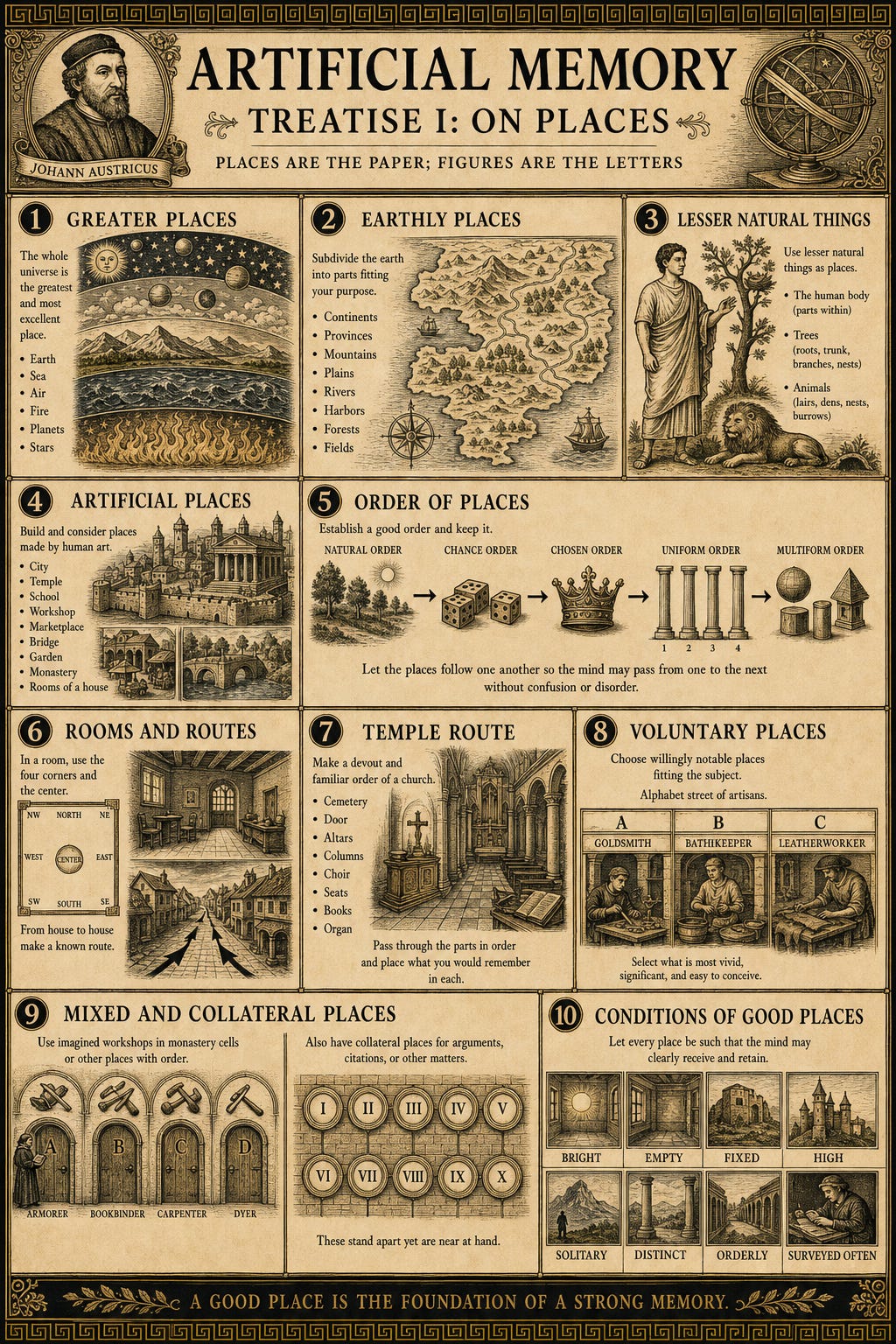
Treatise 1. On Places.
On the greater places.
On earthly places.
On the parts of the lesser natural things.
On artificial places.
On the uniform and multiform order of places.
On the parts of rooms and on their order.
On voluntary places.
On mixed places.
On collateral places.
On the conditions of places.
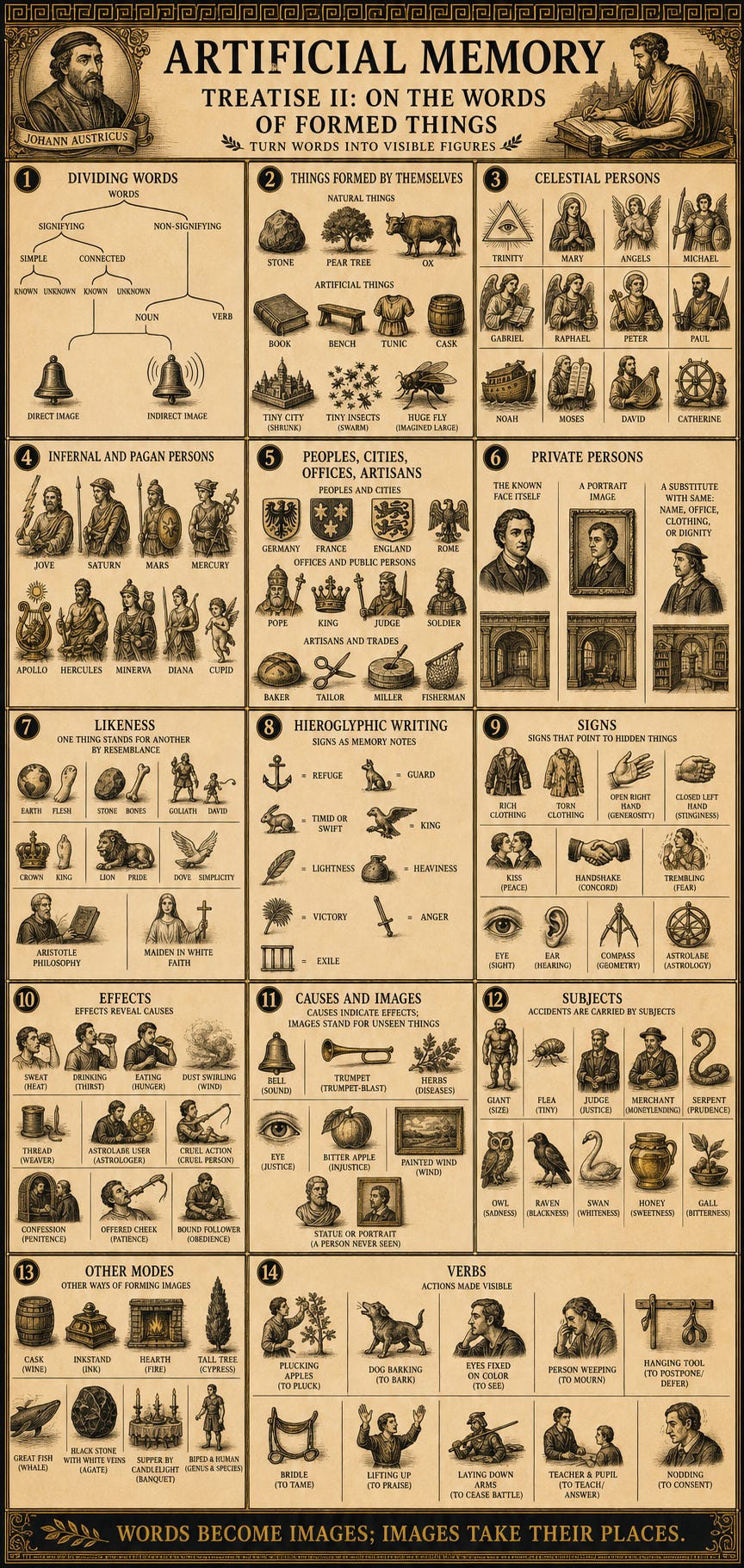
Treatise 2. On the words of formed things.
On the division of words.
On things formed by themselves, and also on those which are endowed with excessive or very small size.
On celestial persons.
On infernal persons.
On peoples, cities, and other public persons.
On private persons.
On likeness.
On hieroglyphic writing.
On figures.
On effects.
On causes and images.
On subjects.
On the other modes.
On verbs.
Treatise 3. On unknown and unformed words.
On perfect words.
On detraction.
On addition.
On commutation.
On transposition.
On syllables.
On letters.
On convention.
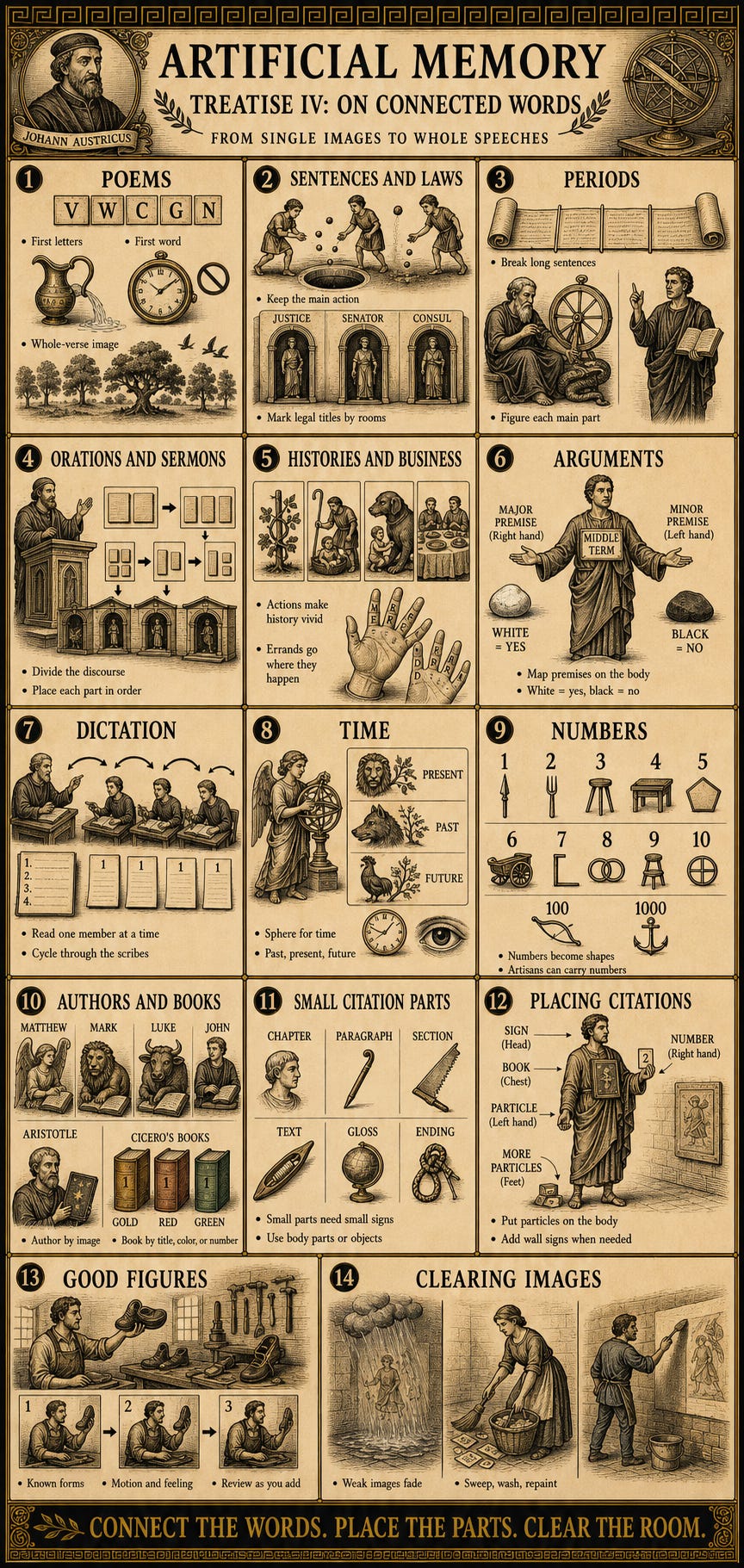
Treatise 4. On connected words.
On poems.
On sentences and laws.
On periods.
On orations and sermons.
On histories and matters.
On argumentation.
On the manner of dictating.
On time.
On numbers.
On the formation of the larger particles of a citation.
On the formation of the smaller particles.
On the application of the said particles to places.
On the conditions of figures.
On removing images.
Treatise 1: On Places
Chapter 1: On the Greater Places
Artificial memory is acquired by two things: places and figures. For just as someone writing with a pen uses paper as a place, and letters, figures, and signs as marks, so the person who learns artificial memory, or hands it down to another, uses places as paper and figures as letters. Therefore I have set up a discussion concerning these two parts.
But before I undertake to explain figures more fully, as the far more difficult part, I will discuss, with as much brevity as possible, what a place is and of how many kinds it is. A place is the seat of figures or images. Some places are natural, others artificial.
They are called natural because they have taken their origin from nature as their author. Of these, some are greater and others lesser; these too, as will soon appear, are very often divided into their own parts. The greater places, which contain others within their own extent, are divided into elemental and celestial parts. Of these, the celestial parts come from the celestial spheres and the elemental parts are composed of the four elements.
The lesser places are those which are next subordinate to the greater. To begin from the lower ones, the chief of them are these: hell, fixed around the center of the earth; the earth, whose parts are two: the inner part, in which are metals, stones, and so on, and the outer part, the surface of the earth itself, visible with plants and animals.
The sea also has its parts: first, its depth, filled with mud and sand; then the middle, in which sea beasts and larger fish swim; last, its surface, furrowed by ships and stirred by storms.
The region of the air is divided by philosophers into three principal parts: the lowest, through which birds fly; the middle, where clouds, rain, snow, lightning, and thunder are generated; and the highest, in which comets and other meteors of that sort shine.
Fire, indeed, and any one of the planets will furnish us only one place, though the galaxy itself will furnish a notable one. The planets, with their spheres, follow this order. We imagine the sphere of the Moon as made of solid silver; Diana sits upon it, gleaming with silvery garments. Mercury, in garments dyed with a color like silvery wine and winged in his usual manner, will stand on his shining planet, whose orbit will glow with ruddy silver. Venus will stand upright over her own planet, gleaming with brightness, adorned in the manner of the Nymphs with curled and scattered hair and with a white garment. You will believe that her sphere has been formed from bronze. Think of the planet of the Sun, together with its orbit, as golden, and Phoebus, sitting in his shining chariot, will govern it.
Mars, armed and sitting on a fiery horse, will be placed above his planet, set upon an iron-like fiery orbit. Jupiter will sit on a seat, as king of men and gods, placed upon an ivory chair; his orbit is fashioned from tin. Saturn, an old man partly bald and partly white-haired, will sit trembling and cold upon his planet, whose orbit is not unlike leaden material.
The starry heaven is contiguous with the sphere of Saturn and can be divided into as many places as the stars you know. Almost infinite parts can be assigned to the empyrean heaven, just as they have been treated most abundantly by Rossellus, a man both polished in every discipline and most outstanding as an author of this art.
Chapter 2: On Earthly Places
There are various divisions of earthly places, according as the earth is considered in its various parts. For one place is made by our hemisphere, another by that of the antipodes; again one by the east another by the west, another by the south, another by the north. Finally there is Asia, Europe, Africa, and America. The individual parts of these contain regions and provinces, as many as possible; and their principal parts are two: mountains and plains.
Places of this kind, as with almost all the others, are some great, some small, and again of these, some lesser and some smallest. The great ones are divided into terrestrial and watery places. Under watery places are placed rivers, ponds, streams, to which springs are added. The parts of rivers are shores or banks, harbors, trees, willows, shrubs, sand, the water itself, and the fish that swim beneath it. The same parts are assigned to ponds. In streams the waters themselves run; fish take the fish-ponds; whirlpools hold the eddies. Springs consist of their source and the water contained in them.
Terrestrial places are divided into cultivated and uncultivated ones. The latter bristle with forests, woods, groves, and other wild places; the former are adorned with green fields and meadows. In forests, woods, and other uncultivated places there are trees, shrubs, herbs, animals of every kind, and their lairs and nests; just as in fields there are plowed lands and gardens, in which there are likewise trees, herbs, planted things, flowers, grains, and besides these, human beings and tame or domestic animals. Meadows too smile with grass, streams, herbs, and flowers.
Chapter 3: On the Parts of the Lesser Natural Things
Of animals lacking reason, some are larger and others smaller. The larger are those which can be divided into parts. Of these, some are flying creatures and others walking creatures. The larger parts, or places, of flying creatures are the head, back, tail, wings, and each wing. Of walking quadrupeds the parts are the head, back, tail or rump, and sides.
The human being, divided in various ways, provides many places. By the first division, ascending laterally from the right foot, there are the lower foot, shin, thigh, side, shoulder, upper arm, forearm, hand, each individual finger, cheek, ear, and right temple; descending, there are the left temple, ear, cheek, fingers, beginning from the little finger just as on the right side from the thumb, then hand, forearm, upper arm, shoulder, side, thigh, shin, and lower foot.
By the second division, there occur on both sides the knees of the feet, the lap or front parts of the thighs, the private parts, belly, chest, throat, chin with the beard, mouth, nose, each eye, forehead, crown of the head with the hair, back of the head, neck, back, buttocks, sacrum, and hamstrings. The third division contains the shin, thigh, arm, and forearm, without the hand, on the right side together with the head; and the hand, arm, thigh, and shin on the left side. The fourth consists of the right foot and right hand, the head, the left hand, the left foot, the chest, and the back. The fifth includes the belly, the head, and the back. The sixth includes the head, chest, and feet, or the reverse. The seventh comprises the right side, the chest, and the left side. To these may be added any other divisions one pleases.
There are also parts of trees, namely roots, trunks, branches, twigs, flowers, leaves, and fruits, on which birds also perch. Shrubs and larger herbs are divided into roots.
The natural parts of mountains are valleys with springs, rivers, and streams; likewise the slopes and the summit. They are also commonly adorned with trees, wild beasts, caves, stones, and metals.
Chapter 4: On Artificial Places
Artificial places, so called from art, are divided into great, small, and smallest. Under the great ones are placed cities, towns, and villages. The small ones are drawn from castles, citadels, country houses, taverns and hospitals, and from public and private houses of citizens; besides these, from monasteries, temples, schools, and workshops; finally, from various marketplaces, porticoes, and other public places.
Some of the parts of these are internal, others external. I call external those that are adjacent to them from the outside, such as public roads, squares, bridges, gallows, mills, gardens, lakes, ditches, ramparts, walls, and many similar things, both named and lacking names.
Individual buildings too are constituted from their own parts, namely rooms. Under the name of rooms I include dwellings and receptacles of every kind that are appointed for people, for animals familiar to human beings, and for domestic goods. I divide each room into its own parts, namely into four walls, or rather corners, and into the middle, which is usually omitted by most people. If these are adorned and distinguished by columns, images, wash-basins, chests, armories, benches, stoves, beds, and other domestic things, they will furnish as many places as there are things discovered in them that distinguish one place from another.
Workshops of artisans, besides the four corners, offer us many other places, made and distinguished by their various instruments. These instruments are also worth noting for this reason: they supply us with no small abundance and equipment of figures. In temples, cemeteries, gates, baptisteries, altars, tombs, seats, vessels with doors, columns, epitaphs, organs, and other notable things.
Chapels provide as many places as they have corners; to these are added the altars, the middle, and the things that are placed between the corners. Altars, often adorned with steps, candlesticks, vestments, images, chalices, books, pulpits, and other things, are made notable.
But it must be noted that, in the whole formation of these things as places, only as many are to be taken as will be sufficient for our business, or as memory can endure with the least possible disturbance.
Chapter 5: On the Uniform and Multiform Order of Places
Before I discuss other places, I will set forth the order of places, on which the knowledge of them chiefly depends. First of all it must be noted that the natural places which I distinguished above from artificial ones are, as regards order, usually joined and mingled with them.
Order is a fixed arrangement and succession of places, and it is threefold: natural, fortuitous, and voluntary. Natural order is that which places have from their first origin, whether they are natural or artificial. Fortuitous order is the one that they receive by chance or by free selection, as when a stone, a trunk, or anything else set down by chance is referred to the number and order of places. I call that order voluntary which we choose by counsel and will, considering the convenience or quality of the matter.
One of these is uniform, which is found in things of the same nature and species; another is multiform, which exists among things diverse in nature.
With these observations made, I come to the order of places. First, to begin from the greatest, the elemental and celestial places hold among themselves the order which I observed when enumerating them in the first chapter.
Nor should the reader expect anything here about the arrangement of the great places, that is, of regions and provinces, since this can be perceived from geographical and cosmographical tables better than it can be handed down in this place. To these this must be added, and diligently observed as a general condition that belongs to all primary places: that in collecting and using them we should begin from the left side and proceed toward the right, whether this happens in a straight line, as is usually the case with these greater places, or in a circular line, as often happens in the others.
Let the same judgment be made about the sequence of the sea, ponds, rivers, mountains, cities, and towns, which can also be gathered from tables without great labor. But the ordering of buildings and of trees, meadows, and other lesser places will be shown by careful observation and contemplation of them.
For recognizing the multiform order of things, altogether greater labor is required. For although cosmographical tables provide us with knowledge of the greater places, nevertheless concerning the lesser things contained within them, whether they are natural or artificial, they make no demonstration, or only an obscure one. Therefore no one can have perfect knowledge of them unless he has acquired it by his own inspection.
Generally speaking, however, concerning their arrangement, this should be observed: in using them, let us proceed according to the order in which they are joined among themselves and with the greater places. I omit examples of this matter because they are too long, and because, for the sake of brevity, they are better explained and declared by the living voice than by writing.
Chapter 6: On the Parts of Rooms, and on Their Order
When you enter a house, this order of rooms and of the places established in them is to be observed: begin from the left side and carry the beginning through toward the right side. For since the method of writing in places, formed by our mind, is not unlike the hand’s use of paper, practice and exercise have made us readier with the pen.
Each room offers places in itself according to the number of its four corners. The corner that first meets your left hand will give the first place; the three following corners will give the second, third, and fourth places. To these you will add whatever things are placed between the corners and make some distinction, such as a table, bench, stove, couch, and the things with which, as I said above, rooms are usually adorned and furnished. If you keep the order in which they have been placed, you will compensate not only for a number of places equal to the corners, but also for any defect of forms.
From the last place of the first room you will pass to the first place of the next; and in that room, considering the places as arranged in the first, you will go on to the third, from that to the fourth, and beyond, until you come to the last. When you have surveyed the lower floor in this way, then inspect the upper ceiling or story, where you will add stairways and whatever else you find noteworthy between the rooms to your supply of places.
When all the rooms of some first street have been inspected, and the individual places found in it have been carefully noted, you will enter the next street, and from this the third, from the third the fourth, and so on, until you come to the last house on the left side of the street.
Having gone out of that house, you will enter the house of the same street on the right side, the last building, and you will act along that whole right side just as you did on the left, until you come to the first house of the same street, the one corresponding opposite to the first of all, and have surveyed it in the same way.
You will note with the pen, or firmly impress upon the mind, what workshops there are in the circuit, and what instruments, wares, and goods, with which they are filled, stand out. You should not persuade yourself that all of these must be retained, but only those which you judge suitable for making distinctions among the places sufficient for you; from the chief and more illustrious ones you will gather and observe those that lack others.
When you are about to enter a temple, consider first what usefulness the cemetery offers you; then you will set down the door through which you enter the temple as the first place. Next, by going around the temple, you will note, in their proper arrangement, whatever noteworthy things are found on the left wall or near it, such as seats, the baptistery, altars, and the other things that I enumerated above, until you descend to the last place on the right side, corresponding to the first on the left.
From this you will approach the left part of the columns. Having diligently distinguished and noted them in order by their statues, epitaphs, and altars, enter through the gate into the choir which follows this side. There, after observing the seats, pulpits, and books for distinctions of places, note the right part of the same choir, together with the following columns on the right side, in a similar way.
Then you will see what useful things the middle and the upper parts of the church contain for you, such as the choir and the organ. You will be able to add to the said places the continuous or collateral buildings of the church, such as the sacristy and the ambulatory, in such a way that, having left as an additional place the door through which access opens to such a structure, you first go from the nearer side into the corner of the sacristy or ambulatory, from this into the second, third, and fourth corners, adding the middle area if it is suitable. From there you will return into the church, to the place which you left beyond the door of the ambulatory, and you will proceed in the manner already described.
This is to be observed similarly concerning rooms joined to one another.
Chapter 7: On Voluntary Places
I have called those places voluntary which are selected from the others by will and counsel. This happens when we choose and leave the rest behind: those that are principal, or especially notable, or far more suitable than the others for the material we have set up, whether they are of the same nature or of different natures. Thus, when the less necessary places have been omitted, someone who is about to speak about sacred matters will choose the places of a temple that he thinks will suffice for him, and among the rest he will select the more splendid and more famous ones.
In the same way, concerning regions he will choose regions; concerning cities, cities; concerning trees or flowers, gardens. Likewise, someone who is going to speak about artisans will set before his eyes the workshops of those artisans about whom he is treating, even if they are very distant from one another.
On this point the reader must especially note that, in the city in which he lives or has at some time lived, he should seek out sixteen, eighteen, or twenty artisans arranged according to the letters of the alphabet. For example: first a goldsmith, or another artisan placed under the letter A; second a bathkeeper; third a leatherworker; and so on. Let him choose, in alphabetical order, whatever artisans he can have or thinks necessary for himself. The nearer they are to him, the more suitable they will also be for our purpose, since the memory will be able to pass more easily from one workshop to the next.
But if you do not find them arranged according to the order and sequence of the alphabet, you will note the successive and real arrangement that they have thinking nothing about alphabetical order. Nor does it matter much whether they dwell on one street, two streets, or more, provided that you retain the arrangement of the workshops, and so also of the streets.
I urge and wish you to note temples carefully according to the arrangement in which they have been built. For since they are public places and almost everyone has access to them, and since the ornaments with which they are furnished present us with many and varied things that are most useful, they can be noted more easily than the others.
Chapter 8: On Mixed Places
So much has been said about pure places; it remains for me to say something about mixed places. Mixed places are partly real and partly imaginative. For example, you may mentally arrange, in some great house or in two houses, workshops of artisans according to alphabetical order, so that the artisans, dressed in their proper clothing and furnished with their own instruments, work energetically. You will observe these in their own order: first, by painting above the door, in black color, the initial letter of the artisan, and that with chalk, or, what is better, with a brush; second, by placing the artisan whom you know firmly in your mind in such a room; third, by placing some instrument of his above the door; fourth, by setting up the artisan himself, or his servant, working under the door.
Besides this, you will very well arrange workshops of this kind in the little cells of one or two monasteries, which we scarcely use because of their similarity to one another. Finally, you may arrange them in one long street, according to the order I prescribed above.
The same method applies to other lesser places, such as trees, human beings, and land or air animals, which, by the work of the mind, are transferred to more capacious places with no small benefit.
For example, fix in your mind a tree in the first corner of some room, under the letter A, say a fir tree. Under this place an animal of the same letter, such as an ass; upon the tree, a bird of the same letter, such as a goose. In the next corner you will place a tree beginning with B, together with a similarly assigned animal and bird, and so on. In remembering these, you will observe that you take first the animal, then the tree, and finally the bird.
Chapter 9: On Collateral Places
To these mixed places should be joined those which we call collateral, especially useful for arguments and for citations of chapters we call them.
For these, a house is to be chosen whose rooms are built with longer and wider walls, in which you will form four circular figures arranged in the shape of a cross. Let them be painted in one part of the room, that is, on the wall, in this order: three above, three in the middle, and just as many below, standing apart from one another at an entirely equal space. But if it does not please you to take three rows, take two, or only one, and enlarge or diminish the circles according to the diversity of the matter.
It will not be inappropriate to substitute two, three, or more human beings for them, as will be explained near the end. For the parts of a human being are, for many things to be remembered, almost the most suitable of all.
Concerning the use of the other places, this must be noted: that we choose those that are most proper to the matter. Moreover, it must not be forgotten that rooms and other lesser places can be accommodated to all things, and therefore they must often be used more than the greater places.
Chapter 10: On the Conditions of Places
It remains to assign the properties or conditions of places. Many of these have indeed been handed down by various writers; but, passing over the others, I will bring forward those which seem more useful and more necessary.
1. That we seek out as many places as possible; this will be done conveniently by one who has diligently considered what I have said thus far about places.
2. That they have some likeness to the things to be remembered. Although almost all places can be accommodated to all things, nevertheless we must strive greatly to choose those which seem more suitable to the matter.
3. They must be surveyed often with the eyes, the mind, or the imagination, so that they become as well known to us as possible.
4. Their order, about which I have spoken, must be observed again and again.
5. The places should be different from one another. For since likeness is the mother of error, error must here be avoided by their diversity.
6. All places, except the smallest, are the better and more excellent the nearer and more continuous they are to one another; but among the smallest there should be a distance of five or six feet from one another, unless the rooms are adorned with domestic things.
7. Places once chosen and arranged should be changed neither in position nor in form.
8. Finally, let the places be high, bright, solitary, and empty of things useless to us.
Summary of Treatise 1
Treatise 2: On the Words of Formed Things
Chapter 1: On the Division of Words
Of words, some signify and others do not signify. The things signified by the former are either all understood by us, or none, or partly known to us and partly unknown. To the words lacking signification, since the method of remembering is the same in each case, all are referred.
Among those that signify, some are simple and others connected; the former by themselves, the latter accidentally, belong to the parts of grammar. Of things signified, moreover, some are things formed by themselves, and others by accident; under the name of thing or being I include absolutely everything.
A thing formed by itself is one which of its own nature impresses upon the eyes a notable appearance, either easily, as a horse, or with difficulty, as night. I call that formed by accident which offers its own appearance to us, not by itself, but through something belonging to it, or through the form it has received from human mind and industry, as when a painting is taken for a sign, a bell for an angel, or the picture of a person for that person.
I directly refer words that designate some thing to the noun and the verb, and indirectly to the participle; no thing belongs to the remaining parts of speech, whose method of formation is the same as that of voices which do not signify.
I have said that words are entrusted to memory when they are expressed by forms or figures. A figure is a mark of that which we wish to remember, placed in a place; it is twofold, natural and artificial. Again, one is perfect or immediate, another imperfect or mediate. A perfect one is that which immediately signifies the thing it represents, as the form of a bell signifies the bell itself. An imperfect one is that which suggests another thing from this, as the same bell suggests sound.
But so that we may keep a fixed order in this teaching also, first we must speak about simple words, which signify things either perfectly or imperfectly; then about things lacking signification, private things, and unknown things; finally about connected things.
Besides this, since words signifying things are contained under two parts of speech, namely the noun and the verb, in the present treatise I will deal with the former first and the latter afterward.
Chapter 2: On Things Formed by Themselves, and Also on Those Which Are Endowed with Excessive or Very Small Size
I have called that a thing formed by itself which presents its own appearance to the eyes. This is twofold, natural and artificial. Under the former are contained almost all corporeal substances, with many accidents, as when a stone, pear tree, ox, or human being is placed in a place by the aid of the mind for “stone,” “pear tree,” “ox,” or “human being.” Under the latter are a bench, tunic, fork, book, cask, and almost countless other things made by human skill and art. If these are expressed in a notable form and in due quantity, they are all formed by themselves.
Among the things already named, some are of such great size that places capable of containing them are often not available; but some, because of their smallness, have neither suitability for a place nor force and energy for rousing memory. Of the former kind are heaven, earth, and city; of the latter, fly, ant, flea, and so on.
Therefore, in forming those things, first we must take care that they are expressed by sculpted or painted figures, as the Sun or Moon by an image of the Sun or Moon, made with saffron or a brush.
2. If they have homogeneous parts, they are shown by some part of themselves, as earth by a part of earth, water by a part of water.
3. By the sharpness of our talent, large things must be conceived as small and fitted to the places, as a small forest or a small mountain.
Things of slight size are assigned to places in three ways. 1. By their multitude, as an ant by a crowd of ants, a bee by a swarm of bees.
2. By an action performed by a human being with them, as a bee by a person taking honey away while the bees fight back with their stings; or flies if a servant drives them away with a fan; or fleas if an old woman catches and kills them.
3. By a magnitude attributed to them in the mind, as if we imagine a fly to be like an elephant, or a louse like a calf.
Chapter 3: On Celestial Persons
Persons are some celestial, some infernal, and others earthly; and of the latter some are referred to private persons, others to public ones.
Therefore take the marks of celestial persons in this way: the most holy Trinity, three persons with a most beautiful and delightful face, will be adorned in a marvelous way. The Father, indeed, is an old man to be reverenced, sitting on a golden throne; the Son is a man most beautiful in appearance, clothed with human nature; the Holy Spirit is a most white dove.
The image of Blessed Mary is very well known.
Seraphim surround the throne of God in a double order, consisting of persons spreading wings on both sides. Cherubim, as if encircling the throne of Christ with a crown, shine with golden garments and golden crowns. Thrones, imagined in white garments marked with red spots, gleaming with swords and lances, sit as judges upon thrones.
To the Dominations, adorned with golden crowns shining with chrysolite, are assigned the lyre, psaltery, cithara, tambourine, and other musical instruments. Virtues are adorned with darkish garments and with celestial spheres in the manner of astronomers. Powers, clothed in pale garments, are occupied with curing every kind of disease. Principalities hold and show kingdoms and provinces over which they preside, depicted on maps.
Among the archangels, Michael will be an angel with arms, Gabriel with a book, Raphael with ointment. Among the Apostles, Saint Peter is with keys, Paul with sword and book, and so on. Among the Patriarchs, Abraham is with a great sword; Isaac with a bundle of wood and a ram; Jacob with a ladder; Noah with a wooden ark; Moses with stone tablets and shining horns; Samson with columns, with the jawbone of an ass, with gates, and with a lion killed.
Among the Prophets stands David with royal dress and a psaltery. Elijah, clothed with a belt of skins, sits in a fiery chariot. Elisha is bald, with a cloak and staff. Samuel is a grand old man with a little vessel of oil. Jeremiah is with stones. Daniel is with lions. Amos is with a garment.
Among the martyrs, Saint Stephen is with stones; Lawrence with an iron gridiron; Clement with an anchor; Sebastian with arrows.
Among the confessors, Nicholas is with three golden apples. Martin, as a horseman, cuts off part of his cloak with a sword. Jerome is adorned with red garments, bare chest, and a rock. Dominic is with a cloak and lily.
To these you will add also the virgins: Saint Catherine, martyr and patroness of students, with a wheel; Agnes with a lamb; Cecilia with organs; Margaret with a dragon; Dorothy with a little basket full of flowers. For the rest, you will form the figures of the saints from the reading of histories.
Chapter 4: On Infernal Persons
It is quite easy to recognize demons, as they are customarily painted, from the figures commonly used; therefore the reader will expect nothing here about them. To these you may add, rather than to divine persons the images of the gods and goddesses of the pagans, beginning from their highest god, Jove. He is proud with an eagle, scepter, thunderbolt, and oak. Saturn with a sickle and an infant. Mars with a lance. Mercury with wings and a cap. Apollo with the phoenix, a golden chariot, and the Sun; likewise with a raven and a swan, with laurel and palm, lyre, bow, and arrow. Pluto is notable by the cypress. Hercules by a club and lion’s skin. Bacchus by ivy and the vine. Palamedes by cranes. Priapus by a sickle. Pan by pine, horns, and goat. Hymen by torches and wedding songs. Cupid by wings, bow, and flaming arrows.
To Juno, most proud, is assigned the peacock, which itself is also proud. To Venus, the dove and swan; to Minerva, the owl, spear, and helmet; to Cybele, the pine; to Diana, the quiver and bow; to the Napaeae, flowers; to Pallas, a shield; to the Graces, a golden chain; to the Nymphs, a boat and reeds; to Suada, a parrot; to the Camenae, musical instruments; to Ceres, grain; to the Fates, wool; to the Furies, dogs; to the Erinyes, snakes; to Alecto, the Gorgon’s head; to the Orcades, stripes; to the Satyrs, horns and goats.
Chapter 5: On Peoples, Cities, and Other Public Persons
A people, province, kingdom, and cities, if they have been imposed by human beings with some reason or with none are represented by their emblems, as Germany or Germans by a spear; the French by lilies; the Spaniards by a lance; the English by a lion and rose; the Persians by bow and quiver; the Scythians by a thunderbolt; the Macedonians by a sarissa; the Romans by an eagle or javelins; the Phrygians by a sow; the people of Cologne by three crowns; the people of Lubeck by a double eagle; the Florentines by a lion.
2. They are expressed by that study and exercise in which they once flourished, as the Egyptians by astrology, the Etruscans by augury, Poland by the glory of horsemanship, the Phoenicians by the invention of letters, the Germans by typography and engines of war, the Nurembergers by the instruments of artisans. Thus some peoples are distinguished in the making of swords, others of clocks, others of other things.
Finally, both provinces and cities are formed by the goods and resources in which they abound, as England is famous for lead, Hungary for copper, Florence for purple, and Eger for coal. Once these precepts have been noted, it will be very easy for someone to form other peoples, regions, and cities, if he has gathered and noted signs of this kind from their chronicles.
Persons holding offices are formed by the garments and insignia proper to each one and joined to him: as the Pope by a triple crown and cross; a Cardinal by a red and broad covering; an Archbishop by a double crown; a Bishop by a staff and miter; an Abbot by a cross and miter a Canon by a fur-lined covering; a Monk by a cowl; a Preacher by a stole and book; a Sacristan by a bundle of keys and a whip. Thus the Emperor is adorned with a crown and imperial orb; a King or Queen with crown and scepter; a Noble by some emblem familiar to nobles; a Consul by fasces and axe; a Judge by staff and sword; a Senator by a toga; a Soldier by arms; a Lictor by thongs and iron hammer.
Artisans, moreover, are expressed in four ways. 1. By the instruments they use: as a baker by a mold; a tailor by a bundle, scissors, and ell; a miller by a millstone. Thus a shuttle reveals a weaver, scissors a barber, a net a fisherman.
2. By the subject matter: as a goldsmith by gold, a tanner by hide, a shoemaker by leather, a tailor by cloth, a merchant by wares.
3. By their effects they are made manifest: as a baker by bread, a shoemaker by shoes, a tailor by garments, a cooper by casks.
4. Finally, by their customary clothing, as green is familiar to a hunter.
Chapter 6: On Private Persons
Private persons are formed in three ways: 1. by themselves; 2. by their own likeness; 3. by a similar likeness.
The first method occurs when a person known by face is placed in the places, as if Peter, whom I know, is himself placed in a place by the aid of the mind.
The second method occurs if I express the same person by images seen only by me, as if I express the emperor Rudolf by an image of him that I have seen. This method is proper to celestial persons and to the others set forth above, because such persons are displayed to us only through images or through writings from which they are customarily formed.
To the third member belong persons whose form, either given by nature or expressed by art, we have never seen. These are put before the eyes by others of the same name, office, dignity, or clothing: as Henry, King of the French, by another king seen by me; the Emperor of the Turks by the Emperor Rudolf, or by another person adorned with imperial dress and known to me. If he has the same name as the person in question, our business will go better, since name and office will both remind us.
Let this suffice concerning persons. Now I will explain, with as much clarity as possible, the modes by which one thing is put for another, common to substances with accidents. These are: likeness, writing, hieroglyphic signs, effects, and images; besides these, subjects, relatives, container, place, genus, and species. I will treat them in order.
Chapter 7: On Likeness
Since I am about to speak about likeness, I will now show in how many ways one thing is put for another because of the likeness between them.
Likeness is a similar substance or quality of diverse things; by the name quality here I understand any accident whatever.
1. Therefore one substance is put for another because of some likeness observed between them in substance, as if an angel is taken for the soul, earth for flesh, stones for bones. Thus air is assimilated to breath, moisture to blood, and the natural heat to fire.
2. Because of equality of continuous or discrete quantity, joined to certain other marks: continuous, as if I had to remember the story of Goliath and David, I would take a great man, equipped with helmet and spear, for Goliath, and a boy with sling and staff, seen by me, for David. Discrete, as if the fingers of each hand are taken for the ten commandments, or each hand suggests the two precepts of charity.
3. Sometimes there is likeness among related things, either of the same name or nature, as between lord and lady, or of different name and nature, as between lord and servant, father and son, and so on. From these, known things are always assumed for unknown ones.
4. Likeness is shown among species of qualities very often. First, indeed, among habits or dispositions, in two ways: properly and improperly. I say it happens properly when the same habit properly belongs to two things, as if for Julius Caesar a liberal man is put; for Augustus, a banqueter; for Nero or Herod, a cruel man; for Penelope, a chaste woman.
This likeness occurs improperly when a certain habit, or some other quality, is in two things, properly in this one and improperly in that one: because of this, a lion displays for us a proud person, a dove a simple one, a pig a lustful one, a horse or peacock an empty boaster.
To this belong those who are endowed with the same arts and sciences. For an outstanding philosopher will conveniently represent Aristotle; a jurist, Bartolus; a theologian, Augustine; a physician, Galen; an orator, Cicero.
It must be noted that authors of this kind can also be marked by their own works or by the instruments they use, as Ptolemy by an astrolabe, Aristotle by a book of logic well known to you.
3. Finally, to habits of the soul are added virtues and vices expressed in other things by their own natural qualities, as humility in nard, virginity in the lily, grace in balsam, hope in the emerald, and so on.
4. The same is observed in bodily habits, where a boy will not unsuitably be placed for Nisus or Euryalus, and a strong man for Hercules or Achilles.
5. Likeness also occurs because of natural power or lack of power. Properly, indeed, it occurs between a forgetful woman and Messala, who, as it were by force of his name and illness, had forgotten even his own name; between one excellent in memory and Mithridates, Seneca, or Hortensius. Improperly, stone or iron represents a hard person, the stork a dutiful one, the fly a forgetful one. So that these may be understood more fully, the books which explain the natural qualities of things should be consulted.
6. There is sometimes a likeness in passive qualities and affections. Because of this, a mourner is like Jeremiah or Rachel, a merciful person like Abraham, black like an Ethiopian, bitter like wormwood or aloe, sweet like onion, honey, or manna. And to embrace the whole matter in a word: whatever possesses any species of this or that quality in an excellent and notable way can be taken for another thing affected by similar qualities.
7. To this are referred brute animals subject to passions, which often set before us human beings affected by the same things as a hare, because it is timid, represents a timid human being; a boar, because it is furious, represents a furious one.
8. Likeness is scarcely ever shown more frequently or more openly than in form and figure; because of this, a pig can be taken for a sow, a dog for a wolf, a hen for a partridge.
So much for the category of quality.
Besides this, some things are referred among similar things because of a similar action or passion, belonging to subjects either properly or improperly. Properly, as one carrying an ox on his shoulders is compared with Milo; one carrying gates with Samson; one flying with Icarus or Daedalus; one thrusting his hand to be burned into the fire with Scaevola, the bravest Roman youth.
Improperly, a toad devouring earth is compared with a greedy man gaping after earthly wealth, just as a dog returning to vomit is compared with a sinner falling back into vices.
The last kind of likeness involves dress, as when a king is suggested to memory by someone who has a crown. Virtues also, among other things, are expressed by maidens adorned in certain garments, though improperly: faith by a maiden adorned in snowy garments and carrying a cross in her hand; hope by green garments and an anchor; mourning by black; humility by ash-colored garments.
Chapter 8: On Hieroglyphic Writing
The very ancient method of writing used by the Egyptians seems to belong to likeness. Since they lacked letters, which had not yet been invented, they used things both to express the concepts of the mind and to form letters and words.
Since this method of writing is quite useful, and not at all unsuitable for this study of ours, I will bring forward things of this kind as notes known by themselves and making us remember other things.
Therefore, according to the present precept, an anchor is put for some faithful refuge at the end; a camel for a sluggish and slow man; an eagle for a king; a hawk for a robber; a dog for a guard; a hare for a timid or swift person. Likewise a hedgehog, hated by all, indicates from others an envious person; an ape or dog indicates an imitator and parasite; a toad, a night thief; a partridge, an insulting person; a pig, a lustful one; a fly, an impudent person; a dove, a simple and upright one.
Moreover, woman is unstable; the miller is a thief; the bull belongs to the laborious man; the horse is not unlike the proud and generous; the wolf is not unlike the rapacious and voracious. Finally, there are many other things in which this is taken for that, as a raging man for a violent one a hook for a deceiver; dice or playing cards for a gambler; a feather for a light person; lead for a heavy person; a thunderbolt or arrow for violence; a spear for wounds; a plane tree for sterility; a golden apple or a rose for something pleasing.
You will also not hesitate to imagine fire for old age; a little chain for anxiety of mind; a sword for anger; a palm for victory; thunder by a cannon; lightning by ignited gunpowder; a family by an old man; exile by a prison.
Chapter 9: On Signs
A sign is the indication of a less known thing. It is twofold: one natural, the other artificial.
To signs belong: 1. The insignia of regions, cities, peoples, kings, and office-holders, about which enough has been said above.
2. Clothing: as a rich or celebrated man is displayed by one who is adorned with splendid dress; a poor man by one who is covered with torn garments.
3. Gestures and movements of the body: as the right hand with the fingers spread out indicates generosity; the left hand with fingers pressed together, tenacity; a kiss is a sign of peace; a handshake, of concord; an embrace, of affection; hunger and a healthy appetite are shown by a greedy taking of food.
Many other internal affections are expressed by gestures, as joy by dancing, modesty by covering the face, fear by trembling of the limbs.
By these also the objects of the four senses are described: sound by ears raised toward one speaking or toward a bell; smell by the nostrils drawn back and brought near to a rose or apple; taste by a cup that has been sipped; heat by a hand suddenly drawn back from fire.
To the fourth member of signs are referred instruments and things destined for causes or effects, attributed by themselves or by accident. Thus the ear is a sign of hearing; the eye, of sight; the nose, of smell; the cupping-glass, of a bath; the feet, of flight; the belly, of a glutton; a book, of study; instruments, of labor; and, by accident, the ear is a sign of faith and of memory.
5. To this belong the characters which astrologers use in marking the signs of the zodiac and the planets.
6. To the same place are referred many other signs, both natural and voluntary, which demonstrate something properly or improperly: as a strong person is known by a human being with larger and more robust limbs, or by one who holds a huge club in his hand; a certain stubborn person by one who has an iron neck. Thus geometry is offered by a compass, astrology by an astrolabe, discord by gnashing of teeth, honor by a scepter, glory by a golden crown.
Chapter 10: On Effects
Causes, taken now near and now remote, by themselves or by accident, are often made manifest through effects, and likewise the matter and subject, and conversely.
Hence any work shows its artisan or author, its labor, diligence, and other things of that sort. Thus someone sweating expresses heat; someone drinking, thirst; someone eating, hunger; just as the whirling of dust or chaff in the air indicates wind, and thread indicates a weaver.
2. To effects are added actions, which, according to many philosophers, truly are effects, and they often make us remember their causes. By these two precepts, artisans of arts, professors of sciences, many habits and dispositions, and natural power and lack of power, are declared. For example: this stone attracts iron; therefore it is a magnet. That man uses an astrolabe; therefore he is an astrologer.
Thus an ingenious work or action reveals an ingenious person; a cruel action, a cruel person; an evil action, evil; a good action, good. For actions frequently indicate what sort each person is.
4. Many other names occur whose signification cannot be conveniently marked unless an action is plainly applied, as if theft or some other stealing is imagined to happen, it will be retained with difficulty by the memory. Through fantasy or imagination, the person who catches flies, or performs some other fantastic action, will represent it suitably. Likewise a person confessing to a priest, or sprinkling his body with ashes, will represent penitence; a person offering his cheek to one striking him, patience; a bound man following his leader, obedience, although the last two seem to be formed through passion.
Chapter 11: On Causes and Images
Just as effects indicate causes, so these are not rarely the indications of effects. Almost the following things are referred to this precept:
1. Natural powers and lacks of power which are formed through subjects, about which below, as through efficient causes: as visibility through a human being, barking through a dog.
2. The objects of the senses: as if sound is understood through a bell, a trumpet-blast through a trumpet, a roar through a crowd.
3. Kinds of diseases, which are not unsuitably marked by herbs as contrary causes; on these consult the books of physicians.
4. Certain other things pertaining directly or indirectly to the four kinds of causes, as justice through the eye, which is as it were its cause; and so injustice through a bitter apple, pleasure through a sweet one.
By images, under which we include statues or pictures, we form many things, especially those which have never been seen by us, whether they have figures, as an emperor does, or none, as spirits do.
To this precept belong: 1. celestial persons; 2. infernal persons; 3. the gods and goddesses of the pagans; 4. things which we have received only through painting; 5. things exceeding ordinary size, about which above; 6. certain things, both natural and imaginary, which do not fall under sight by themselves, such as wind, by wind painted in a picture.
Chapter 12: On Subjects
A subject is that in which something else inheres, as color in a wall. Under this are placed accidents, both real and intentional, which are put before our eyes by the benefit of the subjects in which they exist.
Moreover it must be noted that subjects are not to be taken at random for forming such things, but only those to which they belong either always, or for the most part, or in some more excellent way, whether this is done properly or improperly.
Of real accidents subject to this precept, especially those belong here which pertain to the categories of quantity or quality. For example, to begin with quantity: a human being, ox, or sheep of exceeding size will offer magnitude; grains of poppy, dust, or a flea will offer smallness.
2. Virtues and vices must be expressed through human beings to whom they properly or improperly belong, as honesty, wisdom, justice, luxury, avarice, and so on, through those who are endowed with these virtues and vices.
Here, reader, I wish you briefly to be warned that you should carefully choose and note persons, animals, plants, stones, and any other things whatever in which accidents, as I said, are always, for the most part, or excellently present, so that if these occur you may at once have things to find, with which you may express them as with letters.
Moreover, if it happens that, in remembering virtues and vices, arts and sciences, you do not find persons certainly adorned with them, you will put uncertain persons as certain ones, generally looking to this: that you choose human beings of the state and condition in which such accidents are accustomed more often to be present, as a judge will be taken by you for a just person, a Jew or merchant for a moneylender, a consul for an honorable and prudent person.
Improperly, virtues and vices, as well as passive qualities, are discerned as inhering in certain animals: prudence in a serpent, sadness in an owl anger or magnanimity in a lion.
3. In the same way they have natural powers, which cannot be formed better than by their proper subjects, as laughter by a human being, barking by a dog.
4. To this also belong passive qualities, as blackness to a raven, whiteness to a swan, sweetness to honey, bitterness to gall, provided these things are taken for the former qualities in a more eminent way.
5. To these are added things that happen to form, as beauty and ugliness, which are likewise expressed by subjects.
6. Finally, many other accidents, both natural and artificial, belong under this precept according to their agreement with subjects: as if a fugitive is marked by a worm, solitude by the phoenix, an appendage by pitch, and incitement by a spur.
Chapter 13: On the Other Modes
Things are considered in this place insofar as, as accidents, they rest upon the subjects in which they inhere; therefore by their help the remaining things also are formed.
The container is often put for the contained, as a cask for wine, an ointment box for ointment, an inkstand for ink. The place also denotes the thing placed in it, as a hearth or chimney denotes fire.
Something is also formed by genus, species, and the differences added to them, whatever they are, as the cypress by a tall tree, the whale by a great fish, agate by a little black stone distinguished with white veins, and similar things in which, when the genus is known, the species is unknown.
The same is observed in things not natural, as a supper will remind you of a banquet taken by candlelight, or furnished with the dishes most commonly set out.
Conversely, genera often point to species, as a dog or an ox, or rather a dog together with an ox, may point to the natural property animal; the faculty risible, or laughing, may point to the human being. In the same way substance, quantity, quality, and the other categories will be formed.
To this also are finally reduced the words of the arts called second intentions: as genus by a biped, species by a human being, subject by a formed substance, as a swan, and predicate by an accident, as whiteness.
Before I pass on to the verb, it must be noted that there is the same method of forming synonyms, and also verbs, participles, and verbal nouns; moreover concretes and abstracts, primitives and derivatives, simple and compound words, insofar as they do not depart from their signification. For whatever difference there is between this and that, no one easily ignorant of the office of natural memory will fail to observe it.
Chapter 14: On Verbs
Just as many nouns themselves offer us an image, so there is a very large part of verbs whose figures we seek from the verbs themselves, observing this: that we express their actions and passions by clear objects and as if by living images, as “to pluck” by someone plucking flowers or apples.
But so that we may keep a fixed path here too, I will review in the present chapter the modes to be observed in the formation of verbs.
1. There is one mode in which verbs most suitable for forming actions are contained.
2. Another in which verbs following natural affections are represented by their subjects, as “to bark” by a dog, “to low” by an ox, “to hoot” by an owl, and so on, concerning which Ovid may be consulted.
3. Another in which verbs of the external powers are declared through gestures or through actions applied to their proper objects: as “to see” by eyes fixed on a color; “to hear” by ears applied to a musical instrument; “to taste” by a cup that has been sipped.
4. The actions of the internal powers are expressed, and this is done in two ways. First, through gestures of the body applied to objects exciting such a power: as “to grieve” by someone who twists his body into the posture of a grieving person full of wounds and sores; “to mourn” by someone weeping over his father’s bosom; “to envy” by someone who looks with a sad face upon another person’s happiness; on the contrary, “to rejoice” by someone who takes delight from another person’s present misfortune.
2. They are declared through actions of the external senses, as “to perceive” by smelling, “to know” by seeing, “to hold” by taking something. To want to see or touch something with closed eyes stands for “to be ignorant”; but the former method is better.
5. Many transitive verbs referred to the mind, or to things not subject to sight, must be formed by visible things: as “to postpone” a business or proposal by the suspension of some instrument.
For these this rule must be noted: from synonyms, choose the verbs whose signification, when considered properly, is more evident to the senses, as in “to defer,” choose “to hang”; in “to study with utmost zeal,” choose “to move a rock”; in “to tame,” choose “to put on a bridle”; in “to praise,” choose “to lift up,” and so on. This is worth observing in many other cases.
6. Similar to this rule is metaphor, whose use is very frequent in forming verbs: as “to throw off the yoke” for “to defect”; “to measure” for “to judge” or “to arbitrate”; “to burn” for “to love”; “to apply the spur” for “to incite,” and other words of the same meaning.
7. To metaphorical words can be added proverbial sayings, which we also often use in that way: as “to flee a shadow” for “to fear”; “to measure something by a gnomon” for “to consider”; “to add a hand” for “to involve oneself in another’s business”; “to support oneself by two anchors” for “to have aid,” and six hundred others, about which Erasmus writes abundantly in the Adages.
8. As nouns are sometimes formed by verbs, so, conversely, verbs are sometimes to be formed by nouns: as “to grow old” by an old man; “to be cold” by ice or cold water; “to be wise” by wisdom; “to announce” by a messenger.
9. Verbs signifying a part of time are represented by actions that usually happen then: as “to grow toward evening” by the lighting of a candle; “to grow light” by the extinguishing of the same.
10. Privation is represented in temporal matters, first through an action or passion taken in the mode of privation, as “to cease” by someone absent from work; “to abstain from meat” by someone abstaining from meat set before him.
11. Through the casting away of an instrument, as “to cease from battle” by the laying down of arms.
12. Through the removal of insignia, which is done in verbs designating the privation of dignity and offices, as “to remove a consul, king,” and so on, by fasces taken away from a consul and a scepter taken away from a king.
13. Verbs of motion are formed by removal from a place, as “to go away” by a man going away from a bench.
Some verbs must be expressed through other verbs, as through signs: as “to make sedition,” by beating a drum; “to sound the signal,” by blowing a trumpet; “to publish,” by a herald; “to learn,” by someone studying with an open book.
13. Causes are formed by effects, as “to rejoice” by dancing, “to quarrel” by fighting with swords, “to inhabit a house” by building it; and conversely, as “to live” by taking food.
14. Verbs importing relation are to be expressed through correlatives: as “to teach” by one teaching and at the same time one learning; “to answer” by a master asking and a pupil answering.
15. Verbs that have the nature of a genus, or a more common signification, must be placed through something less common, as “to work” by writing, or by carrying.
16. Certain verbs are shaped by gestures which most people customarily make, as “to revere” by someone uncovering the head, “to consent” by someone nodding with the head, “to be nauseated” by someone spitting. Here it must be noted that gestures should be formed by adding certain instruments most suitable to them, as “to have care” in the manner of a watchman or shepherd, with a staff or spear.
These are the rules which we must observe in the formation of verbs. In what ways the words of the other parts are to be figured will appear from the following treatise.
Summary of Treatise 2
Treatise 3: On Unknown and Unformed Words
Chapter 1: On Perfect Words
Words unknown to us are of two kinds: signifying and not signifying. To the latter are assigned the words of any idiom not understood, together with the words of things not formed. To the former belong those things which are sometimes proposed with study and experience as their cause.
An unknown word, or certainly an unformed one, is observed in three modes: word, syllables, and letters. It happens by word in two ways: when a known and figured word is put for another unknown one, whether that one has been figured or not, because of similarity of sound. This most often happens in words that signify several things, either in the same idiom or in different idioms, especially in a metaphorical way, as if dice, while signifying fortune is formed by a gaming die; or properly and without metaphor, as if “evil” is taken substantively for the adjective, and heart for what is strong and brave.
In different languages this also happens in two ways: for either in both languages the same things signify, or different ones do. If the same things are signified, but they are unformed things, they will have to be formed according to other precepts, as abyssus, which word both Greeks and Latins use, by the figure of a gaping depth. If they are formed things, the same method will apply in both languages, as lychnus by a lamp.
But if they denote different things, the unknown will be made manifest by the known: as mamma, that is, grandmother, by mamma, that is, a breast; ars by arse, that is, neck; so vos, “you,” is taken for vos, “pronoun.” Here, however, one must take careful care, if one has knowledge of several languages, not to think that one is marking the Latin word when he marks the German or some other one.
So much for perfect words. Now we must deal with several imperfect words. Something is formed by imperfect distinction when a word is not altogether like the word we want to form, but some unlikeness and difference is discerned between them.
This difference is found in three places: either in letters, or in syllables, or in both; and that in one or more letters, and likewise in syllables, in three places: at the beginning of the word, in the middle, and at the end.
Such difference occurs from four causes: either because of an abundance of letters or syllables, or because of a defect, or because of diversity, or finally because of the contrary order of those letters or syllables. These defects are remedied by detraction, addition, commutation, and transposition, concerning which we must speak in order.
Chapter 2: On Detraction
The letter or syllable that is excessive in the word which we wish to form by likeness must be removed by detraction. This happens, according to the order of syllables or letters, in three modes: aphaeresis, syncope, and apocope.
Aphaeresis is the subtraction of a letter or syllable from the beginning of a word, as acerum, corvus; mensis, ensis; tiara, ara.
Syncope subtracts a letter or syllable from the middle of a word, as onerare, orare; cannabis, canis; coespes, fera.
In apocope something is subtracted from the end of a word, as anastrophe, anas; verus, veru.
But so that confusion may not occur in use, rules must be given. Once these have been observed, they remind us what must be added to perfect the spoken word. For the understanding of these rules, first one must look at what kind of words have been taken for others.
Then such things must be suitably divided into parts, with a fixed order preserved among them: as a human being into an upper and lower part; into head, chest, and feet; into head, chest, belly, and feet; and so on, according to the multitude or paucity of syllables in the word that is to be formed.
You will divide beasts in the same order into their own parts. Likewise herbs and trees, if they do not admit the division necessary for us, will have to be joined to human beings, with the order and number of parts and syllables preserved.
With these things noted, the first rule is this: if we know which syllable of the word to be formed has been removed, a sign must be placed in that part of the figuring word which corresponds in number to the removed syllable or to the letter that has been subtracted.
For example, if in aphaeresis the word Epirus occurs and must be remembered, I will place a pear tree in some fixed place for it. Since this offers an incomplete word by defect of one letter at the front, I will imagine a nest, or rather a hoopoe, placed on its top. By its reminder, I will easily remember that the letter E, which the hoopoe suggests, must be added to the word, that is, to pyrus.
The second rule is that, for letters or syllables to be added, we add to the words figures formed according to the teaching given about letters, as cumulus by mulus is marked if Caspar fixes a little venabulum or a spit into the forehead of the mule.
The last rule is that syllables that are lacking are marked by the force and efficacy of natural memory. For when the larger part of some word has been formed by this art, it is scarcely credible how easily and promptly natural memory will supply the rest that is lacking.
Chapter 3: On Addition
Addition occurs when a letter or syllable is added to the word to be formed. Like detraction, it happens in three places: at the beginning, in the middle, and at the end of a word.
At the beginning it happens through prothesis, by which a letter or syllable is added to the beginning of a word, as upus or pus gives lupus; per gives aper; otium gives lotium.
In the middle it happens through epenthesis, by which something is inserted in the middle of a word, as laps gives lapsus; mera, merga; alium, allium.
At the end it happens through paragoge, by which something is joined to the last syllable, as colum, columba; papa, papaver.
But so that you may note that the syllables or letters added by this figure are to be removed, this is done: 1. by the sharpness of our mind; 2. by the removal of members which I have enumerated among the parts of human beings and animals, as pus or upus, lupus, will be marked after the head has been cut off and per by a boar with its head cut off, since columba has something at the end.
3. By the same mark added to the parts which correspond in order to the letter or syllable to be removed. This mark may be made by color or by any other sign. Thus, if you mark merga in the middle with a black spot, it will be a sign that some letter must be removed from the middle, namely g, so that mera remains.
Chapter 4: On Commutation
Commutation, in Greek antithesis, occurs when letters or syllables are changed, and this either at the beginning, in the middle, or at the end.
At the beginning, as illa, olla; nix, pix.
In the middle, as alius, alvus; dudum, lutum; ritus, limus or fimus, with two figures joined.
At the end, as cana, cera.
By these last two modes, very many names are formed which have been turned by us from Greek into -inos and from Latin into -us, and those which introduce a difference by the change of some diphthong into a vowel.
This precept is quite easy if, once a word has been set down, we run through in order the vowels, diphthongs, consonants, or all letters together, according to the diversity of the words, until we find a word that serves us.
For example, in forming the word simia, I run through the consonants in this way: bimus, cinus, dimus, and so on. Among these, fimus and linus serve us. The same must be observed in the other cases.
The sign of commutation will be: 1. if a thing similar to the word to be signified joins itself with its first letter changed, as if someone has put stannum upon fimus, it will signify that s must be put in place of f.
2. It will happen if you apply to the thing a person contained under the letter that has been changed, as if Simon sits on fimus, he will indicate the same thing.
3. By the tenacity of natural memory, commutation is very often marked, or rather homoioteleuton, which is a certain likeness between words that they have either at the beginning, in the middle, or at the end; as if arista is taken for Aristotle, or genu for genea, that is, age. This mode must be noted most accurately, as by far the easiest and most useful of all.
Chapter 5: On Transposition
Metathesis, or transposition, is the changed order of letters or syllables, as virgo, virgo; coma, maco; mnaus, manus. It happens in three ways: 1. by the change of position of letters and this either in the first syllable, or in the last, or in the middle syllables.
2. By the inversion of all letters, when, namely, from the last letter of a word we go back in the same order to the first, as afor, rosa; amor, roma.
3. By the transposition of syllables, as visan, curis; nusina, manus.
The sign of transposition will be either the thing or the person to whom it is attributed, inverted.
So much concerning the word.
Chapter 6: On Syllables
Words are formed through syllables when they are divided into parts or syllables. I call it division into parts when words, distributed into two, three, or four parts that signify something in any idiom, are tamed by their proper figures, with some variation of letters applied if necessary: as, let us set down the words statuamus and fundamus. The former is divided into statua and mus; the latter into funda and mus.
But if only one or the other part has been figured, the remaining parts will be formed by the precepts written below: as casus by cachinnus, whose latter part is expressed by a pig, and the former by Caspar giving oats to the pig.
I want words to be divided into syllables when neither they nor their parts signify anything.
Therefore syllables must be formed by figured words which have one or another syllable of this kind at the beginning.
For example, let this word be alacer. Since in it I divide the syllables a, la, and cer, the first two will be given by ala, the last by cerus. Therefore a winged stag will be substituted for the word.
Because this precept is very difficult to understand in what manner it is to be done, I will explain it a little more fully.
Therefore words signifying things, in alphabetical order, must be collected carefully from a Latin dictionary, a Greek one, or from the treasury of some other language, and entrusted to memory. Then, when an unintelligible word occurs and has been torn apart by you into syllables, you will form it by these words collected for this use, not by just any words, but by those which take their beginning from the same syllables as the words proposed.
But if some one word, in order, refers to two or more syllables of the word to be formed, you will take that one before the others, so that the multitude of things may be spared. Thus A, making a syllable, as in amo, is marked by anus, acus, and so on; ab by abacus, abi, abies, and accipiter; ag by agger; al by albumen and allium; ar by arbor, arcus, ara, aratrum, or the name Ara, and so on through all the letters and syllables in order.
Here it must be noted that, in applying these words, we should take not imperfect syllables but whole ones, as for the syllable ac, accipiter, not acus; for an, anser or anguilla, not anethum, is to be taken, lest confusion of things arise.
Proper names of human beings also contribute very much to increasing syllables. For this it must be noted that syllables take their beginning either from a vowel or from a consonant.
If from a vowel, and if it constitutes a syllable either by itself or with a consonant joined to it, by itself so many syllables will result from it as there have been consonants added by you. Thus, if you put Bernard before aratrum, you have arator making the syllable ba, or bara, for forming the word barathrum or a similar one. If you put Caspar, it will make cara; if Daniel, dara; and so on. Thus, if Cornelius eats an acorn, you will make cape; if Peter, pape. Again, if Bernard has solus, he will have bolus; if he has purged an old woman, he will be sanus.
If a vowel composes a syllable with the following consonant, the number of syllables will be increased in the same way. For example, Bernard placed before incus will form bin, Caspar cin, David din, and so on; someone will be able to use these in their own time in words beginning from such a syllable.
But if syllables begin from consonants, they will be increased in two ways: either by prefixing vowels, by which method words grow by one syllable also; as if Johannes binds a ligula with an umbilicus, you will form ilium; or by consonants, as if Caspar gives a rapa to Simon, you will compose cras.
It must be observed, however, that proper names are especially to be used when the word to be formed has a vowel at the beginning, middle, or end. For example, let the words amo, emo, and imo be formed. If Albert strikes a monk, has a jackdaw, or turns a millstone by hand, from the first syllable taken from these you will form the word amo. If Eberhard is occupied around the same things, emo; if Johannes, imo.
In these names, and in names composed from these letters, it must be noted that it is not necessary to compose all the syllables of some word by this art. When one or another syllable has been woven by the same art, natural memory, not at all forgetful of its own office, will promptly supply the rest well enough.
Chapter 7: On Letters
By letters in this place I understand alphabets composed from the proper names of human beings, land animals, aerial animals, and also trees, herbs, stones, fruits, garments, domestic things, and instruments or tools of any kind.
We can use these in two ways: either by taking single ones separately or, what is better, by taking all of them mixed together, substituting, in place of the first letter of any syllable, a person comprised under that letter.
Therefore it is necessary that we have collected many alphabets of persons known to us. Their usefulness in this art is so great that they certainly claim a large part for themselves, both in places and in figures, especially those formed from letters.
Now I will bring forward a few examples, by which students, once warned, will compose any words whatever in a similar way, provided they can be pronounced and written. They need only observe this: that the things constituting one syllable cohere in fitting actions, so that they may rouse memory more quickly and more successfully.
For example, for the word Abdat, Albert, Andrew, or another placed under the letter A, standing with a double axe, with a gun, with a staff, or with some other thing assigned to B, will give Ab. For Sidem, the firing of a gun at an ape or pig, or the striking of them with a staff, will give the sound. For Nec, Nicholas snuffing a candle with a snuffer gives the word. For Mido, Daniel kindling a fire gives mi; Lambert, succeeding next in order, will enclose an egg in a frying pan, and from that action you will compose the latter syllable do. When these have been joined, you will form the proposed word well enough.
By this precept, as also by the following one, the voices of inflected parts of speech and of pronouns are formed as Nam will be represented by Nicholas placing a gaming die, inkstand, or amphora on a table; Iam by John doing the same; Tu by a bull pressing a cow, and the reverse.
But for the present business to succeed more happily, the following rules must be noted.
1. Let us take persons and things very well known to us.
2. Let them be expressed by strong imagination.
3. Let those things composing the same syllable cohere very well.
4. Let the acting person hold almost the first place; the thing, the next.
5. If there are two things standing in a similar relation, the prior will be placed at the right hand of the person, the later at the left, so that the person holds the first place, the thing on the right the next, and the thing on the left the last. Thus Cur is expressed by Caspar with a spit in his right hand and a rake in his left, turned toward you.
6. If one of two things is to be placed as the thing, and the other is treated as the place, the former will be prior and the latter posterior. For example, to remain with the same example, Cornelius will place glass in a ditch.
7. If one person is taken with another, the thing expressed by the accusative case will hold the middle place. For the thing in the accusative precedes the person in the dative: as Cornelius gives glass to Reiner.
8. If this thing is applied to another as by instruments, it will present the same to that other: as the same man lifts turnips with a fan, binds a wheel with a chain, strikes Reiner with rods.
9. The container is placed before the contained, as “he holds an urn of turnips.”
10. The position of persons, accommodated to reason, follows immediately: as John sitting upon a stone gives a book to Urban sitting upon a cask.
11. In choosing words, careful caution must be used lest likeness produce error. If you take taurus, do not suppose you have taken an ox, a cow, or a calf.
12. Synonymy of words, which in this art can be called the mother of errors, must be fled from with the greatest care and diligence, lest, for example, if you have taken the word ensis, you think you have taken gladius, which has the same signification as it.
So that this may be avoided, you will write on paper the words chosen for this use, and once written, you will reread them often. An error of this kind will also be avoided if you assign to things of the same genus some accidental difference that makes a distinction, and if, once distinguished in this way, you accommodate them to the different words to be expressed by you: as if you take ensis for a broad sword, but gladius for a narrow and oblong one.
Chapter 8: On Convention
I call it a convention or agreement when someone expresses words that are more commonly used in a certain art or science, or other words not figured, by figured words, by the proper names of persons, or by certain signs, whether true or fictive: as L. Falcid. by a sickle; Aleator by a gaming die; De Carbon. edict. by a charcoal-burner.
In this way A will give aper; ab, abbas; clam, clavis; palam, pala; inter, interula. In this way it will not be laborious to form the remaining prepositions and any syncategorematic words.
2. Words of this kind are formed by certain persons collected only for their use: as A by Albert, ad by Adam, ante by Anthony, and so on, so that these agree with them in their first letters.
3. They are formed by signs devised by us: as if someone sets a golden star for prepositions governing the accusative, a silver one for those that admit the ablative, and one partly golden and partly silver for those that admit both. Thus you will fashion adverbs of place by little lakes; adverbs of time by clocks; adverbs of confirmation by a stylus; adverbs of demonstration by a pointing finger; adverbs of exhortation by a trumpet; adverbs of likeness by a rule. To copulative conjunctions some bond will be assigned; to disjunctive ones, the same bond torn apart; to discretive ones, a drill; to adversative ones, the horns of a bull, stag, or goat, and so on. The same is to be understood for interjections and for the other powers of conjunctions.
Summary of Treatise 3
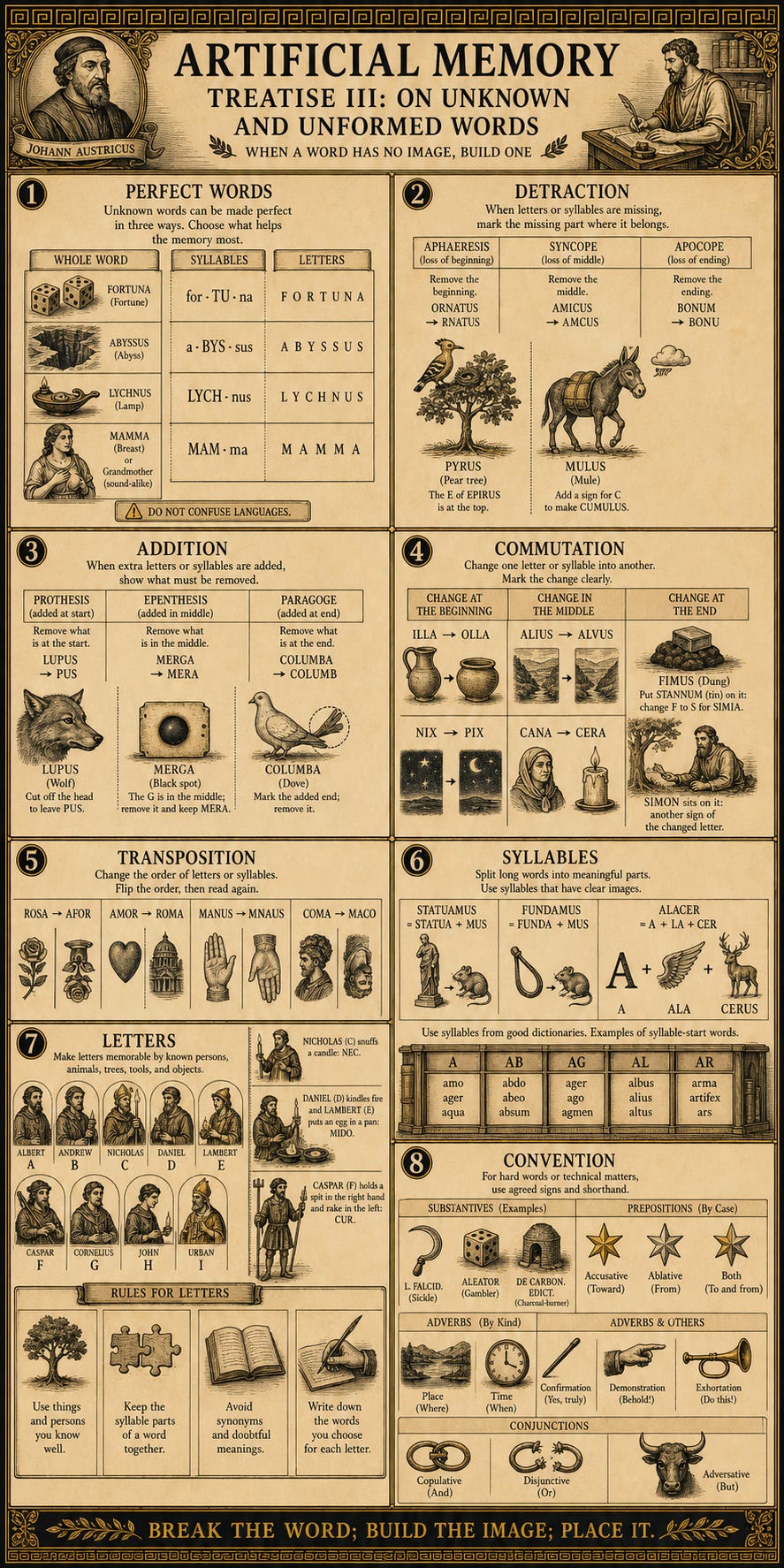
fix doobtful
Treatise 4: On Connected Words
Chapter 1: On Poems
Thus far we have spoken about simple words; now our discussion will be about connected words, or about speech. No one is ignorant that there are many parts of speech; from these I will choose for treatment those that seem to require a special formation, taking my beginning from poems.
Poems are entrusted to memory: 1. by forming only the first letter of each word. For example, so that I may remember this verse, “O mihi praeteritos referat” and so on, I will form the vowel O in a certain place by Onesiphorus, and we will use this when the initial words of verses have not been figured.
2. There is a mode by which the first word of a verse is figured. For example, I will remember the verse “Pomadat autumnus,” and so on, through someone who distributes apples to boys. This has use in formed words.
3. When we express the concept of the thing, or the summary of the whole verse, by a figure. For example, so that I may hold this couplet in memory: “The wave that has passed will not be recalled again, nor can the hour that has passed return,” I will think, in the first place, of water already flowing out of a little ewer; in the second place, I will place a clock, not allowing it to go backward. The former expresses the wave; the latter, the hour.
Here the variety and multitude of the matter, sometimes contained in three, two, or even single words, must be considered. And if we do not trust natural memory, it must be brought forward by as many figures as there has been such multiplicity, lest, for example: “The wood has caught beasts; the restless air, birds.” This verse contains two members, the former in the first half-line, the latter in the second. To observe these, two figures are established, placed in two places. Therefore I imagine a wood by itself, or choose some natural grove for this, filled with beasts, and above it birds flying around in the air, with the memory entering in.
4. A mode composed from the preceding ones occurs when we devise notes from the first letter of a word and from the summary. This mode, just as it is more laborious, is also more convenient. Thus for this verse: “Now let us two, concordant souls, die in one,” imagine two people clinging to one another in mutual embrace, dying under a nut tree. There the nut, as the first place, suggests the adverb nunc; death suggests moriemur, turned toward both of them.
5. The last mode is when the initial letters of a verse are endowed with figures and actions aptly arranged and cohering. In this way you will contain one hundred verses in very few places. I pass over examples for the sake of brevity.
Chapter 2: On Sentences and Laws
Sentences, both political and sacred, are handed over to memory by expressing the summary of the matter in one image or in several, usually with the note of the first word or first letter added. For example, this sentence, “Not all things fall out equally happily for all,” you will form for yourself in this way: imagine three boys playing with nuts, each throwing three nuts into a pit by lot, so that in the first throw all three fall in, in the second two, in the third only one. Through the nuts you will remember No, the first word; through the three nuts, omnia; through the three boys, omnibus and finally through the very different fall of the nuts, non aeque feliciter cedunt.
Note, however, that neither in sentences nor in laws, nor in any part of speech, must individual words be expressed by notes, but only those which touch the marrow of the matter and introduce diversity both by quality and especially by action. For the remaining words, together with their order, must be entrusted to natural memory, which in this art will exercise itself so that, content with the image of the whole matter, it becomes accustomed to retain and render back the rest without any change of words.
If a sentence has several members, several forms also must be placed. Thus for Matthew 7, “Ask and it will be given to you,” and so on, I would set down three figures: first, two men, the one asking and the other giving, in the first place; second, someone seeking and someone finding in the second place; third, one knocking and another opening in the third place.
Frequently, however, it happens that there seem to be as many members of an oration as there are words. Therefore to place its own note for each will sometimes seem not useless.
So much concerning sentences. Concerning laws, three things seem to need explanation: the first is the mode by which the matters about which laws have been written and promulgated are represented to us aptly distinguished and expressed the second is the method of applying laws or individual paragraphs to places, so that their number can be conveniently observed; the last is the prompt and easy way of retaining particles that must be cited in law. I will deal with the first two in the present chapter, referring this last point to the chapter on citation.
As to observing laws, I think nothing need be said here, since all the modes by which this should be done have, if I am not mistaken, been handed down by me partly in the preceding chapter and partly in the following one. Such are: noting the first letter or word of any law; the image vividly expressed of the principal thing or business; the clear partition of a matter’s magnitude in one and the same law or paragraph; the explanation and formation of the individual members if one pleases; and so on.
Therefore I come to the application of laws, and of their paragraphs if they have any. Here care must especially be taken that, if we wish always to remember places for them, we seek out as many very notable places as possible, equal to the titles of some book, certain ones from these being designated. Finally, these are to be written down in such a way that the images formed according to the titles both indicate the distinction of places and clearly show to you in which room or house each title is to be found.
For example, for title 1 of book ff. I will mentally place the statue of Justice above the door of the room in which I wanted to arrange that title; for title 9, a Senator; for title 10, a Consul. When this has been observed for all titles, for the formation of which you will refer yourself to the voluntary precepts and to the other precepts to be treated.
Once this has been done, you will increase the places of the rooms with human beings, trees, earthly and aerial animals, both at the corners and, where it seems necessary, at the spaces between the corners, with those great figures being added.
4. By circles bounded in the shape of a cross and fixed to the walls.
Moreover, it is necessary that you arrange the titles which are prescribed in any one book in order and entrust them to memory. Besides this, it is very useful to distinguish by numbers the places assigned to the laws of some title, so that you may be able to know at once which number each one is.
Two things are especially useful for this: the first is, if a law to which one or more paragraphs are subject is separated by some sign from the others. The second is, if you comprehend the laws in as few figures as possible, so that one image may display to the eyes, if possible, one law and the paragraph added to it. But these things are to be explained by the living voice.
Chapter 3: On Periods
Periods, rhetorical orations, sermons, disputations, and other longer discourses, composed from several periods, are formed by this art if we express either individual periods, or only the principal ones, by figures. Therefore, if I briefly explain by what modes these are suitably formed, it will also have been explained by what method the said parts of speech are entrusted to memory.
Periods consist either of one part or of several parts, joined by a discretive, adversative, causal, or conditional conjunction, or certainly diverse because of the variety of the matter. If a period has only one part, or if it is closed by one member, or by several, if it is one, it will be contained by a single figure. For example, the period in epistle 12, book 5, “Coram me tecum,” will be formed by someone who, with an epistle and a ruddy or covered face, hands it over and immediately departs.
2. If there are several members, several images can also be formed. Thus the period “If some pain of the body” contains several members, although not several parts. The first consists in the word pain, which is formed by a wound; the second in games, which are formed by a comedy; the third in fortune, which is formed by a wheel; the fourth in wisdom which is formed by the name Bis, or by a serpent. Therefore imagine a certain man named Simon, wounded, sitting beside Fortune’s wheel with a serpent, which he holds in his right hand, in a theatrical play constructed in the following place.
3. If periods consist of several parts, the individual parts must likewise be endowed with figures. Thus this period, “If there is anything of talent in me” from the speech For Archias, is completed in four parts. The first three are formed by an orator having sheep’s eyes, a mouth smeared with honey, and a book in his right hand; the fourth will be formed if Albert has Lycia, because of the name poet, and the arts next to him.
4. If a period has been cut into very small members, as in Cicero’s third invective against Catiline, first period, you will figure the members so that the multitude of images is contained in as few places as possible.
5. Periods are marked when we set down a note of the whole matter and business, briefly and summarily comprehended. It must be seen, however, whether an action and an acting person are found in the period or not. If this is so, we will form the images through the acting persons; if not, we must strive diligently to express the principal words of the period by a person or by attributes given to a person.
6. They are displayed by forming the arguments, figures, tropes and other rhetorical ornaments of which they consist.
7. By noting only the first word of each period, as I taught concerning verses.
8. By joining several modes.
Chapter 4: On Orations and Sermons
Since any oration is composed from its own parts, and since perfect knowledge of it depends upon distinct knowledge of these, once the formation of periods has been explained, it will be easy for anyone to understand by what modes orations should be formed.
Moreover, there is another mode especially familiar to orations, concerning which I will note briefly: first the matter expressed by the whole oration, or soon to be expressed by us in speaking, must be inspected and carefully run through in the mind. What it is, what kind it is, of what persons and actions it consists, and then, once distributed into the proper parts of rhetoricians, whatever must be noted in each one of these, according to the variety and distinction of things, persons, actions, arguments, and rhetorical places, is to be resolved again into its own parts and expressed by the most suitable figures.
But here each person should weigh his own natural memory and faculty of speaking, so that according to its powers he may increase or diminish the multitude of parts, places, and forms.
Sermons have the same method of arrangement. Therefore the preacher who is about to deliver a sermon should first divide it into two, three, four, or more primary parts, according to the diversity of the subject matter; and then each of these parts will be cut into lesser parts. Once cut, they will be placed in the places succeeding one another in order, with the most suitable figures, insofar as it can be done.
Two things concerning places occur here to be noted. The first is that, for the larger parts, you choose proper places, most suitable to the matter, as many as you think will suffice for the smaller parts into which those larger parts have been divided. The second is that you assign beforehand to testimonies of Scripture and to the authorities of doctors the places prescribed in Treatise 1 and to be explained more broadly below, according to their multitude.
Chapter 5: On Histories and Business Matters
Histories, both ecclesiastical and political, are some uniform and others multiform. I call those uniform which are completed by a single action; multiform those which consist of various actions carried out by the same persons or by different ones.
Histories are entrusted to memory when individual actions are set up with the most suitable and well-known persons, clothing, and gestures, so that they are represented lucidly, distinctly, and almost expressed from life.
Since this matter is clear enough by itself, I will not take care to make it evident by examples that are everywhere obvious to anyone.
2. Histories are marked when we set down only one note of the principal and most notable business, a note which distinguishes that history from the others. This, indeed, is very commonly used by painters, sculptors, and engravers in expressing histories.
For example, you will remember the history of Cyrus, from Justin, book 1, through a vine sprouting from natural rods, through a boy exposed and found by a shepherd, through this boy nursed by a dog, and finally through a son served up to be eaten by his father at a banquet.
Business matters that must be carried out will be marked likewise in two ways: by the former, if in the places where you have decided to do those same things, or where they are most obvious to you, you set down their signs; by the latter, if on the fingers and joints you put painted notes of the first letter of each thing.
Chapter 6: On Argumentation
I will take up two kinds of argumentation as the chief ones to be treated in this place: the syllogism and the enthymeme, dealing first with the former and afterward with the latter.
Syllogisms are marked when we form either the middle term or the premises. In longer disputations, it is advisable that only the images of the middle terms be fashioned, and that these be best arranged on the parts of the body of the man with whom we dispute, or of another man, according to the order I handed down concerning the parts of the human body.
In other cases, you will distribute the images made from the premises on the human body in this way: 1. by placing the major premise on the chest or belly, the proofs of the major on the right side of the man, and the proofs of the minor on the left.
2. By placing the major premise on the right hand and the minor on the left. The reasons on both sides are to be placed in the same order as before.
You will note the affirmation and negation of propositions: 1. by a sign of the head given by the man on whom you have placed the argument; 2. by those signs which the ancients used in acquitting and condemning defendants, marking affirmation by a white stone, negation by a black one; the former by a white bean, the latter by a black one; the former by chalk, the latter by coal.
Chapter 7: On the Manner of Dictating
The method by which we dictate several and diverse things at the same time is twofold: from writing and from memory. The former is simpler and easier, but the latter is more difficult and more artificial.
Therefore, whoever wishes to read out different materials to different scribes should first take care that the sheets of paper prepared for each matter agree, as far as possible, in an equal number of words, or at least of sentences, members, and verses.
Then he should distinguish separately with longer strokes the members of the verses or sentences of each sheet, and mark the distinct forms of the numbers.
3. In this order he will dictate to the scribes the individual members of the individual materials thus distinguished and marked: when he has read out to the first scribe the first member of the first sheet, he should immediately present to the second the first member of the second sheet or matter; then to the third, the first member of the third sheet; from there to the fourth, likewise the first member of the fourth sheet. When this has been done, returning to the first sheet, he will read from it to the first scribe the second member; after this, from the second sheet, the second member to the second scribe; from there to the third, the third of the second sheet and so forth. If he keeps to this path, it will happen that each scribe has the material read out to him completed at the same time.
The person about to dictate from memory will, according to the diversity of the subject matter, lightly apply to the places set before him the things already about to be read out, one after another, by the sharpness of the mind, and will order them to be repeated continually.
Chapter 8: On Time
Since both time and number especially pertain to citation, it is necessary to speak of these two before I speak of citation.
Time, taken generally, you will form by a mathematical sphere or astrolabe turned very swiftly by an angel.
Its parts are of two kinds: some essential, others accidental. The essential are the present, which is expressed by the head of a lion, or by the said sphere when you place cherry branches with fruit at either end of its axis; the past is marked by a wolf, or its head, or by the same sphere deformed by withered branches; the future is displayed by a licking lion, by a rooster or peacock crowing, or by a sphere with its axis beautifully flowering with leafy branches.
So much for the essential parts. The accidental parts of time are many, taken from the observation of various qualities. The chief of these are the following: year, which is expressed by a serpent biting its own tail, or by a great golden circle; lustrum, by litter-bearers; decade, by a boy riding on a stick or by the letter alpha painted in gold. See the images and figures depicted concerning the ages of human beings, by which the greater numbers of years are customarily marked.
A month, taken universally, will be shown by the Moon, like a horse or rather as something golden. The months themselves are expressed in various ways: 1. by figures frequently painted in calendars concerning the months, as January by an old man warming himself or feasting; February by someone sick; and so on. 2. By their principal effects, as April by grass; May by flowers; October by wine, and so on. 3. By the figures of the twelve signs of the Zodiac, as January by Aquarius, February by Pisces, March by Aries, and so on.
Finally, they are displayed by the principal feasts falling in individual months; consult a calendar about these.
A day, if you take it generally, will be marked by a table of twelve hours. The days of the week will be signed: 1. by the figures of the seven planets; 2. by the characters of the planets; 3. by the metals into which the planets flow; 4. in the custom of Christians, Sunday by the resurrection of the Lord; Monday by the cursing of the fig tree; Tuesday by the marriage at Cana of Galilee; Wednesday by the council and sale of Christ; Thursday by the Lord’s Supper; Friday by the crucifixion; Saturday by his burial.
Night will be indicated by a candle, lamp, or little bottle; an hour by any clock; a moment by the blink of an eye.
Chapter 9: On Numbers
Numbers are noted in three ways.
1. By their own notes, formed in black, red, or golden color, in a suitable size.
2. By artificial figures: unity, as the beginning of number, by a spear, little column, twig, or staff. Two is offered by a two-footed serpent, a fork, a two-pronged spear, a gallows supported by two columns, or any biped animal. Three is offered by a tripod, a seat supported by three feet, a three-pronged fork, a horse drawing a cart, a gallows erected from two posts with a thief hanging on it, or by something else resting on three columns. Four will be given by a bench or table, a wild beast, any quadruped animal, a cart, and so on. Five is expressed by a figure having five angles, a wheelbarrow, or pincers with their handles upright, and by a horse drawing a cart. Six you will form by a tripod a tripod, a seat standing on three feet placed upon another supported by the same number, a quadruped and horned animal, a snail putting out its head, or a cart drawn by two horses.
Seven is expressed by a gnomon, by two acute angles, by a half-military gallows, or by a cart drawn by three horses.
Eight is shown by two rings, two globes, two apples, or two little stools, one placed above the other in both cases.
You will make nine by three tripods or three-legged seats placed upon one another, or by a tripod or three-legged seat carried by a horned quadruped animal, such as an ox or stag, upon its horns.
Ten will be given by a cross, a snake biting its own tail, a poppy head, an apple, a circle, ring, or globe, if you put them after the units. You will form the other kinds of numbers by varying the arrangement of these among themselves.
To this belongs what denotes the number fifty, such as an oyster, foot, axe, gnomon, winged thing, and so on, as if L has been set down. A half-circle, horn, bow, or iron shoe will represent one hundred. Five hundred is represented by a vessel with two handles, or by a Turkish bow set down like D. One thousand by an anchor and other things formed like M.
3. Ten or eighteen different artisans will form numbers, each one of the first ten representing a certain number. This method is very suitable for figuring, so that, with half an hour’s exercise applied it will produce, by its usefulness, a wonderful result.
Chapter 10: On the Formation of the Larger Particles of Citation
The parts of citation are twofold: broader or larger, and narrower or smaller. Since I am about to speak of these, first I will declare what the larger ones are and how they are formed. Then I will explain what I call the narrower ones, in what way this happens, and in how many modes they are to be noted. Finally, I will likewise show by what method the particles of citations ought to be applied to places.
I call the broader parts the author and the work, or book of the author.
The author is displayed in four ways.
1. By his own image, as Saint Matthew by an angel, Luke by an ox. Thus David, Aristotle, Galen, Justinian, and others are represented by their images, if we have them.
2. By the work that he wrote; how this happens will be said immediately.
3. By a book joined to the figure of the author, as Saint Mark will be observed by a lion and a book. If there are several books of the same author, they will have to be distinguished in this way: first, by noting any book added to the author, about which below; second, by gestures or signs attributed to that author differently according to the diversity of the books. For example, for the Gospel of Saint John, John will preach; for the Epistle, he will write; for the Apocalypse, he will have his mind and eyes raised to heaven.
3. By a distinction of books made through different color. For example, Cicero’s first volume of orations will be dyed golden, the second red, the third green.
4. By a number inscribed in the books, as volume 1 by a unit placed on the surface of the book, the second by the number two, the third by the number three.
Finally, a writer or author is offered by another person not unlike him in name and office: as Bartolus by an outstanding jurist, Galen by a very excellent physician, and so on.
A book will be observed in seven ways.
1. By its own figure. This happens when we place, in a place by the use of the mind, books which are very well known to us from frequent reading and daily use.
2. It is known by the author; this usually happens when there is only one work of some author.
3. By the author and book, if each is known.
4. By the inscription or title of the book, as Aristotle’s book On the Heavens will be formed by a book alone, or by Aristotle with a book, which you will add as painted with stars.
5. By the matter of the book, with which the inscription often agrees. If this partial matter, being manifold, is found in the same book, the book will be able to be designated by any of those parts if they are notable and distinctive. Thus the first book of Moses may be designated by the creation of the human being, by the fall of the first parents, by Cain’s fratricide of Abel, by the flood or the ark of Noah, by Abraham about to kill his son, and by other histories found there. This same method is worth observing in all the books of other authors.
6. They are formed according to the precepts given concerning unknown words: as Aristotle’s Logic by lorica; Physics by vesica; Digest by fingers on the hand; Pandects by bread, cloth, and so on; Authen. by auceps, aurum, anus; Codex by codex taken properly, or cortex; Feud. by funda, fidelia, fides, and so on.
7. Finally, by customary or arbitrary signs: as Digest or Pandects by ff, or x, or by a book covered with cloth or a panther’s skin; canon or pontifical law by a huge book shown by some canon or by the Supreme Pontiff, just as civil law by a book held by a citizen. The same judgment applies to absolutely all books.
Now I will proceed to the other part of citation.
Chapter 11: On the Formation of the Smaller Particles
I call smaller parts of citation those which, joined to the broader ones as particles, cut some matter that is being treated into smaller parts, as it were: such among theologians are distinction and the number; among jurists, law, paragraph, and so on, with the first word of the law or paragraph; among physicians, chapter, section, aphorism, and so on; among philosophers, text, comment, and so on. Concerning these and similar formulas of citations, see the tables.
They are formed in five ways.
1. If you imagine them by themselves, painted in books or crowns with the characters by which they are customarily prescribed by authors.
2. By expressing their first letters through the instrumental letters depicted by Rossellus in book 2.
3. By fashioning the same letters through the varied position of members, concerning which the same author speaks.
4. Through those members of the human body which agree with one or several syllables or letters of the particle: as if someone touches the artery of a finger or the ear for art.; for part., the nipple, beard, or knee-bend; for quot., the rib; for memb., the chin; for dist., he may raise a finger or show the teeth; for quaest., he may extend the left arm for resp., he will show the kidneys; for cap., the head; for can., hair, or rather dogs; for leg., the thumb, tongue, and lip; for parag., the palate or cap; for tib., the shin and temples; for collat., the neck; for vers., the crown of the head, belly, or navel; for gloss., the jaw or knee; for cons., the neck; for tract., testicles or ankles; for sect., the spine or shoulder blade; for au., the nose or eye; for com., that is, long hair; for tex., the temples, and so on.
5. According to the precepts about words not understood, set forth above: as quadra, quastio; distinct. by a comb or dish; part. by little sheets of paper or a small shield; art. by a bow or chest; memb. by a table or mint; quaest. by an oak twig or garment; respons. by a little rule or straightedge; conclus. by a cloister, shackle, or dagger; cap. by a goat or little chain; can. by a dog or candle; cons. will give a shell and sometimes consul; num. by an egg or coin; leg. by law, lily, crown of the head, or herring; § by stylus or writing case; tit. by a calf, shin, or firebrand; vers. by a little pivot, spit, or rod. Gloss. is formed by globe, balling together, or glue; tract. by beam, hoop, or wren; sect. by saw, axe, or cut branch; text. by some instrument of a weaver, a die, or a testicle; comment. by a device, hair, or spoon. Princip. will be shown by root, torch, or heart; fin. by rope; infin. by an infula or funnel; diff. by finger, finger ornament, and finally by a whetstone.
Chapter 12: On the Application of the Said Particles to Places
As for the method of applying the said particles to places, it is first of all clear that they either offer only one particle, or two, or three, or often more occurring together. Then it must be noted that they can be applied either to a human being, or to a wall, or to both.
So that these things may be understood, let certain examples be brought forward in order, according to the increase of the particles.
The first mode, by which only the author or his book is cited, is clear enough: namely, when we adapt to the place the image of the author, or another human being of the same name, office, dignity, or faculty, always held by us in place of the author himself, with some sign joined to him, if necessary, indicating the name of the author.
If two parts are joined, that is, a greater and a lesser one, or each of the two, they will be placed upon the human being. Thus if Matthew, chapter 2, is said, Saint Matthew, or another man, as I have said, established for him together with an angel, will sit on a three-legged seat, or will raise three fingers, or will touch his head just as many times; or the number will be written on a long or empty tablet, beautifully distinguished with white strips, fixed to the wall or given into the hand of the person, with the particle of the chapter omitted.
For observe: if the particles of distinction of some work are known to you, it is utterly superfluous for them to be formed or expressed, since they hinder memory more than they help it.
But if only the name of a book follows the author, this book will either be known to you or unknown. If it is known, that book will be given into the author’s hand; if not, the figure referring to the title of the book must be joined to him.
If one narrower particle follows two broader parts, they will be formed in the same way as above. Thus Aristotle, On the Heavens, book 2, will be marked by a book written by Aristotle, known to me, with the inscription of the number two; or by a book painted everywhere with stars, shown by someone who raises two fingers, or by a biped animal beside him.
But if there are two smaller particles placed in the middle with the greater one, as l. 3 or l. Testium ff. De test., you will have a human being with a book marked with ff, known to you or joined with the distinction from the rest of which I have spoken, upon whom you place a note of this kind. Therefore a book will hang from him; in his right hand he will hold a three-pronged fork, tripod, or three fingers raised, or finally the testicles of a ram, on the same hand, whose index finger is adorned with a golden ring and he will have other testicles of the same or another animal on the left.
Moreover, if there are four particles, they will either be reduced to fewer or all will be formed. If the former, they will be arranged as before; if the latter, they will be assigned to the human being in this way: the first particle, or the book, is placed on the chest; the second in the right hand; the third on the head; the fourth in the left hand.
Thus for Servus, l. 7, ff. De bon. possess., the person you know will strike a servant with his right hand; on his head he will have a gnomon standing up, and with his left hand he will carry a little basket with apples, for bona.
The same will be done if a paragraph is added to a law, as l. Bona § Invito, or ff. cod.: he will carry apples in his right hand; on his head, a vine with a bird; in his left hand, a whetstone.
Besides this, if there are five particles, you will be able to place the second on the foot, the third on the hand of the right side, the fourth on the hand, and the fifth on the left foot. Thus if the preceding place is again tied to § nota innecta, I will lay apples at the right foot, or in the pockets of the stockings; for §, a cap in the right hand; for invito auth., a vine with a bird in the left; for cod., a whetstone attached to the left foot.
Furthermore, if there are six parts, you will join the crown of the head to the said members. Thus l. Navis onuss. 4. § cum autem 2. ff. De l. Rhod., you will imagine a ship laden with whatever things you please brought to his right foot, while he holds a quadruped animal in his right hand; on his head he has a cautery impressed, referring by contraction to the words “Cum autem”; in his left hand he has a two-pronged fork; and at his left foot, a cauldron, flask, or herring placed upon a wheel.
Finally, if you wish to add still more particles, such as l., ut, §, and others, you will divide the human being into still more parts.
Chapter 13: On the Conditions of Figures
Just as above I assigned certain conditions to places, so in this place I must hand down other properties to be diligently observed concerning figures.
The first of all, then, is that the matter, before it is endowed with figures to preserve it, should be read through twice, or even three times, slowly and distinctly, as Cicero wishes.
2. Forms most suitable and best known to the things must be sought and chosen, so that by their reminder we may easily be led into the memory of the matter.
3. Motion and action must be assigned to figures. For idle, motionless, and silent things rouse memory less sharply. Therefore it must be noted whether the thing is subject to motion or lacks it. If the former, let the thing itself perform some action, as a fox will carry a hen; if it lacks motion, actions will be attributed to moving things themselves, especially those with which an action may conveniently be arranged.
4. The forms will act in such a way that they call forth effects either of delight, or sadness, or anger, or indignation, admiration, compassion, or others that are of the same kind.
5. Not one note only, nor always one note, is to be fixed in a place, since several figures formed by the mind can be thought at once and transferred into one place. This is done rightly in placing persons when several smaller ones are joined under a larger one.
6. We will use those figures which agree with the places by some natural commonality, as when you wish to place something in a shoemaker’s workshop, you will strive to use instruments found in it. By this it happens that we use natural or artificial images rather than fictive ones.
7. The images should be neither too high nor lower than is proper, since each kind burdens use.
8. The greatest care must be taken that the same thing is not taken on the same or following day for expressing different things, nor, if we are wise, for the same thing in the same matter, since this would easily produce confusion in repetition. For this reason it is necessary that we abound in many and various figures.
9. Nevertheless nothing prevents the same thing, if differentiated by accidents or by some mode joined to it, from being taken more often, either at the same time or for the same thing or for different things.
10. In the figures of those things which we desire to cling firmly in our minds for a long time, repetition is by far the most useful thing. When the second form has been placed, the first image must be looked at again and carefully weighed before we proceed to form the third.
11. It must also be noted, concerning what has often been mentioned, that only rough images of members are to be formed, namely those which either begin different sentences or signify distinct things, and especially things that cohere among themselves. Natural memory will be the careful guardian of those things which are naturally bound together among themselves by the bond of construction.
Chapter 14: On Removing Images
Of the things which we learn by this art after giving them images, there are two kinds: one of stable and enduring things, the other of mobile and temporary things. Therefore, for the former, which we wish always to cling firmly in memory, the images will be uniform and unchangeable in the position, figure, and quality of their place; but for the latter, which we readily allow to disappear, the varieties of images should be changeable and always unlike themselves.
Therefore, to come to the point proposed, once I have briefly shown in this chapter how images can be abolished, removed, and uprooted from places destined for daily use, I will put an end to this little book.
First, if the images of things have not been applied very firmly to the places, a brief space of time will erase them.
Moreover, just as we use the firmest application for a thing that must be given to memory, so this same application will have to be used to overwhelm it into perpetual forgetfulness.
Besides this, it is advisable to imagine the figures struck by thunder, shaken by an earthquake, touched and burned by lightning, scattered and overthrown by hail, washed away by sudden and violent rain, or carried off and utterly removed by the increase and overflow of a river.
One person, or several, drunk, turbulent, and furious, will accomplish the same thing if you imagine them rushing armed into the room with great force and effort, throwing down any images whatever, and dragging them out.
Besides this, a maid sweeping the rooms with a broom, removing the images from their places together with the rubbish and carrying them away, will accomplish the same thing.
Finally, a painter introducing a new color into the rooms will erase all the figures.
The End.
Summary for Treatise 4