
A Philosophical Dissertation on the Art of Memory by Humbertus Brieden, 1856
translated from Dissertatio philosophica de arte memoriae

Elder’s Notes
Humbertus Brieden’s A Philosophical Dissertation on the Art of Memory is an interesting example of what I consider a dark-age mnemonic text: a text on the art of memory written during the industrial era. The metaphysics that once sustained the art had collapsed, but the modern disciplines that might have explained it had not yet matured.
The early moderns were still classically trained, so even when they criticized the art of memory, they understood the world in which it was embedded. Once the Industrial Revolution was fully underway, however, the metaphysics that grounded many mnemonic practices had become a distant memory. As a result, authors investigating the art of memory during this era often lacked the understanding needed to criticize it from a classical perspective.
They also often lacked the hermeneutic tools that later academics would develop to better capture the specific cultural and contextual meanings of the practices they studied. Nor could they draw much from neuroscience or psychology, since those fields were still too embryonic to offer meaningful insight into the practice. Ebbinghaus would only conduct his seminal studies on forgetting curves in 1885, nearly thirty years after Brieden’s dissertation was written.
Brieden was caught between worlds. The cultural assumptions that once supported the art of memory were alien to him, and he was too early to benefit from the modern disciplines that would allow him to investigate the art as an impartial observer. The kinds of work later produced by Frances Yates in The Art of Memory, or by James Worthen and Reed Hunt in Mnemonology, were simply out of his reach because the intellectual landscape just wasn’t able to support them yet.
This doesn’t mean that mnemonic theorists of the era were entirely ignorant of the history of the art, as Brieden’s brief sketch of it is decent. It’s just that the intellectual landscape of the time wasn’t well suited for the task he had set for himself.
Brieden’s dissertation engages the mnemonic methods that were popular in Germany at the time, namely those of Otto Reventlow and Hermann Kothe. Reventlow and Kothe were early modernizers of the art, but, like Joseph von Aretin, who preceded them, they were a century too early.
This quote is telling:
“The inventors of the newest mnemonics chiefly wish to use these laws so that the reefs of memory, that is, numbers, names, and series of representations, may be avoided. To refer numbers to other representations, consonant letters are substituted for numbers. Thus one is represented by t or d; two by n or u, because the letters are written with two strokes; three by m or w, with three strokes; four by r, the last letter of the word four in German; five by s and related sounds; six by b or p; seven by f and related sounds; eight by h or j; nine by g, k, ch, or c; and zero by l or z. In the same way, consonants are put in place of the individual days of months.”
Once the 1800s came around, the art of memory was increasingly reduced to number-peg mnemonics among many practitioners. You’ll find countless books from this era dedicated to memorizing lists of numbers, names, and dates. The funny thing is that number-peg systems were over a hundred years old by the time they took off in the eighteen hundreds. Erich Christoph Lübbern shared an early number-peg system in his 1713 work An Art of Memory, for example.
This dissertation is historically interesting and offers us some insight into German industrial-era mnemonics. Brieden’s brief sketch of the history of the art is also quite good.
Brieden also offers us an interesting argument toward the end of his dissertation:
“Do not think it useful for children to learn everything that must be entrusted to memory by the aid of the art of memory. If you wish to draw the sum from all that we have discussed, this especially must be held: the teacher, rather than the pupil, ought to study Reventlow’s art, from which it is clear that he will prepare for himself very many new aids.”
Brieden’s section on pedagogy and teaching is his strongest. Many of the arguments he raises remain relevant.
Currently, I don’t think mnemonics are the right fit for students, because mnemonics are often pointless without some sort of contemplative practice where you engage the memories you’ve organized.
In my approach, mnemonics aren’t used to “memorize” things, but to organize memories that have already been created. You then engage those memories in acts of contemplation or composition.
In other words, mnemonics serves contemplation and composition. It isn’t an end in itself. Contemplation is the foundational layer on which the art of memory should be built.
Students have to learn how to think about their ideas and experiences before they can benefit from mnemonics, and that requires mastering a variety of metacognitive tools that will only become available at different stages of development.
Teachers, however, are adults in full possession of their faculties and are, hopefully, experts in their fields. Teachers should have access to an encyclopaedic understanding of their domain, and mnemonics makes this kind of internal mastery much easier to attain with a bit of elbow grease.
Teachers also have a better understanding of where their students are in terms of development, so they can mix and match different contemplative practices with different mnemonic tools where appropriate.
If I had to choose between teaching students how to meditate and sit with ideas, or teaching them mnemonics, I’d start with meditation and contemplation. That’s significantly more important, but good luck reorienting the educational system so that it centers deep contemplation.
A Philosophical Dissertation
Written by Hubertus Brieden of Westphalia to obtain the highest honors in philosophy by authority of the most ample order of philosophers in the Rhenish Frederick William University, and to be publicly defended with controversial theses on the fifteenth day of August, 1856.
Bonn, from the press of I. F. Carthaus.
Opponents
The parts of the opponents will be undertaken by Th. Vahlbruch, doctor of philosophy; P. Gross, student of Catholic theology; and F. Linnig, student of philosophy.
The Ancient Art of Memory
When we think about the abundance and variety of things that must be held in the mind, we seek aids by which we may learn quickly and easily. This agrees so closely with the nature and condition of human beings that very often, without knowing it, we apply certain supports and helps to memory.
Since this is so, it is not surprising that the ancients, who had to hold very many things in the treasury of memory and used writing more rarely than we do, cultivated the faculty of remembering with the greatest care and looked around for devices that truly assisted the power of retention. What those arts were is handed down by both Greek and Roman authors, especially by Cicero, Quintilian, and the writer to whom the books addressed to Herennius, written in Sulla’s time, are attributed.
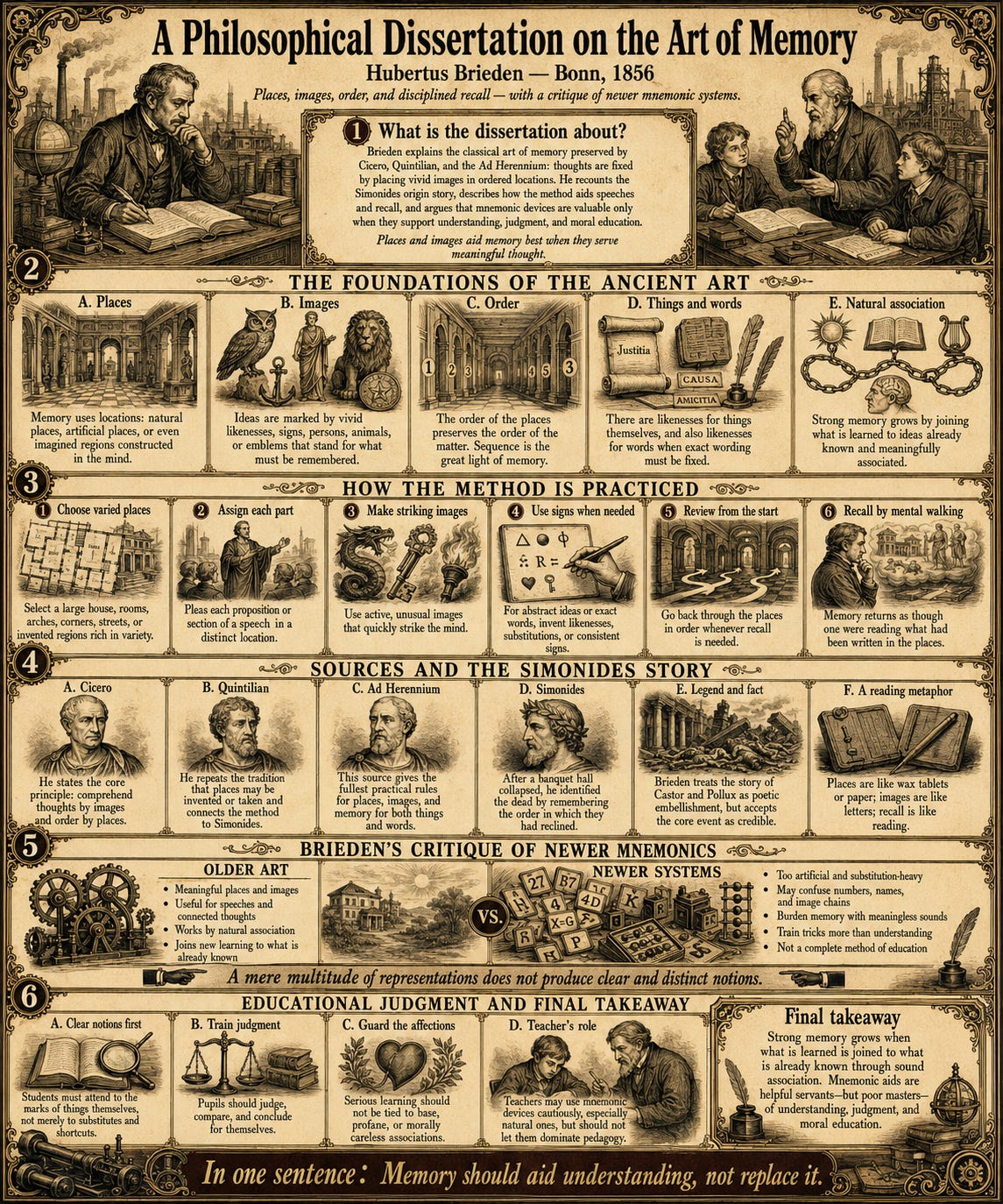
Cicero gives the substance of the matter when he says that those who exercised this part of talent had to take places and shape in the mind the things they wished to hold in memory, then set them in those places. Thus the order of the places would preserve the order of the things, while images of the things would mark the things themselves. The ancient art of memory therefore consisted of places and images.
The places were either natural, such as mountains, rivers, trees, the bodies of human beings or brute animals; or artificial, such as buildings, a space between columns, a corner, an arch, and other things similar to these; or else taken or invented. The author of the books to Herennius warns that if someone who has investigated more does not think he can find enough suitable places, he may make up as many as he wishes. Thought can embrace any region and construct and arrange in it the position of a place according to its own convenience and judgment. Therefore, if we are not content with this ready supply, we may set up a region for ourselves by our own thought and prepare a most convenient distinction of suitable places. Quintilian sums it up briefly: places are needed, whether invented or taken.
Those who wished to learn a speech by the aid of mnemonic art first chose places that were as spacious as possible and marked by much variety, perhaps a large house divided into many recesses. The orator joined each part in his mind with each of those places, as if assigning the first part or proposition to the vestibule, the second to the atrium, and so on. By this connection, the thought of each place also awakened the thought of the proposition joined to it, and by the sequence of the places the sequence of the whole speech was recalled to mind.
Enough now about places. We proceed to images. The author addressed to Herennius says that images are certain forms, marks, and likenesses of the thing we wish to remember, such as a horse, lions, or eagles. If we wish to keep these in memory, we must place their images in fixed places. Since images ought to resemble things, and since from all words we must choose likenesses known to us, there must be two kinds of likeness, one of things and one of words. Likenesses of things are expressed when we arrange images of the matters themselves in summary form. Likenesses of words are established when the memory of each noun and word is marked by an image.
The orator therefore comprehended a thought by an image expressing a certain likeness of the thing to be remembered. This was done in two ways. The image placed in a location could be a certain note or sign taken from the whole matter, as an anchor is a sign of sailing, or something chosen from weapons is a sign of military service. By the warning of such a sign set in some place, remembrance of the whole matter is reproduced. The image can also be fuller, so that it not only reminds us of the matter, but represents it and calls into sight the very thing whose memory is needed.
Because in forensic speeches nearly everything pertains to human beings, and nothing moves a human being more than a human being, the images used for recalling thoughts were chiefly images of persons. Cicero teaches this when he says that memory of things belongs especially to the orator, and that we can mark it by individual persons well placed, so that we comprehend thoughts by images and order by places. He says that we must use images that act, are marked out, and can quickly meet and strike the mind. The author of the books to Herennius treats this matter more clearly.
Often, when less familiar names must be held or a speech must be learned word for word, teachers of the art of memory also used images to fasten words to the mind, marking each individual word. If the word to be held in memory indicated an abstract notion for which no image could be formed, they transferred the marking from genus to part, so that for the abstract notion they took a likeness of some notion that could be represented. If the words to be entrusted to memory were of a kind that could not be represented by any likeness, they formed whatever signs they could and always used those same signs.
The author to Herennius shows by example how likenesses of words were expressed in images. When we wish to express likenesses of words by images, we take up more work and exercise our talent more. It must be done in this way. For the words “Now the return home the kings, the sons of Atreus, prepare,” in the first place one must set Domitius raising his hands to heaven while he is beaten with straps by the Marcii Reges. This will be “now the return home, kings.” In the second place one must set Aesop and Cimber dressing Iphigenia, Agamemnon, and Menelaus. This will be “sons of Atreus prepare.” In this way all the words will be expressed.
When the images had been placed in the locations, those who used mnemonics began to review those places from the start when the memory had to be repeated, and demanded back what they had entrusted to each place. The representation of the place simultaneously brought back the images of the individual things placed there. To use the familiar comparison, the places were very like wax tablets or paper, the images like letters, the arrangement and placement of the images like writing, and the delivery like reading.
Simonides
With these outlines of mnemonic doctrine set down, it is fitting to ask about the inventor of that art. Simonides of Ceos, the famous lyric poet, is said first to have brought forth the art of memory. Quintilian, following the ancient writers, tells the occasion on which he is said to have invented it. Simonides had written, for an agreed payment, the sort of poem usually composed for victorious athletes. Part of the money was refused to him because he had digressed, in the frequent custom of poets, into praise of Castor and Pollux. He was therefore ordered to seek part of the payment from those whose deeds he had celebrated. They paid it, as tradition says.
When there was a great banquet in honor of that victory and Simonides had been invited to the dinner, he was called out by a message saying that two young men who had arrived on horseback were urgently asking for him. He did not find them, but from the outcome he learned that the gods had been grateful to him. Scarcely had he crossed the threshold when the dining room collapsed upon the guests and so crushed them that their relatives, seeking them for burial, could not distinguish not only their faces but even their limbs by any mark. Then Simonides, remembering the order in which each had reclined, is said to have restored the bodies to their own people. Warned by this event, he is reported to have discovered that order above all brings light to memory.
In this charming tradition of the ancient authors we recognize that there is truth, and we also detect that a fiction was mixed in to delight readers. The poetic invention is the story about the arrival and help of Castor and Pollux. Quintilian saw this when he noted that the poet himself does not mention the matter, although he certainly would not have passed over so great a glory of his own. Yet although this is fabulous, there is no just reason to say that the rest of the narrative was made up. It was handed down not only by the authors already named, but also by older Greek grammarians, without any doubt about the main fact, although they were uncertain or differed about secondary matters, such as the name of the athlete and the place of the collapse.
It cannot be denied, then, that when some crowned boxer had prepared a feast and the room collapsed, Simonides escaped unharmed by happy chance among the others who were crushed, remembered the order in which each had reclined, and showed which body was to be buried by each family. On that occasion he was led to topological memory. Thus monuments rightly name Simonides the inventor of mnemonics.
Other evidence proves that Simonides had a very strong memory. Cicero thought that he had handed down his precepts on the art of memory to others, saying that Simonides, or someone else, promised Themistocles the art of memory. In another place Cicero reports that a certain learned and especially cultivated man promised Themistocles that he would teach him the art of memory when it was first being produced. Cicero calls Simonides learned and wise. The testimony and documents of all antiquity therefore confirm that the art of memory was invented by Simonides.
Those in our age who call the matter into controversy because some fabulous element is mixed in rely on no firm argument and surrender themselves to uncertain doubt. Since this is so, something must be said about the time when Simonides invented mnemonics. He records in an epigram the victory that came to him at Athens under the archon Adeimantus, saying that he was then eighty years old. The victory was won at Athens in the same year in which statues were set up for Harmodius and Aristogiton, not long after Hippias was expelled. From this, the year of his victory is placed in the fourth year of the seventy-fifth Olympiad. Therefore he was born in the fourth year of the fifty-fifth Olympiad. Since it is certain that the art of memory was not invented before Simonides entered poetry, we seem rightly to infer that the poet was about forty years old when he invented mnemonics, so that the origins of that art should be sought around the sixty-fifth Olympiad, about 520 before Christ.
Sophists, Philosophers, and Romans
After the death of the inventor, the art of memory was cultivated more fully. Then also the pleasant tale about the intervention of the Tyndarids seems to have been found. The sophists embraced the new art with special care; for, seeking out all new things and dazzling the eyes of the multitude with the glitter of knowledge, they hoped that great help would come to them from it.
Hippias of Elis, who energetically professed the liberal arts throughout Greece, gave very great attention to those memorial devices, as Plato and Xenophon testify. In the dialogue called Hippias Minor, Plato introduces Socrates mocking the sophist’s boasting and referring to his memory art. In the Hippias Major, when Hippias boasts that he will recite fifty names after hearing them once, Socrates replies with irony. Xenophon likewise has Socrates mention Hippias’ concern with memory. From these passages one cannot infer that Hippias invented the art of memory, as Morgenstern tries to prove. Plato and Xenophon report only that the art was cultivated by Hippias. If the Elean had invented it, Plato would not have passed over the matter in silence, especially since he was a very sharp mocker of sophistic arts.
Hippias’ art of memory was so great that it seems to have passed into proverb. Therefore there is no doubt that the sophists cultivated the Simonidean art with the greatest zeal and taught it to many. Yet they did not spread it so widely as Aretinus thinks, who does not hesitate to assign it even to household servants. He was led into error because he did not rightly interpret the relevant Greek word, which denotes cleverness or skill, whether natural or acquired by art.
Aristotle was the first philosopher who seems to have approved the memorial devices, since in his writings are found the laws on which the Simonidean art rests. He also has that art in view in his little book On Memory and Recollection, where he says that people seem to remember from places, and he speaks still more openly in the work On Dreams. The sophists had not ceased to labor in the Simonidean art in Aristotle’s time; Theodectes, son of Aristander, to omit others, is testified by authors to have been a cultivator of mnemonics.
Later, Charmadas and Metrodorus of Scepsis are found more famous in this art. Cicero’s Antonius says that he had seen at Athens Charmadas, a man of the highest rank and of almost divine memory, and in Asia Metrodorus of Scepsis, who was then said to be living. Each said that, just as letters are written in wax, he wrote by images in the places he possessed whatever he wished to remember. Pliny also reports that the art of memory, invented by Simonides the lyric poet, was perfected by Metrodorus of Scepsis, so that nothing heard would fail to be returned in the same words. I would deny, however, that he perfected it by enlarging it. Quintilian criticizes him and wonders how Metrodorus found three hundred and sixty places in the twelve signs through which the sun passes. This was vanity and boasting around his own memory, glorying in art rather than nature.
In the time of Charmadas and Metrodorus of Scepsis, noble Roman youths were accustomed to visit Greece and Asia for the sake of studies, and so their precepts about the art of memory reached Rome. I also infer from a passage in the books to Herennius that mnemonics was propagated through Italy by Greek books. The first Roman writer who commended mnemonics was that uncertain author of the books to Herennius. Although he relies on Greek precepts, he seems to have advanced something new about the art of memory. Cicero and Quintilian followed him.
The praise that Cicero and the Herennius author give to memorial art is for me an argument that it was used at Rome, especially in the time when letters flourished most. It is clear that it was cultivated by very learned men and especially by orators. Quintilian testifies that Hortensius, to omit others, used that exercise. Horace’s Catius proves that in Horace’s age the doctrine was familiar enough, when he answers the poet’s interruption by saying that he has no time, in his eagerness, to put down marks for new precepts, such as might surpass Pythagoras, the accused Anytus, and learned Plato. Horace replies that he confesses his fault in interrupting at such an unfavorable time and asks pardon, adding that if anything has escaped him now, he will later recall it. Whether this is from nature or art, he is marvelous in either.
Among others, Marcus Annaeus Seneca is counted among the mnemonics because he could return two thousand names in the order in which they had been recited and could recite verses given one by one, more than two hundred in all, beginning from the last and going back to the first. In Quintilian’s time, however, the precepts common in Cicero’s age were used very rarely. After setting out the memorial arts in the Institutio Oratoria, Quintilian teaches that exercise and labor are the one great art of memory. He adds that in his own time there were people who did marvelous things of the sort handed down about the power of retention in Themistocles and others, but that he had never happened to be present for such a thing.
From the Middle Ages to the New Art
These are the things I have gathered from writers concerning the ancient art of memory. It remains to set out briefly how that art was cultivated through the Middle Ages before we examine the newest mnemonic precepts.
Quintilian was the last of the ancients who dealt with mnemonics in his own strength. In the following centuries it was altogether neglected and soon erased, so that Philostratus denied that it had ever existed. In his book on the lives of the sophists he says that the arts of memory neither exist nor ever existed. Several centuries after Philostratus, Alcuin professes almost the same opinion. In his dialogue on rhetoric, when Charlemagne asks whether there are any Ciceronian precepts by which memory may be obtained or increased, he answers that there are no other precepts than exercise, the use of writing, the study of thinking, and avoidance of drunkenness.
These precepts for strengthening the faculty of remembering seem to have been observed by the philosophers called scholastics. From the age of Charlemagne down to the thirteenth century, we find nothing among writers about the art of memory worth reporting. At that time Ramon Llull tried new paths in philosophy, sterile indeed, but ingeniously devised. He substituted a kind of topic for all letters and liberal arts. He set out notions that he called fundamental to all disciplines and arts, especially theology, metaphysics, ethics, and logic, and marked them by letters. The predicates of those notions were referred to them by the figures of a circle, triangle, or quadrangle. By this relation he taught that everything to be found could be found, and things to be joined could be joined, so that in the book called the Great Art he said that the principles of all arts and disciplines were set out.
Giordano Bruno of Nola, a philosopher of wonderful talent, made Llull’s discipline more illustrious by a singular method of disputation. At Paris and in other universities he tried to attract many young men to himself by the Llullian and mnemonic arts, no doubt, to use Morgenstern’s words, so that by such preliminary exercise he might more easily prepare a way and entrance among students eager to learn for the discoveries of his own excellent mind, far beyond the common crowd of the learned.
He seems to have aroused a great zeal for the art of memory, so that many later labored in it. But the more recent writers did not in any way enlarge the ancient mnemonics. Their memorial art consisted of the same parts we mentioned at the beginning: places and images. Some chiefly used rooms of several houses as places, setting many images on the walls of each room. Others used the body, especially the hands. Others used letters of the alphabet for fastening numbers to memory. Some, finally, joined to that discipline of places and images a mnemonic logic, which does not differ much from it, or the Llullian art.
Those teachers of mnemonics showed boasting rather than a true love of knowledge, since they proclaimed that they dealt with everything knowable, as they said, and were accustomed to train pupils chiefly so that they could recite in order a huge number of words heard only once. For this reason Morgenstern rightly criticizes those professors of the art of memory with Bacon’s words:
we do not value the immediate repetition of a great number of names or words after one recitation, in the same order, more than the agility and theatrical tricks of rope-walkers and mimes. They are almost the same things: the latter abuse the powers of the body, the former the powers of the mind; they may have something of wonder, but little dignity.
Aretinus and Kaestner were the last who cultivated the art of memory while resting on these principles. But in our age two active men, Otto Reventlow and Hermann Kothe, who follows him, have proposed new precepts for the art of memory. In this dissertation we undertake to examine them. We shall do so by asking whether those newest precepts agree with the laws of psychic functions and therefore can be derived and confirmed from the principles of psychology; then whether those precepts can be applied to the art of educating and teaching, or whether they are useless in pedagogy and didactics and seem to burden and distract the learner’s mind with sterile care.
I seem to myself to have a right to trust that I shall bring this question to a proper end, because when I wrote on the same question, proposed for competition in the preceding year by the illustrious order of philosophers of this university, my work was found worthy of the prize.
The New Precepts
In Reventlow I find this first law: memory is not a separate power of the soul, but an attribute of reason, a form of thinking; when you shape something into that form, you fix it in memory. After setting out this law, he says that it belongs to his art to show by what path all things to be remembered are to be referred to that form. The second law indicates this path: join things to be learned by thought with representations already known and confirm them in the mind by affections.
Kothe commends the same precept in two laws: first, so that a representation may be recalled, refer it to another already known to you; second, if you cannot refer it directly, make a bridge, seeking representations of which you can join the first with some known one and the last with the thing to be fixed. Relation and composition are therefore the foundation of the art of memory.
The inventors of the newest mnemonics chiefly wish to use these laws so that the reefs of memory, that is, numbers, names, and series of representations, may be avoided. To refer numbers to other representations, consonant letters are substituted for numbers. Thus one is represented by t or d; two by n or u, because the letters are written with two strokes; three by m or w, with three strokes; four by r, the last letter of the word four in German; five by s and related sounds; six by b or p; seven by f and related sounds; eight by h or j; nine by g, k, ch, or c; and zero by l or z. In the same way consonants are put in place of the individual days of months.
It cannot be denied that these substitutions, invented by Reventlow with great cleverness, can be fixed easily in the mind. Without exercise, however, they provide no usefulness. Other precepts are added by which one may more easily use the words put in place of numbers, which are called numerical words. In chronology, for example, there is no need to substitute a letter for the number one thousand; euer Genueser is the numerical word for the year 1492.
The inventors of the newest memorial art teach that names and words of an unknown language can be quickly retained in the mind or joined with other representations if the things to be retained are compared with words of a language already known. The known words then bring into consciousness the things you are trying to retain. Thus Jupiter is joined with the notion “highest god” through a chain of sounds and meanings, and Greek words are made to touch German or Latin words by resemblance.
Two paths are indicated by which a series of representations may be fixed in memory. The inventors themselves do not commend the first. They say that in place of the numbers up to one hundred, fixed words are to be chosen, and that the series of names or numbers to be retained should be joined with these, each thing having a relation to the preceding item. By the other path you learn a series by joining the first member of the order with the second; once you have joined the second with the third, the first is to be forgotten. The whole series must be handled in this way, but after two members have been joined, the preceding member must not be thought about. They say that it is of great value in the art of memory for the mind to command itself with such power that it does not look back at what is to be neglected.
Reventlow gives an example. Words of the third declension that are masculine and end in the nominative with the syllable is are to be learned in this way: ensis, sword, earn one’s bread with the sword; panis, bread. Then one no longer thinks about the sword. Panis, bread, fish belong to bread; piscis, fish. Piscis, fish; river fish and sea fish; mugilis, sea fish.
Memory and Psychology
What we have said about numbers, words, and series is enough to show how the laws of the newest memorial art are applied. Let us therefore inquire whether they agree with psychology. We shall first set down the principles of philosophy on which the whole question rests.
While the mind perceives things and is moved of its own accord, it is called back to itself by two different faculties or powers. After it has arrived at consciousness of itself, it knows that it is the cause of all its faculties. Therefore all the powers of the mind flow from one source and are so joined that one depends on another and one cannot exist without another. But the body is also associated with the mind, and through the body’s functions a relation intervenes between mind and nature. A human being therefore consists of two parts, and both must be equally considered.
From these principles it follows that memory is not merely the perception and permanence of things received by mind and body, nor a kind of receptacle or tablet containing everything handed over to us. Before we can discover what memory is, we must show how it arises and is formed. This demonstration is of the greatest importance in this dissertation, especially in the question to be raised about the cultivation of talent.
The things created in us are educated and strengthened by the motion of the outer and inner senses. These senses react against the force of the things moving them, and produce a state which, when we feel it, we call sensation. Affection is followed by perception. The former is passion, the latter action, so that the faculty of sensing is not only a faculty of receiving but also of reacting. We do not perceive the very force of the things moving us, but we refer the states which we oppose to those things, and the external impulses, to that from which we received them, that is, to some thing outside the sensitive nerves. By that relation we represent, or representations come into the mind.
Things also move us pleasantly or unpleasantly. From affection and representation arises appetite. But from things drawn from the senses, representation and affection remain. Because we carry images of things inward, we imagine; and imaginations are the elements of new formations. Formation follows formation in the mind, and all leave traces, so to speak. The things handed over and entrusted to the mind are joined with the actions that occupy the mind, so that things formerly held separately in memory become parts of the same connection.
Such applications are these: thoughts apply themselves to thoughts, sensations to sensations, appetites to appetites, in such a way that when a thought or representation is joined, the sensation given with it and the joined appetite are also included. In the same way, when sensation is present, thoughts and appetites are joined; appetite grows no differently. Thus in every formation of memory there are contained both things joined among themselves by the same origin and things that are not of the same kind.
After the mind has reached knowledge of itself, it brings light into all formations. The more it is cultivated, the greater will be the variety of these involvements. The same representation, the same sensation, the same appetite can be parts of many mental formations. All these connections and involvements remain in the mind. But to what is fixed in the mind by frequent positing there corresponds a bodily formation, which must agree with the cultivation of the mind for producing good memory, since memory, more than all the faculties of the mind, depends on the body. Finally, the faculties of memory grow and increase day by day, as mind, sincere and elegant judgment, and freedom of the will are formed.
All formations made in us without our knowing escape our control, so that we cannot at will either keep thoughts in the mind or forget them. We can indeed strengthen any representations very freely, so that they remain longer in the mind, but we cannot strip ourselves of them. Very often it is clear that the very thing we work to forget is held all the more and longer in memory. For along with the faculty of conceiving, the faculty of retaining was given by the creator. The impression once made in the mind never wholly perishes.
We therefore come at last to defining memory. We have seen that in the mind there is a subjective part, the condition placed in us for formations to remain, and an objective part, the cause outside us by which formations arise. The subjective element is changed into a special faculty by the fact that some thing is retained. If you keep numbers or names in the mind, memory of numbers or memory of names arises. Thus, formally speaking, memory is the faculty of the mind for retaining formations; materially speaking, it is the permanence itself of the formations and cultivated states of the mind. Formally, we can retain something; really, I have retained something.
It follows that memory is not a separate power of the mind. Reventlow calls it a form of thinking, which I would wish to have been said more clearly. We find memory in all thoughts, yet it is not thought itself, but supplies the material of thinking. Since it deals with formations, its material is the material of those formations and its form is their form. Still, it is not equal and identical with the formations. It is only the faculty of preserving the cultivated states which, whether we know it or not, participate in the whole life of the mind.
Repeated experience is the condition for cultivating talent and forming memory. The stronger the faculty of memory becomes, the more often the moving elements approach it. Things of the same kind are drawn more heavily and forcefully, become more and more conscious, and the mind is directed toward the formation with greater pleasure. When the mind emerges from its first states, the growth of memory brings it to the best knowledge of mind, that is, calls it to itself. When this happens, memory grows in three ways: things that were conscious come to greater consciousness; things that were not conscious become conscious; things not yet formed arise.
When things held in memory come into consciousness so that you know them as they were received, and when the individual parts of some thing are recalled so that we know them to be parts of a whole, this recognition is called recollection. It can take place freely or not freely in the mind conscious of itself. There is no need to say more about this, for from what has been said the relation between recollection and memory is clear.
In this respect our opinion of memory agrees with the authors of the newest art of memory: it is not a separate force of the mind, nor a kind of receptacle. Since it is present in all formations of the mind, it cannot be an obstacle to talent. Resting on these arguments, Reventlow and Kothe discovered new laws of mnemonics.
Judgment on the New Mnemonics
The fundamental law is this: so that a representation may be retained and recalled into consciousness, it must be joined with other known representations. Kothe explains this precept by saying that for one representation to recall another, the representation to be recalled must be referred to the one that recalls it. For this reason numbers, which are difficult to refer to other representations, are replaced by numerical words, while words and series of notions can be retained if they are joined with other representations. These laws of the newest memorial art bring us to what is called the association of ideas.
Experience teaches that images and thoughts arise in the mind of the thinker in many ways and, as it seems, without following order. Yet if you attentively observe the functions of talent, you will find that one notion is recalled by another. Psychologists do not agree, and cannot agree, about the laws by which that recall happens. Since the formation, connection, and reproduction of representations depend not only on all the faculties of the mind, but also on formations brought by nature, they are so varied and diverse that they seem to escape a rule. Still, philosophers usually set out four laws, which refer to identity or likeness of motions, coexistence, opposition, and succession.
The teachers of the newest art of memory use chiefly the law of likeness in learning words and names. It cannot be denied that we remember one word when we hear another pronounced almost the same way. But we can easily err by following the precepts of Reventlow or Kothe, for very many words sound alike. Therefore a confusion of motions must be avoided in the newest mnemonics. The second law, which concerns coexistence in time or place, was used especially in the memorial art of the ancients, but has been almost entirely neglected by the recent teachers. The third law is used to stir affections, for, Reventlow says, nothing prevents us from treating serious matters cheerfully and cheerful matters seriously. By this path, however, the holiest things are mocked, as we shall show elsewhere. Finally, the precepts set out about series of representations rely on the fourth law.
Yet it must not be passed over that in a memorial art that calls itself perfect, notions must be joined with certainty or a certain consequence, so that the thought whose remembrance I desire recalls no other. But when bridges are made, to use Kothe’s words, representations are referred by chance along the way to something else, and for this reason they can very easily be confused. What we have said about numbers applies also to words and series of notions. Everyone certainly joins bread with butter or cheese rather than with fish. Therefore, if we try to retain the series ensis, panis, piscis, mugilis by the path indicated by Reventlow, the very connection of words and representations is disturbed and we join notions not sought.
Moreover, an association of ideas is not to be approved when it mixes things in such a way that it offends a sound mind and human reason. What shall we say about the strange joining of notions seen in examples from Reventlow and Kothe, where Greek words, battle names, marshals, and vulgar sound links are forced together? From these it appears that the association of ideas has not always been applied happily by the inventors of the newest art of memory.
Nevertheless, because that connection rests on all formations of the mind, as we learned from what was said about memory, it follows that the art invented by Reventlow is more perfect than that of the ancients. The ancients used only external aids, while the newest teachers consider more of the human faculties and do not neglect the affections. But they do not care for a sound cultivation of the mind for two reasons: first, because they join representations that should not be joined; second, because they burden the mind with words that have no meaning.
Mind is the faculty of understanding. I understand a thing if I know its relation to other things. I understand a mathematical thesis, for example, if I recognize how it coheres with other theses. Understanding is therefore the faculty of clear knowledge. To understand something, it is necessary to know what the thing itself is or is not, and then to know what it is or is not by its relation to other things. Reventlow himself will not dare to affirm that by substituting words, either the things themselves or their relations to other things are known. Thus I do not understand a poem if, in place of its individual parts, I put words offered by chance and do not care how the parts cohere. The matter is no different in numbers and other things with which mnemonics deals.
Understanding and affections are the foundation of sincere and elegant talent and of religion. Therefore those who use from childhood the precepts of the newest memorial art cannot form either one well and rightly.
From what has been set out, this much appears: the newest mnemonic art begins from laws and principles that everyone understands to be right, but there is no doubt that, while resting on association of ideas, it often applies that association unhappily, not rarely offends affection, and does not greatly assist understanding. Therefore sincere and elegant judgment and religion can receive no fruit from that art. Nevertheless, it is more perfect than the ancient memorial art, because it changes everything that pertains to memory into a form of thinking and tries to consider all human faculties.
Pedagogy and Teaching
After we have learned the relation between the laws of psychology and the precepts of the art of memory most recently set out, let us see how far a place can be granted to them in the art called pedagogy and didactics. For this question to be rightly framed, we must set out what pedagogy and didactics are, and then inquire on what principles we can decide the matter.
The creator has set before the creature an end which no one can attain without help from others. Therefore a human being, endowed with freedom, is educated so that he may not wander from that end. Education is possible because things seen move us and the mind is moved of its own accord. Voluntary motion is present both in acting and in knowing, and from this it follows that things to be done and things to be known are assigned to human beings. Education therefore aims at cultivating the mind by things fit for the formation of mind.
Since we live in church and state, each of which performs its various offices, each human being is assigned his own duty, and he must be educated so as not to fail it. From this it is clear what pedagogy is. A human being, when born, is endowed with faculties not yet formed. The discipline that teaches by what method the things created in us are to be educated and strengthened, or how one ought to educate, is what we call pedagogy in its proper and principal meaning. Didactics teaches what things must be learned so that character may be formed and cultivated in all its parts. Thus pedagogy cannot be separated from didactics.
From these definitions and from what we set out elsewhere about the unity of the faculties of the mind, one understands that the principles from which the question must be drawn are these: the human being must be educated so that all powers of the mind are formed on every side toward that end common to all people and toward the condition and station assigned to each. Proceeding from these principles, let us first inquire whether the newest mnemonics cultivates memory well and rightly, and then whether the precepts proposed by that art are fit and worthy to be handed down in educating adolescents.
We have already shown that memory, like all the powers and faculties of the mind, can be cultivated and strengthened by exercise. Its cultivation aims at making the things formed in the mind remain firmly and return easily into consciousness. It is not necessary, however, that all things be retained with the same firmness, since only the more important things must be fixed word for word. The authors of mnemonic art affirm that by their art they show the path by which things that must be learned word for word, especially names, numbers, and series of representations, may be retained and recalled. Whether that path is right will be known once the precepts about exercises of memory have been set out.
The purpose for which we give many things to adolescents to hold word for word in the mind is plain. First, the power of retention and recollection is exercised so that it may be cultivated, strengthened, and made good. Second, other faculties and powers of the mind that depend on memory are rightly cultivated and strengthened. Third, the young person is furnished with things necessary for living rightly and well.
Experience teaches that from the earliest age until about the sixth year of life, the soul chiefly acts so that the dispositions of sensing and perceiving are cultivated. For that reason the infant is drawn by external things, and no great care need be applied to exercises of memory. Afterward the mind is referred to those things that have already arisen and been formed in it. It strives to receive new formations and increases the faculty of thinking. At this age, therefore, memory flourishes most. After childhood, consciousness chiefly looks either toward things already received and held, or toward the force of mind that produces new formations, or toward applying what has been received to life by action.
It follows that in the age during which the adolescent lives under teachers, the greatest diligence and zeal must be applied to exercises of memory. Since the things that remain in the mind depend on traces previously received and on gifts of nature, there is no doubt that memory easily becomes strong in retaining numbers, places, or names if you exercise it only in numbers, places, or names. From this arise different kinds of memory, one of which can become an obstacle to another. To avoid this, one must take care that, besides numbers and names, other things too are faithfully learned and retained by children.
The art of memory, however, rightly exercises the faculty of retaining and recalling neither in numbers nor in names nor in series of representations, nor in other things. Since it uses only substitutions, it teaches nothing but how to make a bridge between notions without difficulty. Strong memory is a faculty of retaining traces of the things by which the mind is cultivated. That virtue grows by always joining and recalling things to be learned with things known. The newest art of memory does join things to be learned with things already held in the mind, but it does so without caring for the cultivation of the whole mind and while neglecting to cultivate the association of ideas rightly.
The ease of memory, or the virtue of fixing things quickly and easily in the mind, whether we know how we retain them or not, is only simulated in the newest mnemonics. The representations by which the joining of the notion to be learned with other already known notions is achieved often depart from sound association of ideas, and it is not easy to make a bridge from one notion to another. Kothe, seeking a numerical word to replace the number 1519, brings in Johann Tetzel, the saying about money in the chest and souls springing into heaven, and finally Stacket. With how much labor that numerical word is found.
From this it is already clear that faithful memory is not formed by the newest memorial art. It cannot fail that in many numbers the numerical words are confused with one another; the same is true of series of representations, as we have shown above by examples. Finally, memory is broad when many representations remain in the mind. I cannot deny that the art of Reventlow and Kothe is fit for handing over very many things to the minds of learning children. But what good are very many things if they are perhaps useless or harmful? Other things that must be remembered the art cannot consider. It makes no mention of conjugation, declension, individual grammatical rules, or other things to be learned. How, then, shall I retain all these if I have learned to fix things in the mind only by the devices handed down by the art of memory? The newest memorial art, which does not rightly care for the virtues or exercises of memory, is not of great value in its cultivation.
We must also speak of the other powers of the mind. Some men well deserving of education have thought that the faculties of children, especially those used in thinking, could be rightly cultivated by daily use of Reventlow’s mnemonics. Whether they judged rightly will be clear from what must be said about the cultivation of mind and affections.
The mind is the faculty of grasping notions, judging, and drawing conclusions. Judgments and conclusions cannot exist without notions. A notion of some thing includes the marks of that thing, which are found when nonessential representations are abstracted from essential ones. Therefore representations come before notions, and from notions judgments are formed. Conclusions arise when you join and compare judgments. It follows that a sound mind depends especially on the formation of representations and on the manner in which they are retained in the mind.
A mere multitude of representations fixed in the mind does not produce clear and distinct notions. For this reason the teacher takes care that children know the marks of things well and rightly and that they keep the mind attentive by thinking about the things and giving an account of everything. But pupils do not distinguish the individual marks of things if they care only to find numerical words to put in place of numbers or substitutes for names and series. Their attention is not on the things themselves, but on the path and method of substitution, especially since they think about things not in order to know them thoroughly, but in order to find substitutions. In this way they are only lightly imbued with things.
The newest art of memory also supplies very many words that have no meaning, such as those put in place of mathematical formulas. What use are joined letters that produce only a sound and no sense? They burden memory rather than increase it.
Judgments and conclusions cannot be separated from notions, since by judging and concluding new notions are formed and those already formed in the mind become clearer. Since this is so, we are called and impelled from the earliest age to judge and conclude. Therefore men experienced in education commend, among other things already set out above, this precept: let the talent of pupils be exercised so that they themselves judge and conclude. But adolescents bound, as it were, by the precepts of the newest art of memory do not think freely about the devices by which they retain and recall the things to be learned. Since they do not have clear notions, Reventlow’s art also sins against this precept of pedagogy.
The talent of pupils is sharpened when the things about which they must think are made more and more difficult day by day. From this it follows that an art of memory which hands over all things to the mind in the same way is not fit for sharpening talent.
Besides talent, the teacher must not neglect the sagacity of the mind, which consists in perceiving and joining similar things with different things. Some say this is quickly achieved by Reventlow’s art, and for that reason they think it fit for forming sagacity.
The newest mnemonics does join representations that are most alien to one another in order to increase that faculty, but it often slips into ridicule and mockery by stirring affections that are not right. The good and honorable must be fixed in the pupil and so joined with all formations of the mind that by a right and stable association of ideas he thinks nothing but the good and feels nothing except what is honorable and right. Therefore, if someone hands down serious matters with such cheerfulness that he joins what is holiest with notions stirring profane and base affections, he makes the mind sagacious indeed, but no teacher of sincere and right mind can approve that sagacity. Who, for example, in order to fix chapters of sacred scripture in children, would wish to use the representation that chapter sixteen of the first book is Hagar bearing Ishmael with Sarah’s permission?
Since this is so, I do not entirely agree with the promise that the newest art of memory adorns the learner with things fit for living well and rightly and for performing one’s office. Therefore those precepts set out by Reventlow and Kothe cannot be used as a system in pedagogy and didactics. Yet beware of thinking that they should be wholly neglected. Very often a teacher cannot avoid using devices by which he exercises the talent of pupils. No one will deny that the aids of the newest art of memory consider all human faculties more than those that were formerly common.
The newest mnemonists try to change everything to be retained into a form of thinking, proceeding from the argument that memory is not a separate power of the mind. The newest mnemonics increases the sagacity of the mind, to mention only this one thing, and for that reason nothing prevents a teacher from using it, provided he takes care not to wound the affections.
The same applies to the precepts that concern words and series of representations. Those that concern numbers seem to me too artificial to be usable in pedagogy, for in that field what offers itself naturally is most to be commended.
Do not think it useful for children to learn everything that must be entrusted to memory by the aid of the art of memory. If you wish to draw the sum from all that we have discussed, this especially must be held: the teacher, rather than the pupil, ought to study Reventlow’s art, from which it is clear that he will prepare for himself very many new aids.
Life of the Author
I, Hubertus Joseph Brieden, was born on the thirtieth day of August in the Westphalian village of Zueschen, of my father Joseph and my mother Hubertina, of the Hockay family from Malmedy. By the kindness of God, the best and greatest, my father still lives and has now completed his eightieth year. My mother I never knew, for by a fate most sorrowful to me she departed this life not long after I was born.
I was instructed in the precepts of the religion I profess and in the elements of letters by I. Peis, a learned man of sincere mind, whose name can never fall from my grateful heart. Not badly prepared by this instruction, I attended the school of Malmedy for five years. Then, after I omitted studies for about two years, I entered the discipline of the gymnasium at Arnsberg. There for two and a half years I had teachers whose memory I shall always cherish piously, especially Hoegg, the excellent director, and Severin.
In the autumn of 1851, adorned with the certificate of maturity, I entered the nourishing seat of letters at Bonn to devote myself to theological and philological studies. I heard the most learned men whose names, dear to me, I willingly record: Martin, Dieringer, Hilgers, Reusch, Floss, Ritter, Welcker, Ritschl, Jahn, Monnard, Diez, Treviranus, Cornelius, Loebell, Knoodt, Calker, Clemens, and Gerkrath. To all of them I give the greatest thanks; but above all I shall follow with a mindful and grateful heart Ritter, Knoodt, and Calker, whose merits toward me are so great that I remain uncertain by what manner I could return just thanks.
Summary
I really enjoyed this piece...it had me really thinking about the early stages of childhood and how these 'truly are' the formative and foundational years...how we navigate through life is so dependant on it...