
Dissertation On memory, its impairment, and its remedies by Johann Wilhelm Baumer
translated from Dissertatio Inauguralis Medica, De Memoria Eiusque Labe Et Praesidiis

Elder’s Notes
This is a medical dissertation published in 1760. The theory of humors was still dominant at the time, so clearly do not use any of the medical advice in this text.
Seriously. There’s an entire section on potions and remedies. This text at least doesn’t tell you to consult astrology to determine when to take your medicine, like Laurence Fries does. Progress!
It is, however, a long way from modern medicine.
On the bright side, it’s a very good example of humourism, and I do enjoy these texts because they help fill in some of the blanks when I’m reading more general texts on memory that mention the humours.
There’s some inadvertently funny stuff in here, too. I particularly enjoy this passage:
Men who tried to compensate for imprudent use of Venus with aphrodisiacs first became forgetful and then altogether foolish. Philipp Salmuth gives an example of this matter. Friedrich Hoffmann testifies that abuse of Venus, especially in old men, produced the same effect. I myself knew a man not very advanced in years who from excessive Venus first became foolish and then was consumed by wasting of the body.
Sorry old guys, but sex causes memory loss.
My favorite passage though is a quote from Cicero:
When you have taken those things that a thing has in common with any other thing, you must not stop with them, but must pursue the matter until something of such a kind is produced that it is so proper to the thing that it can fall upon or be transferred to no other.
This is genuinely good advice. Knowing how to capture the essence of things, to boil them down to what is genuinely proper to themselves in such a way that it can’t be transferred to something else is a power move in mnemonics. Interference is one of the great banes of memory, and distinctives are the remedy. A distinctive is a unique quality that can’t be applied to anything else.
Preface.
If any kind of disease presses cruelly upon miserable mortals, this can certainly be affirmed of diseases that disturb the animal actions. No one will doubt that defects of memory fall into this class. For anyone suffering from them is miserable in many ways. It is easy to see this when one considers that a person struck by this evil, with respect to past ideas, either cannot bring them back into memory suitably enough, or cannot bring them back at all. From this it follows that the use of reason either perishes or is at least greatly diminished. For in such a state the patient, ignorant of antecedents and of the progress of things, does not know how to join and connect future things with these present things.
To this is added the fact that, if any disease gives much trouble to physicians, even to those most skilled in their art, this one is certainly very difficult to cure, and sometimes even escapes the whole force of medicines. Yet notwithstanding this, cases not rarely occur in which physicians, by prudently applied remedies, have fought successfully against this disease, namely when it lay within the power of those treating the patient to remove the causes that sustained the evil.
Moreover, since the office of physicians does not consist only in removing diseases already clinging to the body, but also in teaching mortals how some evil may be avoided, the cultivators of the healing art certainly perform no small duty if, by uncovering the causes of defects of memory, they show partly by what means the occasion for this worst disease may be cut off, and memory therefore preserved unharmed, and partly what rational method of treatment, according to the diversity of causes, must be entered upon to conquer forgetfulness that has already been admitted.
At the same time it becomes clear what hope remains, in particular cases, for the physician and the patient, and when this disease should terrify us not lightly and take from us all hope of cure. Weighing these things, kindly reader, you have the reason why we have applied our mind to showing how this treasury of discovered things may be preserved, or, after loss, restored.
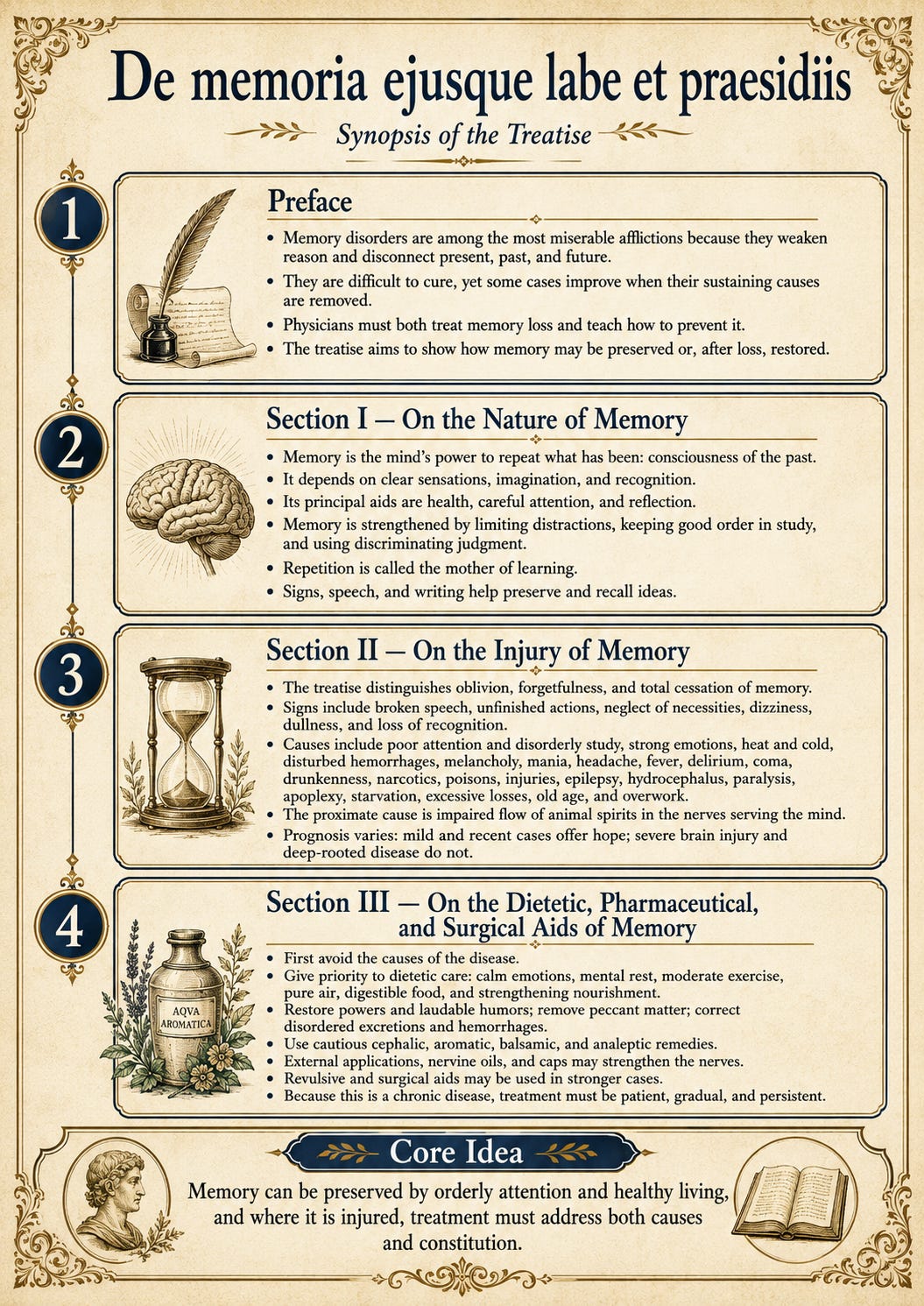
Synopsis Of The Treatise.
Section I sets forth the nature of memory.
It gives a definition of memory. Among the aids of memory it lists health, reflection in sensations, the small number of objects considered at the same time, order in labors, discriminating judgment, repetition, and signs of objects.
Section II indicates the injury of memory.
It defines forgetfulness and the cessation of memory. It enumerates the signs of this disease. It sets forth the moral causes of forgetfulness. It affirms that the antecedent causes include unpleasant emotions, cold and heat, disturbed hemorrhages, melancholy and mania, headache and delirium, coma, drunkenness, narcotics and poisons, external injuries, epilepsy, hydrocephalus, paralysis and apoplectic attacks, starvation, excessive hemorrhages and long diseases, abuse of Venus and aphrodisiacs, old age and excessive labor, and finally a bad constitution of the encephalon. It presents the proximate cause. It gives a general prognosis, then an unfavorable one, and then a better one.
Section III supplies the aids of memory.
It advises avoidance of disease-producing causes and proposes dietetic aids. It forms the general indication. It commends the restoration of laudable humors through dietetic means, balsamic pharmaceuticals, analeptics, sweetened acid spirits and naphthas. It teaches the preparation and evacuation of peccant matter. It requires the restoration of hemorrhages. It praises external dispersing and strengthening remedies. It presents surgical aids. It demonstrates that a chronic cure is needed to remove atony of the nerves.
Section I.
On The Nature Of Memory.
Before we come to narrating the defects of memory themselves, it does not seem foreign to our purpose to indicate briefly what memory is and on what supports it rests. Memory denotes for us that faculty by which the mind repeats those things that have been, or consciousness of the past.
For when some object comes before our senses, having similarity or dissimilarity with something past, the phantasy or imagination reproduces the past idea; and this reproduced idea, if it is clear enough, memory recognizes.
Philosophers commonly refer memory to the lower faculty of the mind. Yet this is not always done rightly, as is clear from the fact that memory can preserve things and their connections, indeed whole disciplines, or rational ideas, just as much as particular ones.
From the very genesis of memory it is sufficiently clear what remedies serve it. Since the integrity of the brain and nerves, which minister to the operations of the mind, is required for every idea, it is not obscure that care spent on preserving good health is also very useful for obtaining the integrity of ideas and therefore of memory. This will be clearer from the enumeration of causes that injure memory. Nor does he stray from the truth who strongly maintains that in the present natural state a notable parallelism is found between the health of mind and the health of body.
From the definition of memory we understand that it rests, as to quantity and quality, upon sensations. Therefore anyone wishing to care for his memory should bring attention and reflection to the things perceived by sense, so that ideas may be brought to a high degree of clarity. For how will memory, after a long interval of time, distinguish and recognize an idea from others, if in sensation it could not sufficiently discern it and separate it from others?
Hence the ancients judged rightly that the first conception of things is the best. Since memory has no place unless imagination has brought past ideas back according to the laws of similarity, you will not understand the similarity of things unless their ideas have been made very clear to you in sensations. Hence Quintilian says in the Institutes of Oratory:
“There is no doubt that in this matter the attention of the mind has the greatest force, like the sharpness of the eyes not turned away from the sight of the things it looks upon.”
Accurate consideration of objects, both as wholes and in their parts, does not allow us to handle too many things at one and the same time, like busybodies. Those accomplish nothing, or rather learn in hope of future forgetfulness, who blunt the brain with an excessive multitude of objects. It is far better to have considered a few things gradually, accurately, and carefully than to have looked at very many as if through a lattice.
Nor do those take care of their affairs whose labors are badly arranged. In this universe there is a certain connection of things, an admirable order of them. Hence such a connection of truths arises that one truth flows from another, as from its own principle of knowing, and can be derived, understood, and demonstrated from it. This is that golden chain of similarity by whose help genius draws truths from the well of obscurity.
Therefore the highest things must not be mixed with the lowest; rather, in learning truths one must proceed by natural order. If this is done, imagination, when the matter requires it, will easily bring back truths once perceived, and memory will recognize those brought back.
Memory cannot be conscious of a past thing, or distinguish it from all others, unless it has previously known its distinctive character in sensations. Therefore in the contemplation of things there is need of discriminating judgment, and the marks proper to them, or those by which they can be distinguished from all others, must be carefully attended to.
Cicero therefore rightly says in the Topics:
“When you have taken those things that a thing has in common with any other thing, you must not stop with them, but must pursue the matter until something of such a kind is produced that it is so proper to the thing that it can fall upon or be transferred to no other.”
When some thing has often been considered by sense or imagination and recognized in repeated perceptions, the mind afterward recognizes the same thing, when it is brought back, more easily because it had already recognized it before. Therefore diligent repetition brings wonderful relief to memory, and the ancients rightly proclaimed it the mother of learning.
Quintilian says that memory is chiefly strengthened and nourished by exercise, which, if it is rational, comprehends those things that we have mentioned.
It is not always in our power to place the objects themselves before our eyes. Therefore signs must be substituted for them, for example words spoken aloud or expressed in writing, and other artificial and arbitrary signs. By their benefit the objects themselves are brought back into memory for us.
Thus accurate knowledge of signs and diligent use of them bring notable usefulness to memory. The Germans express this in a proverb: writing things down is good for remembering.
Since by the help of signs we can gradually distinguish and compare many parts of an object, as is usually done in arithmetic, signs themselves serve the clarity of ideas, reason, and memory. This seems to be the cause, first, why memory does not extend to the earliest years of infancy, but begins with the use of the native language; second, why people whose age has grown up among beasts, outside human society, do not rightly remember that state after they have learned in human society to use speech and reason; and third, why those mute from birth show no signs either of good memory or of intact reason, which has no place without signs.
Since beasts cannot use as many signs as men, their ideas do not enjoy as much clarity as in men, nor can their memory contain so many things or preserve them for so long.
From these things it also becomes in some measure clear why a paralytic affection of the tongue, or morbid muteness, can injure memory.
Section II.
On The Injury Of Memory.
The inability to bring back a certain past series and to recognize the objects contained in it is called oblivion; a notable defect of good memory is called forgetfulness; and where recollection of all ideas formerly perceived has been abolished, they call it cessation of memory. We shall consider below the causes that bring about this evil, and here we note only in general that diligent attention to the genesis of memory casts no contemptible light on understanding its defects and cessation.
Both forgetfulness and cessation of memory create no difficulty in being judged. The patients themselves complain much of this evil, and the matter is easily apparent from their speech and actions. For while speaking they cannot bring sentences once begun to an end; words fail them for declaring their mind; and actions once undertaken they again omit, as if they had rejected their earlier plan and had suddenly entered upon a new way of acting. Unless reminded, they neglect to take food and drink at the proper time, and they do not have the necessary care of natural excretions.
According to the different degree of the disease, in some only the memory of languages and disciplines fails; others are held by forgetfulness of all things. Sleep is accustomed to press them more or less and to overcome them while they are occupied with their business. I pass over for now the diseases that precede, accompany, or follow this evil; fuller mention of them will be made in the enumeration of causes. Many are accustomed to suffer from dizziness.
Some are rendered dull, or altogether foolish. Although they are not deprived of sensations, these sensations, when the evil has greatly increased, are usually only obscure and confused, so that they exclude reflection, sufficient clarity of ideas, and the remaining operations of the mind that depend on these. Nor are examples lacking of those who could not even recognize the most familiar persons. Galen also reports that some forgot letters and arts to such a degree that they did not even remember their own names.
Those who have wholly lost memory are also deprived of reason in such a state, though sensations of some kind can remain.
The consideration of antecedent causes seems to contribute much to understanding the proximate cause of this disease. Therefore we shall narrate these causes in order, as experience has offered them to physicians in clinical practice.
Not a few people can be seized by forgetfulness of past things from moral causes: first, when in sensory contemplation of things they have brought attention neither to the whole object nor to its individual parts; next, when they overwhelm the mind with a multitude of affairs, so that, being attentive to many things, the sense for each is less; third, if a suitable order is not given to labors; afterward, if proper attention is not given to that which distinguishes the thing from all others; and finally, where repetition is neglected. When these things are admitted, it cannot fail to happen that the memory of past things soon departs. These things, however, can be corrected not by medical but by logical precepts.
Temporary oblivion can arise from unexpected disturbance or from an emotion, such as fear, which sometimes happens to orators. This kind does not require medical aids.
The immediate fault is also often everything that lifts too much toward the head humors that sin by thickness; when they stagnate there, they can produce irregular motion, stasis, inflammation, pressure, and the like. Here we first refer unpleasant affections of the mind: sadness, fear, terror, and anger. Caelius Aurelianus, from Apollonius, reports that these have erased the memory of past things. Johann Jacob Manget and August Thoner teach the same.
In clinical practice I saw the case of a certain sixty-year-old woman who, after a great terror inflicted on her by a wicked soldier with drawn sword, was first affected by hemiplegia, then by abolition of memory, mild delirium, and finally by a fatal hectic fever.
Intense cold admitted to the body for a long time constricts the solid parts at the surface, thickens the humors, and drives them toward the inner parts and the brain. Hence Ludovicus Mercatus reports that cold once extinguished memory in a whole cohort of soldiers traveling through snowy mountains. Forestus attests a similar effect of cold.
Heat too is hostile to our body. It induces thickness in the humors, stirs them up, and drives them, once stirred, toward the head. Dodart, in the History of the Royal Academy of Sciences, lists the example of a boy who, under the dog days, forgot everything he had learned, and, when temperate weather arrived, recovered his memory, but under a new heat of the air lost it again.
Artificial hemorrhages long neglected in those accustomed to them, and natural hemorrhages suppressed too early, contribute their share so that ideas previously perceived are extinguished by oblivion. For then blood, sinning in quantity and thickness, can be carried to the brain and cause harm by stagnating and pressing. On this cause Juncker deserves to be read in his pathological conspectus.
That oblivion and melancholy befell a woman in childbed because of disorder of the lochia may be seen in the medical observations of Philipp Salmuth. Daily experience shows what disturbances are stirred up in women by premature cessation of the menstrual flow, especially when neglect of phlebotomy is added. Dizziness, weakening of memory, and other chronic evils are accustomed to seize them.
It is not unusual for past things to flow out of the mind in melancholics and maniacs. Christoph Guarinonius, Johann Wittich, and Forestus observed diminution of memory in melancholics. Balthasar Timaeus noted the same in maniacs. This is not difficult to understand, since the workshop of the mind is wonderfully disturbed in such subjects.
Philipp Salmuth noted sudden oblivion after a severe headache.
In acute fevers, usually joined with delirium, Johann de Gorter shows that it can occur, and that the same has place in their raw state. This evil is to be feared all the more after the most acute malignant fevers.
Peter Forestus recounts that memory was taken away in plague. Thucydides testifies that in the plague that befell the Athenians during the Peloponnesian War, such great oblivion arose in some convalescents that they recognized neither their own people nor themselves.
Dolaeus and Felix Plater report that heavy stupor, or coma, produced the same effect. I myself have experienced that sleepy coma, supervening upon a very acute malignant fever, removed not only memory but also the remaining operations of the mind in several patients within a few days. Since severe inflammations of the brain and their usual bad consequences are common with acute fevers of this kind, oblivion can also follow this depraved state of the encephalon.
Continual drunken excesses, because of the more frequent expansion of the vessels of the brain, pressure on the principle of the nerves, and subsequent relaxation of the fibers, erase the memory of past ideas by oblivion. Indeed, they render the senses themselves more sluggish. Hence Pliny called frequent drunkenness the death of memory.
Narcotics, for example opium and stronger medicines prepared from it, seeds of datura, henbane, and similar things, harm the brain, the operations of the mind, and therefore also memory by extending, pressing, and relaxing the fibers. Bonetus mentions a certain man who, after much use of the red poppy, became foolish. Thomas Willis described memory erased by opium, and Lazarus Riverius observed a similar harm from too much use of red-poppy water, together with ventricles of the brain filled with black humor. Poisons too can inflict violent force on the nerves, so that, memory being injured from this, the person remains dull and unreliable through the rest of life.
Violent contusion, depression, or wounding of the head can tear ideas from memory. Horstius presents the case of a servant whose head was pierced by a ball; although he was restored, he lost the use of memory and reason. A fall that violently shook the back of the head, according to Tulpius, took away memory.
Rondelet observed loss of memory after a wound deeply inflicted into the eye by a sword in a certain learned man. I myself learned by experience of a man who fell from a horse upon the crown of his head and at first lost memory entirely; after cure, he used only a very weak memory through his whole life.
Epileptic convulsions, especially chronic and often recurring ones, can so pervert the state of the brain that memory and judgment are greatly injured, and sometimes those miserable people become utterly foolish. Not rarely the stagnation of thicker humors in the head seems to bring epileptic affections and their consequences onto the scene.
Hydrocephalus, in which a serous accumulation lies between the skull and the membranes of the brain, or between their folds, or in the ventricles of the brain, is accustomed to make patients waver in memory and sometimes to cause greater harms. Doménico Panarolo and Lazarus Riverius give examples of this matter.
Paralysis, especially of the tongue, and other apoplectic affections can be the cause of the evil. Celsus had already observed of those who are violently relaxed through all their limbs that they are either quickly carried off or rarely come to health, but rather draw a miserable breath with memory also lost.
Forestus narrates the case of an obese man who, after a slight apoplexy, had diminished memory. In a woman of thirty years suffering from chronic obstruction of the menses and a hysterical disorder, experienced difficult hearing, paralysis of the tongue, and depravation of memory. A certain old man, after obstruction of the hemorrhoids, was often attacked by hemorrhoidal colic and several times by apoplectic assaults, which a notable depravation of memory followed.
A seventy-year-old matron suffering from serous apoplexy first lost the use of all the faculties of the mind. But after copious sweats she indeed returned into favor with good health; nevertheless many things were removed from her memory for some time.
Whatever draws the animal spirits too much away from the body, so that the powers of nature fail, can overwhelm past ideas with oblivion. Causes of this kind may be given as follows. Galen noted that starvation prolonged too long is harmful to memory. Hemorrhages and other excessive excretions, and long diseases, as they can destroy the powers of the body in general even with danger to life, can likewise bring harm to memory.
Men who tried to compensate for imprudent use of Venus with aphrodisiacs first became forgetful and then altogether foolish. Philipp Salmuth gives an example of this matter. Friedrich Hoffmann testifies that abuse of Venus, especially in old men, produced the same effect. I myself knew a man not very advanced in years who from excessive Venus first became foolish and then was consumed by wasting of the body.
Daily experience places beyond doubt that memory can fail through the fault of old age. Johann Schenck, Antonio Guainerio, and Welsch narrate examples. Those who are too distracted by business and continually exhaust the workshop of the mind can also incur injury of memory. Rosinus Lentilius reports the case of a certain learned man in his forty-third year who, after many labors, lost memory and judgment. Some also, for the sake of ostentation, destroyed by certain artifices the good memory with which they were naturally endowed.
Juncker proposes that there is also an inborn foolishness. This sometimes manifests itself with the passage of time in certain persons whose ancestors labored under the same disease.
It is easy to see that a bad constitution of the brain is present in this disease. Most authors seem to point to excessive flaccidity of the little fibers that constitute the beginnings of the nerves. Schulze shows that the brains of such people, inspected after death, appeared almost liquefied from excessive moisture and softness, so that they could scarcely be handled with the hands.
Bonetus testifies that in others only the left part of the brain was relaxed and the dura mater livid. Heinrich ab Heer, in a forgetful man of forty, found the brain hard, dry, friable, and yellowish, but still soft around the ventricles and of a corrupted color. In others, according to Felix Plater, a tumor of the corpus callosum was present. In another, stones were found in the falx. See Vater on wounds of the brain.
We believe that the proximate cause consists in the denied influx of animal spirits into the nerves that pertain to the actions of the mind, whether this arises from defect of the nervous fluid, or from compression, paralytic affection, atrophy, or destruction of the nerve fibers. Wegner presents the matter in this way: the greatest moments of the causes lie hidden in an injured figure of the head, in the medulla of the brain badly formed, pressed, or less fit for motion and secretion, and finally in intercepted motions of the nerves and spirits and communications of the pathways. This etiology seems to agree with our opinion.
As for prognosis, nothing very certain or joyful concerning this disease is found among the authors, and it is greatly to be feared that in this affection what philosophers say is true: from privation there is no return to habit. Otherwise the matter seems to come to this, that according to the difference of causes and degrees one may hope for something favorable or for nothing.
For if a lesser degree of the disease is still present, and the causes can be removed in such a way that the free influx of animal spirits is restored, then patient and physician can conceive good hope of driving out the disease. But where the evil has already driven deeper roots and the causes do not know how to yield, then we judge that the worst things must be feared.
Serious injuries of the brain, total resolution or destruction of the nerve fibers serving ideas, leave no hope of cure. Johann de Gorter shows that oblivion in acute diseases portends evil. That which has arisen from malignant diseases or poisons is also cured with difficulty. If in epilepsy the mind has been injured or resolution of the nerves has occurred, medicine scarcely has a place.
That injury of memory which is connected with paralytic weakening about the head and is also mildly delirious has an extremely difficult outcome. Abolition of memory with excessive desire for sleep, or with perpetual wakefulness, is each of bad omen; the former foretells apoplexy, the latter mania. Memory suddenly injured without an external cause is an indication of approaching paralysis or apoplexy.
Experience proves that injury of memory gradually induces defects of judgment and reason. We showed above that a slow and hectic fever can follow this evil, and Dolaeus observed the same. Even if the diseases that gave occasion to this defect are driven out, memory scarcely returns to its former habit; its weakness for the most part remains.
Greater hope shines if the evil is periodic, recent, or born from external causes in an otherwise vigorous body. Oblivion arising from pressure of humors stagnating in the head has, according to the case, been cured or at least greatly diminished either by artificial ventilations of blood, by natural hemorrhages restored to order, by a large outflow of serum from the nose and mouth, by fever and uninterruptedly succeeding sweats, and sometimes by copious mucous and bilious evacuations. That which drew its origin from excessive labors is made lighter or overcome if long-continued leisure is granted to the mind, so that it may become better able to return to thinking.
Section III.
On The Dietetic, Pharmaceutical, And Surgical Aids Of Memory.
As for therapeutic treatment, we note in general that before all things the occasional causes of this so stubborn evil must be avoided, for it would be foolish to admit what can be prevented.
Next, we believe that in most cases there is more hope in dietetic aids than in pharmaceutical ones. Therefore those seized by this disease should carefully guard themselves against unpleasant affections of the mind; and if there are things that will exasperate their spirits, it is best, while they are ill, to keep these from their knowledge.
Leisure must also be given to the mind, and every busy action must be cut off that can in any way harm by fatiguing the mind and brain. The body must be moved by moderate exercises, by which excretions are gently promoted and strength is added to the fibers, unless excessive weakness stands in the way. In that case we prescribe rest of the body also, to refresh the powers.
Finally we establish that pure air, food that is easy to digest and produces good juice, pure drinks, and analeptics are especially suitable when there is defect of spirits and paralytic atony of the fibers. Thus by careful living one prevents useless matter from remaining in the body; and when the powers are strengthened, the soul is rendered more vigorous and more cheerful.
It is clear that one must abstain from fatty and thicker foods, fish, smoked things, baked goods, and other things hard to digest.
Since to cure diseases is the same as to remove the causes of diseases, in every particular case one must carefully examine whence the evil drew its origin. Unless this caution is applied, in a disease depending on such diverse causes the physician will never enter upon the right way of treatment.
Therefore diligent account must also be taken of antecedent and accompanying diseases. When these are rightly judged and driven out, a great light is kindled for instituting the cure; indeed, not rarely the injury of memory itself is overcome. Yet since the causes finally conspire toward one and the same end, the general indication returns to this: that the free influx of spirits into the nerves serving the operations of the mind be restored.
This is obtained first when, in defect of laudable humors, a sufficient quantity of them is again generated; next, by legitimate removal of peccant matter pressing the principles of the nerves; finally, if the atony of the nerves paralytically affected is met and their natural strength is restored. We must now descend to the special treatment of these indications.
If it is ever true that chronic diseases require a chronic cure, it applies especially to this disease. By long use of right diet and suitable medicines the health often inclines toward the better, which cannot be obtained by excessive haste. Physicians could certainly bring excellent help to many people in very many diseases, if some patients did not desire, by a childish opinion, that they always be cured quickly and pleasantly. Such excessive haste and pleasure very often become dangerous and deadly.
Whether the defect of laudable humors and the weakness depending on it has arisen from a preceding serious disease, from excessive excretions, or from old age, prudent restoration of powers and humors is needed. For when these are lacking, neither their legitimate influx into the vessels of the brain and the nerves can take place, nor can the patient undertake the functions of mind and body.
Both the humor serving the nerves and the remaining nourishing serum are drawn from the common treasury of the blood. Blood grows from chyle, which is separated from chyme and the humors poured into it. Chyme is owed to digestion, and for digestion food and drink are required that are endowed with laudable juices and suited to the sick body.
Therefore restoration of powers must be sought more from dietetic aids than from pharmaceutical ones. Gelatinous foods, easy to digest and producing good juice, soft-boiled eggs, wholesome meats of younger animals, broths prepared from these and from healthful roots and herbs, prudently seasoned with aromatics, and moderate use of generous wine and other restorative and nourishing drinks are to be prescribed.
Nor should the cautious use of cephalic, aromatic, and balsamic medicines be despised. We see these commended abundantly by several authors. It would be long indeed to enumerate them all; therefore we shall bring forward only the more usual ones.
Some highly praise cubebs eaten on an empty stomach. Balsams of life rightly prepared and taken in a reduced dose do not frustrate all hope. Amber, kermes grains and their essences, the sweet essence of Halle, essence of aloes wood, simple and compound rosemary flowers, spirit of lilies of the valley, Wedel’s cephalic elixir, Augustan cephalic spirit, compound tincture of sassafras wood, Hoffmann’s ambered catechu earth, the strengthening electuary of Forestus and Michaelis, and similar things are everywhere commended and used by practitioners with good omen. We do not disapprove them if, other things being equal, these and similar remedies are applied with a grain of salt against the inertia of the solids and the languor of motions.
Mixtures prepared from analeptic waters, powders, and syrups, juleps, and potions made from fragrant substances are usually not without pleasing effect. Allen affirms that the following tablets, eaten frequently, especially evening and morning, produced an excellent effect: take one drachm of cassumunar root, two drachms of species diambr without odoratics, and double the weight of the whitest sugar; mix. Others adorn the powder of Abbot Trithemius with praises.
It is well known that toasted fine white bread sprinkled with generous wine and strewn with aromatics and sugar has analeptic virtue. Forestus commends an electuary made from cephalic herbs and flowers, such as rosemary, ground-pine, betony, and candied aromatic calamus root, cubebs, and the like, with syrup of stoechas added.
Yet those rocks must be avoided against which physicians often strike when they always and too much use hot remedies. From this it happened that the anacardine confection was called by some the confection of the wise, and by others the confection of fools. In a weak body, things that stir and stimulate, imprudently applied, are more fit to cause harm than to bring help.
We believe, taught by use, that sweetened acid spirits and their naphthas have great power for sustaining the powers, whether they are given alone or mixed with other medicines. We hold that true Peruvian bark and its extract, if nature has been weakened after long diseases, help by strengthening, and that their energy is increased from the known powers of this bark.
Because the cure of this disease also requires prudent removal of useless matter pressing the principles of the nerves, humors sinning in quantity must be drawn off by cupping glasses applied to the previously incised skin, by venesection, or by promoting other excretions.
Those that sin by thickness must be cut and invited by gentle stimulus to a freer and more equal flow. Serving these purposes are tinctures from fixed alkali, volatile alkaline spirits, neutral salts, succinated spirit of hartshorn, and tea-like infusions prepared from nervine and resolving roots and herbs, for example white pimpernel root, peony, zedoary, greater valerian, Bohemian arnica herb and flower.
The body must also at times be cleansed again from mucous and bilious impurities by a medicated wine made from cephalic and laxative ingredients, or by laxatives through gradual moderation. Thus what had harmed within is usefully poured out. Crato’s pills of amber, Becherian pills, and others mixed from gums, bitter antiscorbutic extracts, and rhubarb are suited to this matter. Masticatories may also be called into use as the case requires.
If the mouths of the veins that were accustomed to pour blood in hemorrhoidal persons have been suppressed, or if the menses in women do not answer, those hemorrhages, after preparatory remedies have been sent ahead, must be restored as far as can be done. If the matter does not succeed according to desire, artificial ventilations of blood must be substituted in their place.
Thus too account must be taken of other disturbed excretions, so that they may be brought back into order and the cause serving this evil removed as quickly as possible. If the disease seems to degenerate into mania, one must fight with stronger resolvents, evacuants and antispasmodics being interposed.
One must abstain from opiates and narcotics, because they do not know how to remove the disease and rather increase it.
Balsamic and nervine remedies rubbed on externally, or placed on the head in the form of caps, serve the preceding indication and at the same time the correction of atony of the nerves. They can be useful by dispersing what has harmed through coagulating, and by strengthening.
Examples are oil of cajeput, nard oil, costus oil, nutmeg oil, oil of castoreum, oils of peppers, and oil of myrrh, which Horstius and Forestus praise when rubbed on the temples and occiput. Sylvius’s oily volatile salt, other distilled nervine oils, and balsams also repay the effort. For caps ordered to the same end, benzoin, calamite storax, cinnamon, cardamom, cubebs, cloves, aromatic aloes wood, yellow sandalwood, cyperus root, galangal, aromatic calamus, herbs and flowers of marjoram, rosemary, southernwood, betony, sage, hyssop, thyme, flowers of lily of the valley, red roses, and caraway seed are suitable; nervine spirits can be dropped upon them.
Since in diseases afflicting the brain there is often need of stronger revulsion and calling away of useless matter, authors everywhere commend rubbings of the head, irrigations, which the Greeks call epithemes, mustard plasters, blisters, setons, cupping glasses, issues, and the actual cautery itself. From these, milder or more powerful remedies can be chosen according as the degree of disease and the powers of the patient seem to require and bear it.
Even wounds of the head themselves have sometimes been observed to be useful.
Concerning artificial ulcers opposed to this disease, this must be noted: they should be kept open so long as the defect which we are helping by revulsion has not quieted.
Against atony of the nerves, otherwise, one fights rightly and much with the dietetic and pharmaceutical remedies already enumerated here and there, and with others well known to physicians, and help is brought to the patient. Moreover, that these remedies may have greater weight, leisure must be granted for a long time to mind and body, so that the patient may gradually be strengthened.
But since in an evil that has already advanced far, neither the removal of peccant matter nor the restoration of powers can be obtained as quickly as many falsely persuade themselves, and since most persons laboring under this disease are strengthened and recover their powers only slowly, we again warn that nothing should be done rashly, nor should hope be cast away at once. Time must be given to the medicine that stirs healing and to nature as she gradually cooperates.
Thus patients very often bear the most desired fruits of prudence and patience. Those are deprived of these fruits by their own fault whose spirit and well-known intemperance do not admit a rational cure of the disease, although otherwise they could be healed.