
From the Vaults: Memory And Absence of Mind
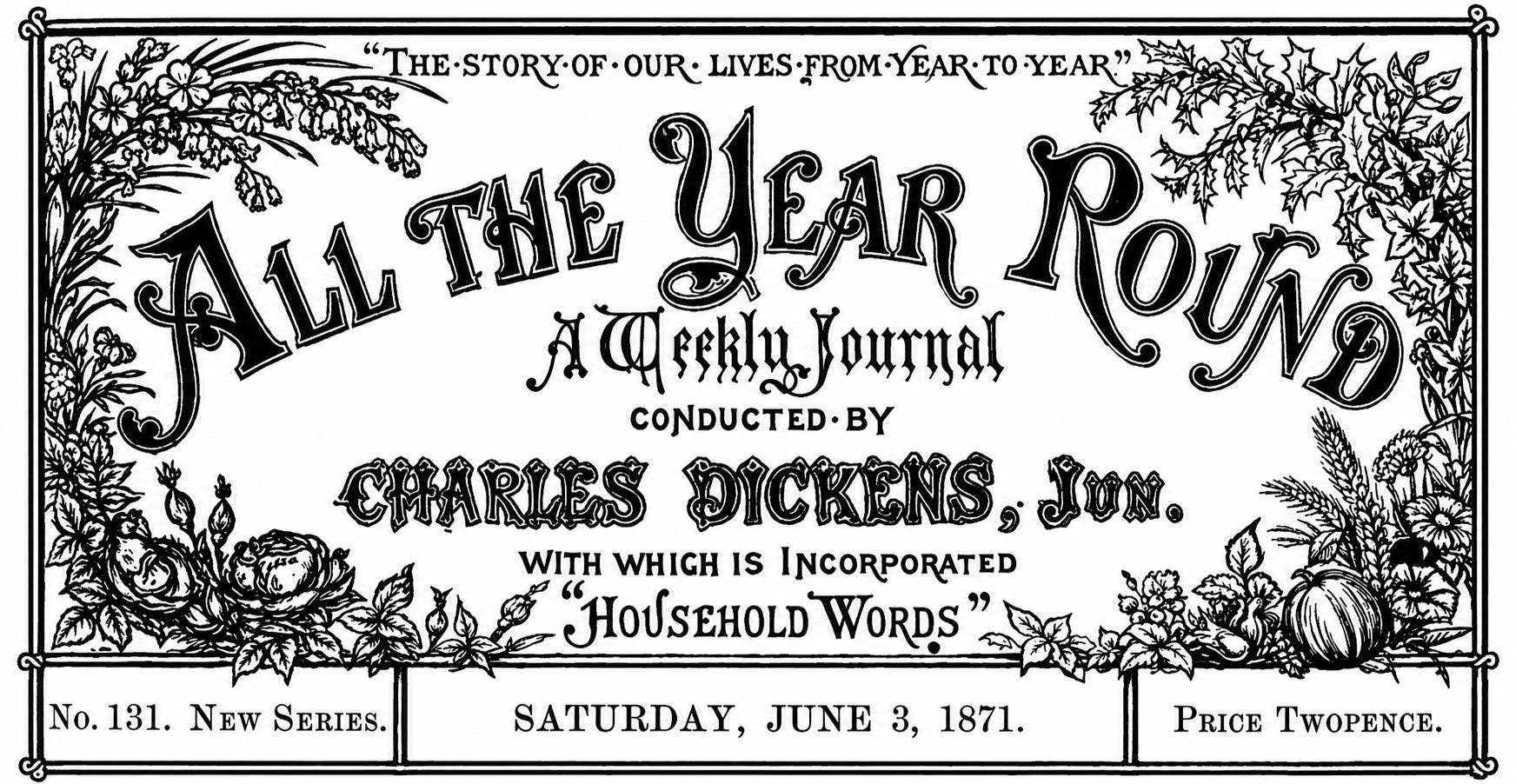
An essay from Volume 6, issue 26 of All The Year Round, a magazine published in 1871

Table of Contents
Elder’s Notes
This article on memory was published in 1871 in All The Year Round, a magazine edited by Charles Dickens. It offers a variety of historical examples of people with excellent and not-so-excellent memories.
Memory And Absence
Memory is nearly as much a puzzle as ever. Why in some men memory should be strong and in others weak; why the memory should be stronger at one time than another; why the same man should have a strong memory for some subjects, and a weak one for others; why illness should obliterate some subjects completely from the mind--are problems still undergoing patient and attentive scrutiny.
Memory for Figures and Calculation
The memory for figures, or power of mental calculation, is well known to all of us, either by its presence or its absence. Jedediah Buxton, George Parker Bidder, and Zerah Colburn, are instances too familiarly known to need detail here.
George Watson, the Sussex calculator, could tell the dates of every day since he was a child, and what he was doing on that day; he could show many other strange freaks of memory, but was a heavy, ignorant fellow generally, very vain of his one acquirement.
Memory for Languages
The memory of languages is quite a distinct faculty, so far as can be judged from recorded instances. Mithridates, we are told, could converse, in their own languages, to the natives of twenty-three countries which were under his sway.
Cardinal Mezzofanti appears to have had this faculty in a stronger degree than any other person that ever lived. While educating for the priesthood, he learned Latin, Greek, Hebrew, Arabic, Spanish, French, German, and Swedish. As a professor at some of the Italian universities, he constantly added to his store; until at the age of forty-three he could read in twenty languages, and converse in eighteen.
In 1841, when he was sixty-seven years old, he was as well acquainted with Portuguese, English, Dutch, Danish, Russian, Polish, Bohemian, Servian, Magyar, Turkish, Irish, Welsh, Wallachian, Albanian, Bulgarian, Illyrian, Lettish, Lappish, as with the languages which he had first learned; while to Arabic he added Persian, Sanscrit, Koordish, Georgian, Syriac, Chaldee, Samaritan, Chinese, Coptic, Ethiopic, Abyssinian, and other Asiatic and African tongues.
At the time of his death, in 1849, Mezzofanti could write eloquently, and converse fluently, in more than seventy languages.
Memory for Words and Text
All the other accounts of memory for words are poor compared with this; nevertheless, many of them are sufficiently remarkable.
John Kemble used to say that he could learn a whole number of the Morning Post in four days; and General Christie made a similar assertion; but it is not known how far either of them verified this statement.
Robert Dillon could repeat in the morning six columns of a newspaper which he had read overnight. During the Repeal debates in the House of Commons, thirty-seven years ago, one of the members wrote out his speech, sent it to the newspapers, and repeated it to the House in the evening; it was found to be the same verbatim as that which he had written out.
John Fuller, a land agent in Norfolk, could remember every word of a sermon, and write it out correctly after going home; this was tested by comparing his written account with the clergyman’s manuscript.
Scaliger could repeat a hundred verses or more after having read them a single time.
Seneca could repeat two thousand words on hearing them once.
Magliabechi, who had a prodigious memory, was once put to a severe test. A gentleman lent him a manuscript, which was read and returned; the owner some time afterwards, pretending he had lost it, begged Magliabechi to write out as much as he could remember; whereupon the latter, appealing to his memory, wrote out the whole essay.
Cyrus, if some of the old historians are to be credited, could remember the name of every soldier in his immense army.
There was a Corsican boy who could rehearse forty thousand words, whether sense or nonsense, as they were dictated, and then repeat them in the reversed order without making a single mistake.
A physician of Massachusetts, about half a century ago, could repeat the whole of Paradise Lost without mistake, although he had not read it for twenty years.
Euler, the great mathematician, when he became blind, could repeat the whole of Virgil’s Aeneid, and could remember the first line and the last line in every page of the particular edition which he had been accustomed to read before he became blind.
Memory Through Sheer Application
One kind of retentive memory may be considered as the result of sheer hard work, a determination towards one particular achievement, without reference either to cultivation or to memory on other subjects. This is frequently shown by persons in humble life in regard to the Bible.
An old beggar-man at Stirling, known some forty years ago as Blind Alick, afforded an instance of this. He knew the whole of the Bible by heart; insomuch that, if a sentence were read to him, he could name book, chapter and verse; or, if the book, chapter, and verse were named, he could give the exact words.
A gentleman, to test him, repeated a verse, purposely making one verbal inaccuracy; Alick hesitated, named the place where the passage is to be found, but at the same time pointed out the verbal error. The same gentleman asked him to repeat the ninetieth verse of the seventh chapter of the book of Numbers. Alick almost instantly replied, “There is no such verse; that chapter has only eighty-nine verses.”
Strange Losses of Memory
There are no phenomena of memory more strange than those in which--usually through some illness, or some accidental injury to the brain--some particular facts or classes of facts baffle the recollection altogether. The instances recorded by Abercrombie, Winslow, Wigan, Carpenter, Holland, and other physicians, are too well founded to admit of any doubt.
There was a gentleman who, when in disturbed health, uniformly called coals, paper, and paper, coals, quite unconscious of any anomaly in the matter. Another called his snuff-box hogshead; and it was remarked that, in earlier life, he had been connected with the tobacco trade in the West Indies.
Doctor Scandella, an Italian physician resident at New York, was attacked with yellow fever at New York; he spoke only English when first attacked, only French in the height of the fever, and remembered only his own original Italian just before his death. A Frenchman, at the age of twenty-seven, spoke English well; he received an injury in the head, and could then for some time only remember French, believing and asserting himself to be but sixteen years old.
At St. Thomas’s Hospital an invalid suddenly began to talk in Welsh, a language which he had entirely neglected for thirty years. One lady lost the memory of exactly four years, well remembering events before and after that period; and in another instance the lost years amounted to eight or ten. A gentleman forgot the names of his friends, but remembered their ages, and adopted that as the most convenient mode of referring to them.
Another lost so completely the meaning of nouns-substantive, that he unconsciously gave the names of places to things, persons to events, and so on, rendering his talk unintelligible. A lady, similarly under temporary ailment, could not remember the names of any of the ordinary things in her household; she was forced to go from room to room, and point to the articles concerning which she had any orders to give, or any observations to make.
A military officer, mentioned by Doctor Winslow, sometimes remembered his own name, but not his address; at other times remembered his address, but not his name. He would occasionally, with a perplexed expression of countenance, accost a stranger, “I am Major --, can you tell me where I live?” Under his other frame of mind, “I live at --, can you tell me my name?”
Corroborative instances of a kind more or less analogous are so numerous, that we need only cite a few more as illustrations. There was a man who could remember the first syllable of long words, but no others. A soldier, after receiving an injury in the head, forgot the figures 5 and 7, and everything connected with them. A gentleman in a similar way lost the memory of the letter F.
An old French lady could express herself intelligibly in any ordinary conversation; but if a direct question were put to her, her memory seemed to depart from her at once, except in reference to two words; her regular reply was “Saint Antoine.” In another case, of a wounded French soldier, he evidently understood the meaning of what was said to him by others, but his memory could only assist him to the uniform reply, “Baba.”
John Hunter, the great surgeon, called on a friend at a time when indisposed; for a few hours he could not remember anything concerning any person or object beyond the walls of the room he was in; it was a painful time to him, for, without any hallucination, he knew perfectly well that his memory had in great measure temporarily deserted him; he walked to the window, as a possible means of getting back some recollection of the outer world.
An artillery officer, in 1785, could read out well when a book was open before him, but could not remember a word of the contents when the book was closed. A Spanish tragic author forgot his own writings; when reminded of them, he declared they must have been written by some one else.
A French scientific man could scarcely ever remember the names of his colleagues; he was accustomed to speak of them as the authors of such and such works or papers, or as the discoverers of such and such facts. One gentleman forgot the names of the whole of his children for a time.
An agriculturist, a man of extensive business and good intelligence, was obliged to use a dictionary to understand the ordinary implements of his trade; the sound of each word suggested the shape of the letters, and the sight of the latter suggested the sense; but the sound did not directly suggest the sense. A lady, after an illness, forgot all pronouns, and all inflexions of verbs except the infinitive; when wishing or intending to say, “Stop, my husband has just come,” she said, “To stop, husband to come.”
Perversion of Memory
Another variety is what may be called perversion of memory, memory running to wildness, generally manifested during or immediately after an illness. One instance is that in which we imagine other persons to be doing or feeling that which is really attributable to ourselves.
There was a gentleman who, when thirsty, believed that others experienced the thirst; and after he had coughed, said to a friend near him, “I am sorry you have so bad a cough.” Samuel Rogers, when very aged and declining, was riding in a carriage with a lady, who asked him about another lady well known to both; the name seemed a blank to him, and stopping the carriage, he asked his servant, “Do I know Lady M.?” “Yes, sir,” was the reply.
A gentleman, sitting with his wife in the evening, found his thoughts wandering back to a lady at whose house he frequently spent an evening in former years; ludicrously confounding time, place, and person, he rose up, and, addressing his wife as “madam,” declared that it was getting late, and that he must return home to his family.
Forgetfulness
The forgetfulness arising from sheer absence of mind is different in its nature from any of the above. The man may be in good health, and may be the reverse of stupid, but he is so absorbed in a particular train of thought as to be nearly oblivious to surrounding sayings and doings.
Sydney Smith cited two instances of absence of mind which struck his fancy. “I heard of a clergyman who went jogging along the road till he came to a turnpike. ‘What is to pay?’ ‘Pay, sir, for what?’ asked the turnpike-man. ‘Why, for my horse to be sure.’ ‘Your horse, sir! What horse? There is no horse, sir.’ ‘No horse. God bless me,’ said he, suddenly looking down between his legs, ‘I thought I was on horseback.’
Lord Dudley was one of the most absent men I think I ever met in society. One day he met me in the street and invited me to meet myself. ‘Dine with me to-day; dine with me, and I will get Sydney Smith to meet you.’ I admitted the temptation he held out to me, but said I was engaged to meet him elsewhere.
Another time in meeting me he put his arm through mine, muttering, ‘I don’t mind walking with him a little way; I’ll walk with him as far as the end of the street.’ He very nearly overset my gravity once in the pulpit. He was sitting immediately under me, apparently very attentive, when suddenly he took up his stick as if he had been in the House of Commons, and, tapping the ground with it, cried out in a low but very audible whisper, ‘Hear, hear.’”
Absence of Mind
An absence of mind more or less similar has often been displayed by men habituated to deep study. Domenichino, the great Italian painter, became so absorbed in his own picture of the Martyrdom of Saint Andrew that he reviled, with the fiercest passion, a soldier who was represented insulting or mocking the saint. Caracci, who was present, was so struck with Domenichino’s excited expression of face that he afterwards adopted it as an impersonation of rage.
Crebillon, the French dramatist, impatiently said to a friend who entered his study, “Don’t disturb me; this is a moment of exquisite happiness; I am going to hang a villanous minister, and to banish a stupid one!”
Isaac D’Israeli says: “It has been told of a modern astronomer, that one summer night, when he was withdrawing to his chamber, the brightness of the heavens showed a phenomenon. He passed the whole night in observing it; and when they came to him early in the morning, and found him in the same attitude, he said, like one who had been collecting his thoughts for a few moments, ‘It must be thus; but I will go to bed before it is too late.’ He had gazed the entire night in meditation, and was not aware of it.”
Doctor Stukely called upon Sir Isaac Newton, and was told that Sir Isaac would come to him directly. The waiting was long and tedious, dinner was brought in, and Stukely, feeling hungry, sat down and nearly demolished a tempting roast fowl. Newton at length appeared, and seeing the empty dish, exclaimed, “I protest I had forgotten that I had eaten my dinner!”
The Count de Brancas, a friend of La Bruyere and Rochefoucauld, was one day reading in his study, when a nurse brought in a little infant; he put down his book, took up the infant, and caressed it admiringly. A friend came in, and Brancas threw down the baby on the table, thinking it was a book, not detecting his error until a loud crying announced it.
On another occasion Rochefoucauld crossed the street to greet him. Brancas said, “God help you, my poor man!” Rochefoucauld smiled, and was about to speak, when the other interrupted him: “I told you that I had nothing for you; there is no use in your teasing me; why don’t you try to get work? Such lazy idlers as you make the streets quite disagreeable.” Rochefoucauld’s hearty laugh at length roused him from his reverie.
Men have been known to exhibit such instances of absence of mind as the following: Taking out a watch, looking at it, and then asking, “What’s o’clock?” Going to a house where friends have lived, and forgetting that they had removed; going up to dress for dinner, forgetting the main purpose in view, and getting into bed instead; taking imaginary pinches of snuff while talking, forgetting all the time that the box is empty.
Dante went once into a bookseller’s shop to witness a grand street procession. He became so absorbed in a book that the whole spectacle passed without his noticing it; and when he went home was surprised at being reminded of it.
Hogarth, dining one day with friends, rose in the middle of dinner, turned his chair round, sat down with his back to the company, meditated awhile, resumed his proper position, and went on with his dinner. Sheridan, conversing with his sister one day, unconsciously cut up into shreds an elegant pair of ruffles which she had just made for her father.
A gentleman, invited to dinner, sat in the drawing-room alone for awhile; by the time the lady of the house appeared, she found that he, in a brown study, had picked a hearth-brush to pieces; he had the denuded handle in his hand, while his dress was covered with hairs.