Here follows a commendable little book called Ars memorativa in Latin
printed by Johann Bämler in 1480

Elder’s Notes
This is a great little German book on mnemonics issued during the Renaissance. Written in 1480, it offers dozens of striking mnemonic images.
The division of rooms in the text is pretty simple:
You know that every chamber has four corners. Therefore you should also have four places in one chamber. If you have a hundred rooms, then in every room four corners give you four hundred places. If the chamber has doors too, those are also good. You know that every door has four corners; each corner may also serve as a place. That also makes five hundred places. In this way you can set five hundred words or articles there.
Martin Sommer uses birds as distinctives in his memory-camp technique, which you can read about in Kluber’s Compendium of Mnemonics, so this passage caught my eye:
For the first place they put an eagle, for the second a sparrowhawk, for the third a hawk, and so on in order: such as calves, and also many other foreign things, such as swans, sheep, birds, ravens, and the like.
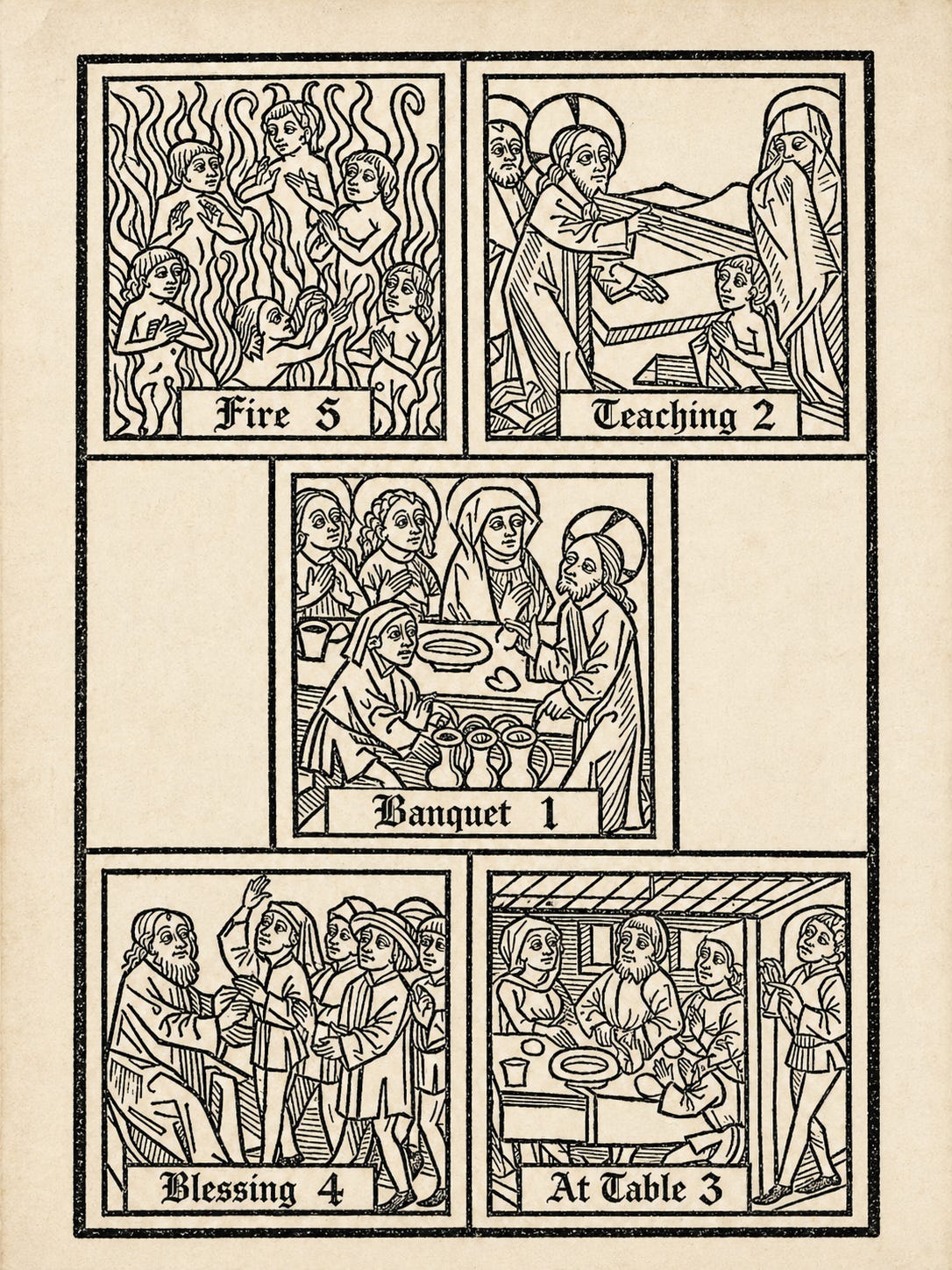
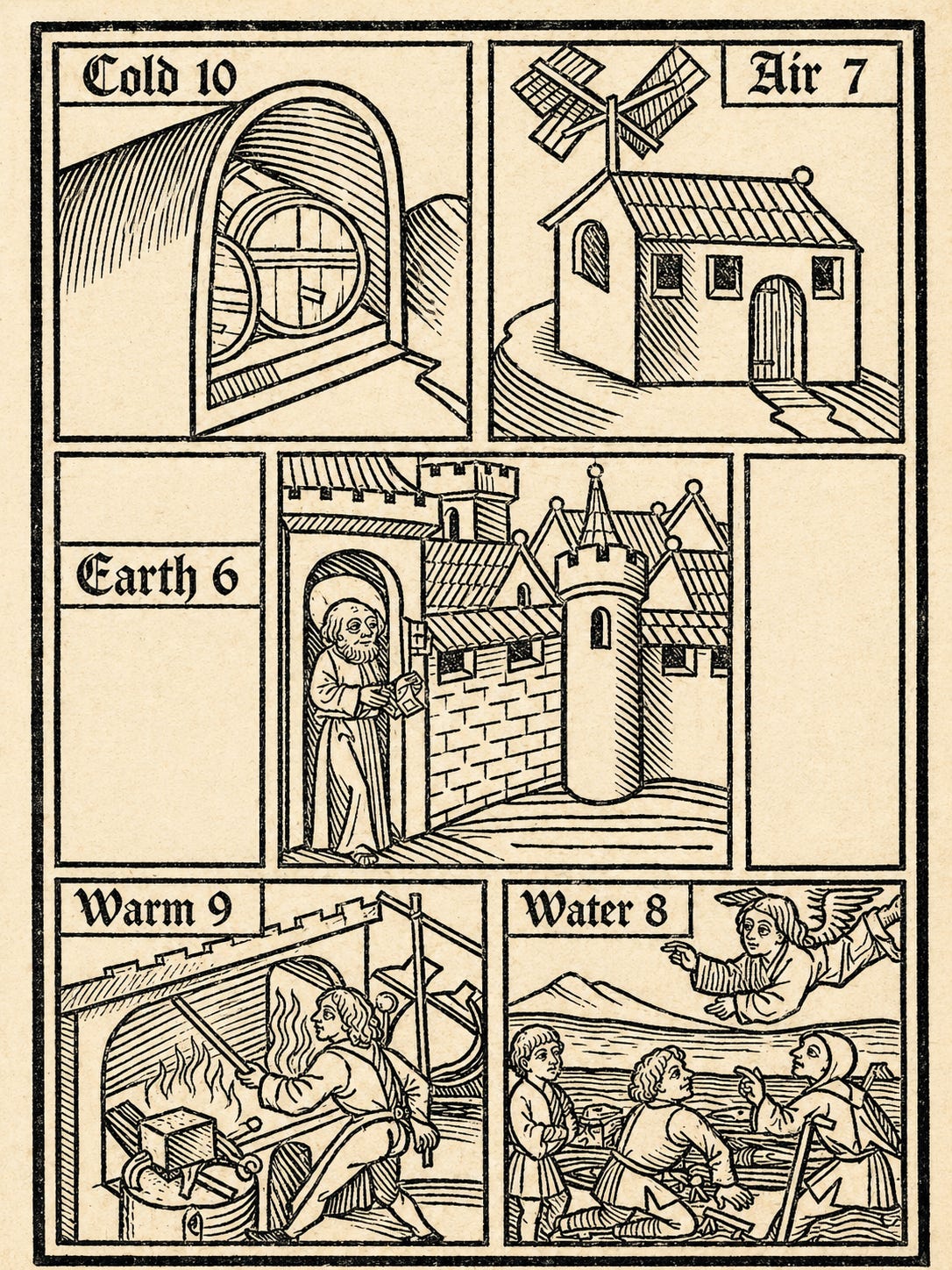
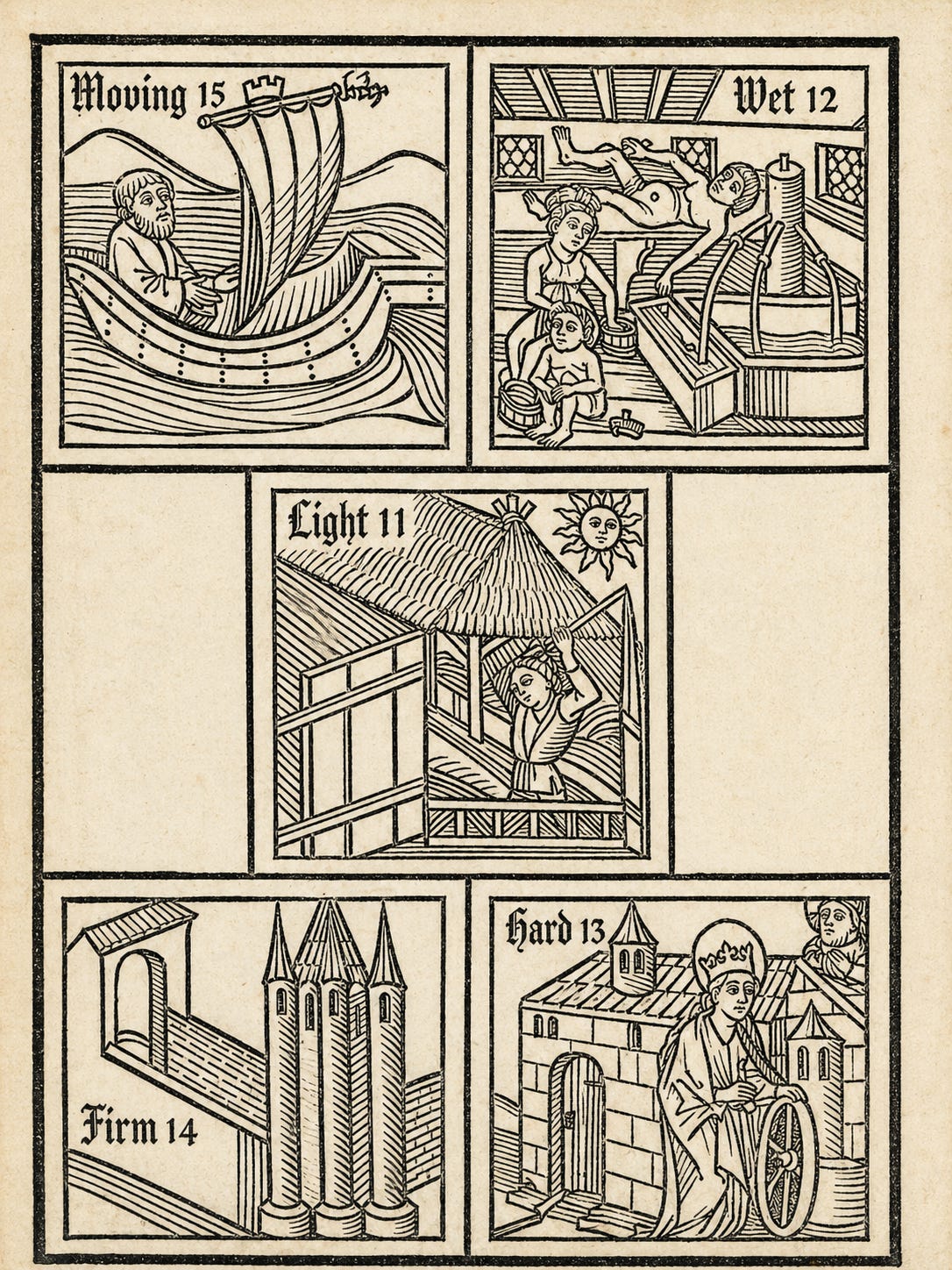
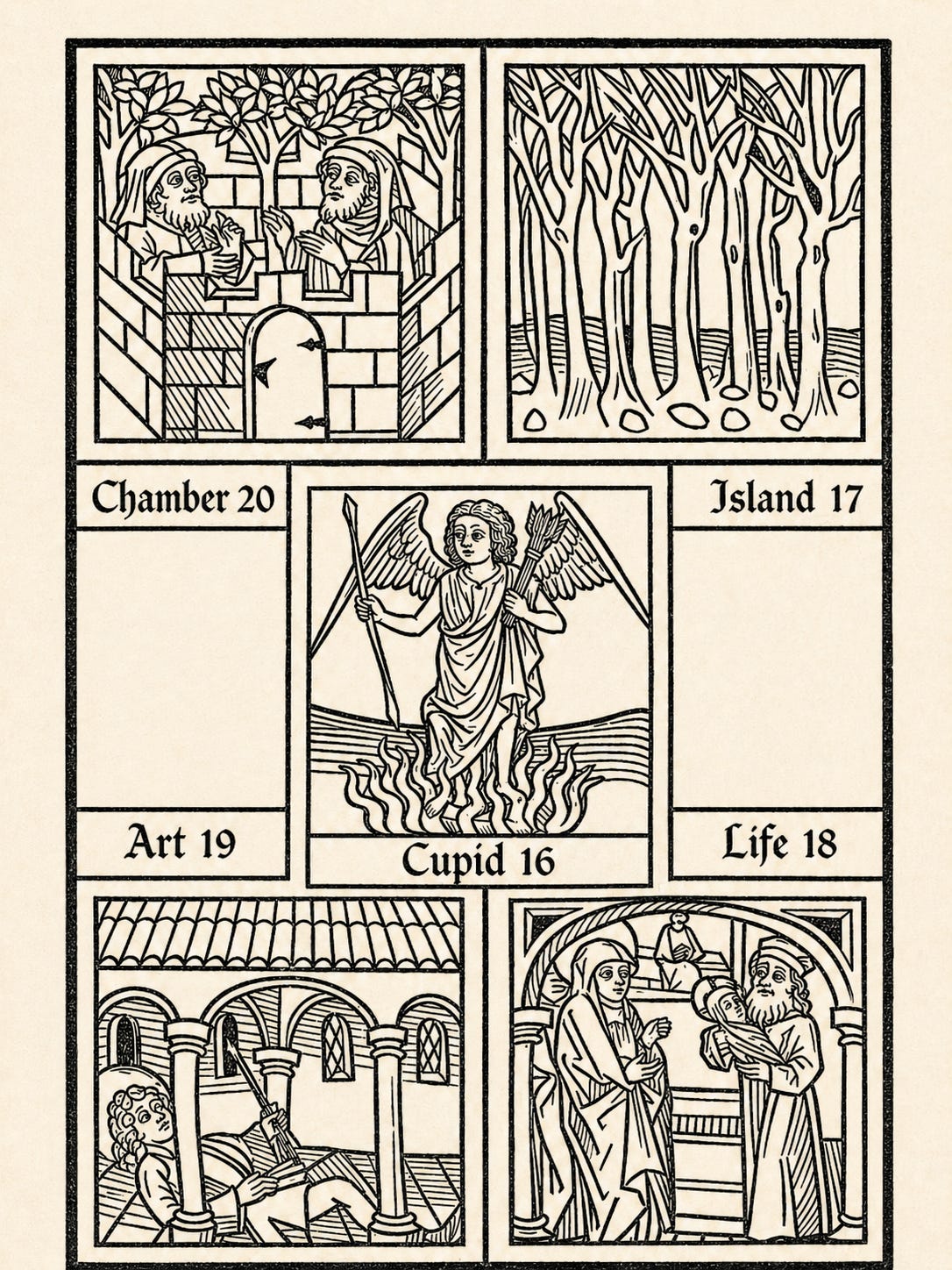
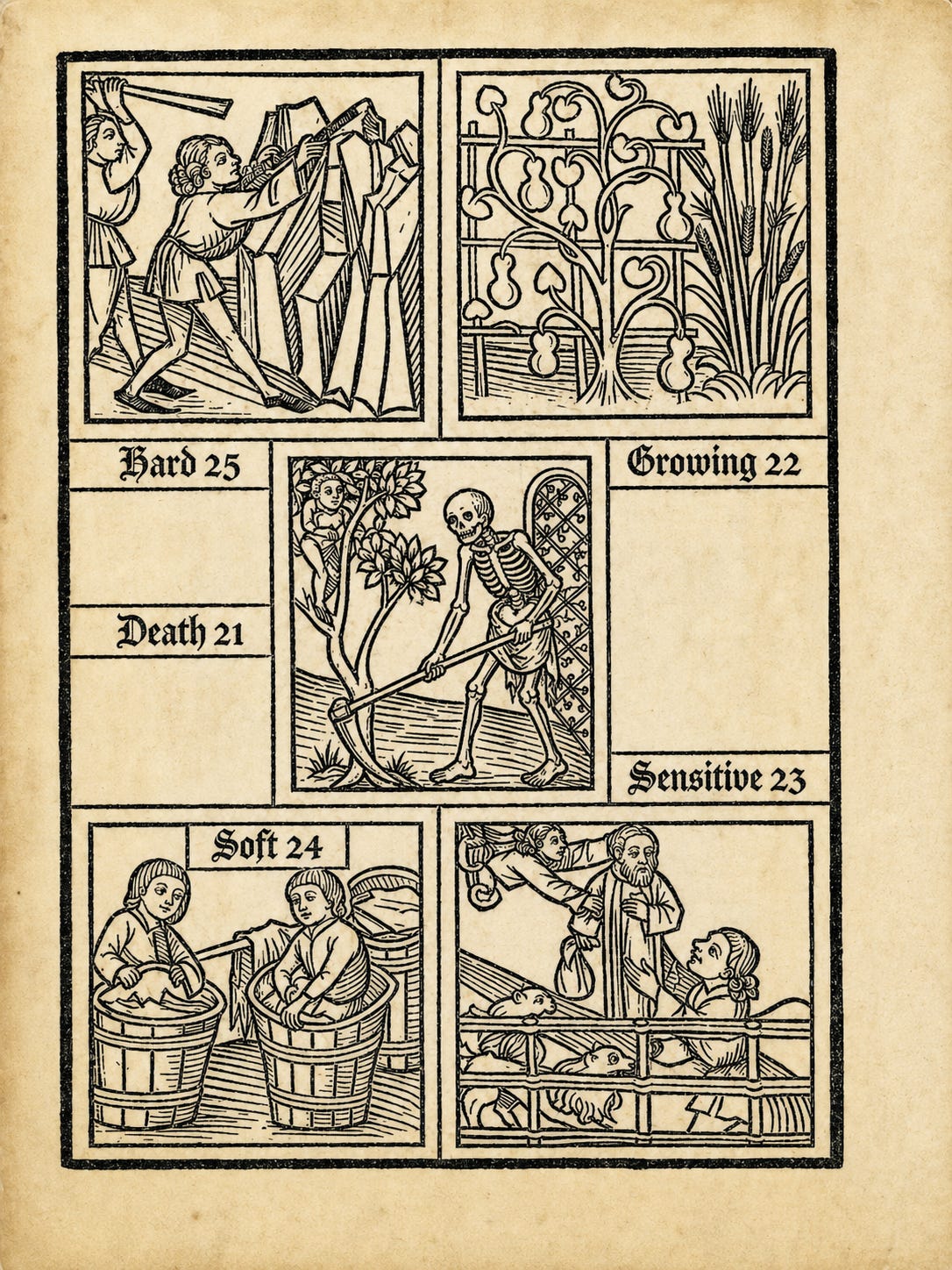
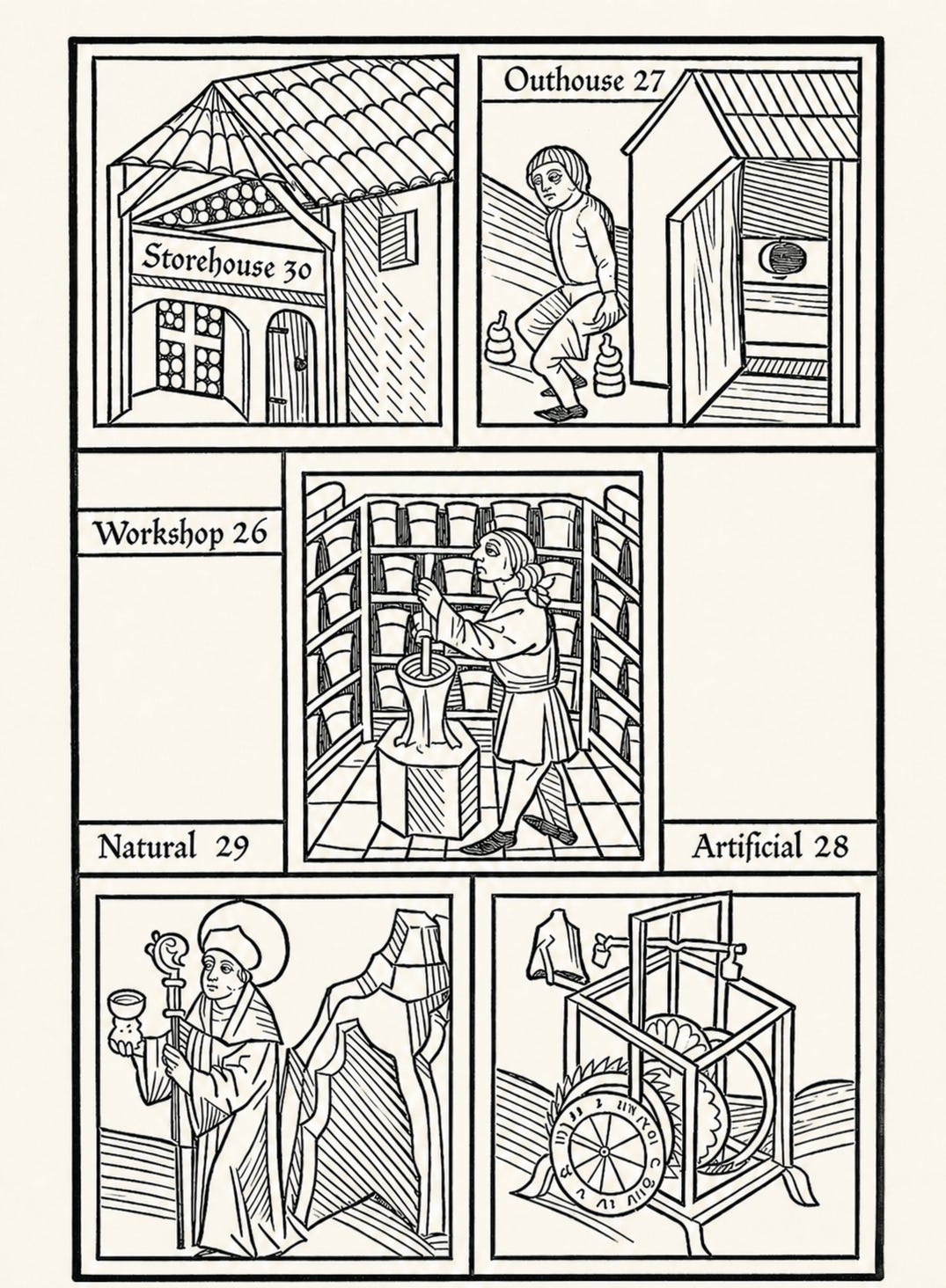
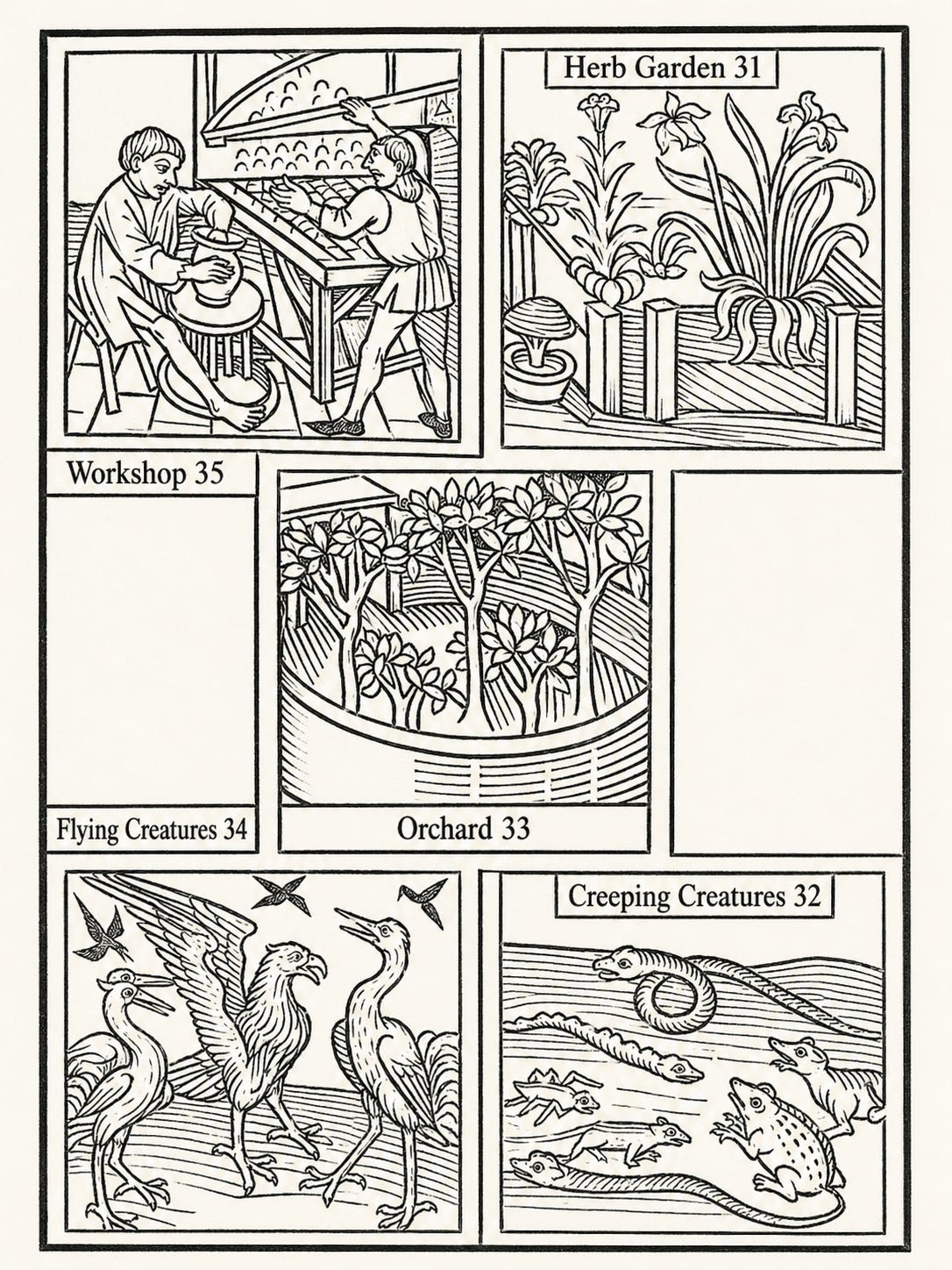
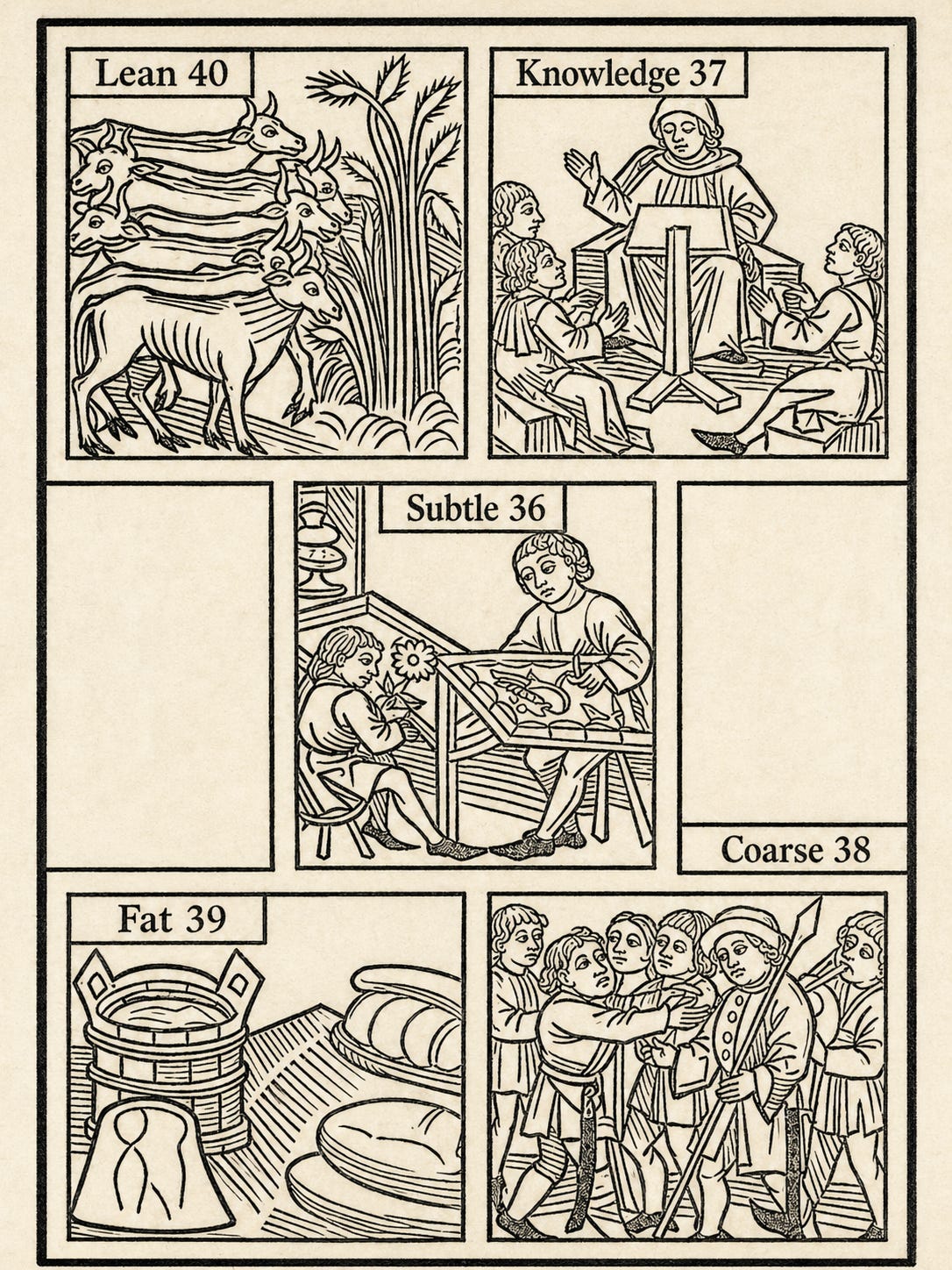
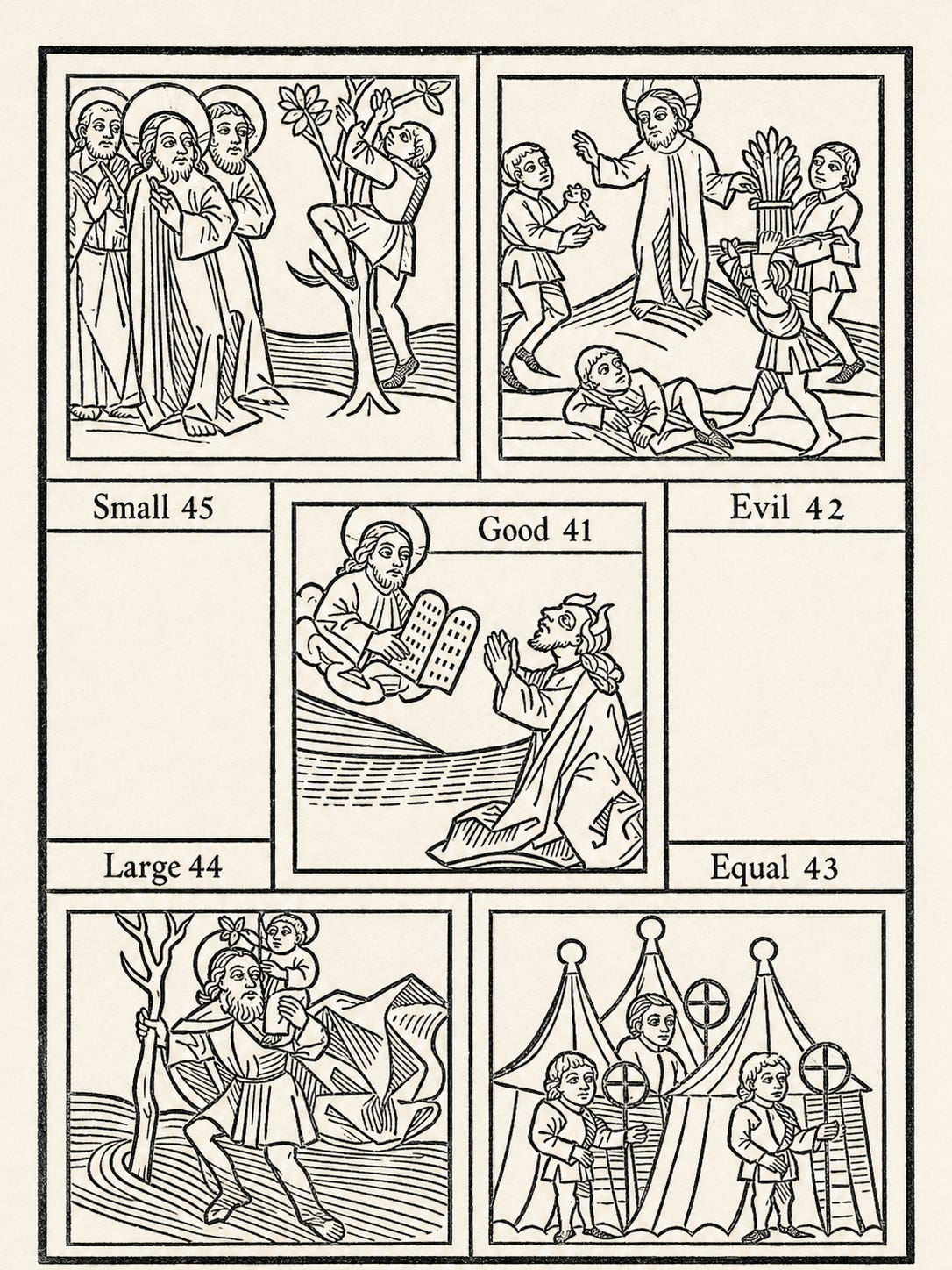
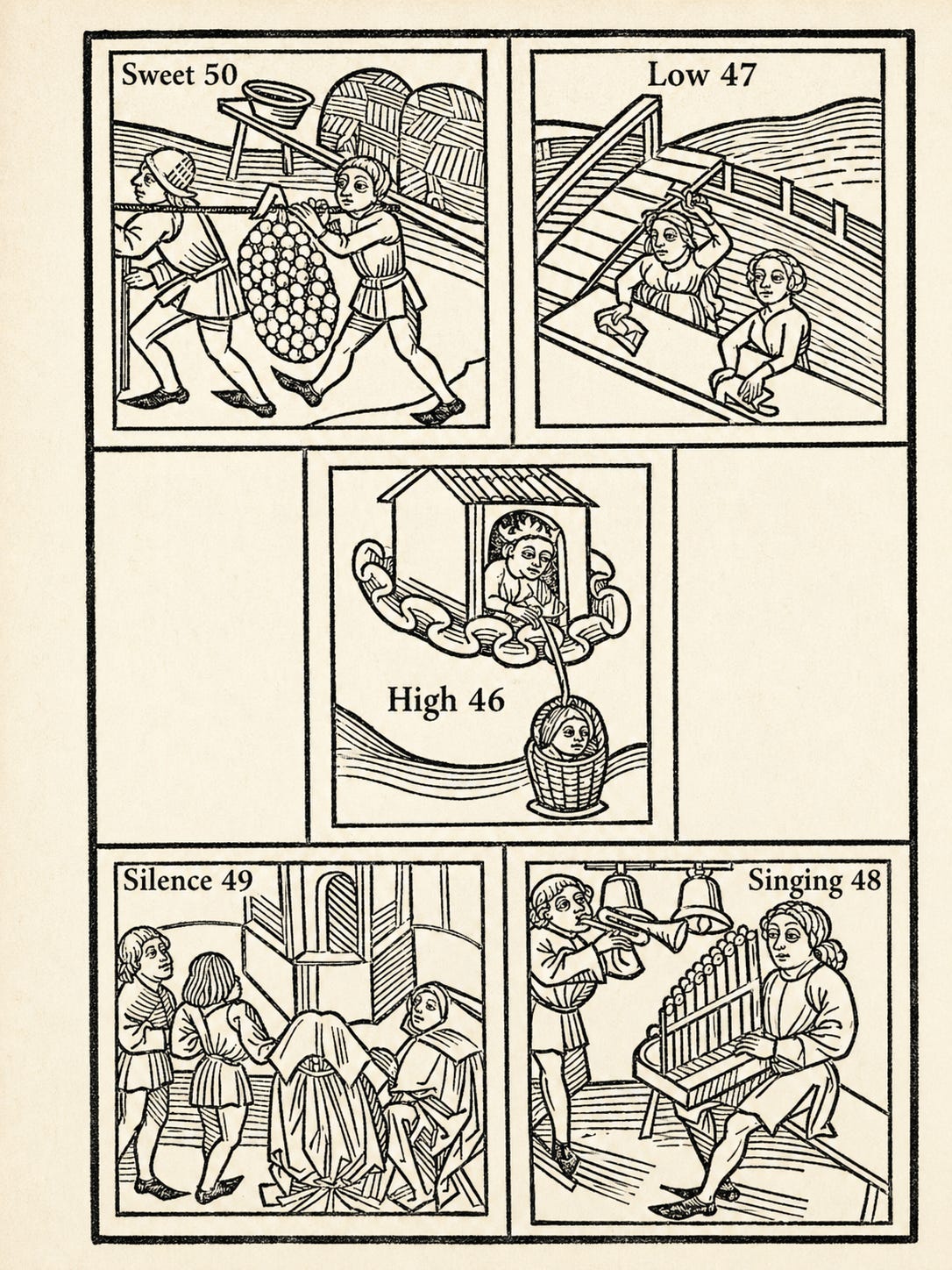
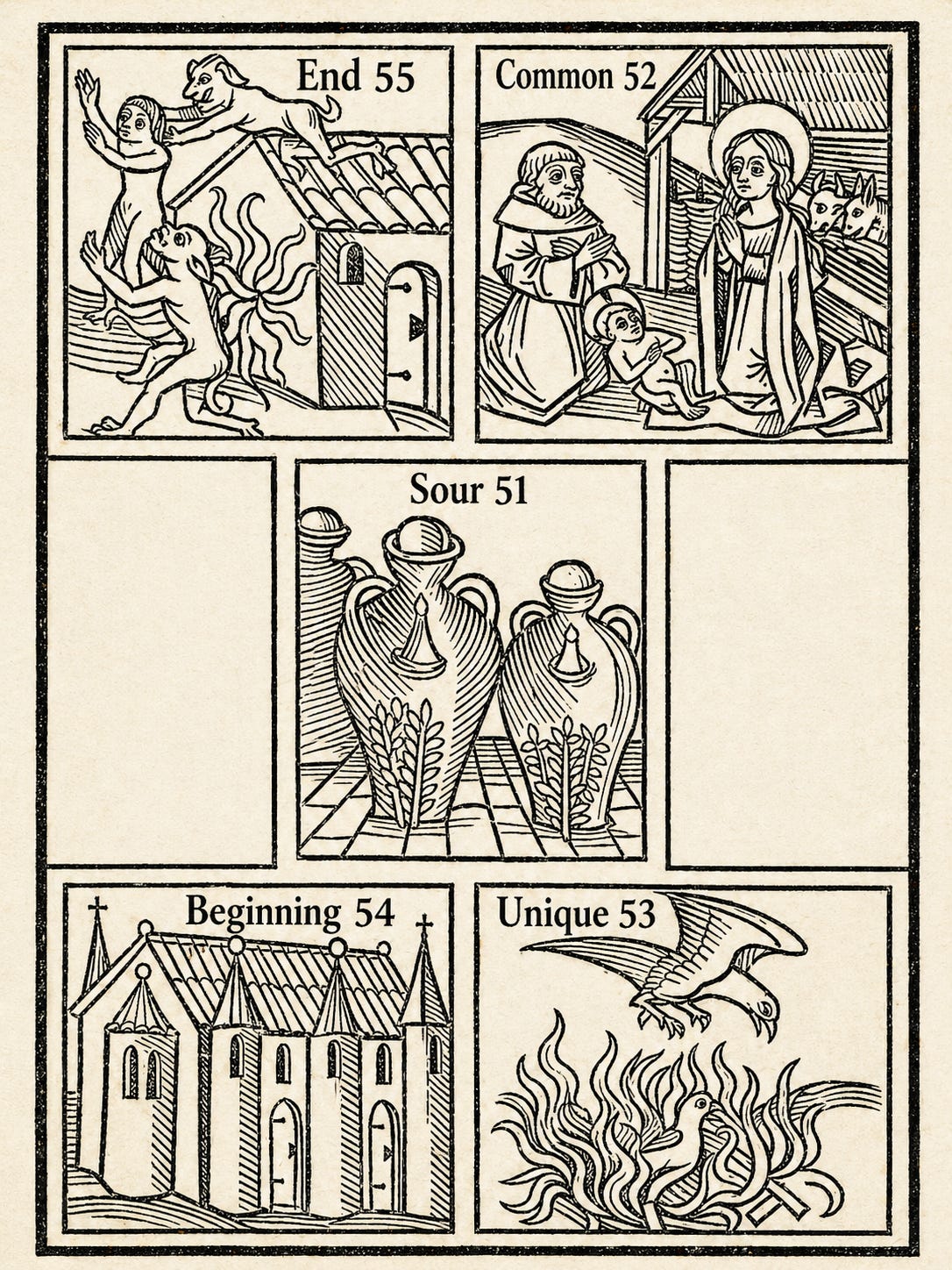
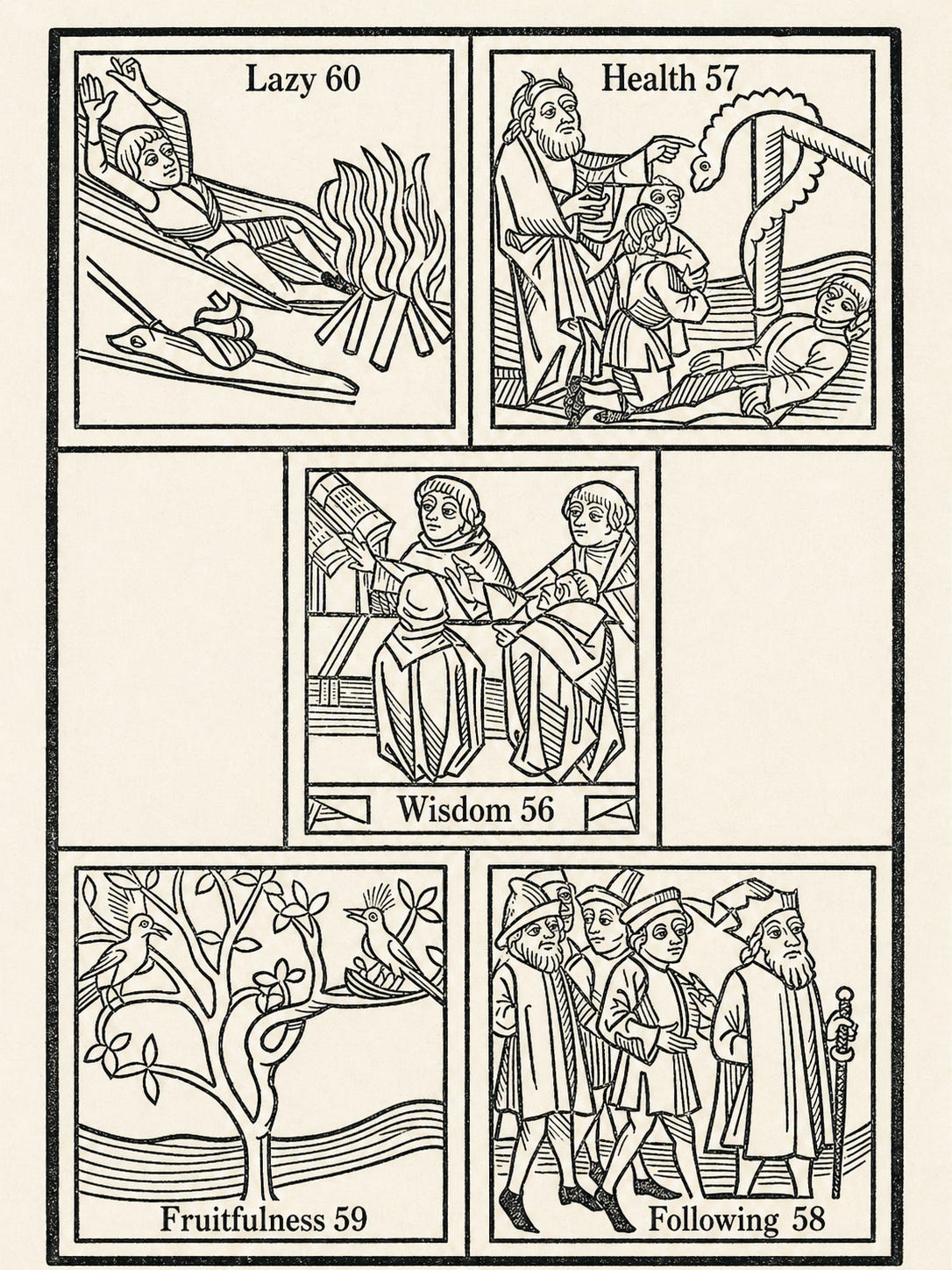
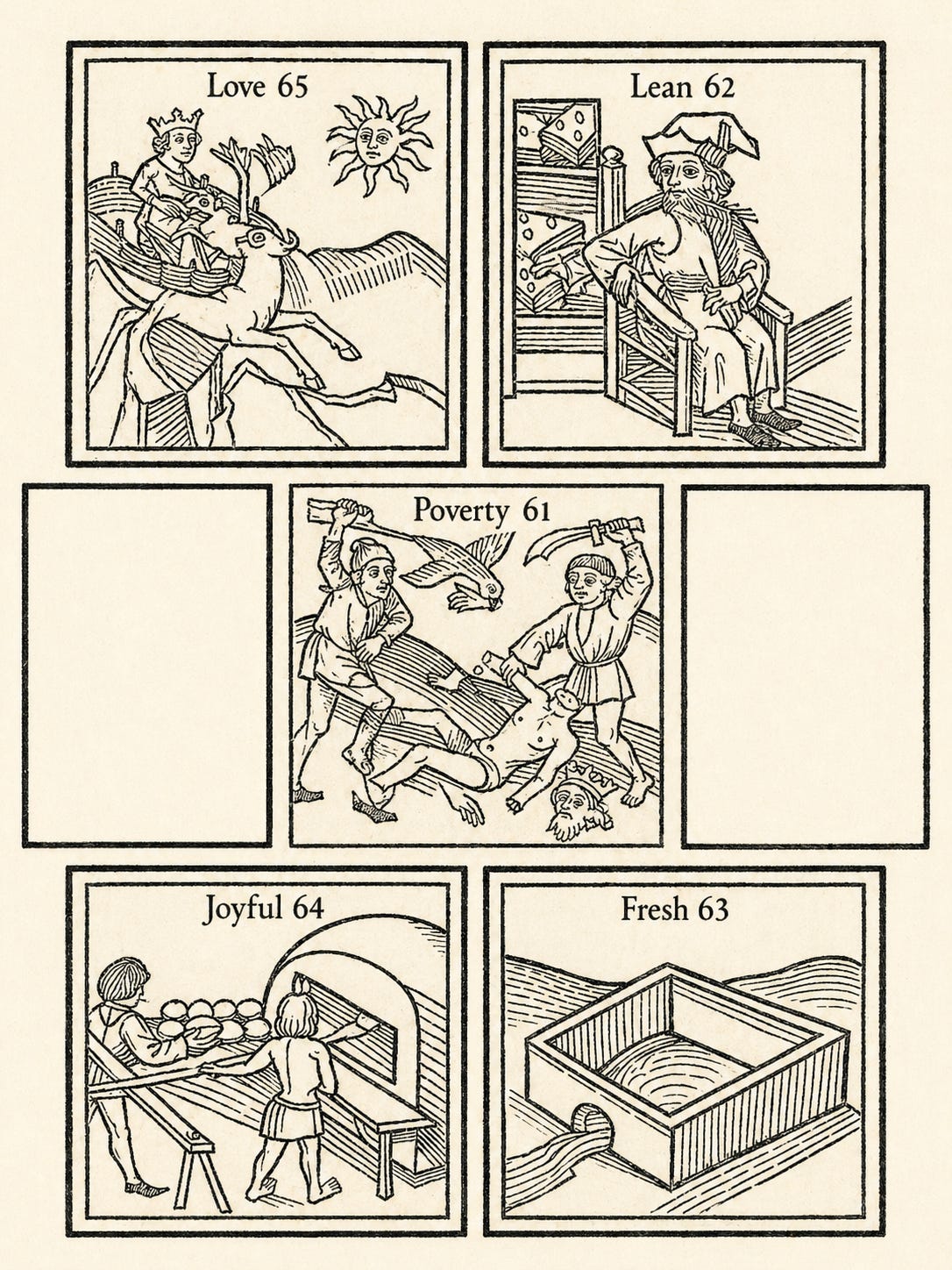
The heart of the book is the thirteen prints the author prepared:
Now we have spoken about the places, namely that one may paint them with various images, so that you can now do the same. Therefore I have had the following figure painted for you, which you may impress upon thirteen places, and from which the explanation is drawn.
You mentally imprint locations with these drawings, which then become pegs you can hang things on.
Pre-made mnemonic imagery was common in the Renaissance and early modern era. I’ve already shared The Art of Remembering by the Figures of the Evangelists, a mnemonic book for memorizing the Gospels using pre-made imagery. There are a few other books in the pipeline that also share pre-made mnemonics which I’ll be sharing in the months ahead.
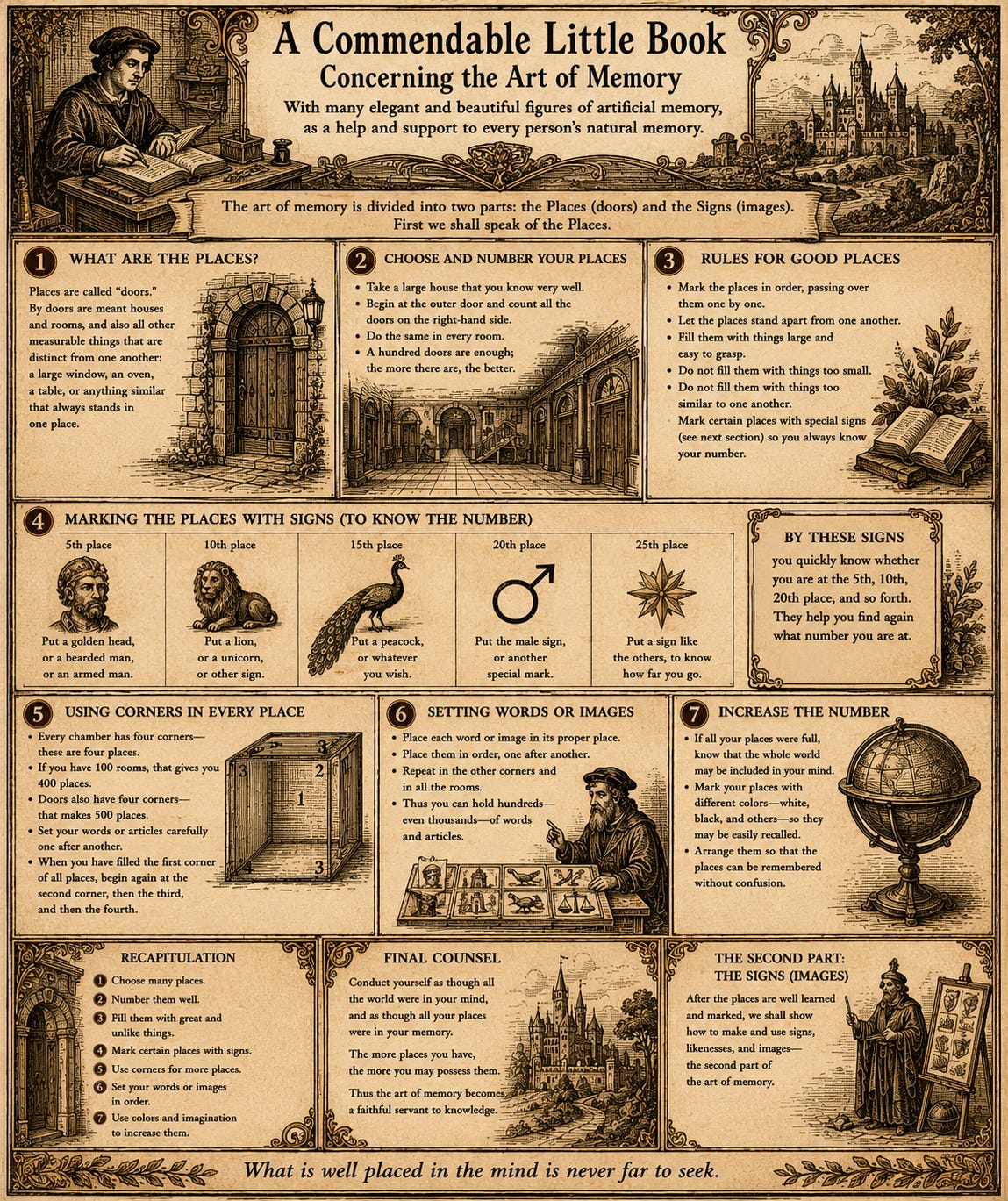
Here follows a praiseworthy little book, called in Latin Ars memorativa, with many elegant and beautiful figures of artificial memory, as a help and support to every person’s natural memory.
At the beginning of the art of memory you should know that the art is divided into two parts. The first is the places; the second is the signs/images. The others are likenesses or images. First I shall speak of the places.
You should know that the places are called doors. By “doors” are meant houses and rooms, and also all other measurable things that are distinct from one another: a large window, an oven, a table, or anything similar that always stands in one place.
If you want to learn many words or articles, you must have many places. Therefore, if you want many places, take first a house that you know very well. Begin at the outer door and count and number according to the right-hand side around all the doors. In the first room, and then in the other rooms, do the same. A large house with many doors and rooms is best for this. Yet it should not have more than is convenient; it should have a number that you can remember well. If you have a hundred doors, that is quite enough; but the more there are, the better it is.
You should fill these same doors in such a way that you can know very well how to find them for yourself when you wish to use the places.
Learn and mark the places in this way: mark the doors evenly, one after another, according to the right-hand side, so that you pass over them in order. You should also make sure that the doors and places stand apart from one another. The places should be filled with things that are easy to grasp, for what is too slight or too vague the understanding cannot hold.
The places should also be filled with large things. If a thing is too small, one cannot easily find it again. They should not be filled with things too small, as if one were to put small items into a small place, for that is not useful. Nor should one fill the places with things too similar to one another, as when five things are alike, or one is like another; then great error arises, because you cannot easily find out which is the first, which the second, which the third, or which the fourth in the number.
When you have all your places and have arranged them, you should mark them well. If you come to the fifth place, put there a visible sign or image, so that you know that it is the fifth place. For example, put there a golden head, or a bearded man, or an armed man, or whatever you wish, so long as the fifth place is clearly marked.
Then at the tenth place put another sign, such as a lion or a unicorn, or whatever you wish, but in such a way that you do not confuse the fifth and the tenth doors.
At the fifteenth place put, for example, a peacock or whatever you wish. At the twentieth place put a male sign. At the twenty-fifth place put a sign that is like the others in kind, so that you know how many places you have and can reckon whether you have reached the fifth, the tenth, the twentieth, and so on.
Also, because of this, you should always know at the fifth place that you have a sign there, and that it truly is there. That helps you quickly find what number you are at, whether fifth, tenth, or twentieth, and so forth.
And because of this, you should set your images and words into the places in proper order. If you wish to learn words or articles, place them carefully, one after another, just as I teach you here concerning the other articles of the image.
But before you learn the places, as I have said, you should mark the places well. When you have learned them and have set them into the doors, and when you know how large the room is and how many places you have taken for yourself, then fill the doors with places.
You know that every chamber has four corners. Therefore you should also have four places in one chamber. If you have a hundred rooms, then in every room four corners give you four hundred places. If the chamber has doors too, those are also good. You know that every door has four corners; each corner may also serve as a place. That also makes five hundred places. In this way you can set five hundred words or articles there.
But if you do not want to take the corners, then you should not name all the corners of every room or door one after another. Because you have already placed the places so that every place stands for one word, begin again at the first corner and set another word in the same corner, or another article, just as I shall teach you later how you should set it.
Then set the same thing again in the other corner of the same place. You should put it around the first corner of the other place, and afterwards in the third place. But in this you must take careful note: where the words are still more numerous, begin again at the second corner of the first place and put one in each corner, one after another, until all are taken up. Then begin again at the third corner, and afterwards at the fourth. Thus you will have the places together with the corners. In that way, you will have a hundred places, and if every place has four or five hundred with the corners, that is a large number. You can have more or fewer, according as one door has more or fewer places. If it often has fewer, then arrange yourself accordingly.
Even if there were still more words or articles than in a whole law book, or the Bible, or the chronicles, or more than all your places and corners would contain, nevertheless there would still be more places available to you.
Therefore, conduct yourself as though the whole world were included in your mind, and as though all your places were in your memory. The more places you have, the more you may possess them, especially if they are marked with colors: white, black, or other colors. Yet arrange them so that the places can be easily recognized.
Begin with white. When all the places have been marked with white, read them through in order, just as they stand. Then put one word or article in each corner. If the white color is full with all the corners, then proceed in the same way with the black color, and after that with the other colors. Whether there are more colors in the corners, or wherever else you wish to place them, you may still set more there. Yet be careful that it does not happen that, because there are so many, the places seem too few.
Thus, if you wish to organize your places well, you may use various kinds of walls or surfaces: those of a school, a house, a cloth partition, a wooden structure, a stone wall, or a paved wall. A wall may also be used as a number or reckoning. It need not itself be a word; what matters is that you know its place in the sequence, both before and after, so that you can recover your words again.
You should also know that the thing that is set highest is the one that is read last. Therefore you must read your words or articles from behind forward. After that, you should arrange yourself accordingly.
They should all be placed so that they are recognizable from behind, especially if a place is named for you. Then you should know what number it has: whether ten, twenty, thirty, or three hundred, and so on. As long as you do not know them well, it remains hidden from you. Therefore you must bring yourself to the point where you know it, because all art and reckoning depend on this.
Remember also the corners well. The first corner means one; the hundredth, when the place is the hundredth, means one hundred. But if the place is more or less, then the other corner at the first place means two and two hundred. Thus you will find it correctly, so that you do not become confused.
These are actually the masters’ names for the places: door, pillar, bench, table, chair, bridge, window, or such things. But because people call the door the most familiar place, they have it painted in books among the places as Vögel, Tier, Fisch, and so on.
For the first place they put an eagle, for the second a sparrowhawk, for the third a hawk, and so on in order: such as calves, and also many other foreign things, such as swans, sheep, birds, ravens, and the like.
They have these as places, because they have only words and know well which ones they have. For the places they also use the letters: x, xx, xxx, and the numbers. But Aristotle, who selected from all of them in secret, chose the doors and rejected all the others. He says that nothing is easier or better than doors in a house, because they can be known most distinctly.
And whether it is written in a book or depicted, one should nevertheless take the places in such a way that one has an image of them in memory and knows where they stand, especially when you have placed the places clearly in yourself. Therefore raise them out of one room into another, as I have told you how you should learn them.
You should not take only one kind of place. It is good that you know how to say the others too, but do not take them for yourself.
Now I shall speak of the other part of artificial memory: the images. You should know that the places in the art are like a wax tablet or paper upon which one writes. The images are like the figures or letters that are written upon it, or like the meaning that one wishes to write on it. Therefore you make the image out of things, just as, on a wax tablet, one cuts away the letters and puts others in their place.
For the first point, you should know that there are two kinds of images. The first is when you set the same word as it means, as an ox for the word “ox,” or an ass for the word “ass.” If it seems to you that the word belongs to the place, then it is called a true or proper image.
If it seems to you that the name’s meaning belongs to the place, then the image is also fitting and memorable.
If I were to give you many names, and they were alike, such as Peter, Drexel, Hansen, and the like, then pay attention to how one is different from another. One has a beard, another is clean-shaven; one is marked in some other way. One may have a part of him that is different from the rest of the image.
When one gives names, take likenesses according to them. For example, where someone is called Leusch, place a rampart; where someone is called Rampold, place a rampart in the garden. You may make many names recognizable by their likeness: a cardinal by the red hat, a bishop by the miter, a king by the crown, a tailor by the needle, a smith by the hammer.
Thus you should give every name its own image, as you may make it recognizable. It is all the same whether the image is made according to sound or according to meaning, provided that you recognize it yourself and place it in the place where the same name is put.
You should learn the names that you understand, whether they are German, Bohemian, Welsh, or Latin. Take for each a picture by which you can most easily recognize it. For example, retroire means Bohemian; you should know what it means in the likeness. If a thing is called by some expression that fits it, then represent it by that. Thus a man named “Rucka rucka,” or something like it, may be represented by a back or by a piece of armor. In this way you may make all names that are unknown to you meaningful, so that you yourself can place them as images, just as they signify.
So the selfsame word, bird, rose, leaf, and the like should each be placed in the image. You must mark in your mind that the image is exactly equal to the place where it has been put. But if you yourself do not know what image or likeness you should make, you should teach yourself from the very name, and from what you can discover through it.
By this you may recognize it. The image itself should become so familiar to you that you can know what it means. But it will be difficult for you at first. When it becomes familiar to you, it will be as easy as the wind.
You know that, just as something is painted or written with the eyes on the same door, so, when you have understood the image and the likeness artificially, as I have told you, you can make many words secretly and silently. You can read them inwardly and by yourself, after they have first been written.
If a word is given to you that means many things, as Ofen may mean an oven, and also a place of the same name, take it according to the sense in which you want it, whether it means a place or an oven. Such names would be ambiguous. Therefore make the image according to the easiest sense you can use, or according to the easiest thing that comes to you. Then arrange yourself according to everything that you want to learn; you must direct yourself by that.
You may also give every word its likeness according to its resemblance, by which you can recognize and remember it. If it were a word meaning “manly” or “brave,” you may represent it by a lion or a bear, for those are also brave and manly. Make the likeness for the brave as seems best to you: like a courageous man, or something that would be suitable.
For the timid or frightened, make the image by a hare or rabbit, for such is very fearful. For the strong, use a wolf, which bites much. For the delicate and clean, use a lamb. For the bad, use an evil example, by likeness, such as an ape, a toad, or a snake.
In this way, whatever image or figure most resembles the thing should be taken, so that you know what it means. It may be difficult at first, but once it becomes familiar, it will be easy.
When you have painted or written the image with your eyes on the same door, and when you have grasped the image and the likeness in an artificial way, as I have said, then you can place many words secretly and silently and read them to yourself as though they had been written before you.
If a word is given to you that has more than one meaning, take the meaning that is most useful and easiest for you to remember. Do not trouble yourself over all possible meanings, but choose one that gives you the clearest image. Make the figure according to the thing you want to learn, and set it in the place.
Likewise, you may give every word a likeness according to resemblance, so that you can recognize it by its image. For what is bold or manly, choose a lion or a bear. For what is fearful, choose a hare. For what is strong or fierce, choose a wolf. For what is innocent or gentle, choose a lamb. For what is wicked or ugly, choose an ape, a toad, or a serpent.
Thus you should always make the image according to the thing that is most like the word, and set that image into its proper place. Then, when you return to the place in your memory, the image will lead you back to the word or article that you wished to remember.
You may also give thoughts and likenesses with contrary words. For example, for a beautiful person who is very pretty, one may set a Moor; or for someone who is malicious or evil-natured, one may set a lovely person. You may do the same with letters: set one thing by likeness, and another by contrast.
For example, if a word were foreign to you, make it in your mind just as large as the word itself, written with golden letters upon the same door. If the word were “Rom” or “Peter,” you would make the letters appear as though they had been written out. For Rom you would set a Moor; for Peter, “reter” or a rider.
If a name is very foreign, as long as Matusalem or Melchizedek or the like, and you cannot make any likeness or image for it, then divide the same word into syllables and give each syllable its own likeness. For Matusalem: “ma” may be made from mat or matte, “tu” from a cloth or something similar, and the rest should be made according to its nature, as reason suggests.
Do this in the same way as titles are written in books, according to their meaning. You may also put an entire word on one tablet. For example, put fran for Franz, er for Erhard, weiß for Weland, and so forth. In this way, do with all words as it is easiest for you to make them known. I have taught you concerning single words.
Now I shall teach you concerning articles. You should know that an article is when a thing concerns or relates to something. It means something like a single unit or clause. For example, “to fight against weapons and armor for money” would be three articles, or a book in which there are many articles.
Thus you may set a whole article, as a word, upon one place.
You should learn it in this way: you must have as many places as there are words. Set in each place one word, with its memory-image, as I taught above. But if you want to learn it in a different way, then take note of the articles and give each one its own image.
Make all the articles very wisely and mark well what the counsel or subject suggests to you about every article. Set it also, with its image, in the same place. This is very good and useful in all things.
For example, if you want to memorize a saint’s life, such as Saint Katherine’s, set each article in its own place. Make an example from Saint Katherine: she was a beautiful maiden. Her father was a heathen king. Put this in the first place.
In another place, put that she separated herself from the world and went away from the abbot. Set in the third place that her father and mother were there at the punishment. In the fourth, that she was captured and put into a tower. In the fifth place, set that she was brought before the prince. In the sixth place, set the wheel with sharp weapons. In the seventh place, that the wheel broke. In the eighth, that she was beheaded. In the ninth, that milk flowed from her. In the tenth place, that the angels carried her to Mount Sinai.
So you may examine and learn all written histories, chronicles, or whatever you wish to learn.
When you wish to give words or articles a likeness, see whether they are very noble, very pleasant, or beautiful and graceful in measure, and whether they are not strange or rare. What is greatest is usually common to everyone: we see the sun every day, and we take no special notice of it because it is ordinary. But when an unknown sun appears, the greatest man may stare at it for a long time.
Therefore it is also with images: set common images and likenesses aside as much as possible.
Rare and unusual images are remembered very quickly. The more unusual something is, the longer it stays in memory.
You should know that artificial memory is founded on the words with which nature can be strengthened and helped. Whatever is contrary to nature is not worth much in this art. Therefore do not overburden yourself with everything that you hear and read. Place in it only what is good for you: not what is black or obscure. For when a person entirely abandons himself to artificial memory, or relies on it too much, he soon forgets the next thing, or what he has already lost from ordinary memory, just as someone who takes poison becomes sick.
The excess harms his nature. Therefore you should not set artificial memory above natural memory, which is the more excellent. Rather, you should strengthen and refresh yourself with it.
Know also: when you have placed something in the places, let it be to you like a law book. Always keep it. But when you have set something in there that you no longer need, as when you have memorized a speech or a sermon once before a lord, then you should remove all the images from the places and no longer remember them.
It would be good and useful for you to have two kinds of places: one set in which you place familiar things that you want to keep always, and another set in which you place temporary words or articles that are no longer needed after being remembered once. You may then erase those again, when you have shown and proven the art before people.
Read and practice all the written matters and articles until you know them very well and can keep them. This is the reward for all the labor.
Now we have spoken about the places, namely that one may paint them with various images, so that you can now do the same. Therefore I have had the following figure painted for you, which you may impress upon thirteen places, and from which the explanation is drawn.
If you do not want to use that, then cover the image with a white cloth. Yet in this way you can easily learn the material from the image itself.
Summary