
How to Build a Memory Palace with 200,000 Locations: Memory Diner Digest # 4

Table of Contents
Introduction
This Week’s Translations
1️⃣ The New Art of Memory by Jodocus Wetzdorff, 1500
2️⃣ The Art of Memory by Christian Umhauser, 1501
3️⃣ The Prolegomena and first 3 chapters of Book 1 of the Literary Polyhistor, 1732
4️⃣ The Compendium of Mnemonics, by Johann Ludwig Kluber, 1804
5️⃣ A Concise Theory of Mnemonics by Johann Christopher Von Aretin, 1805
Reprints
1️⃣ Of Memory by Thomas Fuller, The Holy State 1642
2️⃣ Memory by A.J Faust, The Appleton Journal, 1880
Thank You For Reading
Introduction
Welcome to this week’s edition of the Memory Diner Digest.
I have 8 translations and 2 reprints to offer readers.
The highlight of the week is definitely Johann Ludwig Kluber’s Compendium of Mnemonics, a German edition of Martin Sommer’s book.
I decided to translate Kluber’s translations (very meta) instead of Sommer’s Latin version, because Kluber had already done the hard work of piercing through the deliberate obscurity that Sommer’s cloaked his book in.
Sommer, and his teacher Schenkel, were secretive of their arts, and often made their texts difficult to read to those who weren’t their real life students.
Sommer’s 200,000 room memory palace technique can be found by scrolling to this week’s translations, it’s hard to miss.
Four of the other translations are from the Literary Polyhistor by Daniel Georg Morhof. This includes the prolegomena, and the first three chapters of the first book. The Literary Polyhistor contains multiple books. It's a beast.
The Polyhistor is split into multiple volumes, like the Literary Polyhistor, which contains manuals on how to study, the Philosophy Polyhistor, which is a study guide for philosophy, and the Practical Polyhistor, which is concerned with the sciences. All told, this work is well over 1800 pages, which is why I’m going to be drip feeding this one.
Besides translations and reprints, I also released a compendium of mnemonic imagery last Saturday, which I accidentally sent before I was finished with it.
This compendium collects imagery advice from the books I’ve been sharing, and starts with a short commentary on the art of imagery.
This commentary discusses 3 important points:
The central pillar of mnemonic imagery is meaning. The images you use need to evoke what you want to recall. You need to be able to effortlessly understand what your imagery means.
Words can be turned into images via several operations: by adding letters, by subtracting letters, by dividing words, by multiplication (either by adding new words or images, as in a rebus puzzle), and by re-arranging the letters of a word.
In some scholastic models, images from real life are handled by a different power than those created from fantasy. An image of your grandmother is a product of the imaginative power while an image of Godzilla is a product of the phantastic power. The imaginative power is stickier than the phantastic power. When creating mnemonic imagery, it’s usually better to extend the reach of the imaginative power via the phantastic power (like by picturing your grandmother acting like Godzilla), than to rely on the phantastic power alone. This is why many modern mnemonists create peg lists of people they know. Imagination trumps fantasy, but fantasy still has it’s place.
In the future, I’ll be releasing compendiums for places, models, and techniques. The compendium of techniques will cover compound mnemonics that combine different imagery & place practices. The compendium of models will share the frameworks that different memory artists recommend.
I’m also going to rebuild the topica, which you’ll find in the menu bar of my substack. The topica is meant to help researchers identify common threads woven through different works, so that they can easily find which texts mention which figures, techniques, metaphors, and so on.
I haven’t updated the topica in several weeks because I’m still working out a style guide for it.
Now, on to the translations!
This Week’s Translations
The New Art of Memory by Jodocus Wetzdorff, 1500
Wetzdorff’s New Art of Memory is a short and sweet beginner’s manual. It’s another example of the syllable method, and includes a slightly different alphabet than the one by Celtes Conrad.
I think it’s amazing that the syllable technique seems to have been lost to us until I started translating these texts. The closest I can find to a modern version of the technique is the Olli system, which I think isn’t nearly as elegant as the one used by renaissance mnemonists.
The syllable method is the renaissance version of the consonant number systems (like the major system) used by modern mnemonists. I vastly prefer the syllable method for most things. I’d use the major system for numbers, but that’s about it.
The Art of Memory by Christian Umhauser, 1501
Umhauser’s is another simple guide to memory. He offers up five techniques for creating images, as well as basic advice on how to harness the art. It is very short, so it makes a fine introduction for people who are completely new to the art.
The Literary Polyhistor, 1732
This week, I’ve released Johann Moller’s prolegomena to the Literary Polyhistor as well as Daniel Georg Morhof’s first three chapters of book 1.
Early in the prolegoena, Johann Moller ofters this banger of a quote:
“Certainly the degrees, as they call them, of the academies, once the true honors of erudition alone, sacred and public appellations, began afterward to be sold for a price and to be conferred indiscriminately on the worthy and unworthy; so now they have so lost their value that the illiterate laugh at and scorn them, the most learned men grow weary of them, and many of the very professors and judges of prizes who were once endowed with them think it beneath them to add them to their names, as if they were too little suited to their dignity.”
The edition I’m working from was published in 1732, though the quote might be even older than that. I love that people have complaining about degrees for hundreds of years. Plus ça change…
The rest of the prolegomena is a biography of Morhof’s life as well as an in-depth journey through everything Morhof ever published, and more amusingly, failed to publish. There’s an entire section where Moller shares all the texts Morhof promised to write but never got around to starting. It’s like if someone included a list of broken promises in your obituary.
The prolegomena contains references to a variety of never before translated works, and the one that really caught my eye was Otto Sperlinger’s On Learned Women, which was never published. It contains a list of 1400 female scholars, and was written at some point in the late 1600s. There’s a manuscript of the work, but it’s never been digitized. I wish it had, because I would love to translate it.
The first chapter of book 1 introduces us to the world of polymathy. It discusses the circle of arts, the dangers of taking on more than you can chew, and the importance of having a central discipline that you master. Morhof was basically an early advocate of t-shaped skills.
The second chapter discusses the history of literature, it’s development, decline, and renewal. It offers up several investigatory plans, with the highlight’s being those of Bacon and Lambeck.
The third chapter is a guide on establishing libraries, and will be of interest to any librarian curious about the history of their art. It also has two of my favorite quotes of the week in it, from Rolando Maresio:
“That reading is needed for the acquisition of doctrine is doubtful to no one; but attentive meditation and accurate consideration of nature and of the things which come before the eyes, and of daily events, are perhaps of no less use, provided you have drawn in the first elements of the disciplines and at least tasted the best writers. Yet in this matter I see much fault committed. For among us too little is meditated upon, though nonetheless one may easily and everywhere practice it; but we spend all our zeal in reading books, and we adorn the memory with a varied stock of things, with almost no care for judgment; and we retain only what someone has said, not judging why he said it.”
And from Lucas de Penna:
“A book is the light of the heart, the mirror of the body, the teacher of virtues, the expeller of vices, the crown of the prudent, the diadem of the wise, the glory of honors, the honor of the learned, companion of the road, domestic friend, talker and fellow-diner at table, colleague and counselor presiding, vessel full of wisdom, little jar of eloquence, garden full of fruits, meadow distinguished by flowers of all kinds, beginning of intelligence, storehouse of memory, death of forgetfulness, life of recollection; when called it hastens, when ordered it hurries, it is always ready, never disobedient; when asked it replies at once; a sincere adviser, it does not flatter, it does not speak to gain favor, sparing no one because it fears no one; it lies about nothing because it can do nothing; it never loathes you, even if you may loathe it; it reveals secrets, clarifies obscure things, makes doubtful things certain, resolves tangled things; defender against adverse fortune, moderator of favorable fortune; it increases resources, drives away loss; an inexhaustible well, immense treasure, unspent treasury, a paradise from which you cannot be driven out unless you wish it; fruit-bearing pleasantness, which you can enjoy as long as you wish; a teacher freely given, making you known if it finds you unknown.”
The Compendium of Mnemonics, by Johann Ludwig Kluber, 1804
The highlight of the week is Kluber’s translation of the Compendium of Mnemonics. This book is a must-read for any serious student of mnemonics.
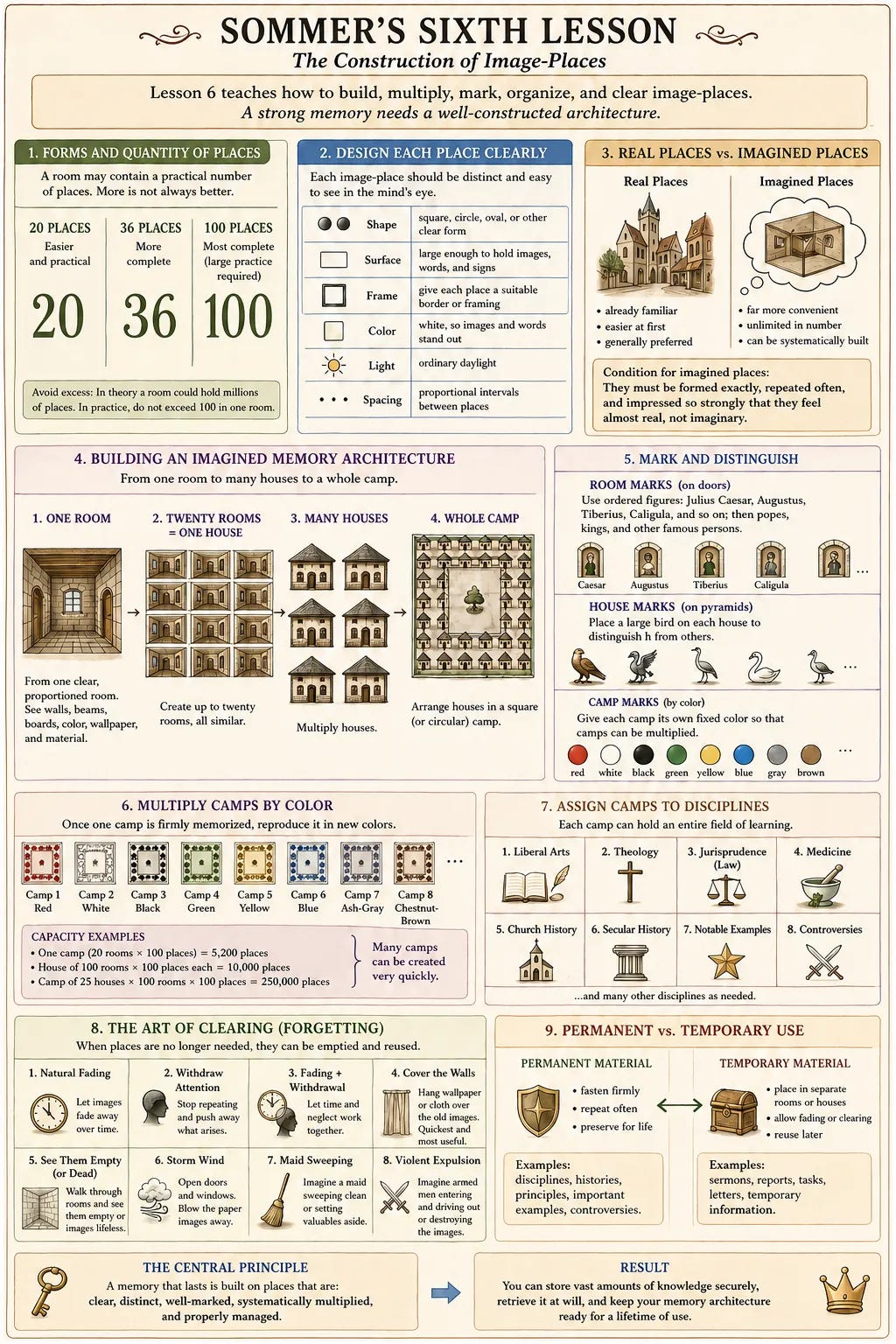
It gives us a brief overview of the eight lessons that Sommer’s taught in the mnemonic classes he gave in the 1600s.
In other words, it’s the actual curriculum of a mnemonic course from hundreds of years ago. It’s not the full class, since Sommer’s doesn’t share all his techniques in the book, but it at least gives us the main idea of what he covered.
Weeks ago, I speculated on what Sommer’s technique might have been for the “200,000 room memory palace” he mentioned in A Brief Outline on The Uses and Admirable Benefits Of The Art of Memory, the advertising pamphlet he published for his courses.
My speculations were right: the technique does involve dividing and multiplying places.
He discusses the mechanics of his mega palace method in the 6th chapter of the compendium. It involves creating a camp full of imaginary houses and then dividing the houses in the camp so that they contain 10,000 places to store images. Using his technique, a camp with 25 houses would hold 250,000 places.
You could then easily multiply these camps by painting them different colors. Do you hate yourself and want to memorize ten million items?
Well, have I got a technique for you.
I don’t think Sommer’s actually used his camp mnemonic to memorize hundreds of thousands of items.
I’m sure he did use it, but for a reasonable amount of items. Instead, I think the main purpose of the mega camp technique was to hype up and advertise his courses.
Learn how to remember everything by building your very own 250,000-loci memory palace! All for the low, low price of three gold coins! Places are limited, so sign up now! Satisfaction guaranteed or your money back!
Sommer really did offer a money back guarantee for his courses. A true salesman, through and through.
In practice, his camp technique should work, but as I’ve written before, extremely large palaces aren’t that useful because you will never have the time to actually sit with the items you store in it.
My favorite chapter of the Compendium is the third, which covers the art of abbreviation. Abbreviation is something I use in my own practice: Sommer argues (correctly), that you can segment any palace into parent and child nodes in such a way that recalling the parent node will also remind you of all its child' nodes. Using abbreviation, you can recall the contents of a book by retrieing just 10 images instead of 250.
The fact that he covers abbreviation in chapter 3 before discussing how to create an incomprehensibly large memory palace is one of the reasons I doubt Sommer’s ever really used his mega camp technique . He clearly knew the value of shrinking palaces down to a reasonable size.
He should have spent more time explaining how abbreviation can work with his camp mnemonic.
Out of the two techniques, I would spend more time learning how to master abbreviation than learning how to create infinite palaces.
The eight chapter is my second favorite, which covers his approach to studying the liberal arts using the art of memory. It’s a bit underbaked, but the fact that he capped his book with it speaks volumes to the actual purpose of the art: having conversations with things that genuinely matter.
A Concise Theory Of Mnemonics by Johann Christoph Von Aretin, 1805
This is the first part of Aretin’s larger system of mnemonics, which I will eventually translate once I find a better scan of the book. A Concise Theory was published in 1805, while his system itself was published in 1810.
Aretin was among the first people to try to bring the art of memory under the umbrella of science. His book fails to do this, but it’s an admirable effort. He’s obviously a skilled mnemonist.
He does offer some valuable insights in this piece, but again, he’s trying to write a scientific work on memory a century too soon: at the time he published A Concise Theory, both the fields neuroscience and of psychology were barely embryonic. It would be eighty years before Ebbinghaus published his seminal work on forgetting curves, which more or less kickstarted the genuinely scientific study of memory.
Aretin lacked the tools to accomplish what he set out for himself. This work of his is best viewed as a kind of awkward transition between the early-modern era of mnemonics, when Aristotle and the Scholastics were still influential, and the industrial era of mnemonics, where the influence of their metaphysics had been completely severed and replaced with nonsense since neuroscience and psychology just weren’t where they needed to be to explain what was going on when people engaged in the art of memory.
I often talk about the mnemonic Dark Ages, which began in the mid-nineteenth century, once number-peg systems like the Major System, popularized by Aimé Paris, Francis Fauvel Gouraud, and others, became ascendant. This era would last for over a hundred years, into the 1960s.
The publication of Frances Yates’s The Art of Memory in 1966 is a good ending point for the mnemonic Dark Ages. After the sixties, real research into mnemonics became common, as did real innovations in the art.
Aretin’s efforts predates the fall of mnemonics, but he just wasn’t able to create the conditions necessary to prevent it from happening. It’s a shame, he had the right idea, he just didn’t have the right tools, and by the time those tools actually existed, the art had been mostly sidelined outside of self-help movements like Pelmenism.
Reprints
Of Memory by Thomas Fuller, The Holy State 1642
Thomas Fuller’s Of Memory is a small chapter in a much larger book. Its most distinguishing feature is the criticism Fuller metes out against mnemonic teachers. Fuller believes that the only people who benefit from the art of memory are the teachers who charge students to learn it. Fuller’s real target isn’t memory itself, but the commercialization of memory when sold as a shortcut detached from serious study.
There’s some weight to this critique. Mnemonics is a subsidiary art. It needs to be part of a larger practice in order to shine. It’s a force multiplier, but not a force in itself. Combine the art of memory with a powerful philosophy of learning, and you’ve got something magical. Teach the art of memory on its own, divorced from a greater purpose, and your teaching it at half strength.
It’s not a coincidence that the greatest influence mnemonics ever had was when it was taught as one of the canons of rhetoric. It’s an excellent supporting character, but it can’t carry a subject on its own.
The greatest failing of the mnemonic tradition, in my mind, is that its practitioners never succeeded in developing a curricular home for the art outside of rhetoric. Mnemonics needed to be embedded in a larger course of study, where memory served grammar, rhetoric, philosophy, theology, history, law, medicine, and the sciences.
I like Sommer’s approach because his final lesson covered how to use mnemonics to study the liberal arts. I don’t think that single lesson of his was enough, though: it really should have been baked into all eight of his classes.
Memory by A.J Faust, The Appleton Journal, 1880
Faust’s essay on Memory offers up several excellent biographies of multiple polymemnones.
The highlight for me, though, is that he discusses the culture of memory. This touches on what I just mentioned in my brief review of Fuller’s essay. I’m going to use this as an excuse to go on a fairly long tangent.
The art of memory requires a culture of memory in order to realize its full potential.
You can have the best mnemonic techniques in the world, but if you lack a coherent culture of memory, one that allows you to make use of those techniques, then you’ll end up like the Ancient Greeks who developed early versions of steam engines, fantastic steam and air pressure devices, which they mostly just used for theatrics.
Instead of figuring out how to use these air pressure devices to kickstart the industrial revolution, they built thrones that lifted kings, automatic doors for their temples, or ways to move figures and props around.
The art of memory requires a new culture of memory, or it will just meet the same fate as those old pressure devices: something that’s on the wrong edge of revolutionary.
This is a theme I’ll be revisiting frequently in this newsletter: there are incredibly powerful forces at work that benefit from severing people from their roots.
A society that honors the past and where all citizens are capable of holding real conversations with it would look substantially different from our own.
There’s also a big difference between the gacha memory of current scholars and the ordered memory made possible by mnemonics. Gacha games involve slot machine mechanics where players are randomly awarded characters or accessories.
I call it gacha memory, because when you fail to organize your memory, what you get changes every time you retrieve something from it. You get what the slot machine in your head gives you.
An ordered memory allows for structured engagements with the past. You know what you’re going to get, which means you can sit with a stable representation of it instead of a more chaotic summoned representation that’s at the mercy of your circumstances. It's the difference between having a phone that connects you with random people inside a building, and having the phone numbers for the exact people you want to call.
Mnemonics enables tools of thought that are unlike anything currently practiced in our society.
Unlike most memory artists, I don’t consider mnemonics the art of memorizing or even of making memories: I consider it the art of organizing memories. It’s structuring what you already know and what you’ve already experienced.
When you read a book, you form a mental representation of what you read. All mnemonics does is make it easier to recall that representation. It does not form that representation.
You already did that by reading. Or thinking. Or experiencing life.
All mnemonics does is help you find what you’ve already experienced.
Order your memories, and you can call on them at your own convenience.
Imagine a book club where everyone can discuss each page of what they read, or at least their understanding of it, from memory. No notes. And i’m not talking about reciting each word on each page, but recalling the general gist or main idea. The res, not the verba, as the ancients would say. Everyone experiences the world differently, and in this magical book club I’m talking about, you could walk through how each member experienced the book. Each page looks different for everyone, and mnemonics would make it a breeze to explore those differences.
And what’s true of books is true for society writ large. Just as mnemonics empowers new forms of discussions, it can also empower new forms of investigating and relating to knowledge.
Mnemonics, as an art, will only reach maturity once it becomes a social practice. Not an individual practice. Social mnemonics is what will break the art wide open.
There was an excellent study on cultural continuity by Michael Chandler and Christopher Lalonde. You can read the PDF here. Chandler and Lalonde showed that suicide rates among First Nations communities were lower in communities with stronger markers of cultural continuity.
Cultural continuity is a protective shield against alienation. When we recognize our existence as one link in a great chain that stretches back in time, one embedded in specific places, among specific peoples, with specific histories and traditions, we experience the world differently. We are protected from the atomization and alienation that our societies are currently engineered to produce.
Knowing your family history is a good predictor of emotional well-being, as studies using the Do You Know scale have shown. Similar results have been replicated in different contexts, showing that the protective effect of shared memories applies to more than just knowing about your family.
Feeling connected to your community and embedded in it is a basic need for most people. The art of memory is something that can be used to cultivate that sense of connection.
Our societies are now increasingly designed to uproot everyone and everything so that we can become easily replaceable widgets in a great economic machine. This machinery severs us from the past, but the art of memory, at its highest level, is a practice of reattachment: to the places we live, to the people who made us, to the history that led to us, and to the collective inheritance that was left to us.
Restoring our relationship to the past is a dangerous act. The art of memory cannot reach the heights it’s capable of reaching without throwing a wrench into a very big social machine that profits from our immiseration.
A culture that can enable the full expression of the art of memory would be inimical to the cultural amnesia that our society currently requires of us.
We need to be ignorant of why things are the way they are in order to tolerate the dysfunction that surrounds us.
A cultivated memory pointed in the right direction would make the level of ignorance demanded of us impossible.
This might seem outlandish to some of you, but you should ask yourself what a world where the past is valued actually looks like.
It’s very different from our own.
The fact that a sense of cultural continuity helps protect against suicide should give you an idea of the protective power of cultural memory.
This might seem like a strange tangent, but the art of memory will never thrive without changing our relationship to the past and how we engage with it. And we can’t do that without a lot of downstream consequences.
Ahem, well, that was a bit of a side quest, but it’s what Faust’s article called to mind.
I recommend reading it, and just like my book club example above, I’m sure you’ll take away lessons from it that are quite different than the ones I did.
Thank You For Reading

Thank you for reading this week’s digest. If you enjoyed it and want to read more like it, be sure to share and subscribe. See you next week!