
The Easy Guide to Learning Chiromancy & Physiognomy by Jean Belot

Elder’s Notes
Jean Belot’s The Easy Guide to Learning Chiromancy & Physiognomy is a collection of three works: the titular book on palmistry and face reading, then a work on the Lullian art of memory, followed by a work of prophecy about the comet of 1618.
Belot was a parish priest and professor of divine and celestial sciences. He’s forgotten now, but his impact on the occult lives on, thanks in part to Richard Saunders, who translated substantial portions of Belot’s work without credit for his 1653 work Physiognomie, and Chiromancie, Metoposcopie.
Several things stand out about this compilation.
I really like the hand palace Belot uses for the Lullian alphabet. It’s very clever, and I already see several ways to adapt it for more modern applications.
Here’s what it looks like:
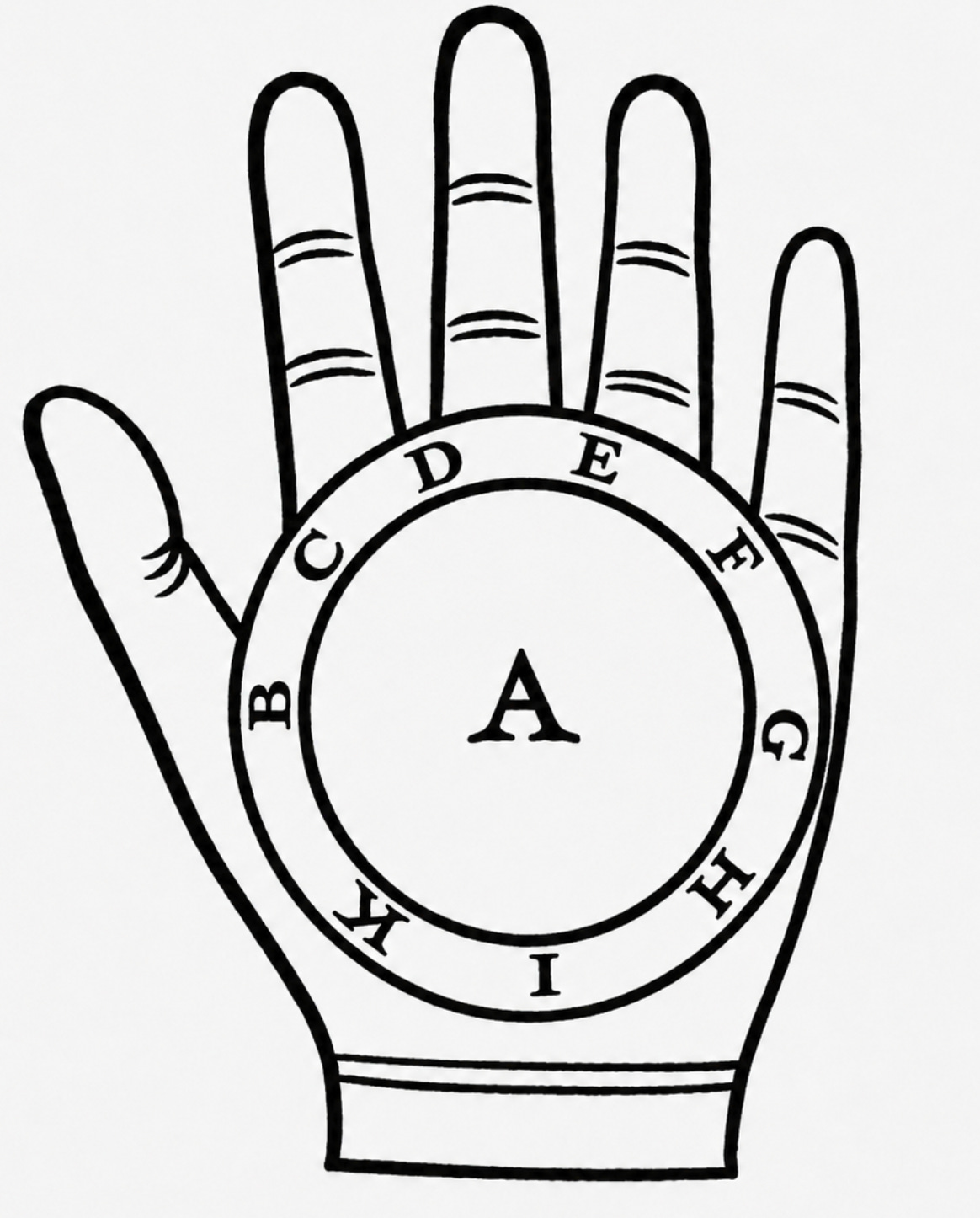
A stands for the subject, and each of the other letters corresponds to the Lullian alphabet, so each letter has one of four possible values: as absolute and relative predicates, as questions, or as predefined subjects. Let’s say you want to investigate penguins. You’d put the penguin where the A is, and then you’d use the other letters to investigate it.
That’s the CliffsNotes version. It’s more complicated than that, but the general framework is that you put a subject in your palm and then surround it with different prompts that force you to engage with the subject in different ways.
You can see how a device like this could be used in a creativity practice. Just replace the Lullian values with your own selection of prompts, and you’ve got a fun way to interrogate different topics.
Let’s say you’re an animator. Imagine if you assigned each letter of the Lullian alphabet to a different luminary in your field, preferably someone you have a deep understanding of, and whose works you’ve committed to memory. You put Don Bluth on B, Tex Avery on C, Walt Disney on D, Mary Blair on E, Max Fleischer on F, Matt Groening on G, Hayao Miyazaki on H, Mike Judge on I, and Joe Barbera on K.
You now have a host of people standing around the subject that you can imagine interacting with it. If you have a deep understanding of their work committed to memory, this is fairly easy to do.
Belot’s treatment of the ars combinatoria, or the art of combination, is one of the first times I’ve actually encountered the topic directly instead of through secondhand sources.
The art of combination is one of the things I’m most excited to investigate in this newsletter. It’s a structured way of combining items in your memory palace so that you can better investigate issues or compose works. In other words, it’s the perfect tool to help your contemplative and creative practices, which is why I’m interested in mnemonics in the first place.
Belot provides 24 combinations for the first three letters of the Lullian alphabet.
Six full permutations:
BCD, BDC, CBD, CDB, DBC, DCB
And 18 double-letter variants:
BBC, BCB, CBB
BBD, BDB, DBB
CCB, CBC, BCC
CCD, CDC, DCC
DDB, DBD, BDD
DDC, DCD, CDD
These are rote combinatorial exercises. You can use them to train how you engage with a subject. So imagine if B is “definition,” C is “distinction,” and let’s assign D to “demonstration.”
B = What is it?
C = What kinds or distinctions does it have?
D = How is it proved or shown?
So if the topic is angels, B defines them, C lists their attributes or distinctions, and D offers an example of them. BDC means you start with a definition, follow with an example, and then contrast or distinguish it. CDB, meanwhile, starts with a distinction, followed by an example, before settling on a definition.
The combinatory drills are a way to tackle a problem using different steps in different orders, with some repetition thrown in for good measure.
You then use the remaining Lullian letters as memory places for the material in your composition or investigation.
It’s very neat.
Table of Contents
The Easy Guide to Learning Chiromancy & Physiognomy
Preface to the Readers
What One Needs to Know in Order to Learn the Science of Chiromancy.
The True and Complete Description of the Hand
Why the seven planets and the twelve signs of the Zodiac are necessary in the science of chiromancy.
Which of the two hands is more proper for the purposes of this science
What the chiromancer is required to know.
Epitome or abridgement of Physiognomy.
On the mouth, the ears, and the face in general
On the four humors or the temperaments of man.
On predictions from the hands in general.
WHAT ARTIFICIAL MEMORY IS, OR THE ART OF RAYMOND LULL.
What artificial memory is.
The places where one must imagine these letters to be set.
Why the art is called brief.
A more intelligible alphabet.
How this art must be practiced.
ASTROLOGICAL DISCOURSE AND GEOGRAPHICAL AND TOPOGRAPHICAL DESCRIPTION OF THE COMET THAT APPEARED OVER OUR HEMISPHERE
The Easy Guide To Learning Chiromancy and Physiognomy.
In it is taught the most perfect of the secrets of artificial memory, called the Short Art of Raymond Lull. It is extremely useful both to people whose profession is preaching, public speaking, or pleading cases, and to those who are heavily involved in trade and business.
Also included: an astrological discourse and a geographical and topographical description of the comet that appeared over our hemisphere last year, 1618, together with predictions about it, whose outcomes will be fearsome.
All by Master Jean Belot, priest of Milmonts, professor of divine and celestial mathematics.
Paris: sold by Nicolas Rousset and Nicolas Bourdin, on the Isle of the Palace, opposite the Augustinians. 1619. With the King’s privilege.
Against the envious man.
Whoever you are, if you envy these things, set aside what does not please you. Or else read this excellent work, so that envy, if it can, may grow.
To my lord, the most reverend and most illustrious Bishop of Chartres, Master Philippe Hurault, counselor to the King in his councils of state and private councils, grand almoner to the Queen Mother of the King, and so on.
My lord,
I offer Your Greatness this gift. It will seem small and slight to people whose only profession is to criticize and condemn the arts and sciences, and who, deceived by their own empty presumption, try by that means to pass among fools as deeply learned. They are like the spleen, which can grow larger only by harming all the other members. But learned people and lovers of letters will value it highly for its rarity.
So, my lord, as soon as this little work began to be born, the wish was born in me at the same time to dedicate it to you, for two reasons. First, because I recognize the love you have for lovers of the Muses, a love that belongs to you by origin. Your father, my lord, that great Chancellor, loved them passionately, as all learned people testify, along with the many writings dedicated to him. Second, because your virtues are so famous: they make you revered throughout France, which regards you as a phoenix among prelates. Your birth and the stars promise you the highest ecclesiastical honors to which French prelates can aspire. For just as your late father, whose virtues and name you inherit, was born under Virgo Astraea and was raised to the highest rank of justice, so I believe that you, born under such a star, are promised elevation to one of the most eminent great honors of the Church, namely the cardinalate: a dignity your merits have earned, both through the zeal you bear toward the Bride of Jesus Christ and through the services you have rendered in this French monarchy. Because of those services you are cherished and loved by our great and just king, Louis XIII, and by the Queen his mother, the most virtuous princess we have ever had, whose extraordinary virtues made her the wife of the most pious, wise, and warlike monarch who ever held a scepter.
Considering these things, my lord, and considering my own station, I neither could nor should dedicate this labor of mine to anyone but you. I do so to pay you the tribute of my labors, just as the stars pay tribute to the Sun, father of their light, or as springs and rivers pay tribute to the great ocean. In the same way, being the least of so many venerable priests who adorn your diocese, I offer you this gift.
We read in the poets that Jupiter and Mercury lodged in the house of Philemon and Baucis, where those simple people presented them with a few garlands of little flowers, which they courteously accepted; and to show that they found such a gift pleasing, they crowned their brows with them. Imitate those deities, my lord: Your Greatness will kindly receive this small gift, without looking at its lowliness, but instead at the affection of the one who gives it, whose only aim is to make himself immortal in this capacity.
My lord,
April 10, 1619.
From your very humble and very obedient servant,
J. Belot, priest of Milmonts.
Preface to the readers.
To satisfy the curiosity of a few of my friends, dear reader, I took up my pen to sketch this little treatise on chiromancy. I wanted to publish it in a brief and truthful form, so that people pursuing and studying this science would have something to satisfy their curiosity without being worn out by a long reading and an overly drawn-out, boring discussion.
That is why, in this preface, I began with the definition of this art, to keep things short and to help the unlearned benefit from it and recognize its principles, just as the learned can. In this way they may become knowledgeable in this art without long and laborious work. This little book is an epitome of it, though still broad enough to teach curious readers properly.
Chiromancy, then, is a divination by the look and inspection of the hand, gathered from its lines and marks; or, according to H. C. Agrip:
“It is a kind of divination practiced by inspecting the lines of the hands.” Or, as he says elsewhere: “Chiromancy forms, in the palm of the hand, seven mounts according to the number of the planets; and from the lines seen there, by a harmonious correspondence of those lines, people think they can know what a person’s temperament may be, what results may follow, what life he may have, and what fortune.”
The distinctions of the hand will be made in the first chapter that follows, where we will treat them. But before entering into that, let us say how highly antiquity valued this science. We see some fairly striking traces of it in Holy Scripture, both in Job and in Wisdom, where the wise man says: “Length of days is in her right hand, and in her left hand riches and honors,” and so on. Wise and curious people take these words seriously, as a sign of divinity.
The wisest pagans, and the greatest men raised to the ranks of magistracy, have stopped to consider this chiromantic science. Aristotle, prince of philosophers, wrote full and very learned books about it. Virgil, Plautus, and Juvenal were masters in it. The last of these said in Satire 6: “She offered her forehead and hand to fate.” Among those raised to the highest offices of magistracy who loved this science was Lucius Sulla, and Julius Caesar, as Suetonius and Josephus note. Josephus says that by the hand Caesar recognized the false Alexander, who claimed to be the son of Herod.
But without swelling my discussion by researching the curiosity of the ancients about this science and their praise of it, I will ask those who love it to look at what Cardinal Aliazensis, Savonarola, Scotus, Andre Corvin, and several others say about it. They were highly expert in its secrets. This science is unfailing in its effects, and through it we can foresee many misfortunes. It is a science necessary for priests and physicians when they visit the sick, so that by the features of the face and hand they may recognize the state of their illnesses.
So, dear reader, you will not take it badly, given my profession, that I have devoted myself to this science and written about something that would have been more praiseworthy in a physician than in me. I assure you that I have done it only at the request of some of my closest friends, who urged me to publish this little book so it could serve them as instruction in this science. Complying with their wish, I have done so with the plainest simplicity I could manage, and by a method so prehensible, as one can see, that even people of the dullest mind can understand it easily and become skilled and learned in it. But once they have knowledge of these rules, I hope before long to satisfy them, and you too, dear reader, by giving you higher and worthier things on this subject.
Farewell.
Privilege of the King.
Louis, by the grace of God King of France and Navarre, to our beloved and faithful counselors sitting in our courts of Parlement, to the Masters of Requests of our household, to the Provost of Paris, and to all our other judges and officers whom this may concern: greetings.
Nicolas Rousset, bookseller of Paris, has humbly explained to us that a book has come into his hands, entitled Familiar Instruction for Learning the Sciences of Chiromancy and Physiognomy, in which is taught the most perfect of the secrets of artificial memory, called the Tree of Raymond Lull, together with an astrological and topographical discourse on the comet that appeared last year, by Master Jean Belot, curate of Milmonts and professor of divine and celestial mathematics. He wishes to have this book printed, and asks us for letters to that effect.
For these reasons, wishing the petitioner to be repaid for his expenses, outlays, pains, and labor, and on condition that he place two copies in our library, we have allowed and granted him, and by these presents do allow and grant him, the right to print, sell, and distribute the said book throughout our kingdom, lands, territories, and lordships, for the space of six years from the day and date of these presents. We expressly forbid all persons to do the same, on pain of confiscation of the copies and a fine of four hundred livres, half payable to us and the other half to the said petitioner.
We further wish that, once this is done, these presents, or an extract from them, be placed at the beginning or the end of the said book, so that they may be considered publicly notified and known to everyone, and so that no contrary obstacle may be placed or allowed against him.
For this we give you special power and command, for such is our pleasure. Given at Paris on the sixth day of April, in the year of grace 1619, and the ninth year of our reign.
Signed: Des-Yves.
The said Rousset has agreed that Nicolas Bourdin, also a bookseller in Paris, may enjoy the said privilege, according to the agreement made between them.
Finished printing this Saturday, 15 June 1619.
A Summary of What One Needs to Know in Order to Learn the Science of Chiromancy.
Chapter One.
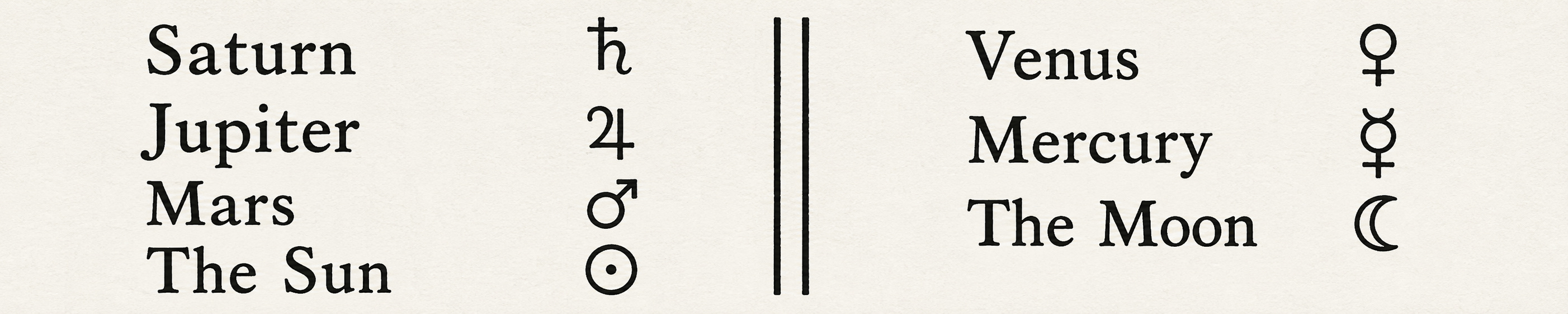
First, you need to know and understand that there are seven planets, called wandering stars. Each has its own character or sign, used in astrology. These planets have great power over lower bodies and each one rules some part or member of the human body, especially parts of the hands. According to the astrologers, their characters and marks are as follows:
You must also know that there are twelve signs in the Zodiac, and know the marks by which they are recognized, and where they are placed on the hand. You must know what the Zodiac is. It is nothing other than an imagined circle in the sky that regulates the years, the months, and their seasons. The Greeks call it Zodiacos, meaning “life-bearer,” because the life of all animals depends on this circle: as the Sun climbs toward us along it, it brings the generation of things; and as it descends, it brings decay. The Latins call it Signifer, that is, “sign-bearer,” because it is divided into twelve parts called signs.
According to Sacrobosco, these signs are named in this verse:
Aries, Taurus, Gemini, Cancer, Leo, Virgo, Libra too; Scorpius, the Archer, the Goat, the Water-Bearer, and Pisces.
Let us put them here according to their seasons, with their characters, so that they can serve in this chiromantic subject:
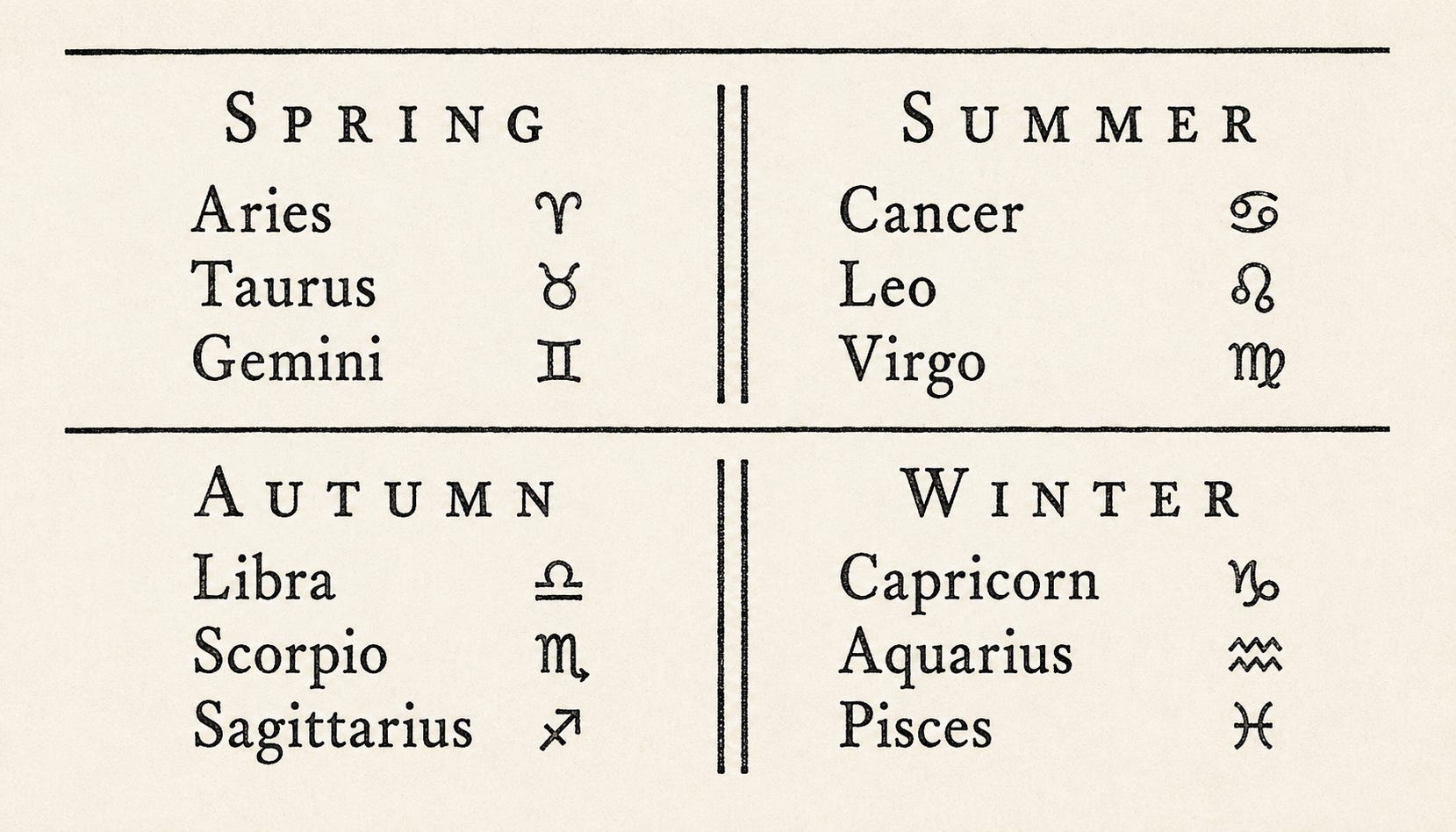
There is no need to set out here their qualities and their dominion over bodies. But as for the hand, you will see that in the second and third following figures. For now, let us set down the names and titles of the seven lines of the hand, the chief part of chiromancy. They are:
The Mensal Line, also called the Line of Fortune
The Middle Natural Line
The Life Line, also called the Heart Line
The Liver Line, also called the Stomach Line
The Sister Line of the Life Line
The Percussion Edge of the Hand
The Restriction Line
All these lines are recognized in chiromancy. You need to know them, recognize them, and distinguish one from another. To make that knowledge easier, I have chosen to give you these three figures: the first for the planets and lines; the second for the signs of the Zodiac; and the third for the same signs placed in other locations.
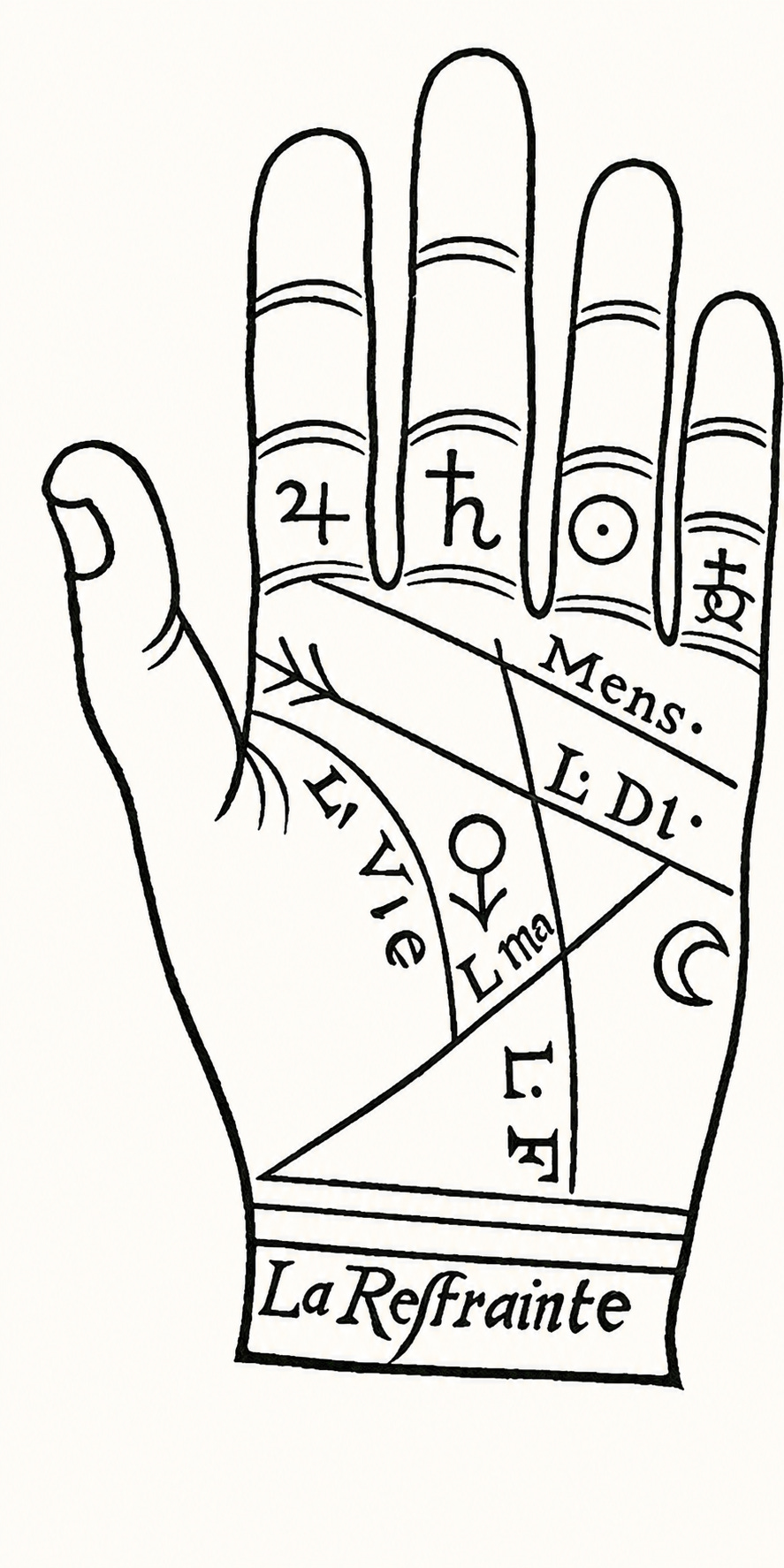
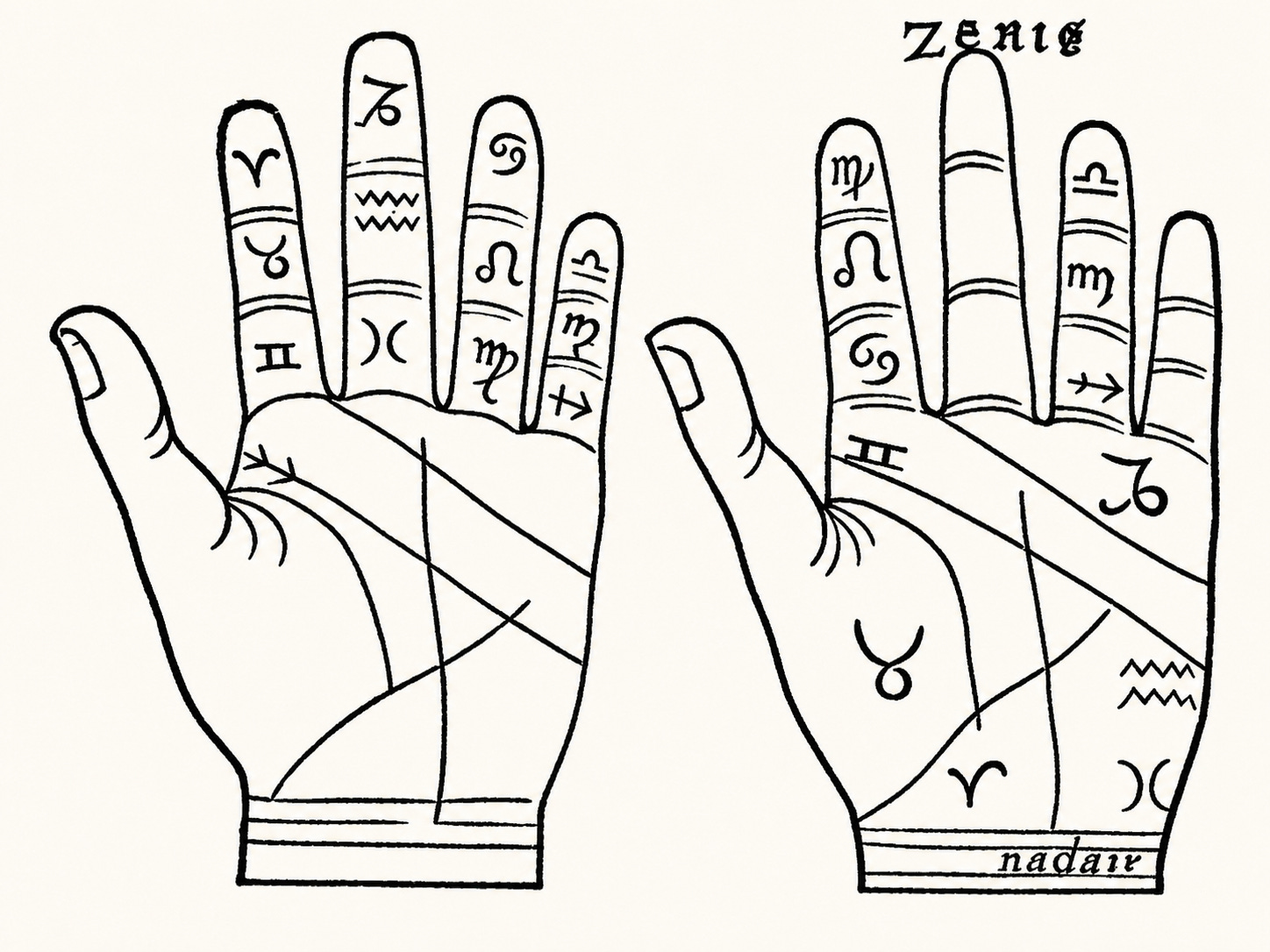
The True and Complete Description of the Hand, Which One Must Know in Order to Understand Anything in Chiromancy.
Chapter Two.
The hands are among the principal parts of the body. They are so necessary and indispensable that our French poet gives them these epithets:
“Chambermaids of Nature,
Fives of the Eternal, instruments for every art,
And, to save our bodies, soldiers who take no pay,” etc.
The anatomists divide them into three main parts, namely the wrist, the forehand, and the fingers. The finest description is found in the Osteology of Hippocrates. But among chiromancers, the three parts just named are described as follows.
One is the palm, a word and term Apuleius used in his Golden Ass when he called this part Dea Palmaris. In chiromancy we call it the Plain of Mars. Another part is called the Vole: it is the outer side from the thumb toward the little finger, called the auricular finger; we call this the mount of the hand, or of the Moon. The third part consists of the five fingers, which must be noted by their names. According to physicians these are Pollex, Index, Medius, Annularis, and Auricularis.
I have chosen to show them above in these three figures, rather than with an endless number of diagrams that only create confusion, as Indagine, Cocles, Corvus, and many others have done. Besides, your own hand alone is enough for you to recognize them properly without any other figure.
You should therefore observe that the thumb, as the first, largest, and strongest finger, is so called and is dedicated to Venus, with her sign. The next finger is called Index, or indicative, or demonstrative, because with it we point out anything whatever. The ancient philosophers named it that way, including Socrates, who for this reason was depicted pointing with this finger at a woman representing Nature. This finger is assigned to Jupiter and his sign.
The third finger is called the middle finger, or “mirancier,” because it is placed in the middle. Some call it the physician, because with it one touches the private parts when they are diseased. The Latins called it Verpus, from the word verro, which in our common language means “to scratch”; hence, as Juvenal says, the Jews scratched their shameful parts with it when they had dysentery. And Horus Apollo, in his Hieroglyphics, represents this finger as a man who has been defamed and marked with some disgrace.
Yet this finger, together with the thumb and the index finger, once represented the Trinity, or the hand of justice of our kings. Examples of it can be seen on our ancient buildings, especially at Plaisy in Gaul, which President Fauchet discusses at length in book 7 of his History of the Decline of the House of Charlemagne.
This finger belongs to Saturn and has Saturn’s mark and sign. Enough about that one. Let us speak of the one that follows, which we call the ring finger, because people customarily wear a ring on it, especially on the left hand. Learned physicians and anatomists say the reason is that in this finger there is a very tender, delicate nerve that runs to the heart; therefore it ought to be surrounded by a ring, like a crown of dignity.
Notice also that in marriage ceremonies, after the matrimonial ring is first placed on the thumb, it is withdrawn and placed on the other fingers one after another until it reaches this one, where it is left. Some writers who have paused over these ceremonies, such as Durand in his Rationale of Divine Offices, say that this is done because the finger corresponds to the heart, the seat of affections and love. Others say it is because it is dedicated to the Sun, and because most rings are made of gold, a metal that is also dedicated to the Sun. And so, through this union and sympathy, the heart rejoices in it. This finger has the Sun’s mark.
The last and smallest of all is named the auricular finger, because we most often use it to clean our ears, like a little tool. We read that Dionysius, tyrant of Syracuse, would never use any other instrument to clean his ears, fearing that someone might give him a poisoned instrument. He was an extremely fearful and suspicious prince, and his life under tyranny was miserable because of the fear stamped into his soul. This finger is attributed to Mercury and bears Mercury’s sign.
Now all these fingers have swellings rising from their roots or bases. These are called mountains, attributed and dedicated to the planets. To them is added the visible and raised flesh that belongs to the percussion of the hand. The four principal fingers have twelve joints or ligaments, and to these twelve are assigned the twelve signs of the Zodiac, as can be seen in the preceding figure. To each finger is assigned one of the seasons of the year.
For example, the index finger, which belongs to Jupiter, is assigned Spring; and to each joint of it one of the signs of that season: at the first joint near the fingertip, Aries; at the middle joint, Taurus; and at the root joint, Gemini. Their marks are the three characters Aries, Taurus, and Gemini.
This finger corresponds to the little finger, or auricular finger, which is assigned to Mercury. It is associated with autumn and corresponds to Jupiter’s finger. Together, they represent two seasons equally mild and temperate, whose first two signs are equinoxes, meaning that they make the days and nights equal.
The signs of this autumn season, assigned to this finger and arranged in the same way as the others, are Libra, Scorpio, and Sagittarius, whose symbols are Libra, Scorpio, and Sagittarius.
The middle finger, which belongs to Saturn, represents Winter for us, the harsh season because of the cold. It has the signs Capricorn, Aquarius, and Pisces, marked accordingly. The ring finger, which belongs to the Sun, has the signs Cancer, Leo, and Virgo, with their characters. These two seasons have, in their first months, the two solstices: that is, the Sun neither descends nor rises any farther, but stops at the two extremes of the Zodiac: at the Zenith for its elevation and at the Nadir for its descent. Since these two angles are represented in the hand, we must imagine the Zenith at the tip of the middle finger, and the Nadir near the Restriction, where the line of life ends. This forms an oval figure.
We can represent it according to the third figure above by imagining the belt of the Zodiac running along the index finger, descending above the thumb and the Mount of Venus, which will be included within the oval of the Zodiac. We then imagine our signs as follows: Aries on the swelling above the Restriction; Taurus on the Mount of Venus and on the branches and offshoots of the line of life, which denotes life for us; Gemini placed on the first root or joint of the index finger; Cancer on the second; Leo on the third; and Virgo. We leave the thumb apart, since it is not a perfect finger, having only two joints or ligaments, which is the first number, called “flat” by the arithmeticians, which has not so much perfection as the ternary, or the number three, which is the second. We call this half-circle the Arctic one. As for the other, the southern half-circle, which we call Antarctic, we begin it at the tip of the ring finger and place the first sign, Libra, on that finger’s first joint; on the second joint, Scorpio; at the root, or third joint, Sagittarius; at the end of the Mensal line, Capricorn; in the middle of the Mount of the Moon, Aquarius; and near the restriction on that side, Pisces. In this way the seven mounts of the planets are enclosed within the belt, or zodiac.
One must know and note that each mount, as I will explain more fully later in the rules of this science, signifies and marks out something important: the mount of Venus, love; Jupiter, honors; Saturn, misfortunes; the Sun, riches; Mercury, learning; Mars, military exploits; and the Moon, mental afflictions and illnesses. I will not go further here into the meaning and interpretation of these mounts, since I am reserving that for another chapter. But before leaving and concluding this one, I will say a word about the lines and marks of the hand that are needed here.
Within the enclosure of the hand, then, there are six lines, divisions, or cuts. These all depend, as one should know, on the three main parts of a human being: the head, the heart, and the loins. From these depend the three worlds, namely the intellectual, celestial, and elemental. They are set out as follows:
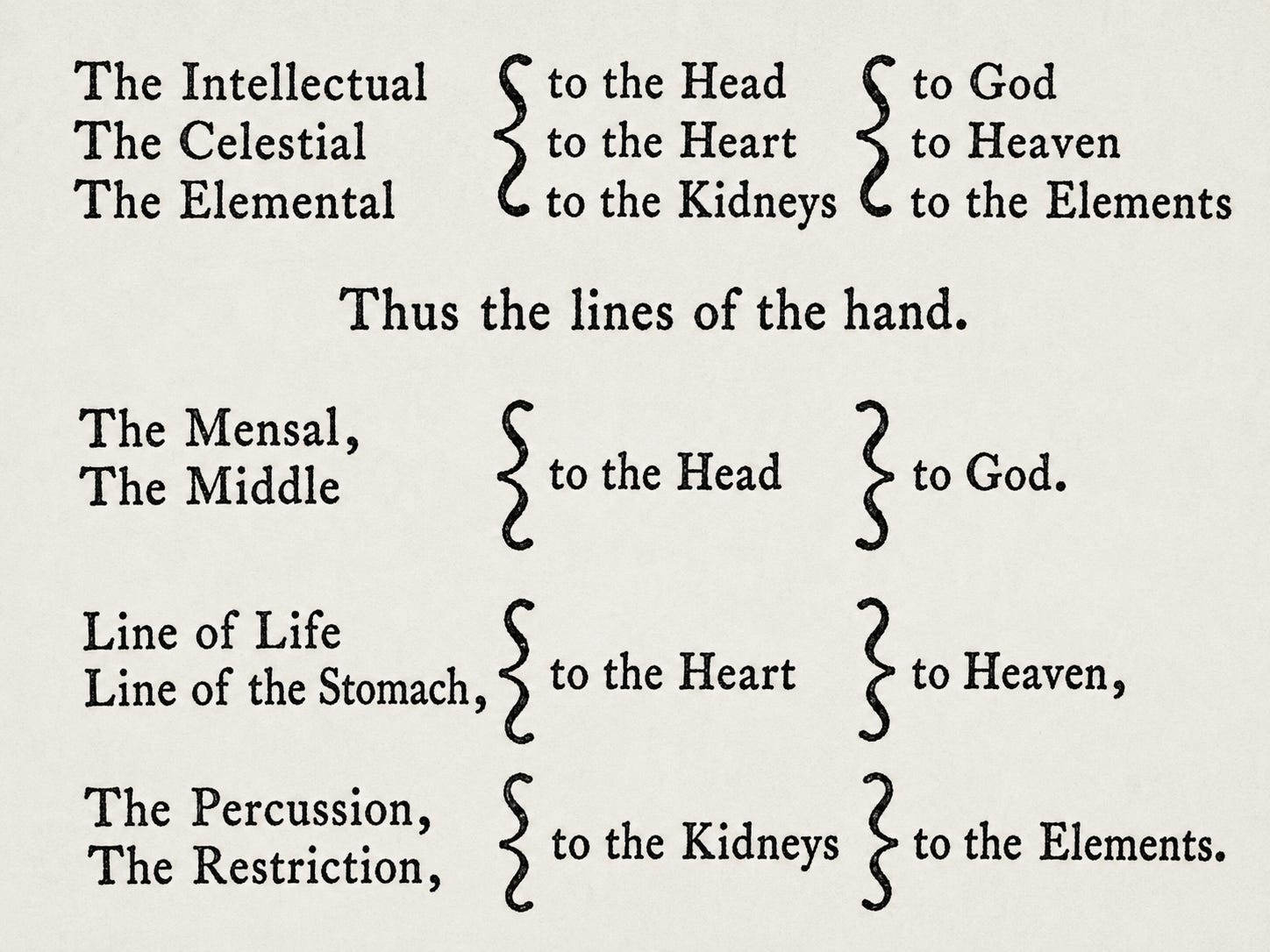
The intellectual, the celestial, and the elemental correspond to the head, the heart, and the loins; and to God, heaven, and the elements.
So too with the lines of the hand:
The Mensal line and the Middle line correspond to the head and to God.
The Life line and the Stomach line correspond to the heart and to heaven.
The Percussion and the Restriction correspond to the loins and to the elements.
To recognize these lines, one must first know that the Mensal line takes its force from the whole head. It begins at the percussion of the hand, or at the mount of Mercury situated under the little finger. It runs with two or three branches, and more often by itself, to end beneath the index finger. Sometimes it joins with the Middle line, since both correspond to the head; and with the Life line they form an angle ending between the mounts of Venus and Jupiter.
The second line of the head, called the natural Middle line, is the one that begins at the root of the line of Life, and passes through the middle of the palm between the mounts of Mars and the Moon, and comes to rest beneath the mount of Venus, and more often at the Mensal line, as was said above.
The third line, the Life line, called the line of the heart, begins at the mount of the index finger and ends near the band that we call the Restriction, dividing the mount of Venus from the triangle, or palm.
The fourth, called the line of the liver or stomach, has its origin and beginning under the mount of the Moon. It goes on to form the triangle of Mars, crossing the Middle, or direct, line and joining the Life line above the mount of Venus.
The fifth is the Restriction: the spaces that appear at the joint of the hand, where there are at least two lines, at most four, and several strokes rising toward the mount of Venus.
For the sixth, we will count the sister and companion of the Life line, which follows it. Then we add the percussion, which is the outer part that moves when we strike something. These are the most notable parts of this science, which we must mark and recognize so that we do not fail in divinations, since they are the principles of this chiromantic science.
Why the seven planets and the twelve signs of the Zodiac are necessary in the science of chiromancy.
Chapter III.
Before going further into the answer to this question, and before instructing the eager student who wants to learn this science, I want to satisfy the learned reader and make a digression here, though a shortened one, about the planets and the signs of the Zodiac. I want to show how antiquity adapted them, and their influences, to the sciences, arts, and dispositions of bodies.
The Jews, from whom we have received our faith and belief, and who are our elders both in knowledge and in the worship of the true God, adapted these seven planets to their days or meanings from the earliest centuries. But later, when time brought diversity and corruption into their religion, they raised these planets higher still, and looked to the Greeks, the first to recognize their powers and influences and to give them their names.
The authors who composed the Talmud, in the first part called the Order of Seeds, in the sixth treatise called Massechet Shevi’it, that is, the Treatise of the Seventh, adapted them strongly to their mysteries. Rabbi Abraham Aben-Ezra, in his commentary on this book, makes the ten Hebrew Sephiroth and the ten celestial spheres correspond to the ten commandments of the Law.
The first commandment shows the most simple unity of the Father, who is, as it were, the base and foundation of everything: “I am the Lord your God, who brought you out of Egypt, out of the house of slavery. You shall have no other God but me.”
This corresponds to the tenth, immobile sphere, as supporting the throne of God: “Heaven is my seat, and the earth is the footstool of my feet,” in Isaiah 66.
From there it moves the first movable sphere, and consequently all the rest. “All things rejoice when moved by the Father,” says Saint Dionysius in his Hierarchy, speaking of the intelligences which, being moved themselves, move the spheres and the celestial bodies over which they preside.
So Trismegistus defines God as a circle whose center is everywhere and whose circumference is nowhere, because this is plainly represented by these two numerical marks, according even to the Rabbis in their gematria: 10. The 1, without the zero, is worth one; it is an indivisible point, or the center that is everywhere. For there is no number in which unity cannot be found, since all numbers come from it and are nothing but a heap of units strung together. And the 0, or zero, being round and circular, is said to be nowhere, because by itself it does nothing. Thus it corresponds to the Ensoph, the unended or infinite.
The second commandment: “You shall not make any image or likeness of anything that is in the heavens above, or below on the earth, or under the waters, in order to worship it.” This commandment suits the ninth sphere and the first movable sphere, which moves and carries along with itself all the other subordinate spheres in twenty-four hours. And it suits the Son, who is the first movement of all things, proceeding from the unmoving Father. On this point I remember what Boethius says:
“Maker of earth and heaven, you command time to move from eternity; remaining stable yourself, you grant that all things move.”
This Son has banished and rooted out all the idolatries of the world wherever his Gospel is carried and proclaimed.
The third commandment: “You shall not take the name of the Lord your God in vain, for the Lord will not hold innocent the one who takes it in vain.” This corresponds to the eighth sphere, where all the fixed stars are, and the Zodiac with its twelve signs, which belong to our science; and then there are the forty-eight principal figured constellations, as one sees them in Hyginus and in several other astrologers.
The fourth commandment: “Remember to keep holy the Sabbath day.” This corresponds to the sphere of Saturn, which is represented for us by the middle finger. That sphere or planet is unlucky, malignant, and harmful; so Moses judged that nothing should be undertaken or done on that day, but that one should remain entirely at rest and devote oneself to divine service. Saturn presides over the first hour of Saturday, which begins in the evening at nightfall, just as Mars presides over the last hour and is also harmful in its way. This does not occur on any other day. For this reason the Zohar and other Kabbalists claim that evil spirits have more power to harm on all fourth and seventh nights, over which these two planets preside, than on the other nights of the week.
The fifth commandment: “Honor your father and your mother, so that your days may be prolonged on the earth.”
This is attributed to the sphere of Jupiter, which is benevolent and represents peace, love, piety, and mercy; so too does the sphere of numbering, Chesed, and the divine name assigned to it.
The sixth commandment, “You shall not kill,” is attributed to Mars, god of war and murder.
The seventh, “You shall not commit lechery,” is attributed to Venus, following the opinion of the Brahmans and Gymnosophists, because she corresponds to the numbering Netsach, or Victory, representing for us the victory we must have over our desires.
The eighth commandment, “You shall not steal,” is given to the Sun, which carries off, takes away, and steals from all the stars their brightness and light, which it extinguishes and obscures.
The ninth commandment, “You shall not bear false witness against your neighbor,” is dedicated to Mercury, as patron of every kind of subtlety and trickery: deceit, guile, deception, and fraud.
The tenth commandment, “You shall not covet your neighbor’s wife, nor his house, his servant, his ox, nor anything else that belongs to him.” This last commandment is referred to the Moon, the lowest of all the celestial bodies, just as covetousness is the lowest and most abject passion of our soul, and the one that debases us most.
That is how things stand for the Jews. For our theology, these seven planets are set beside the gifts of the Holy Spirit; the seven petitions of the Lord’s Prayer; the twelve signs of the Zodiac, beside the twelve articles of the Creed; and again the seven planets are adapted to the seven candlesticks of the Apocalypse, where the living man walks in the midst of them. This doctrine is found in Rupert and in Saint Cyprian’s sermon on Pentecost, which learnedly moralizes on the number seven. That is enough for our evangelical theology. Anyone who wants to see something rare about this sevenfold number should look at what Henry Cornelius Agrippa wrote in book two of his Occult Philosophy, where, finishing his discussion, he says: “In short, this number is the most powerful of all, both for good and for evil.”
And Linus, the ancient Latin poet, said of this number:
“When the seventh light came, the almighty Father began to complete all things; the seventh belongs to the good, and it is also the seventh origin of all things. The seventh is at once first, perfect, and sevenfold; from this too the high heaven of wandering stars is turned and carried around on just as many circles on every side.”
The Egyptians, Arabs, Magi, and Chaldeans, in their occult sciences, attributed angels, intelligences, numbers, and spirits to both the planets and the signs of the Zodiac. Let us see how they adapted these to the liberal arts.
In dialectic, the ten celestial orbs are assigned to the ten categories, or predicaments, in this way: essence to the immobile sphere; substance to the first movable sphere; quality to the eighth sphere; quantity to Saturn; relation to Jupiter; situation or position to Mars; the agent to the Sun; the patient to Venus; habit to Mercury; and the five predicaments concerning everything contained under the concavity of the Moon are dedicated to the Moon. Thus these categories and predicaments are adapted to the planets and heavens. For music, the tones and voices are also assigned and as for their assignment, you will see it in these verses taken from the Galliade, or The Revolution of Arts and Sciences, by the learned Guy Le Fevre de la Boderie:
“Now the sequence of notes, where the E is understood as fifth,
by steps and degrees goes no farther
than the seventh; and God, who orders everything,
makes almost everything rest on the number seven.
But different men, already in ancient centuries,
held different opinions about the seven voices of the heavens.
Some thought that in the great heaven of Saturn
the deep, almost nocturnal voice is made,
like Ut, the lowest note; Re, a little higher,
is made in the next heaven; then Mi leaps
in the sphere of Mars; and Fa, moving forward,
sounds in the heaven where Phoebus leads his round dance.
And because Venus and Mercury complete their courses
almost at one time, almost in the same days,
some have thought that Sol is sounded there,
and that it resounds twice in the same unison;
and that La, which is raised the highest,
remains enclosed and shut within the lunar heaven.”
Alchemy also has its share in this: for the seven principal metals of that science are assigned to the seven planets: lead to Saturn, copper to Jupiter, iron to Mars, gold to the Sun, tin to Venus, quicksilver to Mercury, and silver to the Moon. From the characters of those planets they make their secret writings. The Abbot Trithemius, in book five of his Polygraphy, makes these into the most hidden secrets. Moses likewise ordained, among these ceremonies, a candlestick that was of molten gold and not solid, which weighed one hundred minas, which according to the Hebrews was seventy cinchares. Moses had composed it, as Josephus says, according to the mathematicians who divide the planets, and the Sun had seven divided branches. Numa Pompilius also instituted twelve Salii priests in honor of Mars. On the day of their festival each carried a shield, one of which was said to have been given from heaven. There were also seven Flamines; all this was instituted in imitation of the Hebrews.
But to leave this digression: let us see how anatomists adapt the planets to the members of the body, following the astrologers.
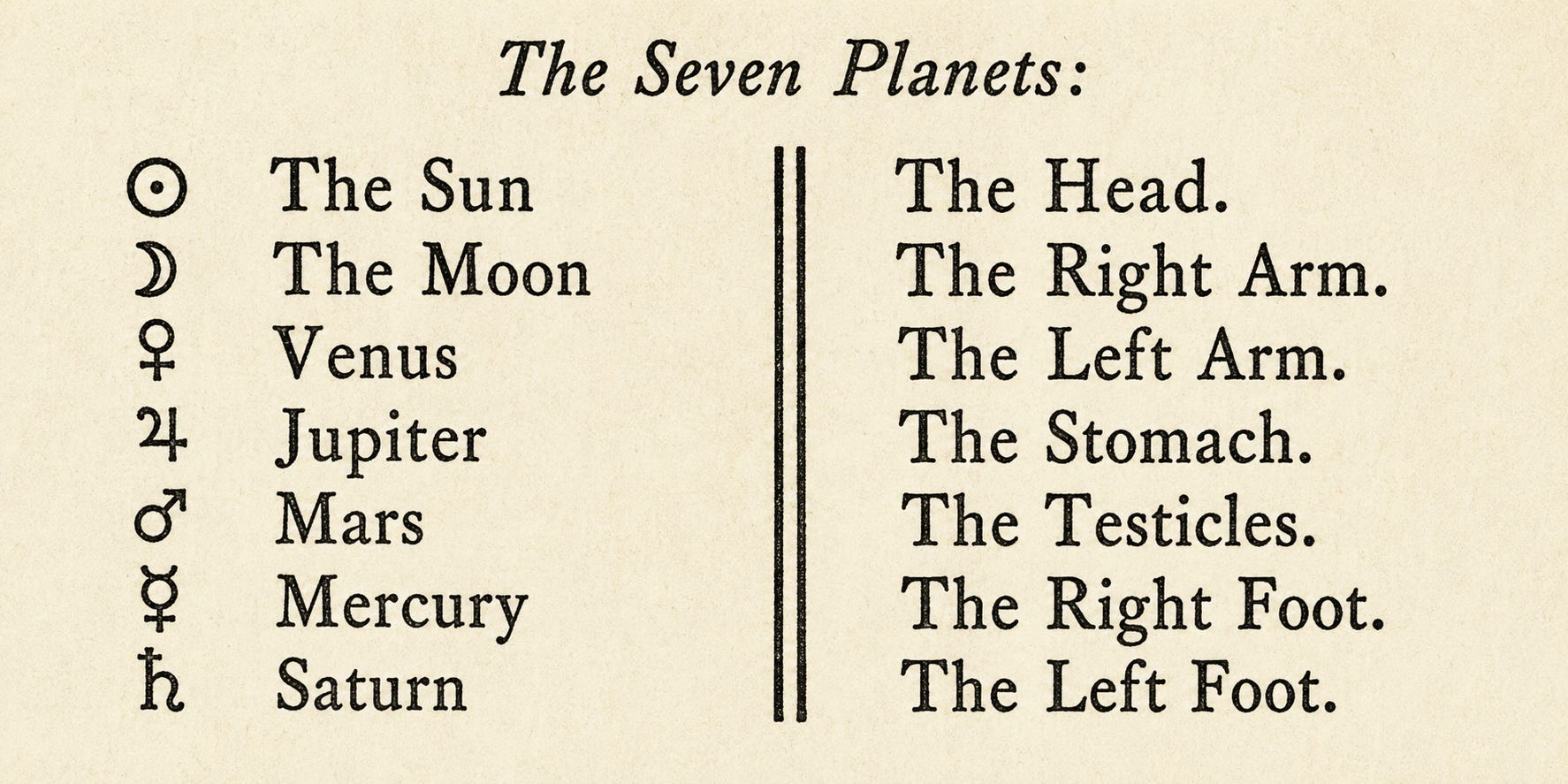
Or else, according to the circles of H. C. Agrippa: Mars, the head; Venus, the right arm; Jupiter, the left; Mars, the stomach, which is the center of the human body; Luna, the testicles; Mercury, the right foot; Saturn, the left.
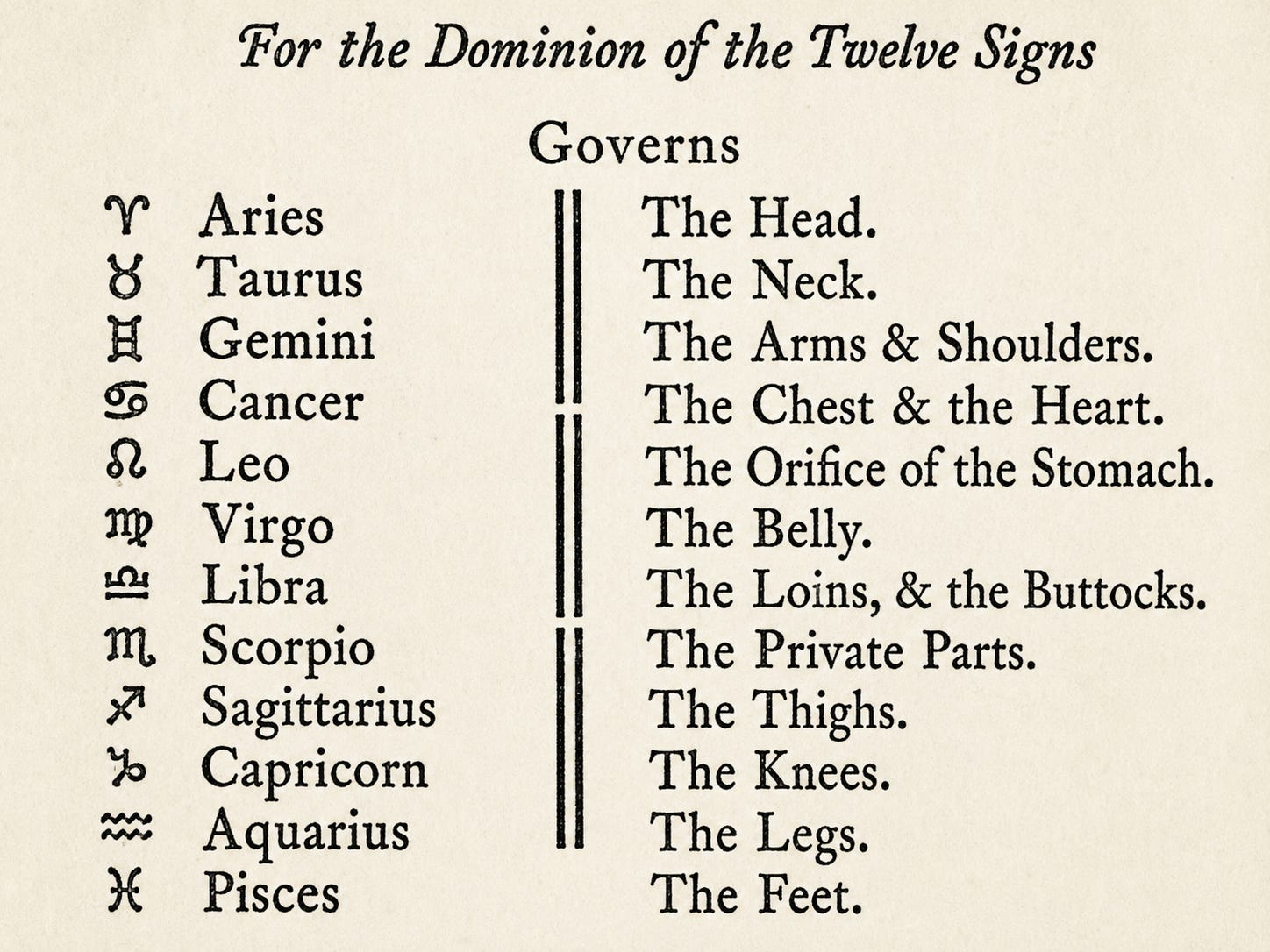
.Our chiromancy surpasses all these sciences, and so does physiognomy: one, through the hand, and the other, through the face, contains all of this. So, to support this claim, if people ask us what use the seven planets and twelve signs of the Zodiac have in this science, we should say that they are essential parts of it.
By locating and assigning the places of the planets and signs in the hand, or in the face, we recognize the good or bad fortunes that may happen in life: in love, wealth, military exploits, sciences and arts, business and trade, marriage, and other accidents to which this life is subject. We also recognize when it may happen, and in what season and month.
One should note that when the shape of a star, or a half-cross, appears on one of these mounts, and one of the rays of that star, or one of the strokes and lines of that half-cross, points toward one of the zodiac signs that we imagine in the hand, then the direction matters. Wherever the line of that half-cross, or the ray of the star, points, the misfortune or bad luck will happen in the month signified by that sign. The same applies to the happiness and good fortune indicated by a cross, by a single line, or by a branched line, not at its top but at its lower end.
André Corve and Indagine approve this. Cardinal Alliaco tells us, on the subject of the death of Julius Caesar, that Caesar was warned by Spurina the mathematician to beware the Kalends of March. Spurina had seen in Caesar’s left hand a half-cross arising in the Plain of Mars, whose end pointed toward Aries, which we place near the Restriction, in the swelling above it, representing the month that belongs to this planet. That day of the Kalends was fatal to him because he would not accept Spurina’s prophetic words.
So one must observe this: if a star or half-cross appears on the Mount of Venus, and some end of it points into Aries or Taurus, then without doubt some misfortune in love with women will happen in those months to the person who has such a thing in the hand. Likewise, if they point to other signs, it will be in those same months. If a single line rises in the Plain of Mars and points toward the Mount of Venus, and toward Taurus or Gemini, that denotes a victory that someone will win for a lady, whether in mourning or otherwise. But if the line happens to fall by the Mount of Venus toward Taurus, then the lady for whose sake the fight is undertaken will be lewd and lustful. This is noted by Dictys of Crete in the combats between Menelaus and Paris over Helen.
Likewise, whoever has a line under the Mount of Jupiter that points into Gemini, Cancer, or Pisces will undoubtedly, in the months ruled by those signs, receive honors from kings and princes; those months are fortunate for him. But if, instead of a line, there is a star or half-cross, that will mean misfortunes, disgrace from great people, and loss of honors.
If on the Mount of Saturn there is one of these marks, such as a star or half-cross, pointing toward Sagittarius, Scorpio, or Pisces, beware an infamous death in those months. On the Mount of Mercury, beware deceivers, especially through misleading eloquence. On the Mount of the Sun, be careful regarding wealth; for if the marks point into Capricorn or Virgo, and if the lines are straight and point toward Venus, this means a wealthy marriage for the person who has such a sign and line in the hand, arriving in the months governed by those signs.
On the Mount of the Moon, if a star appears whose rays point into Capricorn, fear a violent illness and danger of death in that month. If they point into Scorpio, which is October, beware madness of mind or mania. If it points toward Aquarius, which is January, beware a melancholy that leads to despair. And let the person in whose hand such a star is found not throw himself into the water. The signs of the Zodiac in this science are used to mark precisely the time, season, and month in which good or bad fortune may happen. This is one of the more particular points one needs to know, so that the person who has been warned may avoid the misfortune promised to him by these marks.
Which of the two hands is more proper for the purposes of this science
Chapter IV
If I wanted to start this easy little lesson the way Lycophron does — with his bold promise to “tell everything clearly from the very beginning” — I’d be promising something simple and then doing the exact opposite. I’d be imitating a poet so famously obscure that even Saint Jerome openly admitted he could not understand him.
So, to avoid that mistake, and to keep things short and clear, I’ll explain how to go about learning this science. Someone who wants to be instructed might ask which of the two hands should be used for studying and recognizing the lines and marks. The answer, as a true and reliable rule, is the left hand — though one can see both hands, since in one the length of days is recognized, and in the other riches and honor, as the wise man says. But the hand on which the chiromancer should base his predictions is the left hand, because it tends toward the heart and is ruled by Jupiter and dedicated to him.
Through this hand, says Avicenna, and through the pulse of this arm, the physician should recognize the condition of the sick person. All the veins and lines of this hand and arm go to the noblest parts of the body, especially to the heart, which is the place and seat of all desires, affections, and appetites, from which the conceptions of all our actions proceed.
The anatomists, who have recognized in the human body 248 bones, or 309 according to Paré, and 520 muscles, and who have divided and allotted it into seven parts for the seven planets, have assigned this hand and arm, up to the heart, to this Jovial planet. Galen gives the reason for this, saying that the heart is the storehouse and arsenal of life; according to its disposition, the other members are governed. And because this hand is closer to the heart, it gives better information about the passions than the other hand.
Therefore the chiromancer, or anyone who wants to know something in this science, should base his judgments entirely on this hand. He should look at it calmly and recognize the arrangement of the lines, their positions, accidents, and colors. He may also look at the right hand, especially the Restriction, which is the place of life and from which one recognizes the years and the illnesses that may occur; but in that hand you will seek nothing further.
What the chiromancer is required to know.
CHAPTER V.
Hippocrates, prince of medicine, says that the physician cannot be fully accomplished in his art unless he has knowledge of astrology. In the same way, I will say of the chiromancer that he is not perfect and complete unless he has the art of physiognomy. Physiognomy is:
“The science by which the nature of people is indicated from the appearance of the body.”
[Greek/Latin gloss, partly unclear:] to practice physiognomy, to draw help from the face and know things through nature’s signs.
Or, to make it understood and define it plainly: it is a science by which one clearly recognizes people’s conditions and temperaments from the features and indications of their faces. It consists of two things: namely, the complexion and composition of the human body, which openly declare and show the things that are inside a person by means of outward signs, such as color, stature, and the arrangement of the limbs and forms.
These two sciences are so joined and united that one does not go forward without the other; to profess one without knowledge of the other is useless. These sciences were linked together even by the ancients. The satirist Juvenal:
“He will survey both spaces of the turning-posts, draw lots, and offer forehead and hand to fate, while the questioner keeps smacking for an answer.”
And yet, when Juvenal depicts his wicked Zoilus, he does it through the bad spots and signs of his body, not those of the hand; for not every chiromancer is allowed to see everyone’s hands. And he said of this Zoilus:
“Sad, you would meet him with clouded brow, like Marsyas defeated...”
“A heavy face, a rough forest of dry hair, no brightness anywhere in the skin; like one smeared with a bandage of warm birdlime, with neglected bristling hair, and filthy legs,” etc.
Homer, in book 2 of the Iliad and book 18 of the Odyssey, describes Thersites and Irus, both wicked slanderers, by the lineaments and composition of their bodies. Here is the description of the first according to Salel’s translation:
“For it seemed that Nature
had worked to forge his ugliness.
He was awkward, lame, and hunchbacked,
sharp-headed, with a badly boned body,
very little hair, and a very long, wide ear;
in short, so ugly it was a marvel.”
For the second, Homer depicts him without beauty: he was tall and cowardly, just as Lucian represents his Happelopin. For greatness of body diminishes courage, says Aristotle, and the soul follows the habit of the body, that is, its signs. Likewise, by contrast, this poet represents Achilles and Ulysses as of medium height, and therefore courageous.
Through physiognomy, the humors and the inner state of the soul are known so truly that Socrates, a philosopher of integrity, about whom the oracle itself bore witness by saying:
“Of all men, Socrates is the wisest,”
was nevertheless described by his physiognomy, by a philosopher skilled in that science, as the dirtiest and foulest of all living men, and as completely ruined by lechery and lust. His disciples tried to make fun of this and said the man had lied falsely. Socrates corrected them and said: “My friends, these things came to me by nature, but I have corrected the vices of my nature by the rule of reason.”
By this he meant that the imperfections we have by nature can be amended by virtue, and that a person can, in some way, resist and oppose destiny when he is wise and tempers his bad fate with the medicine of present effort or future shame.
There is a story on this subject, taken from the learned Pasquier in his Recherches de la France. He says that in the reign of Louis XII, the Duke of Nemours, nephew of that king, was his lieutenant general in all the lands beyond the mountains. As he was considering giving battle to the Spaniard, around the days of that battle he found himself at Carpi with most of his captains. The lord of that town was named Albert Mirandola, very learned, and first cousin of the great Pico della Mirandola. This lord, while speaking with the prince and captains, brought up a judicial astrologer he had, a man very expert in this science, then about sixty years old, who made himself remarkable by his predictions.
At the request of the Duke of Nemours, this man was sent for. As soon as he arrived, the duke presented him his hand; and after many courteous words, the astrologer told him that he would give battle against the viceroy of Naples and the Spaniards and would win the victory, but he warned the Sieurs de La Palisse and de Bayard to watch over him, because he would be killed in that battle.
He told those gentlemen the future and everything that would happen to them. In particular, he told an adventurer named Jacquin Caumont, who carried an ensign in the companies of Captain Molart, and who had done him some injury, that he would be hanged within three months, which happened. And for everyone whose fortunes he told, things happened as he had said. He looked, as Monsieur Pasquier says one must note, at both the face and the hand; and yet he did not look at the hand of Jacquin, who was hostile to him, but only at the appearance of his face.
Likewise, H. Sanurenda, a good religious man, revealed the adventures of Charles VIII, king of France, by physiognomy, and told him the outcome of his journey to and return from the kingdom of Naples; this made the said Sanurenda suspicious in the eyes of the Pope. Therefore, without stopping any longer over all these accounts and stories, which the reader may see, if he likes, in the authors cited here, I will say by way of conclusion, and to move quickly and without wordiness toward my instruction, that no one can properly predict or judge anything in the science of chiromancy without physiognomy. That is why I will give here an epitome, or abridgment, of physiognomy, as a necessary instruction.
Epitome or abridgement of Physiognomy.
CHAPTER VI.
The Hebrews held this science of physiognomy in esteem, and Scripture depicts and describes the physiognomy of Jacob, Moses, David, Absalom, Jonathan, and many others. The compilers of the Talmud made a treatise on both chiromancy and physiognomy, named Massecheth Iadaim, that is, “The Treatise of the Hands.” There they distinguish physiognomy from metoposcopy, which is nevertheless only a small part of physiognomy. The Greeks understood this well when they said that metoposcopy comes from “forehead” and “to observe”: a science by which future things are known from looking at, or observing, the forehead.
These Greeks also included umbilicometrie and several other branches, but for physiognomy they set it out according to this figure.
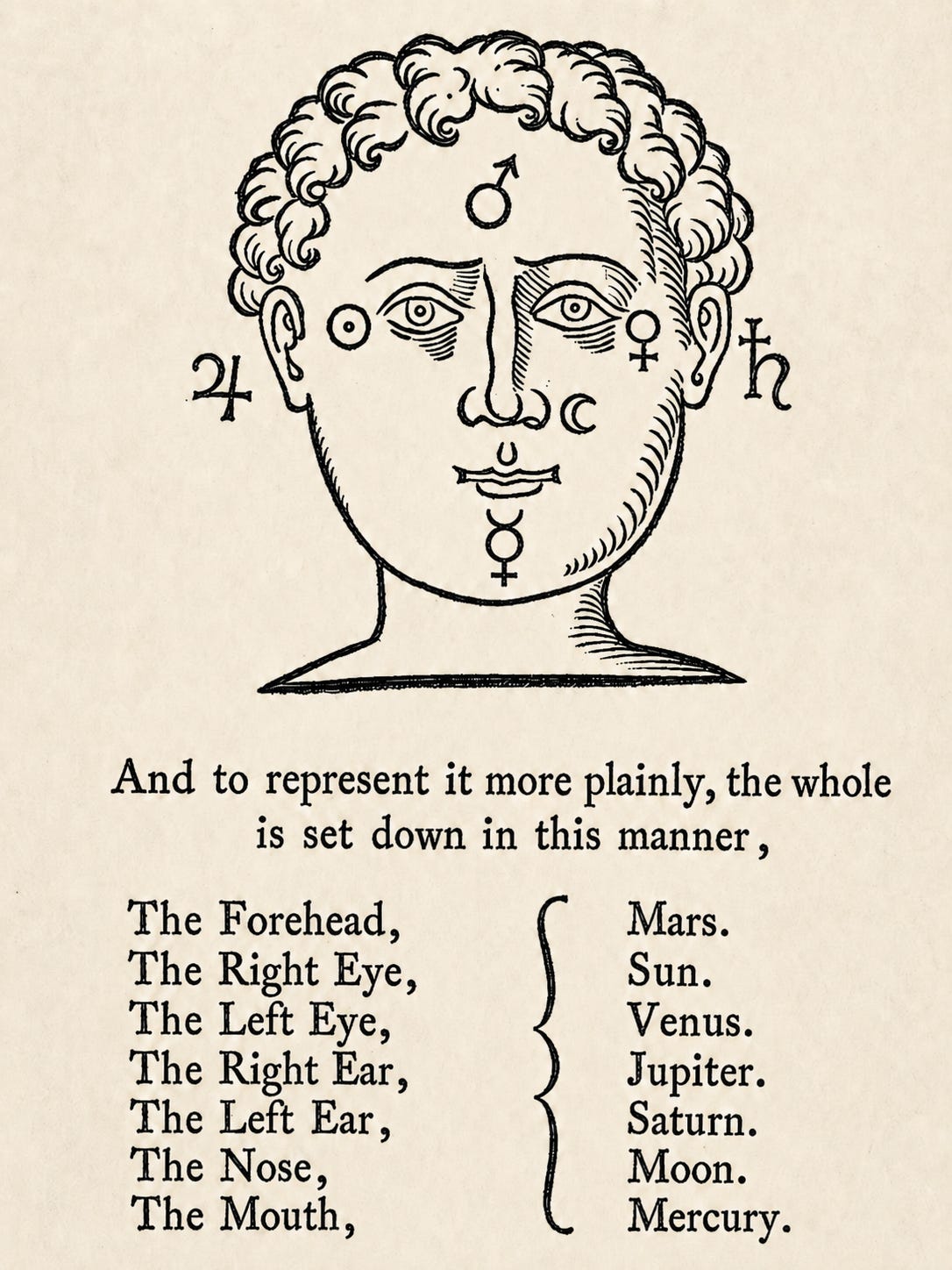
And as for the signs of the Zodiac on the face, they are assigned, fitted, and placed as follows.
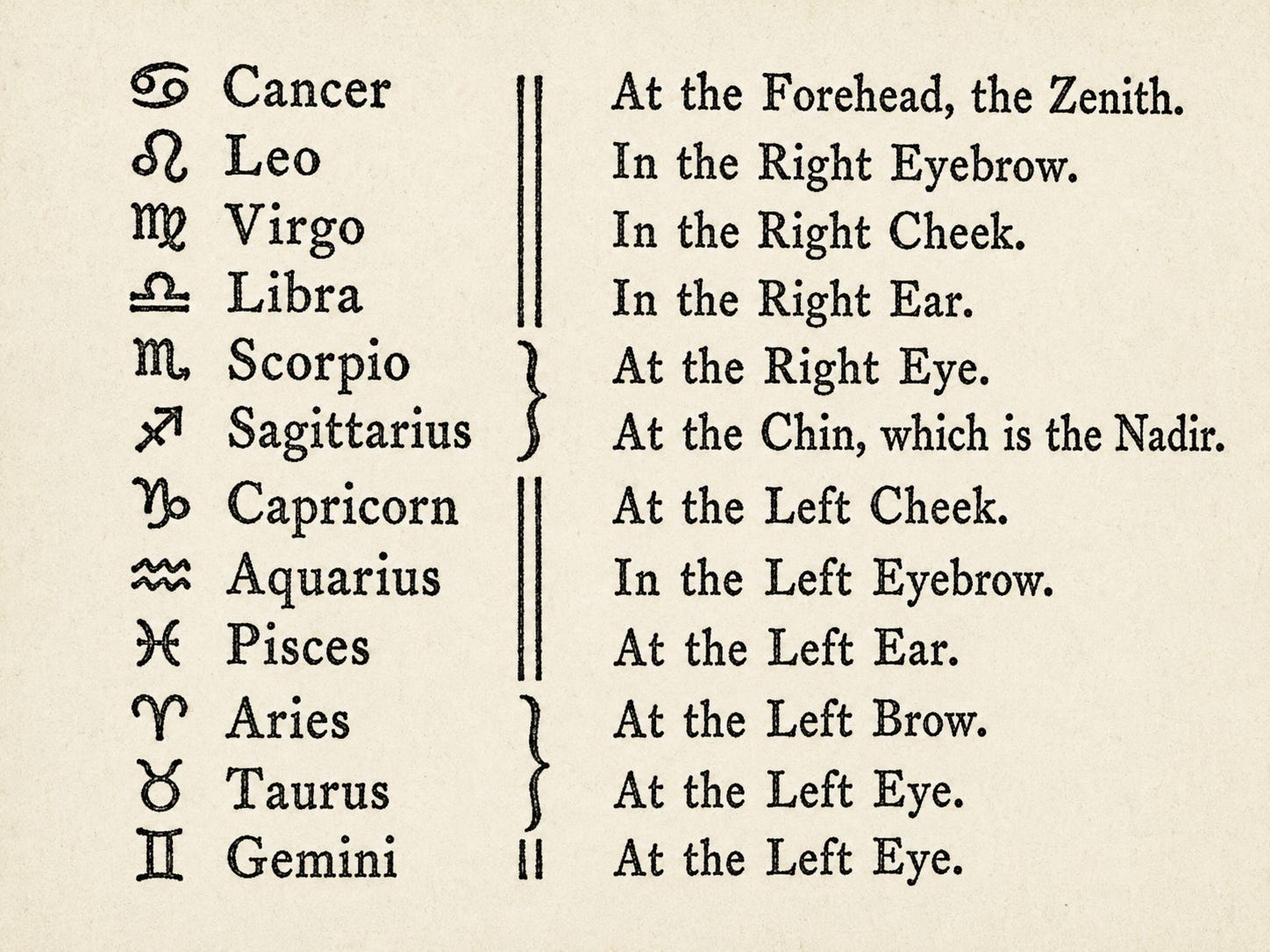
This is how the Greeks and Latins arranged and established them. But to keep things brief, let us look at the rules.
FOR THE FOREHEAD.
1. A forehead that is very raised and rounded is praised, provided it is in proportion to the other dimensions of the head. It points to a generous, cheerful person who is easy to deal with.
2. A broad forehead without roundness points to an angry person, taking after the planet placed there. Such a person is also deceitful, as Ulysses was.
3. A small forehead, narrow in shape, if it is wrinkled or frowning and sinks downward in the middle, is a sign of cruelty. That cruelty is joined with two good qualities, namely courage and a strong understanding.
4. A forehead without hair or wrinkles marks a confident liar.
5. A very long forehead, high and rounded, means a person is simple, weak, and completely innocent.
THE EYES.
The eyes let us recognize a person’s goodness or badness. That is why Homer calls Minerva the blue-eyed maiden and Venus black-eyed, to show prudence in the one and lust in the other. This is why the left eye is assigned to Venus: if, in women, it is bright and quick in the movement of the eyelashes, it indicates a great appetite for the business of Venus; and if that woman is olive-colored or yellowish with black eyes, as Venus is described by Hesiod, then do not look for any chastity there.
1. Large, bulging eyes point to a lazy, bold, lying man, with a heavy and dull mind.
2. Eyes of different colors, especially the right eye, which is assigned to the Sun, point to a man stirred by different passions and opinions, especially in matters of religion. They say Michael Servetus had eyes like this.
3. Eyes set deep and hidden in the head, that is, sunken eyes, point to a great mind, full of doubts. If they are green, they mean remarkable knowledge, though accompanied by malice, lust, and envy. If they are reddish, they show the nature of a cat.
4. Eyes that stick out strongly and are very visible in their color or appearance mean that a man is simple, foolish, and wasteful.
5. Sharp eyes that look well and lower their eyebrows calmly point to a deceitful, secretive, lawless man.
6. Small eyes like those of moles or pigs mean weakness of mind, a person fit to be made a cuckold, and someone who believes everything he is told.
7. Beware of anyone with slanting, sideways eyes, because among a hundred such people very few are faithful.
8. Eyes that move a great deal and look slowly, especially when this is accompanied by a lowering of the flesh of the eyebrows, point to a lazy, unfaithful, quarrelsome man.
9. Worst of all are yellowish, citron-colored, and painted-looking eyes. Watch out for those, and for people who wink while speaking to you, because people with such eyes have a double soul. And if it is a woman doing this with her left eye, be careful about faithfulness in love, and notice where she is throwing those glances.
ON JUDGING THE NOSE.
The Greeks called the nose “Pyn,” because through it flow the waste products from the ventricles of the brain. That is why we assign it to the Moon: since the Moon is closer to the earth, by its influences it gives us and makes a thousand exhalations evaporate down here.
“The nose is the gutter through which the waste products of heavy matter
are drained downward,” etc.
So says Du Bartas; they compare it to the Moon. For these predictions we say that a long nose belongs to a vain mind and is not suited to the business of Venus, although there is a proverb that says:
“You can tell from the shape of a man’s nose what he’s got raised below.”
On this subject, once, for my own amusement, I made this couplet or epigram in praise of one of these noses, imitating Martial:
“The man whose nose is long and hanging
has a very long hanging penis.”
1. The Persians have greatly esteemed people who had long, hooked noses. Their king Xerxes, according to the testimony of Xenophon and Plutarch, had a long nose. Even today they do not give their kingship to anyone but these long-nosed men; long noses are hereditary in the line of Shah Ismail the Sophy. They like these long noses just as the Americans or Brazilians like having a flat nose, which they consider one of the features of beauty.
2. When the nose is flat, it means the man is impulsive, vain, lying, very lustful, and quick to believe others. If a girl is flat-nosed and has black, sparkling eyes, believe, following Euripides, that she is no virgin. With this sort of physiognomy, if you want to find them virgins, you have to take them from the cradle.
3. Whoever has a large nose, long in every part and hanging is greedy for all beautiful things, simple in good fortune, wise and discreet in bad fortune; but he mocks other people’s actions and is satirical. Horace was like this, as Persius says, describing him in these verses:
“Crafty Flaccus touches every fault while his friend laughs;
once admitted, he plays around the heart,
clever at keeping the people hanging, with his nose shaken free.”
4. A man whose nose is raised in the middle but lowers and slopes at the tip is changeable, unlucky, and distrustful even of those closest to him. Louis XI had such a nose, as Commines portrays him.
5. When the nose is twisted, curved, and rather long, it points to a proud man: envious, given to wine, seductive, boastful. The end of a man or woman with such a nose is never good, but threatened by justice.
6. A nose very rounded at the ends, with small nostrils, means and shows that the man is proud, over-trusting, faithful, and vain. A woman with such a nose is immodest and wicked.
7. A nose naturally red in color means the man is liverish, coarse in nourishment and mind, not a lover of barley-water; but he is fit to make a sergeant. If it is half lead-colored and laced with red veins, he will have an unquenchable thirst because his liver is hot, and he will be very subject to a disease called morphea.
8. A nose that is suitably large on all sides, and flat on top with warts and redness means a joyful and peaceful man, one who is never without thirst. He is suited to play Bacchus, drinking at every moment, or else a Maenad, priestess of Bacchus. Caesar considered such men good companions and did not distrust people of this kind, since they were not malicious.
9. Someone whose nose is a little hairy at the point or on top, with hair on it, is a completely simple man; this is where the saying comes from: “He is a good man; he has a hairy nose.”
10. The woman who has a neatly shaped nose, as a poet says,
“A pleasantly rounded, rather long nose, with a delightful profile,”
has not only one of the perfections of beauty, but is shown to be wise, prudent, and chaste, especially when she has blue eyes. To finish this chapter, one should note this piece of knowledge, this secret drawn from the Natural Magic of Giambattista della Porta of Naples, of whom Indagine also speaks: to know whether a young boy or girl has been corrupted in the body, one must know, since this is chiefly recognized by the nose, whether the cartilage at the end of the nose can be cut, or whether it is separated from the bone. That is a sign that the child is corrupted, and the girl as well. In a girl this can also be recognized by the vein on the forehead, called Preparata.
On the mouth, the ears, and the face in general.
Chapter VII.
The mouth is a part of great use. It is the main route for nourishing the body, the common public road that supplies the stomach with what it skillfully distributes to the other members. In short, as Galen says, it is the first principle of nourishment. And just as boiling and roasting prepare what enters the mouth, the mouth also prepares what enters the stomach: some cooking of the food already begins in the mouth. The mouth clearly changes foods and gives them, as it were, their first fire, though without transforming them completely.
Moreover, the mouth is the starting point of breath and respiration, insofar as it draws in, attracts, and receives into itself the air that afterward rises partly to the brain and partly descends through the lungs to the heart.
The mouth is the chief organ of the voice.
The mouth serves to purge the brain, the stomach, and the other neighboring parts.
But without stopping to praise the mouth any further, leaving that to an anatomist, and since it is not my subject, let us deal with predictions about it.
ON THE MOUTH.
1. So, a man who has a large, wide mouth is shown to be shameless, a great chatterer and liar, a great carrier of false news, very foolish, impudent, and yet courageous, though treacherous. Black people are subject to this, approaching the nature of the Ethiopians. Indagine and Corvus say that they were never deceived by this sign.
2. By contrast, a small mouth means that the man or woman is peaceful, faithful, timid, eloquent, full of wisdom and learning, and eats little; or else that the other person is a great glutton. They say the great glutton Apicius was like this.
3. Those who have thick lips, since the lips must go together with the mouth, being one of its parts, indicate a person more simple than wise, who readily believes everything he is told and is excessive in all things. Women with such lips are voracious, given to wine, and consequently to lust.
4. Those who have thin, small, delicate lips are eloquent, great talkers, full of foresight, and have a good mind. And those whose lips are well colored and a little full are shown by this to be faithful and devoted to every virtue, fleeing vice.
5. Whoever has one lip larger than the other shows and reveals a person without much wit, slow to understand, and more inclined to foolishness than wisdom. That is enough discussion of the mouth; let us deal with the ears, the second part of this chapter.
ON THE EARS.
The ears are the organs and instruments of hearing. They are made of skin, a little flesh, cartilage, veins, arteries, and nerves. They are folded and twisted without any inconvenience, because they yield to whatever is placed on them. This would have been inconvenient if they had been bony. Those who want to know more anatomy should read Pare and Coster. I will be satisfied with this, since anatomy is not my subject in this simple instruction. I will only give the four rules needed for our physiognomic science.
1. Large, thick ears mean that a man is simple, taking after the nature of the donkey, like the ears Midas, king of Phrygia, had. He is dull-minded, lazy, and has a bad memory.
2. Small ears indicate a good mind, but one must be careful that they are not those small, misshapen ears found in humans as well as in sheep, which for that reason are called “Mounets.” Such ears mean every kind of wickedness and malice.
3. But for those whose ears are well proportioned, this shows good understanding, wisdom, discretion, honesty, modesty, and courage.
4. Those whose ears are somewhat long are bold, shameless, ignorant, gluttonous, and lustful. That is everything that can be recognized from the ears. To conclude this chapter, let us speak of the face in general.
ON THE FACE.
1. A very fleshy face means a timid, cheerful, generous, discreet, lustful man, very loyal to other people, stubborn in his will, and presumptuous.
2. A thin face means a man is wise and sensible, but more cruel than merciful.
3. A round face that is very small shows that the man is simple, weak, and has a bad memory.
4. Whoever has a long, thin face is bold both in actions and in words; he is quarrelsome, insulting, and lustful.
5. Whoever has a broad, thick face is slow-witted and vain.
6. A person whose face is pale in color is unhealthy and has an obstruction of the spleen.
7. A person whose face is ruddy is good, wise, and capable of every good thing.
8. A person whose face is white, feminine, soft, and cold is soft and effeminate. This color suits women very well, because they are of good nature but suited to males.
9. A red complexion in the face shows, as the proverb says, a hot temperament.
10. A violet or lead-colored complexion means a wicked, Saturnine man, who does nothing but plot betrayals and dangerous schemes. Brutus and Cassius had this complexion, and so did Nero. That is enough of this; let us talk about the humors.
On the four humors or the temperaments of man.
CHAPTER VIII.
The Hebrews, carried into deep meditations in their gematria, assign lofty and secret things to the number four. Pythagoras, who had drunk a little milk from their school, had noticed this number as something very mysterious, calling it the Tetractys; and their greatest and most solemn oath was by this number, as can be seen in these verses:
“With a pure mind I swear to you by the holy Four,
the source of eternal nature and parent of the soul.”
Now the reason the Hebrews revered this number was that God had appeared to them under the name יהוה, a four-letter name. It has been so revered that no nation has wanted to translate it into its own idiom or natural language without giving it four letters, to correspond to the Hebrew letters. Thus the Egyptians, Arabs, Persians, Magi, Muslims, Greeks, Turks, Latins, French, Italians, Spanish, and others have names of this kind: Thievt, Alla, Sire, Orsi, Abdi, Theos, Esar, Deus, Dieu, Dios, and so on. In the four letters of the name of God, the Hebrew Mecrobalites understood all of this: both the heavenly world as well as the elemental one; and in the secret of their gematria they set out their table this way:
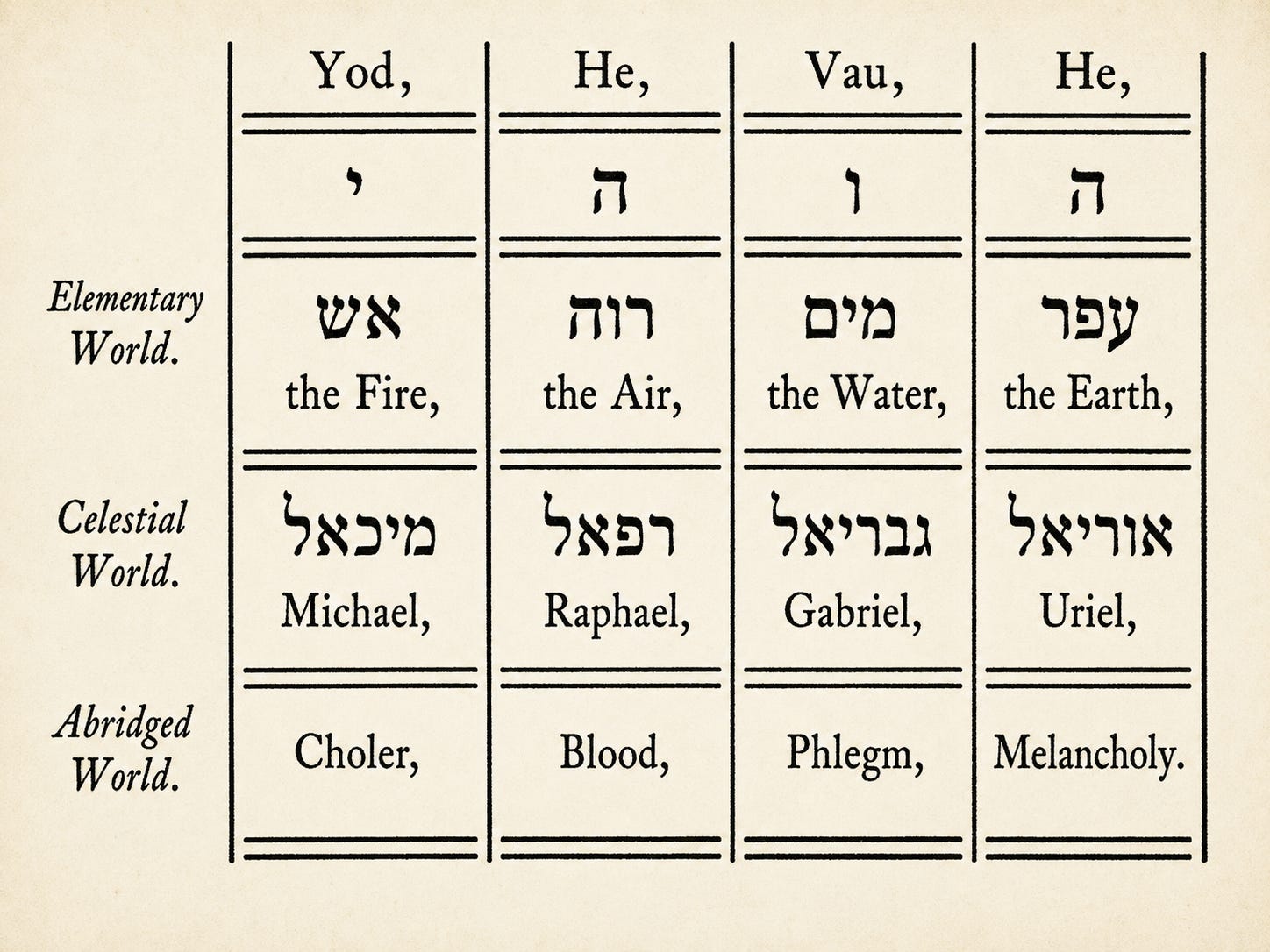
These worlds, arranged like this, show us what we might seek in their deepest secret. For the great world, called by the Greeks the macrocosm, is made up from this first number and from the four elements. The second, according to Rabbi Joseph, is made from the four chief angels. And the third world is made from the four temperaments or humors that compose this microcosm, or little world, which is the human body.
1. So from these temperaments we derive, for physiognomic knowledge, that the hot or choleric humor dries a person out. It does not stop his growth, but leaves him without bodily strength, and sad in almost all his actions.
2. The sanguine or airy humor makes the body grow with beauty of face and fatness; it does not change in its misfortunes.
3. The moist temperament, or the one corresponding to the nature of water or phlegm, makes bodies soft and weak. Such people are fearful and timid. They do not sleep deeply, but they are lively and ready for pleasure.
4. The melancholic humor makes the body grow slowly, but the mind grow greatly. Such men are worthy of great speculations, though not of loyalty, because men like this do not think about the truth when they think they are pleasing those most bound to them, but only about what they have imagined. I will say no more about physiognomy, since the rules given above are enough for anyone who wants to understand this art without a longer instruction. Let anyone eager to learn read them. And now, continuing our rules, let us speak of chiromancy.
On predictions from the hands in general.
CHAPTER IX.
You have recognized above the seven lines of the hand corresponding to the seven mounts, or seven planets. Now one must know the judgments to draw from them, so that the length of the discussion will not bore anyone and so that everyone may be instructed easily. We will begin with the Restraint.
1. When there are four lines at the Restraint, similar to one another and well colored, they mean that the person who has them will live to the age of eighty or one hundred. But if two little branches are found above them making a sharp angle, that means the person will inherit property through someone else’s death. In old age he will be raised to honors according to his ability, and he will be very fit and healthy.
2. When there are only three lines in the Restraint, and they are upper lines and broad, that means sixty years of life, with plenty of goods in youth but poverty at that age. If the first line is thick, the second thin, and the third small, this shows and lets us recognize wealth in the first age, decline in the second, and increase in the third.
3. When there are only two lines, life is limited to fifty years at most, with illnesses.
4. To have only one means a death close at hand. But when the first line of the Restraint is crooked, and the following lines continue with a straight and continuous angle, this will show weakness in worldly affairs.
5. If you find scattered lines in the Restraint, they represent a person of little wit but enough courage, who will live to forty at most.
6. If cross-lines are found in someone’s Restraint, he should beware of the law.
THE LINE OF LIFE.
1. When the line of life is well arranged, in good proportion and good color, well corresponding to the Restraint, that assures a long and secure life. But one must note whether there is any star whose extended rays are on the mount of Venus, Jupiter, or Mars, and so on. This means misfortune for the person who has such a mark or star, whether in love, honor, war, or the like. And one must pay attention to what month it may happen in, according to the signs of the Zodiac placed in the hand.
2. Whoever is found to have a double line of life may be sure of long and very fortunate years, and that he will be loved by kings and princes. And if a king or prince has such a line of life, he may confidently go to war, because he will be victorious without any misfortune and will increase his kingdom and country by his strength and virtue.
3. If it is a woman, she may count on good fortune and on being greatly loved by her husband. If she is unchaste, great men will love her passionately. Lais and Flora had a similar line.
4. When the hand is a little thick in its body and then stretched out nearby, it will mean a changeable man of bad life, unless he is helped by the triangle of Mars. According to the goodness or badness of that triangle, I judge his life to be at stake. Whoever has this line of life livid or pale, like the color of lead, shows a frenzy that will shorten life. If it is very red, it represents a temperate life. Pay attention to the crosses, lines, or stars that meet this line, and remember their meaning; the heart governs this line, and it corresponds to the basilic vein. If, as it closes between the mounts of Venus and Jupiter, there are branches, that is a sign of perfection, of wealth during life, and of honors. But if a star is found there, beware illnesses, especially in old age. Look along this line to see whether there are any crossing lines, because they are misfortunes.
In short, this line means, and by it we can learn, nothing except about life and its length; and it runs together with the Restraint.
1. Still, curious reader, note two more rules, which are very true. First, when three stars are found within this line, they mean that the man will be slandered and abused because of women, and hated by the great.
2. If crosses are found there, he will be loved by women and will make his fortune with them, but his life will be endangered by the pleasure this brings him.
THE MENSAL LINE.
The Latins call a table “mensa,” and this line is named from that word. Also, we call the space between this line and the middle natural line the table. This line corresponds to the head along with the middle line. In the head is the storehouse of the senses and perfections of man, such as fantasy, common sense, imagination, the thinking faculty, judgment, and memory. One must know that from this line we draw part of our judgments. For example, if it extends beyond the middle of the mount of Jupiter, that is a sign of a violent and intense mind. One must note and observe that half of all our chiromancy depends on this line, because this line runs along the four mounts. For if a star is found on it, whether on Jupiter, Saturn, the Sun, or Mercury, these are misfortunes: on Jupiter, for wealth; on Saturn, for health; on the Sun, for honor; on Mercury, for learning. If a cross is found there, it is good fortune in the same areas.
1. Whoever has this Mensal line broad and well colored is cheerful and strong-hearted, but all of it will come from little intelligence.
2. If crosses are found on this line toward the little finger, that means death follows the person who has such a cross.
3. Whoever has crossing lines on this line may expect just as many afflictions or illnesses to come from them. But if it is a young boy or girl, this will happen through love. If these lines or cuts are on the side of the middle finger, that means a flatterer, and someone who will be deceived in his flattery because of his inconstancy. If this line goes beyond the pointing or index finger, it shows happiness; but if it does not pass it, beware poverty, and in a woman, debauchery carried along by pleasure.
THE MIDDLE LINE.
1. This natural middle line corresponds to the head, like the other one; but the person who has on it crosses may be sure he will be fortunate in riches, but he will be a great liar and a true torrent of words of every kind, though flattering ones. As many lines as there are between the Mensal line and this line, so many illnesses are marked in the first age of life, though they will not be fatal. And when the lines end near the middle finger, they mean that these illnesses will come in the second age. If they go as far as the index finger, they mean that these illnesses will come in old age; and with the first one, beware death. If in one of these lines there is a half-cross, or if it is branched, and if a branch comes from the Mensal line and crosses it, going toward the index finger, while the other goes toward the middle finger and is blunt and dull, it shows and makes clear that the person will be fortunate and will acquire wealth through his own labor.
2. When the line of Life and the Mensal line are joined and make an angle, and the Middle line is not found, the man will be cruel in heart and beastly. The danger of death will hang over him until the thirtieth year of his age, and he will have conflict with his father or mother, or with his wife. He is also threatened with despair; and if, in place of this Middle line, he has some star, let him beware the gallows. This is a recognized rule.
3. When this line is cut through and broken, and some splits cut across it, the man will flee princes and lords and their service, and will suffer the danger of losing his life when those lines are pale.
4. When you find some projecting splits from the little-finger line, and they are of good color, they mean beatings, wounds, and prisons.
As for the line of the Stomach, we will not speak about it any further, because it relates back to the line of Life.
ON THE HANDS.
But as for general predictions from the hands, since they are mirrors of the soul and of the emotions, we will say what we think about them briefly, but with complete truth.
1. If you find lines at the tips of the fingers, beware being drowned and submerged in water. Pay attention to which finger they are on, so as to know the month when this misfortune could happen to you, and so foresee it.
2. If you find two lines under the joint of the thumb, that indicates great inheritances and possessions. But if there is only one line, it is a sign of little worldly wealth. If these lines are large and visible, the man who has them will indeed hold property, but with disputes and lawsuits.
3. If two extended and well-joined lines are found between the joints of the thumb, the man will be a gambler, and because of gambling he will be in danger of death. But if they are separated, bent, or crooked, he will be exposed to thieves and to violence.
4. If you come across a hand that has two lines joined together inside, under the last joint of the thumb, this is a sign of danger from water. But if they are pale, it means this happened in childhood, or will happen late. If they are on the outside, they will threaten harm done by fire.
5. If a woman has lines at the base of the thumb, on the mount of Venus, then however many lines there are, that is how many children she will have. If the lines are on the outer side, they show the number of men who will know her, or whom she will marry.
6. If you find, on the first joint of the thumb, a line attached to it on the inside, on the side of the index finger, the person who has it that way will be hanged. This is especially so if that line appears to come down from the mensale line. But if the same line is joined on the outside and not on the inside, it is a sign of losing one’s head; and if it goes all the way around, the man will be hanged.
7. When the mensale line is curved and falls between the middle finger and the index finger, it means bloodshed, as we have said.
8. When you find the mount of the thumb, as it is called, crossed by lines running from the life line to it, the person who has this is lustful, and for that reason will be hated by his relatives and superiors. But when you find two clear, well-marked lines near the nail, they mean abundance of worldly goods.
9. If someone’s mount of Venus is swollen and high in the hand, it means lust and shamelessness.
10. If you find a hand that has a split or crack with three little branches, the man who has it will be hated by great people, but he will be a great dissembler; for that reason he will fear them little.
11. If you find the life line separated or divided halfway through, it means the man will be wounded in his body by a sword.
12. When you find a woman with a short palm and long fingers, it is a sign that she will give birth with pain and difficulty. The reason is that the necessary parts are small, since the hand is the figure of them.
13. When you find a hand that is a little long, with fingers that are a little thick, it is a sign that the man will be slow, sluggish, lazy, and phlegmatic in temperament, though still good and very modest.
14. When you find the palm long, the fingers well proportioned, and not soft to the touch but rather hard, the person with such a hand will be clever, but changeable, given to theft, and vicious.
15. If you find someone with a concave hand, solid and well joined at the joints, that is a sign of long life; but if wickedness accompanies it, it shows a short life.
16. Someone whose hand is out of proportion with the whole body, with fingers that are too short, and thick and fat at their ends, is shown by this to be a thief, a schemer, and full of every evil. He is a model of vice, all the more so the more swollen his fingertips are.
17. When the palm is longer than its proper proportion, and the fingers are thicker because they are shorter, that means the man is lazy, careless, foolish, and proud, especially if the hand is broader where it strikes.
18. Someone with long, large hands is shown by this to be generous, good, shrewd, broad-minded, good at giving advice, and very loyal to his friends.
19. Someone whose hand is shorter than it ought to be in proportion to the other limbs is a sign of a great talker, and of someone who is an insatiable glutton, insulting, and critical of other people’s actions.
20. Someone whose fingers bend back toward the back of the hand is lustful, subtle, and clever. The bonier and drier-looking his fingers are, the more wicked he is, and the more he grows in every vice, being an enemy of virtue. When the lines at the finger joints are similar, be on your guard against such servants.
21. Someone whose fingers are very joined together and cling so closely that air can barely pass between them should be understood as curious and very careful about his affairs.
22. When you find someone whose fingers are twisted at the top joints and bent backward in order, as appears here, that is a sign of an envious person. Indagine and Savonarola say he is envious; but here it is envy of virtue, and he is a deadly enemy of vice.
23. If you find someone whose fingers are spread apart, larger at the joints, and thin and dry between those joints, as though the flesh had been drawn away, that indicates poverty and misery. People like this are great talkers and suffer poverty because they are too wise.
24. Someone who holds his fingers so that he strikes them together, as if he wanted to beat a drum, is changeable in his thoughts and thinks badly of others.
25. Someone who, while speaking with other people, is in the habit of clapping his hands and cannot stop himself has imperfect understanding, with his mind confused and tangled up with affairs, which make his mind muddled.
26. If you find someone whose hands tremble moderately when he reaches them out to take something, this shows that he is not angry. Other people have this weakness because of an abundance of Bacchus, so one must be careful about it.
27. When one finds a man who, when he eats, opens his mouth and brings it toward his hand or toward the food he is holding out, he is a glutton and an enemy of everyone. And the person who, while doing this, pulls his hat down over his eyes is treacherous, fond of every vice, and avoided by the wise.
The last of these rules is worth noting, because chironomy depends on it, that is, the science of the subtlety of the hands. This science is very necessary for those who make a profession of gaming, and so I have been willing to give the figure here. Still, I will not stop here to explain it further. I leave that subject for my Divine Mathematics, where I will show all the secrets of steganography and several others worthy of admiration.
Here is the chironomic figure.
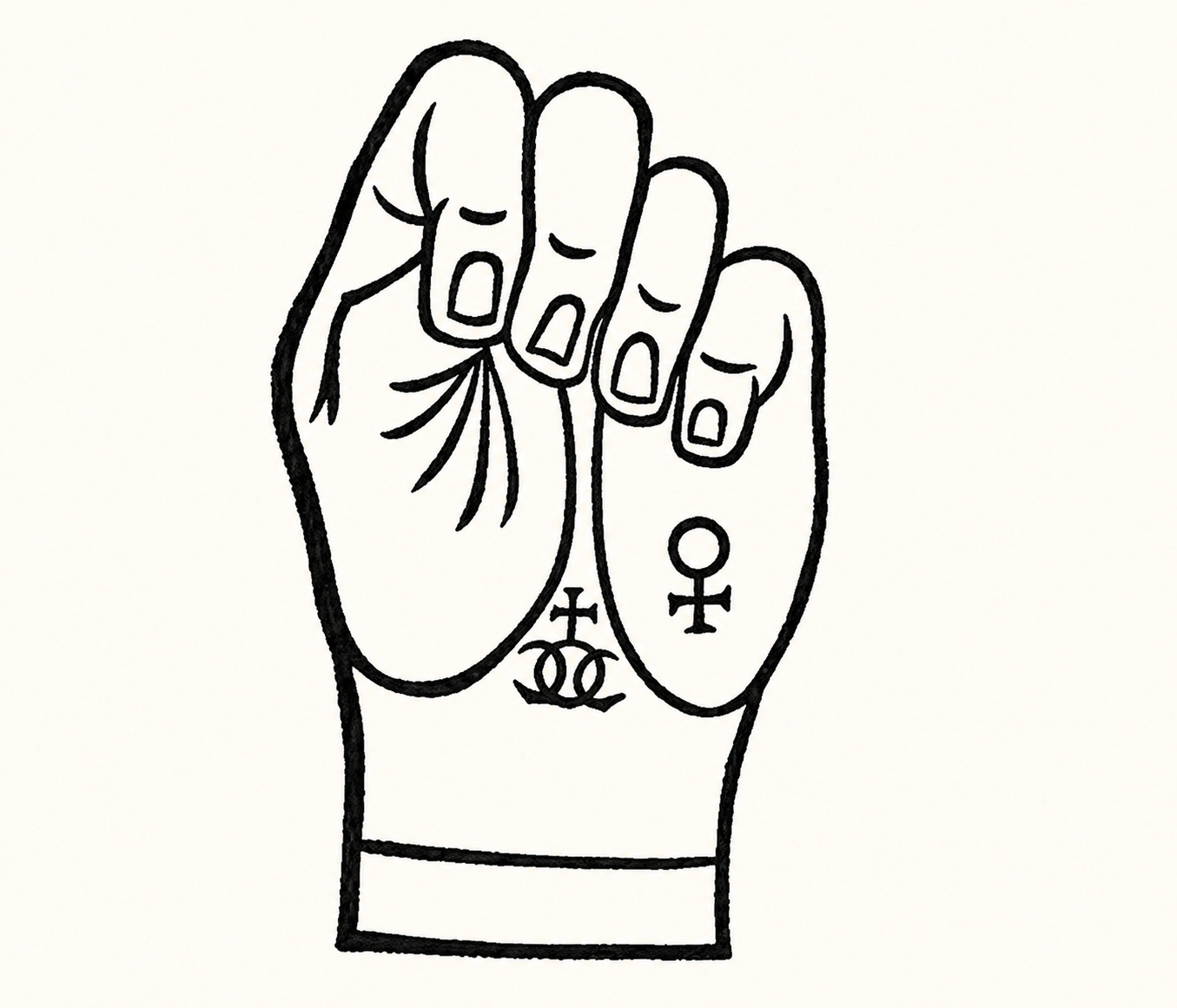
But according to chiromancy, someone who walks with his hands closed in this way, moving his arms, is impulsive and a great gambler. And if he keeps his thumb between his other fingers, he is greedy, wants to live only by plunder, and is deeply given to gambling. If a figure close to the character of Mercury is found in his hand between the mounts of Mars and the Moon, he should boldly give himself to play, because he will be lucky at it. Still, he should not neglect this chironomic subtlety: joined with his own inclination, it will bring him to the greatest riches that can be acquired by gaming. Some superstitious people have blessings pronounced over such figures, but I will leave all that aside in order to finish this first treatise.
End of the treatise on chiromancy.
WHAT ARTIFICIAL MEMORY IS, OR THE ART OF RAYMOND LULL.
CHAPTER I.
Artificial memory is nothing other than an art for helping natural memory. One cannot exist without the other: technique would be of little use if there were no natural ability. But when natural ability is directed toward some science or art, technique is unquestionably very useful to it. Through technique one can shorten what would otherwise be acquired only through a long and drawn-out time. This is what Raymond Lull, a man of exceptional learning, worked very hard on: finding the perfection of this brief art, this artificial memory. He did find it, but he hid it from us under riddles and ambiguities, so that learned people would take the time to understand and acquire it, but recognizing that this art was necessary for people whose profession is to give sermons, speeches, legal pleadings, or to carry on some business in trade, I wanted to make it clearer. Through the hand, or chiromancy, I wanted to make it known and make it so much easier that even the simplest person, if inclined toward something, will become perfect in it, by means of the alphabet that contains all the others, which we must imagine in our hand, as can be seen in the figure placed below for this instruction.
First, one must know that the curious ancients before Raymond Lull divided it in two, or tried to acquire it in two ways. The first was very dangerous: it was by drugs and medicines that they took to purge the coarser humors and make their mind clearer, and therefore better suited to grasping everything. The second method they followed was more visible. They said it had been revealed to the wise Solomon by the great God, of whom Scripture says that he knew everything from the hyssop to the cedar, that is, every science. A certain Apollonius wrote about this science; a treatise by him can be seen inserted among the works of H. Cornelius Agrippa, full of prayers, most of them made up of unknown words. Still, he almost touched the truth. For in the figure that he presents as secret, instead of using [Hebrew letters] c. Michael, if he had used the name of ten letters in this form, he would have reached perfection.
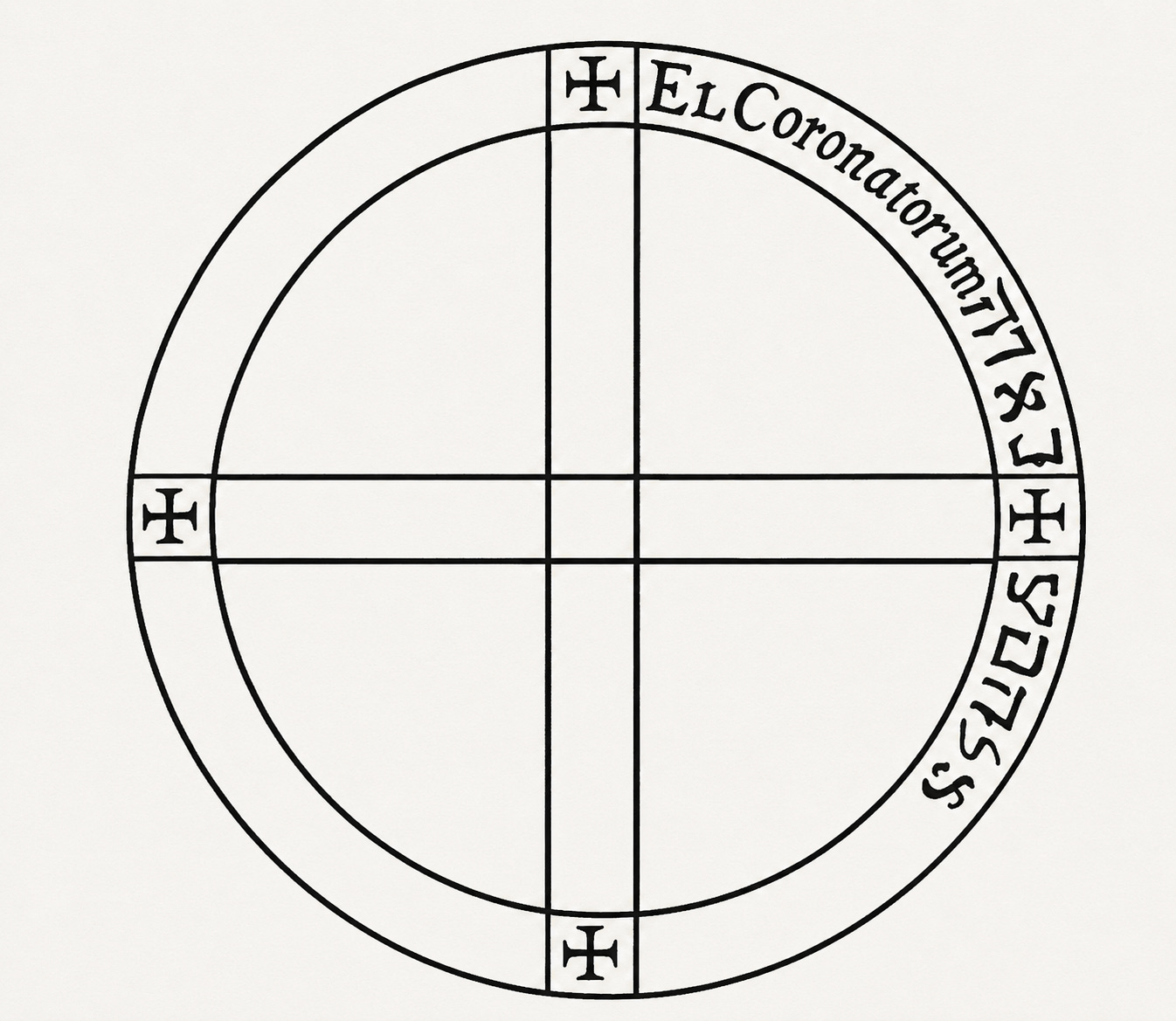
For I will say plainly, without disguising anything, that this figure is very necessary to it.
Still, I find the invention easier through chiromancy, having read and reread Raymond Lull and those who wanted to make him easier, such as H. C. Agrippa, Jordanus, Brunius, Alstedius, Lavinhetus, and several others, since they place and ground this whole art in these ten letters: A, B, C, D, E, F, G, H, I, K.
So let us place them in the hand, in order to instruct.
The places where one must imagine these letters to be set.
CHAPTER II.
As one sees in this figure above, we place A as the foundation of this art in the middle of the hand, which in chiromancy we call the plain of Mars. This letter is the base and foundation of this science, to which the nine other letters refer. The Rabbis had noticed this in the ten-letter name of God, which begins with an Aleph, as you see in the figure above. For whatever subject one wishes to treat, one must place it on this imagined A, and the definitions and distinctions on the other letters, as we will explain more fully below. B, which is the first letter of the circle, is placed under the thumb, on the mount of Venus. C is under the index finger, or the mount of Jupiter. D is under the finger of Saturn. E is under the finger of the Sun. F is under the finger of Mercury. G is below, on the crossing of the mental line. H is on the mount of the Moon. I is at the root of the life line, near the Restraynte. K is at the beginning of the mount of Venus. Once you have imagined them this way, form in your mind, on each letter, whatever point you want to discuss or remember.
Why this art is called brief.
CHAPTER III.
Raymond Lull, a man fully accomplished in every science and art, invented this art to help the natural memory, to shorten the path through all the sciences, and to make them easy for everyone to grasp in condensed form. His aim was to make people, in a single moment, capable of speaking expertly about those sciences and arts, and to let them penetrate the deepest secrets of their principles.
That is something they could never acquire through ordinary labor and study, even if they spent their whole lives on it — even a life of eighty years. All that study would not get them even halfway there, nor make them perfect in it.
But this art teaches it easily; indeed, it would make a seven-year-old child capable of forming every kind of argument. Those who have practiced it and mastered it have shown wonderful results from it. H. C. Agrippa made that clear, even though he mocked it, just as he mocked the other sciences. But he wrote that declamation against these sciences and arts in order to show how deeply he understood them; before blaming them, he had said marvelous things about each one. By that irony, this mind, steeped in everything, wanted to wipe away the blame that some weak and empty people wanted to lay on him. I am sorry, for the honor of Monsieur Beaulieu Bonfils, that he insulted him, along with Ramus, in the Introduction to Philosophy, because that insult rebounds only on the person who tries to insult such men.
The reason is that he cannot put out their reputation with his criticisms: they are immortal in the memory of learned people. But the philosophy of that Beaulieu was dead almost before it was born. Agrippa was not the first to taste this science; Simonides of Miletus did, and so did that great and wise captain Themistocles, who were both deeply practiced in it. In more recent centuries there were Peter of Ravenna, Francesco Petrarch, and Hermannus Buschius; and still more recently Giordano Bruno, who worked wonders with it. Still, someone will ask me why Raymond Lull gave this science the name “the brief art.”
He answers by his own reply in the prologue to this Art, briefly, in these words:
“So that the great art may be known more easily. For just as this art spoken of above, and also other arts, can be known and learned only with difficulty.”
There is no science that cannot be shortened and set into memory, provided that the person who wants to acquire it is prepared for it by these ten letters.
For rhetoric, the definition is placed on B; the parts on C; the thirty rules on D.
Dialectic, or logic: the definition goes on B; the ten predicaments on C; the three figures of syllogisms, each figure having four modes, two that conclude universally and two that conclude particularly, are contained in these verses:
Barbara, Celarent, Darii, Ferio;
Cesare, Camestres, Festino, Baroco;
Darapti, Felapton, and so on.
All of that is put on D. Equivocal sophisms, amphibologies, ignorance of refutation, and the fallacy of the antecedent go on the other letters.
For arithmetic: the definition goes on B, namely that it is a science invented for numbering several units. Its first rule is put on C, which is numeration. The second goes on D, addition. The third on E, subtraction. The fourth on F, multiplication. The fifth on G, division. The rule of three goes on H. Reduction of fractions goes on I. Algebra goes on K.
For geometry, distinction goes on A, triangle on B, and likewise the other figures are set on the remaining letters:
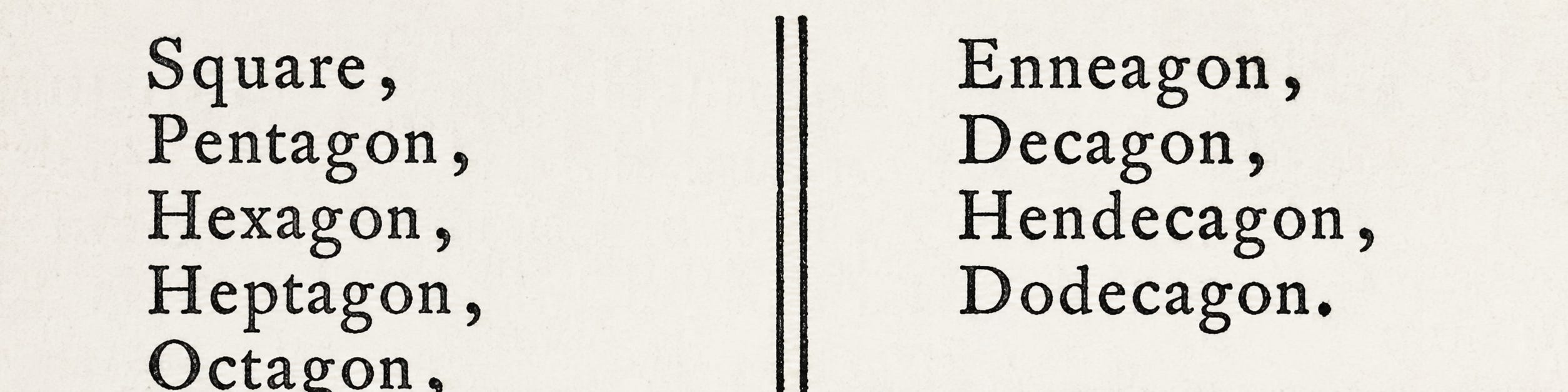
For music: its definition, its six notes, its eight tones, and its shades or inflections are all contained in these words:
“There are three times three modes by which every melody is put together: namely a single sound, the semitone, the tone, the semiditone, the ditone, the fourth, the fifth, the semitone with the fifth, and after these the octave sound.”
They are placed on the letters.
For astrology, the definition goes on A, along with the ten parts of the sphere: the equinoctial, the zodiac, the colures, the solstice, the equinoctial colure, the meridian, the horizon, the Tropic of Cancer, the Tropic of Capricorn, the Arctic Pole, and the Antarctic Pole. Then the seven planets and the whole body of recognized stars: forty-eight figures, containing 1,022 or 1,025 stars, to which fourteen others have been added, namely five nebulous ones and nine dark ones.
For alchemy: the seven minerals; the seven planets to which the seven salts are assigned, ammoniac, common salt, nitre, alkali, saltpeter, gem salt, and rock salt; calcination, reduction, fixation, friction, pulverization, sublimation, elixation; or, according to Arnold of Villanova, the body, the atom, Azoch, Zernich, Chibrit, Adrop, and Topum.
For surgery: anatomy, phlebotomy, and the “Ancharis” parts, which are Mirach, Siphac, Zirbus, the bones, and other parts.
For practical medicine: aqua vitae, drinkable water, swallow-water, strong water, whitening water, preserving water, vivifying water. And so with the other arts and sciences, which do not need to be set down or used here. To put it briefly, all these sciences are contained in a hundred definitions. But to shorten them even further, we will gather everything that can be said and debated into these nine letters, as can be seen in the tables placed here before we enter into the practice and use of this Art. They are as follows.
QUESTIONS.
B. “To know, mine?” God, goodness.
C. “Who?” Angel, magnitude.
D. “About what?” Heaven, duration.
E. “Why?” Man, power.
F. “When?” Imaginative, wisdom.
G. “What kind?” Sensitive, appetite.
H. “When?” Vegetative, virtue.
I. “Where?” Elementary, truth.
K. “How?” Instrumental, glory.
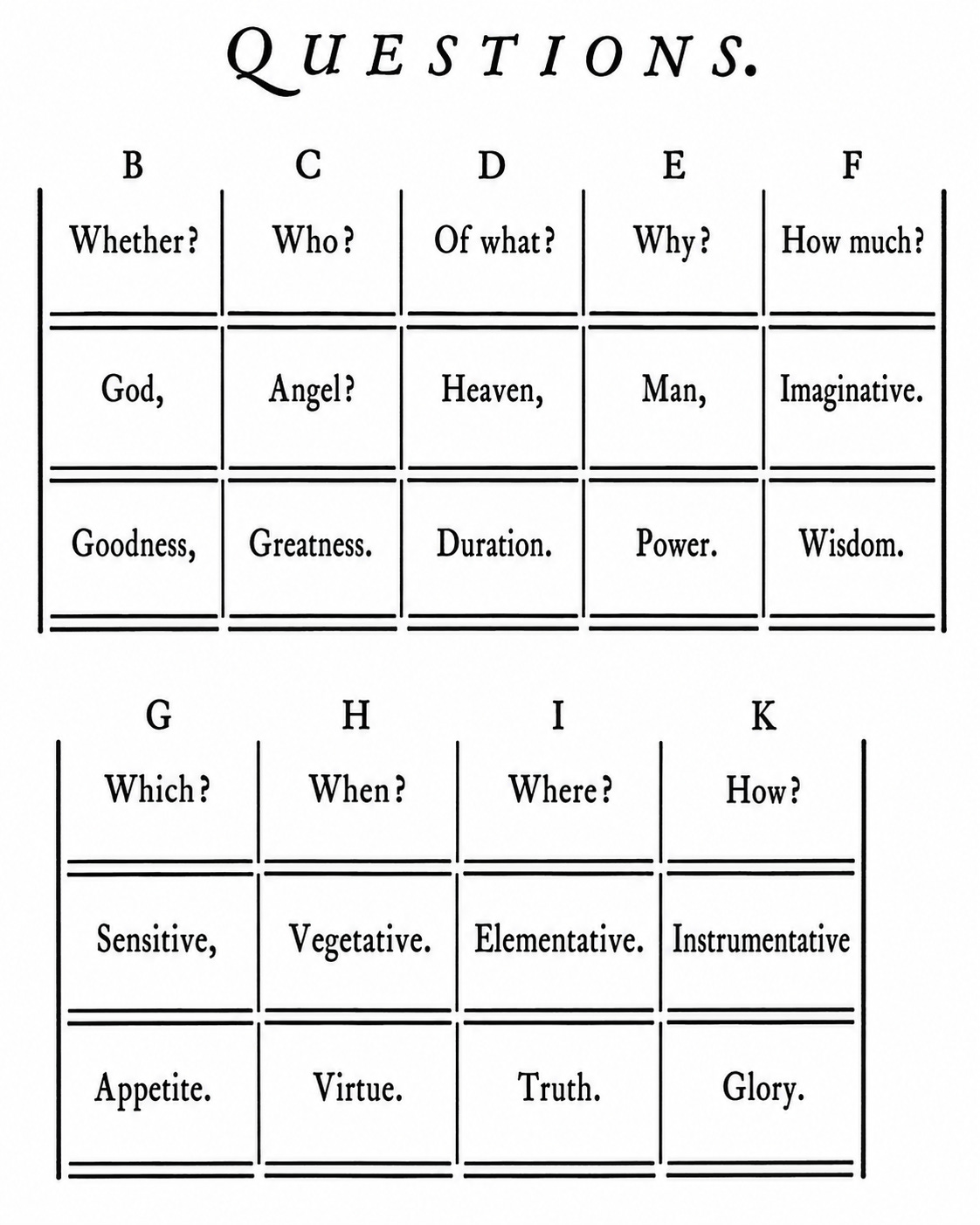
A more intelligible alphabet.
Chapter IV.
B means and represents this first question, “to know, mine?” For its subjects it has God, goodness, difference, justice, and greed.
C represents this one: “Who?” Its subjects are angel, magnitude, concord, prudence, and gluttony.
D: “About what?” Heaven, eternity, opposition, strength, and lust.
E: “Why?” Man, power, principle, temperance, and pride.
F: “When?” Imagination, wisdom, middle, faith, and laziness.
G: “What kind?” Sensitive, appetite or will, end, hope, and envy.
H: “When?” Vegetative, virtue, greatness, charity, and anger.
I: “Where?” Elementary, truth, equality, patience, and lying.
How this art must be practiced.
Chapter V.
So the person who wants to practice this science must first learn these ten letters. But he should keep A as the principal one, and practice saying these letters: B, C, D, E, F, G, H, I, K, and then saying them backward from K to B. Then, to become more skillful in handling these letters, he should handle and recite them in the following way, through twenty-four “cylinders”:
BCD, BDC, CBD
CDB, DBC, DCB
BBC, BCB, CBB
BBD, BDB, DBB
CCB, CBC, BCC
CCD, CDC, DCC
DDB, DBD, BDD
DDC, DCD, CDD
Once he is practiced in handling these letters, he should look at what he wants to propose and set it out like this. If he wants to discuss a preacher’s topic about angels, his subject must be put on A, the place where any matter one wants to discuss or debate must be set. He should enter at B, at the definition, as the first letter of the circle placed on the mount of Venus. And no one should be considered capable of debating if, when entering into a question, he does not define what he wants to debate.
“One must begin from the definition, so that it may be understood what the thing is about which the debate is being held,” says Cicero.
On C one must put the distinction. Then, for the subject proposed above, take histories for the same subject placed on B: the story of Abraham. On C, the conception of Samson. On D, the story of Elijah. On E, the revelations of Daniel. On F, the revelations of Zechariah. On G, the Annunciation of the Virgin. On H, the Resurrection of Jesus Christ, and the angels who appeared to the women who were going to perform the last rites for him. On I, the angels who appeared on the day of the Ascension. On K, the angel of the Apocalypse. If you multiply them, put back on B the angels of Lot, Tobias’s angel, the one in Acts who frees Saint Peter from captivity, and many other stories. Imagine them to yourself while imagining these letters and this figure of multiplication.
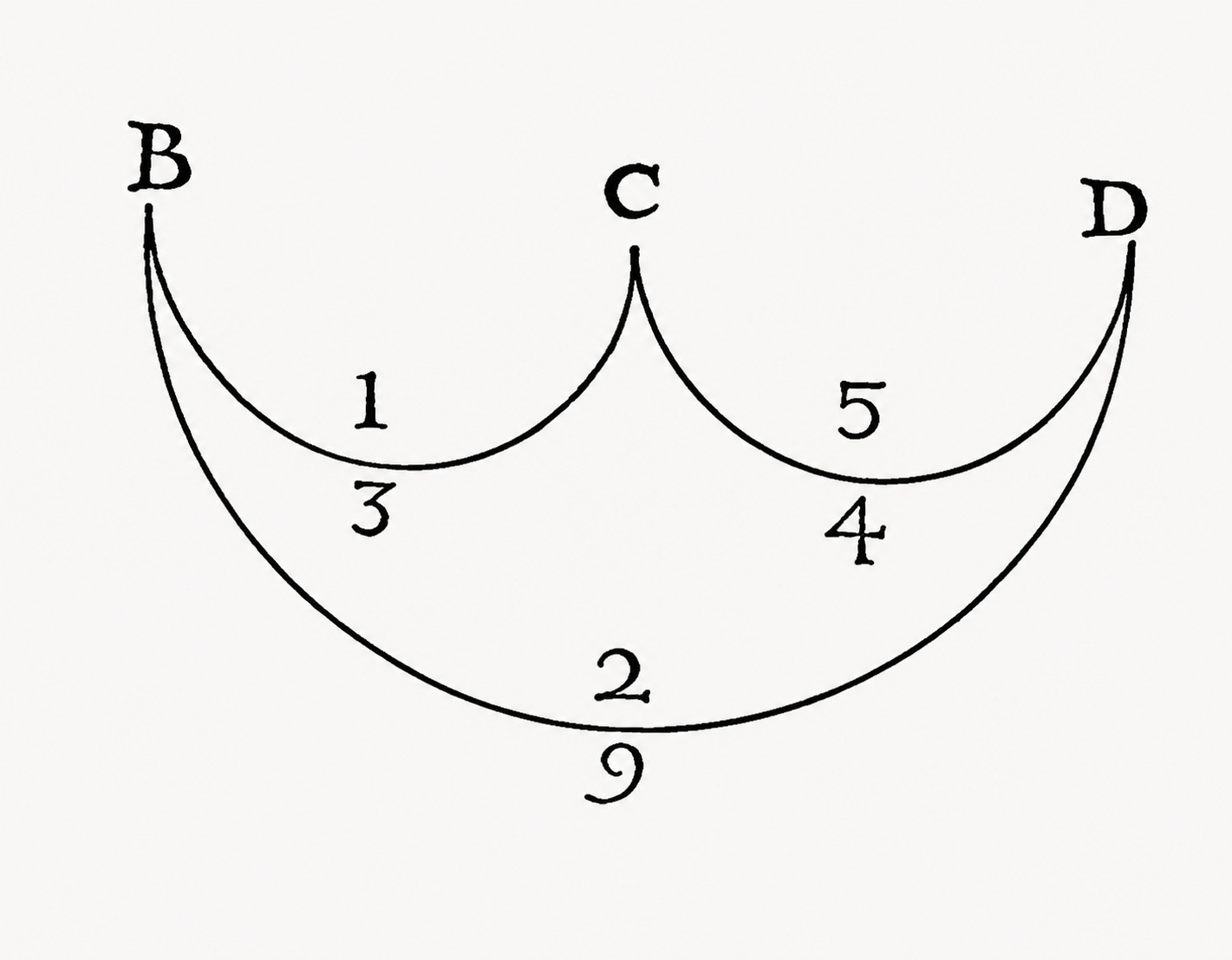
For notice that a person who knows arithmetic can conceive and understand numbers held in someone else’s memory just as easily as a lover of this Art can conceive, retain, and learn anything he wants by means of these ten letters. He can even count without addition, except from zero. It is set up like this.
Suppose someone thinks in his mind that he has chosen one of these numbers: 1, 2, 3, 4, 5, 6, 7, 8, 9, or 10. To reveal it, you who want to know it should have him triple the number he has thought of. Then have him halve the triple. But if, at the first step, the tripled number is odd, which you must ask about, tell him to make it even by adding one, and then divide it in half. From that addition you will take one. You will then tell him to do the same again, but you will keep two in mind. Then tell him to subtract 9 from his last number as many times as he can.
For your part, count four for each time, and then add whatever you have kept aside. For example, suppose someone has thought of 7. The triple is 21; adding one makes 22; half is 11. Tripled, that makes 33, and that cannot be halved unless one is added, so it becomes 34; half is 17. Here you note down 2. Tell him to cast out 9 as many times as he can. Since that can only be done once, you note down 4. You do not ask about the remainder. If you had kept 3, that joined with 4 makes 7. Handle these letters in the same way, multiplying them for the number of words you want to set out. Take pleasure first in putting words like these on each letter, so as to get used to exercising your memory.
B, goodness; C, charity; D, deity; E, drunkenness; F, fortune; G, greatness; H, honor; K, Katherine. Learn that going forward and backward, and multiply them to increase your memory. B, kiss; C, heaven; D, delight; E, edify; F, strong; G, glory; H, horror; I, Jesus; K, Cato. Then make arguments on each of the words. The first figure, for B:
All goodness is praiseworthy.
Charity is a goodness.
Therefore, etc.
ANOTHER.
Every virtue is praiseworthy.
Charity is a virtue.
Therefore charity is praiseworthy.
ANOTHER.
Every good thing is praiseworthy.
Some pleasure is not good.
Therefore some pleasure is not praiseworthy.
And so with the others. But all your arguments must always look back to the subject you are discussing, which is placed on A. For example, you as a preacher, wanting to speak about principles or about the Principle, place it on A in your hand, and then on B, make this argument: whether there is some priority in divinity. On C, make this syllogism:
Every agent is prior to its patient.
The father is agent and the son patient.
Therefore, etc.
So, by working in this way, placing histories on the other letters for this subject, and not letting these letters, the principles of our science, slip from memory, they can do anything. Indeed, by this Art a seven-year-old child can in a moment be made capable and fit in every science, provided he has some natural inclination toward it. And I promise that, at that age, if a child stays with me for some time, ten days at most, I will make him argue and form syllogisms like a good logician on any point anyone wants to propose to him. For this art produces astonishing effects in those who embrace it with zeal. Let the merchant also profit from it in the same way, placing the subject of his trade on the letter A and its dependencies on the other letters; remembering those letters will bring them back to him in everything he has to do.
Studious reader, I beg you, understand this little treatise of mine, and you will recognize the usefulness of this Art. You will also praise its first inventor, whose memory ought to last forever. If it pleases you, be assured that before long I will give you a full book on all the divine mathematics, where the secrets of the Kabbalah and the gematria of the Jews will be shown to you, and whatever is most curious to the works of everyone who has written on occult philosophy. Accept these notes as a New Year’s gift, and count me as your friend.
End of the treatise on artificial memory, or the Art of Raymond Lull.
ASTROLOGICAL DISCOURSE AND GEOGRAPHICAL AND TOPOGRAPHICAL DESCRIPTION OF THE COMET THAT APPEARED over our hemisphere on November 27 and disappeared on December 28 of last year, 1618.
WITH ITS PREDICTIONS, whose outcomes will be terrifying.
By Mr. Jean Belot, priest of Mil-monts, professor of divine and celestial mathematics.
Paris:
Published by Nicolas Rousset and Nicolas Bourdin,
on the Ile du Palais, opposite the Augustins.
1619.
With the king’s privilege.
TO THE READER.
I know that during the days when this comet was visible, dear reader, several clever writers took up the pen and brought out various treatises. Some were full of comfort, meant to reassure people who had felt some fear at the sight. Others tried to deal with its predictions, but so briefly, so beside the point, and with so little knowledge of astrology, that I do not think any of it can satisfy wise minds that are anxious about what is coming.
So, despite the variety of these writings, I too take up the pen to give these new Centuries, made for each day on which this comet was seen, in keeping with the prophecies of Saint Hildegard and Saint Bridget. Both of them had revelations and heard the voice which the Hebrews called [Hebrew word], that is, “daughters of the voice,” so clearly that John Trithemius, abbot, and Theodoric, also an abbot, both of the Order of Saint Benedict, presented them as if the first of these women were like Saint John the Evangelist, because, like him, she heard this voice, and this voice dictated to her the prophecies whose fulfillment is taking place in this century. They wrote them, as he did, under certain images and figures, in the form of hieroglyphs or riddles, so that not everyone would have knowledge of these mysteries. That was the manner of all the Hebrew prophets and of the Greek oracles.
That is what I have wanted to imitate in these Predictions, for two reasons. The first is that, by imitating those ancient Hebrew prophets, I hide under figures what could otherwise be known plainly, so that everyone is not free to interpret them according to his own fantasy. Instead, people must become capable of understanding intelligible things through the light of the Holy Spirit, who lets us see clearly in the middle of darkness.
Plato spoke of it this way: “The mysteries of sacred things must be veiled, so that they may be protected from the unworthiness of the common crowd.” And again: “It is utterly unworthy and shameful for the mysteries of hidden things to be opened to the people, since those things would be handled by the polluted hands of the human race, though it is proper for them to be treated only by people initiated into the sacred rites of philosophy.” The second reason is that under this reign, truth could create enemies just as much as in the time of Jeremiah, Micah, and so on. Daniel, as one of the seers, did not merely have [Hebrew word] and [Hebrew word]; he also represented under figures the birth and decline of the four sovereign empires. So did Zechariah, Saint John, and later Saint Hildegard. And I follow them with the same fear.
As I say farewell to you, dear reader, I give you my excuse in these lines from Horace:
“Indeed, even the law was passed,
and a penalty too, because it did not want anyone
to be attacked in a malicious poem: fear of the cudgel changed the tune.”
Remember also the story of Brother Girolamo Savonarola. Read Commines and you will learn what that means. Farewell.
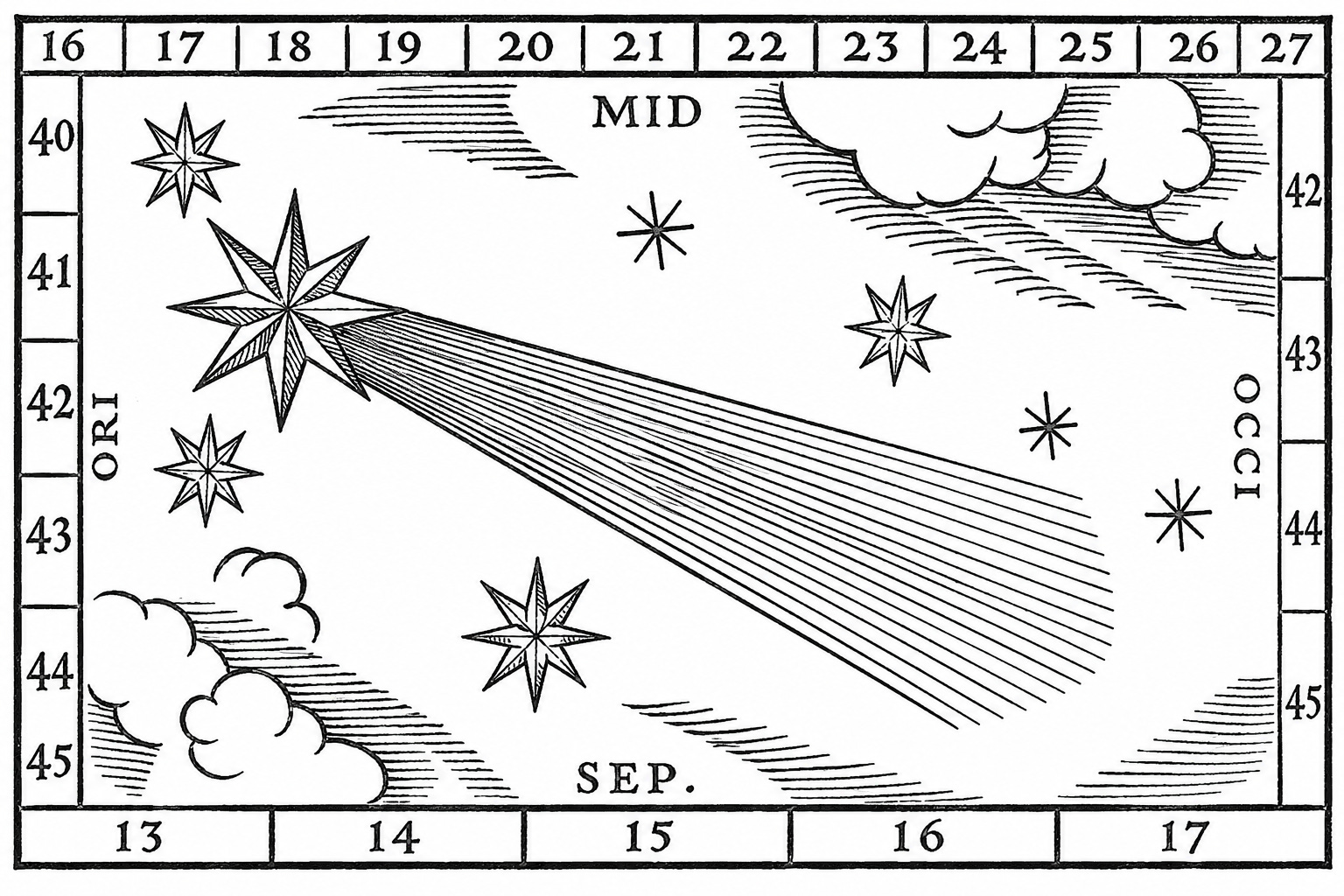
DESCRIPTION OF THE COMET.
Before beginning the discussion of our comet, I need to deal with the fiery impressions that form in different ways in the air, so that the reader can more easily understand how they are generated. More recent philosophers have divided the air into three regions. One lies along the surface of the earth, another is joined to the concavity of the elemental fire, and the third lies between the two.
Now, the proper nature of air is to be hot and moist, but its chief quality consists in moisture rather than heat. That heat can be increased or taken away by external events.
Following this, we see that the region of the air nearest the earth is warmed by the bright rays of the sun that strike it, and the region nearest the elemental fire is warmed by that fire. By contrast, the middle region is made the receptacle of all cold, and of the vapors and exhalations continually raised up from the earth and the water, because the heat of the upper region and the heat of the lower region compress this cold there and cannot reach it to destroy it.
From this we learn that the upper and lower regions of the air are especially suited to fiery impressions, which are produced there without any violence by the heat residing in them. The middle region is not suited to them, except through collision and conflict of opposites, which cause thunder and lightning.
Exhalations and vapors are suited to these fiery effects in opposite ways. Exhalations are better material than vapors for receiving impressions of fire, and they are also disposed to rise into the upper region of the air. Vapors cannot do that. They are stopped in the middle region, where the cold freezes them into clouds because of their excessive moisture and makes them fall back down. As for exhalations, it should be noted that they cannot rise more than two or three miles above the earth.
So let us say in general that all flames which appear in the air without thunderbolt or thunder, in the form of comets, columns, lances, and other shapes, whether long, wide, or round, are generated by heat in the lower and upper region of the air, when that heat meets exhalations suited to being converted into such flames.
But concerning all the other impressions produced there, some philosophers have held that comets are especially produced in the air, and are not formed in the heavens by the meeting and conjunction of the rays of two planets in aspect to one another. The leader of this opinion was Aristotle, who says in book 1, chapter 7 of the Meteorology, [Greek quotation]. What he meant was that these fires are set off by a thick exhalation in the upper region of the air; as soon as that exhalation begins to fail, the fires likewise, since they cannot survive without what served them as food, are forced to go out and disperse.
But such arguments are worthless and empty. At this point I would rather honestly admit our incapacity than put something forward rashly as certain and get stuck in these vain opinions. For just as wine is not always useful to the sick, but is very often extremely harmful and dangerous to them, so that it is far better to forbid it to them entirely than, in the uncertain hope of some benefit, to give free rein to the violence of their illness and put their life in danger; in the same way, it is much better to leave people who are curious about empty things without answers than confirm their foolish opinions.
We have already said above that exhalations cannot rise more than two or three miles above the earth. But one cannot deny that comets appear in the highest region of the air, which is free of every kind of smoky exhalation and of the sulphurous smell that other fires leave behind them. Nor can one deny that they are noticeable to all peoples living under the same hemisphere. That could not happen if they were not near the orb of the Moon, whose shortest distance from the center of the world is an interval of 32 diameters of the earth, that is, 122,760 miles.
Some astronomers have even written that the great comet that appeared in November 1573, on the right side of Cassiopeia, had no parallax and belonged to the fixed stars. That, however, is false. It does not follow that it was a fixed star just because it had no parallax, or no difference of aspect, because the doctrine of parallaxes is very deceptive, since its reach cannot extend beyond the star of Venus, whose difference of aspect is already very small. Besides, this comet disappeared within fifty days, as the history of that time reports, which does not happen to fixed stars. But since it was motionless in relation to its position in the constellation of Cassiopeia, though it had its ordinary motion through the first movable heaven, and since it was close to our zenith, it gave many people reason to think it was a fixed star, as one may judge from our own comet. Still, one may judge from that fact that it was not very far from the orb of the Moon, and that it was a forerunner meant to signify the calamities that followed, so great and terrifying that Cyprian Leonicus and Lutinius dared to note something major in the year 1588, for that year was the beginning of all miseries, especially in this kingdom of France.
The ancients too, in every age, whose memory stretches far back toward venerable antiquity, observed that one should not dismiss what comets signify, apart from whatever might be said about their natural cause. Aristotle would have held this opinion about the natural cause, but by that opinion he would fall into an infinite number of other, greater difficulties, which must be listed before we enter into the Predictions of our comet. They are these.
If we grant Aristotle that smoky exhalations rise all the way to the concavity of the orb of the Moon, that nevertheless cannot happen. How could all the exhalations of the air pile themselves into one globe in order to feed so great a fire? Or, if the exhalations are scattered throughout the whole air, why would comets not also be scattered here and there? But we see them rather in summer, when there is such great heat and dryness that the air nearly catches fire everywhere from the exhalations rising up, until all at once, once its material is consumed, it goes out. And yet one does not see all this fire gather together into one sphere.
Besides, if a comet is produced from an exhalation, why is it that the one called Jovial in astrology appears in the air with such great brightness and purity of light, while another, which they call Saturnine, appears with a darkness mixed with a pale color tending toward blue? Likewise the Mercurial comet is horned, the Martial one is fiery and very frightening to see, and the one belonging to Venus has a long tail of hair. For this reason some people have thought that only one of the seven planets could become a comet. Palingenius says:
One star from among the seven wanderers makes them; while it impresses its rays on the vapor lying beneath it, it shapes a tail and leaves its light in the cloud.
Now, since these exhalations are all of one and the same kind, they should therefore have one and the same underlying nature. It is also held that the comet of Venus moves through the whole Zodiac; such a one was seen in the year 1470, at the Ides of January. But how could they move from east to west with such steadiness, as the one that appeared in October 1577 was seen to do, and not be scattered by any wind or storm, if their matter is an exhalation? Aristotle claims that winds are stirred up from these exhalations, and that is false. And why would we see comets in winter, as we saw ours, even more readily than in summer, when at that season there are few exhalations, and those very weak, held down by the earth, which is frozen by the cold? Why also why would they be seen more often toward the north than toward the south? Or why would they differ so much from one another, and each of them from the rest of the fiery figures, such as the hairy comet from the bearded one, and the one shaped like a sword blade from those two, since exhalations have no shape at all? Why would the Barrel, the Torch, the hollow-horned comet, the Dragon, the Lance, and an almost infinite number of other such figures all be unlike one another, not only unlike this one but unlike each other too, given the reason just stated?
Besides, a comet can sometimes equal a third or a fourth part of the earth in size, as ours did, since it was seen from more than two thousand leagues away. Justin reports that at the time Mithridates was born there was one that covered a fourth part of the visible sky, and in the places where it stood it almost darkened the light of the sun. So too with the one that appeared for three months in the year 1314; and another in 1337; and another in 1472, which was driven with such speed through the whole Zodiac that it almost completed its course within a month. It began in the sign of Libra, and as it pursued its path it moved at first forty degrees each day, then near the end one hundred and twenty. Likewise another appeared throughout August and September in 1556. This one kept its course from the Equator toward the Little Bear, with a brilliance of very visible brightness, and it was so large that I do not say-- that the exhalations, being so dry and light, could hardly have supplied the nourishment it would have needed for the two months during which it kept shining. In fact, even all the forests in the world could not have supplied it. And this is leaving aside the comet that appeared in Nero’s reign, which lasted six whole months, as Seneca wrote in his Natural Questions. Josephus also wrote, in his book on the Jewish war, that another appeared and blazed for a whole year over the Temple of Jerusalem before the ruin of that temple and city, shaped like a sword. Anyone who wants to see countless other examples appearing from time to time should read the Meteorology of Garcaeus and Lycosthenes’ collection On Prodigies.
But what fuel could be enough for such great fires? Several petty sophists have dared to say that the sun and the other stars feed on exhalations. That idea is laughable, but no more deserving of mockery than the earlier claims about comets. Posidonius based his argument on this: the whole world must be consumed by fire, because he thought that moisture, which was the food of the stars, would finally be used up.
Before discussing our comet, I will settle two questions that have already been raised and could still be put to me. The first is whether the tail of comets is always on the side opposite the sun. If that is so, the comet cannot be a blaze of fire, nor a fiery substance, but rather the appearance of a pyramid shaped by the meeting of the sun’s rays and by the opposition of a body denser than air. The second question is this: since it has been observed throughout antiquity, as Cicero says in book 2 of On the Nature of the Gods, and Pliny in book 2 of his Natural History, that comets are messengers or forerunners of famine, plague and other public diseases, or civil wars, which does not happen through exhalations that have caught fire, might Democritus’s opinion be plausible? By it he meant, as he left in writing, that comets finally return into fixed stars.
To the first question I answer that this is observed in eastern comets, as was seen in ours during the first days when it appeared, and in those that do not move from one place. But it is no longer seen in the rest of the other comets. For it has certainly been observed that the rough-haired or hairy comet, whichever one wants to call it, throws its tail or hair behind itself, just as a torch throws its flame backward when the person carrying it runs quickly forward, or when, without moving, he lifts it upward. In that way the flame spreads out like rays, or like a beard hanging down from the chin. It is the same with a comet if it moves from east to west: its hair is gathered up toward the east, although the contrary was seen in ours. That, however, is by a hidden mystery, which was not the case with the comet that appeared in October 1577 and was swept along with great force by the course of the first mover. But the one that appeared in August 1556 took its route from south to north, with its hair turned back toward the south. From this one can see that the opinion of some people is false, when they think a comet is an appearance rather than a true substance. The same goes for those who think its nature is no different from that of the other flaming impressions in the air, which suddenly appear and suddenly withdraw from human sight.
To the second question, we answer Democritus by saying that this is probable, though not necessary. It seems probable to me in this respect: the ancients observed that comets came and went without any generation or corruption, as Pliny testifies. That is, comets did not go out any more than the other stars; rather, little by little they withdrew from our sight. But this cannot happen unless we admit that comets gradually rise upward until, having withdrawn into the firmament with the other stars, we lose sight of them. Still, this reasoning is not necessary, because it may be that they perish entirely, since we do not see the number of stars increase when they come. Yet it could just as well be that, because of their extreme height, they cannot be seen any more than the tiny stars can.
On Democritus’s view, several people have thought that comets are the souls of illustrious men, an opinion Plutarch touched on in his treatise on the failure of the oracles. After remaining for an immense number of years on earth, these souls are finally brought to the common end of all other things that have come into being and that come to an end. From this view they infer that, once changed into comets, this was the final triumph of their blessed life, and that they returned to the starry heaven like shining stars. From this they thought famine, public diseases, and civil wars came, as though peoples, kingdoms, and cities had been abandoned by their governors and good captains, whose presence used to calm the anger of the Divine Majesty.
For my part, I would not want to assert anything rashly against this opinion, nor to put faith in the views of others about a thing so far removed from human understanding, and which, because of its height, cannot easily be reached by human judgment. For me it is enough to have shown, by arguments very certain and well suited to make others necessarily yield to my opinion, that comets are not exhalations that have caught fire. If that were so, they would be produced rather near the earth, where there is a greater quantity of exhalations, than in the highest region of the air, where neither vapors nor exhalations can penetrate. For if exhalations did rise that high, as they say, this would be only a natural cause, which could not bring about war, barrenness, or diseases. For everything natural does not oppose the good of Nature. These comets, then, are supernatural and prodigious; consequently they cause down here below marvelous and terrifying effects, and they have rarely appeared without marvelous effects coming from them. Events most often do not follow them immediately, because the one who makes them appear has vengeance that comes on soft feet and does not punish as soon as he has been offended.
It is no new opinion that comets and other prodigies are forerunners of miseries that come upon human beings. Antiquity held it firmly. One sees a thousand histories and examples of it in Livy, Suetonius, and others, and in Holy Scripture itself. The poet Lucan says that he saw such prodigies before the civil wars, and he is very sure of it. Here are his verses, which I give you in French:
Then the sky was lit by new stars,
burning on every side as though with torches,
driving the dark night from the blue pole.
Fires flew beneath the slanting belt
of heaven, which showed itself angry at humankind.
Fear met fear on every side
at the sight of long hair appearing on the stars,
and comets in the air, which often make known
a sad outcome for public affairs,
and a new change for the scepters of kings.
But before entering into the description of our comet, I will recite the verses of our French tragic poet Robert Garnier, as a warning to kings and princes to foresee their misfortunes and afflictions, which press close behind them when such comets appear, and to understand that it is especially they whom comets threaten. This poet was speaking to Henry III, king of France and Poland. Here are the verses and his poetic fury:
Kings, children of heaven, are the images of God.
Jupiter cares for them and guards them from insults.
He makes them revered, considering the honors
paid to his lords as done to himself.
When they sometimes have souls too cruel,
mistreating subjects who have not rebelled against them,
then, although seized with anger, he always makes
signs warn them of his burning wrath.
He troubles the air with winds, lightning, and thunder.
He makes the seas swell, he makes the earth tremble,
makes the sun’s great shining face grow pale,
or fastens a hairy comet in the sky,
so that, frightened by his harsh threat,
they may amend their life and return to his grace.
So merciful is he to them, and so much more willingly
does he avenge the crimes of faulty monarchs.
The description of the Comet and Its Birth.
Our comet, which we intend to discuss, appeared on a Tuesday morning, the 27th day of November, the last day of the October full moon, at its first rising, in the place where it had been formed, which was at the 28th degree of Gemini, close to two degrees from Cancer. On the morning when it rose, I was already up and waiting for it, having had revelation and knowledge of its appearance through astrology. This is what made me wonder that none of our astrologers had noted it in their ephemerides. At its rising I observed it and recognized that it took its birth near the Milky Way. At first I thought it was one of the stars of Procyon, or of the Little Dog, whose feet are on this Milky Way according to Hyginus. But observing its course, I saw it climb up to the 27th degree of our Cancer, and then set in the west with the other fixed stars.
The following night it left Procyon and joined the Arrow, and likewise the other southern stars, until its swing and course carried it toward the north, where it rose in the last days of its appearance, now near the Dragon, now near Bootes, and so on. In the first days of its appearance it first had its tail turned toward the west; later, when it was in the north, it had it turned toward Spain, then shaped like the iron head of a spear, or else like a lozenge. It held sway for fifty days and was seen for thirty-five nights. During the other fifteen it was not seen, because the air was darkened by clouds and rain.
On the nights when it was visible, I never failed to look at it, to consider its nature and what its motion was. That motion was so rapid that in those fifty days it made the circuit of the earth, rising sometimes at ten o’clock in the evening, then at eleven, then at twelve; but its usual time was four in the morning. This variation made me recognize that it was an embassy of marvelous secrets from the Divinity. That is why, after it had first been seen and after I had considered it with a curious eye, I prayed to the Father of lights to make me understand, according to my frail ability, what effects would come from this comet. Every night when it could be seen, after I had withdrawn into my study, I made a quatrain or century for each sign it entered, partly by astrology and partly by another inspiration. After its disappearance I compiled these and was willing to share them with the public, and to illuminate them with ancient prophecies. This led me to search the Babylonian Talmud, the prophecies of Saints Hildegard and Bridget, Merlin, and others.
But among them all, the prophecy of Hildegard, a pious virgin, stands out. She lived about four hundred years ago under the empire of Henry. She was from Upper Germany and of good family, and from the earliest days of her adolescence she was inspired by God. It is not out of place to recount here the cause of her divine inspiration, and how the prophecies were revealed to her, since this is a subject of our centuries. The venerable Abbot Trithemius says these words when speaking of this holy virgin: This good girl knew neither how to read nor how to write, but one night, while she was occupied in meditation, her spirit being drawn outside her body, she had a vision from heaven, which commanded her to write everything she would see and everything that would be said to her. Filled with astonishment at hearing such words and such a command, and knowing neither how to read nor to write, she shared this vision with a pious and holy religious man, who advised her, after she had revealed to him the excesses of her rapture, to obey that vision, or else she might suffer a still greater penalty for it. So she put her hand to the pen to write, and immediately recovered her health and strength. At that time Pope Eugene was staying at Trier, shortly after the Council of Rheims had been held. The bishop of Mainz, following the advice of the most learned and prudent men of his clergy, agreed that the pope should be informed of Saint Hildegard’s visions and writings, so that it could be determined whether they conformed to the word of God.
The pope sent the bishop of Verdun to her, accompanied by notable persons, who brought back her writings. They were read publicly in the presence of several learned doctors, and especially of Saint Bernard, abbot of Clairvaux, who had been Eugene’s teacher and abbot. Once these writings were read, part of them was suppressed because they touched on the reform of the Church, a reform Saint Bernard was calling for, especially at this Council of Rheims. She was ordered to write, but at the same time it was ordered that the writings not be published. And that is what happened, except for the works that have come down to us: her prophecies and expositions on the Gospels, and a few of her most secret prophecies that have reached our own time in cabalistic form, like this one, which astonishes the whole earth.
One day, coming out of a prophetic sleep, this virgin said: I have seen the Decade fulfilled, and the Sexenary of a hundred; when they are fulfilled, the triple little Sexenary will come, and then the heavenly triad will cause an unfamiliar star to appear in the sky. This is the one that led the Magi from the East to adore a Monad begotten from the Monad, “and from two comes fire,” which will come back upon us. Then, when the three little climacteric periods have been completed, on the day when I first saw the light, the luminous body will be eclipsed, and then “trouble will arise in the Church of Saint Peter.” This prophecy must be fulfilled in these times.
Hildegard was writing in the year 1266. She also says that the Decade, that is, a thousand years, has already passed; but when the sexenary of a hundred has passed, which makes sixteen hundred years, and when the triple little sexenary has also been fulfilled, which makes eighteen years, then an extraordinary star will be seen. This is our comet, which must be taken as certainly a new star, as all comets are. Some people even held the opinion that the comet that appeared in 1556 was the star that appeared in Persia to serve as guide and lead the Magi who came to adore Jesus Christ, and that this one is the same.
But as for the eclipse of the luminous body, which will come once three little climacterics have passed from the day when she first saw the light, that is, the day of her birth: this is the solar eclipse that will occur on March 20, 1621, the day of her birth according to Trithemius and Theodoric, abbot of the order of Saint Benedict, who wrote her life. Three times seven will be fulfilled at twenty-one, a mysterious number both by the ternary and by the septenary. This eclipse will be great and terrifying to those who see it, both because of the darkness that will come so great over our horizon, and because of the terrifying conjunctions of two planets, namely the Sun and the Moon. It will take place in the sign of Pisces. It will begin at nine o’clock in the morning according to the Gregorian calculation, but Origan, following the old calculation, places it on March 11 at the same hour. It will be an eclipse of ten digits, and therefore very great.
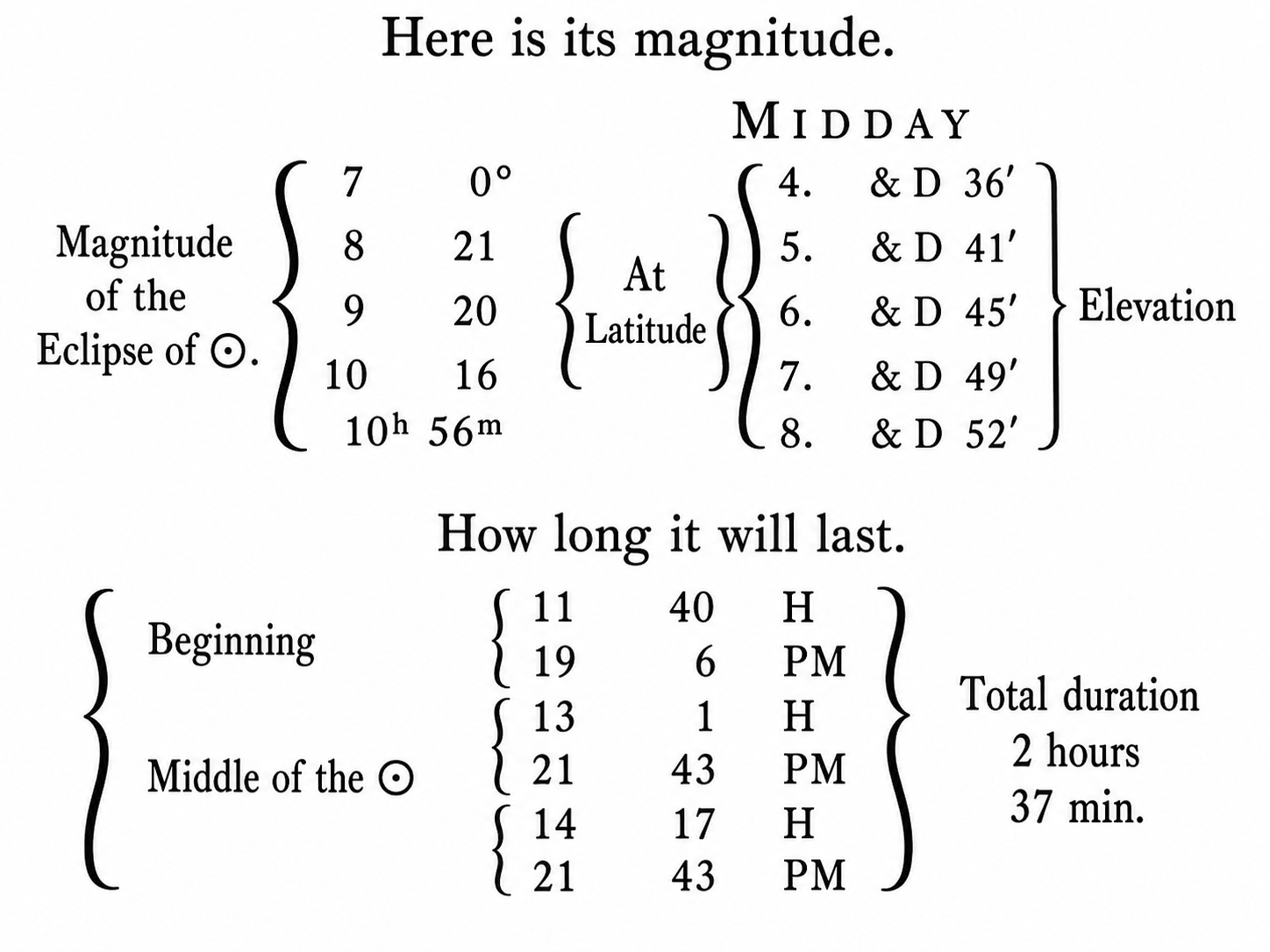
The effects of this eclipse correspond to those of this comet. Those effects are so great and terrifying that, after searching them out with great labor and finding them according to the secret of the prophecies given above, I chose to declare them only through these quatrains or centuries, where every four quatrains I have attached a prophecy, from which I drew extracts, in order to confirm the centuries just mentioned. Those who have a spirit of understanding will grasp them. Four or five quatrains cover one year, continuing those in my almanac for this present year 1619.
V. For 1619-1620
I see pale death with plague-filled eyes
running here and there, from province to province.
Another watches it with hollowed eyes,
and both of them mock kings and princes.
VI.
Then a little Phidias wants to measure
the Lion from the Ister shore by its claw.
Five, one have already passed; this Lion does not understand,
for his mad thought has driven him into frenzy.
VII.
I fear the mushrooms born on a mountain,
which you carry gently into the rich kitchen.
If you fry them too much, they may go to your head,
since you have put in too much pepper from China.
VIII.
Where will you be, H. E.? The crisis already has hold of you.
Listen to the words of the Holy Cabala.
Do not boast of P., for what sustains you
is only the fatal five of Cephalus’s dart.
Cabala mosin abri masson busal sophas strabis
Cassalis sta satax solamer alchida zefari aleia-
zac staphia picuris, impresso la fustach qua-
drem solimanis drastu leirboga dos geccelum grasale cosaphumus osyres bachin scandriu vachil
lazarus stoyoman aston satrapi, solthor zarnl
ganoph distrossphela chalu frizo Theleman ca-
strator Othomen cosmer loratho belide por the-
mo squiso gab.
This prophecy is taken from the ancient Babylonian Talmud, and was written in characters called Celestial characters, or in the writing called Scriptura Malachim or Melachim. You can see an alphabet of it in the appendix of the many and various languages of Theseus Ambrosius, and also in H. C. Agrippa, in the third book of his Occult Philosophy. I have not been able to give it any other sense that would make it easier to understand.
IX. For 1621
The already-wounded Dragons, living in weakness,
will hear the voice of Heaven down here on earth:
“She has fallen, she has fallen, with her children,”
the one who wanted to wage a new war against us.
X.
Then a thousand young Eagles, driven toward slaughter,
will make a noise with their cries like locusts.
Coming out of this well of opposition,
they will devour the City with cruel greed.
XI.
Beware the cruel discord of the Ghibellines.
The five rounded orbs, united quite the opposite way,
will have their power, by an actual act,
put very far back.
XII.
The old fifty-five, seeing himself offended,
will seek war through the plucked Eagle.
But Atropos, coming with angry shears,
will hand them both over as captives to the earth.
Under a great Eagle, which will keep fire warm in its breast, the Church will be trampled down. For God is powerful enough to raise up even the Franks against the Church, and they will humble it. Saint Bridget.
After this, the Eagle will come out from Germany, from many cliffs, accompanied by Griffins. Rushing toward the rising place of the chrism, it will drive the one seated in the Shepherd’s seat from the fifth climate into the seventh. The Cumaean Sibyl.
XIII. For 1622
The Ottoman crescent of Gog will want to know
its hope and its power; but LOIN, full of courage,
will halt the course of its mighty power,
whether the hope is that through Troy they are kin.
XIIII.
I fear that a great scythe will turn toward the Archer,
or that the angel of Phoebus will lead us to Sagittarius,
and through arms will become the author of great evils for us,
filling the universe with a military exploit.
XV.
The death of many will cause peace to be granted,
A. E. G. F. and V., but it will last only a little while.
The crescent, rising up, will want under these laws
to swallow everything down here, and the ethereal vault too.
XVI.
And then the Phocaeans, a rather warlike people,
will want to enter the lists against this Crescent.
But the sweet fig tree, all cold and shivering,
will keep us all frozen by fear and malice.
Patissa homos ghelur C. siapherum, menilketi,
alur: Kenzua, almai, alur: Kapzeiler ie dy
yladegh, Gyawr Keleci est Kmassi, on iki yla-
degh, onlarum beghligheder ennui, iapar baghi,
diker: bahessai, baghlar, ogli Kezi olar on iki,
yldenssora Kristianoñ Keleci, ebkar ol Turki
gheirsina. Franciscus Ricoldus, in his Arabic prophecies.
XVII. For 1623
Etouas will want to climb up to Lake Geneva;
very great after this, fortune discolored,
four, nine, eleven, and six with Supelimans;
and yet they will still not make their fortune.
XVIII.
Ah, what fire and blood all around the altars!
Everything is strewn with dead bodies; there is no more concord.
For even the immortals live without pity,
and in heaven and down here there is no mercy.
XIX.
In this year twenty-three many will be found
who have no God, only painted hypocrisy.
Hooded in their habits, they will support themselves by their hands,
saying that their frenzy is recognized everywhere.
XX.
One P. will want to raise another P. very high,
but the C. will have mortal hatred for the Greek G.
I know that none of this will fail,
for they are too closely joined with their following.
By just judgment, through hostile attacks, Peter’s little ship will be trampled down and the clergy will be thrown into confusion. Saint Bridget.
He will lie in ambush against the bride of the Lamb, impoverishing her worship. The Sibyl of Crete.
XXI. For 1624
The Lyre and the Dolphin suddenly saw him
born on the banks of the clear Thames,
and joining the North with a wholly vain face,
he will put many people in doublet and shirt.
XXII.
Then down here two terrifying armies will be seen,
coming to clash in the middle of the plains
of the afflicted Sarmatians; but the more nimble one
will make the other lose heart and breath.
XXIII.
Then the fleur-de-lis, through its wise goodness,
will settle these disputes and then cause the keys
to be taken back from one and two, who will have subdued
the very cruel schism, and will make everything be restored.
XXIV.
You, Cross of Godfrey, will be raised up
on the sharpest mountains and proudest summits.
You will be seen by everyone and adored by all;
the honor for it will be yours, precious souls.
The day of the Lord is near, it is near, and very swift. Pray for the things that belong to the peace of Jerusalem. Comfort the Church, now grieving; teach her, now wandering; reunite her, now divided; bring her, shipwrecked, back to harbor, so that the great schism may not happen, the one that will be the forerunner of Antichrist.
At his coming, that saying of the prophet Jeremiah will be verified concerning the Church: all her gates destroyed; her priests groaning; her virgins in squalor; and she herself crushed by bitterness. Then Peter’s little ship, long shaken by the storm of schism, will be broken apart and soon sunk. Johannes de Burgis, in the book entitled On the Variety of Astronomy.
Because of the tyranny of princes and the greed of prelates, the Church has been struck and left a widow. Saint Hildegard.
XXV. For 1625
Then an Angel will cry, “Nothing, nothing, come here;
and come out of the prisons, for our bitter wormwood...”
And if he is not in second place, he is now without a nose,
for everything is unstable and stuffed with misery.
XXVI.
Loving at this voice will make everything resound
above the banks of the waters, the most beautiful nymphs,
hoping that very soon one will see depart,
within the enclosure of the great walls, his less than faithful friends.
XXVII.
Take care that this vile god, seen in the gardens,
too little and too carried away, filled with disgrace,
through the too-swift exploits of the very small Arguses,
does not have these ashes of his brought back to life.
XXVIII.
So I see a dear I. aspiring to the Hat;
greatly deceived, but full of hope,
he draws himself up on his own good fortune, for he sees the boat,
or rather a great Ship, that needs assistance.
XXIX.
There is nothing down here that does not change,
the Angel of Heaven will say to the whole company.
But obey the laws of the sacred High-Thunderer,
and you will receive both honor and life.
AND NOW COME, LORD JESUS.
Look at Master Alain Chartier in his Book of Exile for these last centuries; you will see admirable things.
O great God, who taught the hands of your servant David how to handle weapons, be the protector of our king. Guide his hands to win victory over his enemies, all for your glory, for the growth of your Church, and for the good of his people, so that one day, laden with the years of Nestor, the victories of Alexander, the peace of Augustus, the piety of Constantine, and the zeal of Theodosius, he may reign with you eternally in the glory you have prepared for your own.
TRUE PROPHECY, OR
A prediction of the state of the Church
until the end of the world,
by Saint Wulfran.
When the hatred of the perverse world
comes to an end
against the saints of Christ who walk in justice;
when among the beloved children of God
the murderous Serpent is without envy and malice;
when the chosen ones are found on earth
without vice,
subjects for chastisements no longer; when God no longer wishes
to increase the happiness of his own who suffer for his service,
then the Church, without a cross, will enjoy rest.
END.
Wonderful this is music to my ears/eyes. I have been investigating some of this. Mnemonics and anatomy is the basis of a curriculum I am developing next to the 7 liberal arts. This might be of interest to you too.
Would be good to compare Chinese face reading with these findings.
...the nose epigram 😂...I really needed that laugh!!