
Tractatus on Artificial Memory by Johannes Cusanus
Printed in Vienna in 1514

Elder’s Notes
The tractatulus artificiose memorie omnibus cuiuscumque etatis studiosis admodisque utilis et necessarius by Johannes Cusanus, published in Vienna in 1514.
It stands out for its treatment on collateral locations and use of the syllabary technique.
The text offers up several useful ideas, including this one:
Images are called “marks” because through a single specific image, they mark or represent several things. Images that represent whole sentences are called notae — shorthand signs, basically.
A simple image is made when a single thing is represented by one image or by one mental reasoning. A composite image is made from several things gathered together into one known image.
These are the kind of distinctions that make using the art of memory easier. Not all mental images are the same, some serve different purposes. We know that Johannes Christoph Von Aretin divided meaning-images and order-images, and here we see that shorthand images are distinct from images that capture only a single word or idea, while composite images also have their own role to play..
The text also offers a simple mnemonic for memorizing syllogisms, which Cusanus does using body pegs:
Here is how the syllogism should be arranged:
The subject of the argument is placed in the left location.
The major proposition is placed in the right hand.
The minor proposition is placed on the chest or head.
The conclusion is put on the left hand.
You could just as easily do this using the syllabary method, which Cusanus includes in his book.
Cusanus also warns about the limits of mnemonics towards the end:
This art should not be used in everyday study in such a way that each individual thing someone reads is placed artificially. It is better to have memory through art in difficult and necessary studies, in disputations, responses, conclusions, and arguments.
The books wraps up with a treatment on natural memory and how to improve it using the nostrums of the era, I’m sharing it for its historical value. Do not take medical advice from Renaissance writers without talking with a professional 🙄
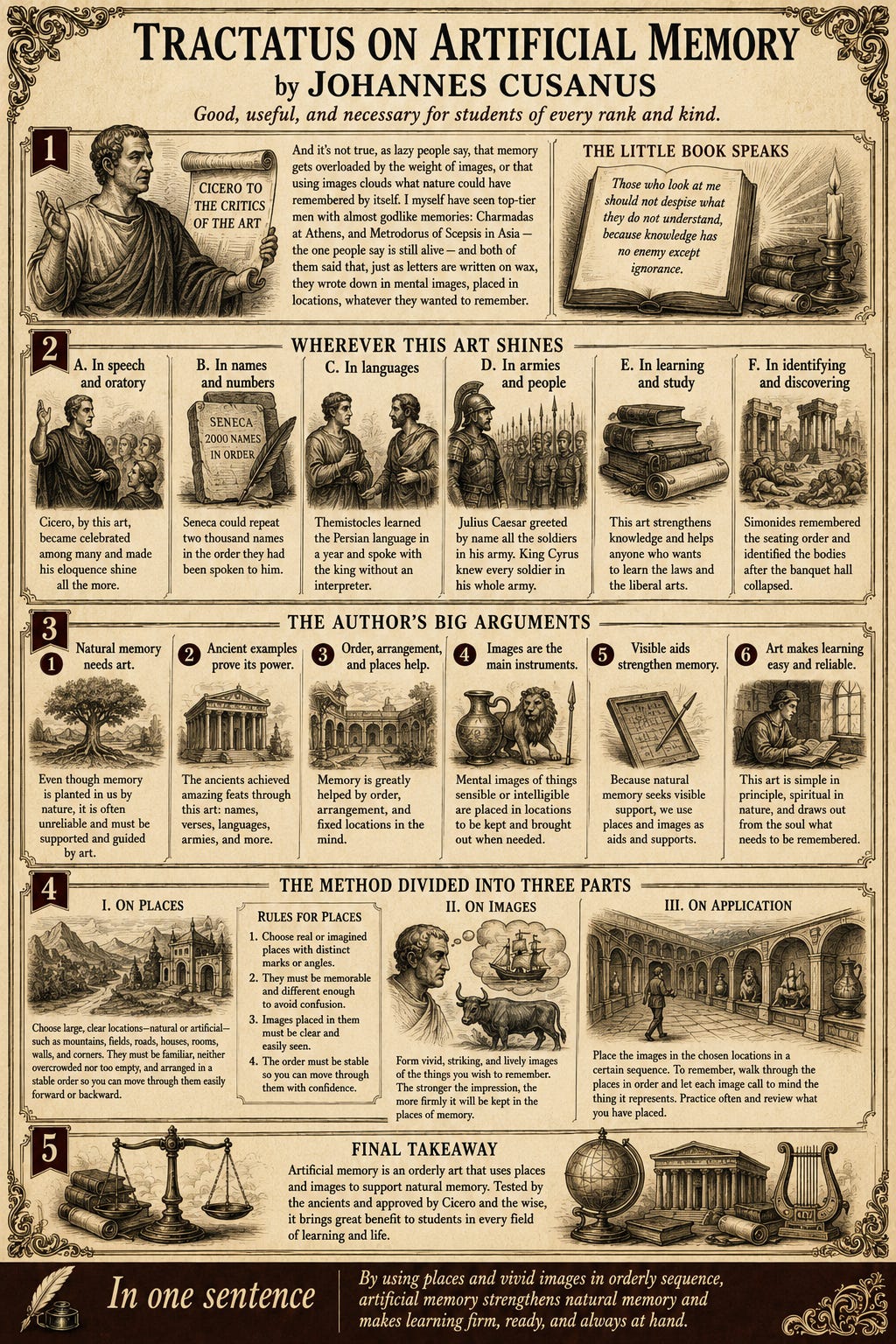
Tractatus on Artificial Memory
Good, useful, and necessary for students of every rank and kind.
Cicero to the critics of the art
And it’s not true, as lazy people say, that memory gets overloaded by the weight of images, or that using images clouds what nature could have remembered by itself. I myself have seen top-tier men with almost godlike memories: Charmadas at Athens, and Metrodorus of Scepsis in Asia — the one people say is still alive — and both of them said that, just as letters are written on wax, they wrote down in mental images, placed in locations, whatever they wanted to remember.
The little book speaks
Those who look at me should not despise what they do not understand, because knowledge has no enemy except ignorance.
In Praise of Artificial Memory
An epigram by Master Buchius of Münster
So that lessons learned long ago
can stay fixed in your mind,
read this collected art of remembering.Without it, no one can really keep their judgment steady.
This art is the light of intelligence
and the guardian of hard work.
It lifts up the senses
and makes them bold.Do not look down on what Cicero approves
with such eloquent speech,
and praises everywhere in his words.And do not dismiss what Simonides —
or Metrodorus, as they say —
was glad to have invented through his own effort.Even Aristotle did not hesitate
to call it something like a divine gift,
the first glory of sacred wisdom.In this art Carneades, praised by all Athens,
became famous;
and the man from Scepsis was outstanding too.This art strengthens knowledge;
it helps anyone who wants to learn the laws.
Hardly any other work was more loved by Pallas.
Eberhard Verberius of Danzig,
student of Master Johannes Cusant,
on artificial memory
Reader, if you want to know the invention of Simonides,
or the noble work of Metrodorus’ art,
then here, with Cusanus as your guide,
gather the art of remembering.It will bring great benefits to your mind.
Tractatus on Artificial Memory
Authority teaches the wise person, and everyday need shows from experience, that natural, bodily, and spiritual powers are helped by art. For the convenience of life, many different crafts have been invented, so that where nature falls short, skill can step in.
So even if memory is naturally planted in us, it is still often unreliable and needs to be supported and guided by art.
After the ancient discovery of artificial memory, its cultivation produced amazing results among serious students. Seneca, in his old age, used to repeat two thousand names in the order they had been spoken to him. In one lesson he could recite more than two hundred verses spoken by his students, not only in the exact order, but even backwards.
Themistocles, after a year of work, learned the Persian language so well that he could speak with the king without an interpreter. Julius Caesar, by this art, greeted by name all the soldiers in his army. King Cyrus knew every soldier in his whole army by name. Cicero also became celebrated among many learned men through this art and made his eloquence shine all the more.
And so, in his book On the Orator, Cicero says that Simonides first brought forth this art of memory. There were guests at a banquet who had grown sluggish and careless, and when the banquet hall collapsed, they were crushed in such a way that no one could identify the bodies. But Simonides had remembered where each person had been sitting, and by that he identified them. From this he realized that memory is helped a lot by order, arrangement, and fixed locations.
The basic inventions are simple and spiritual; they are easy, and they are drawn out from the soul itself by using certain likenesses — that is, images — which can be held in the mind for things that are sensible or intelligible.
Artificial memory is described like this:
It is an orderly introduction, arrangement, and distinction of things that are sensible, or presented under sensible form, into the mind, so that they can be referred back to natural memory, kept there, and brought out when needed.
And because natural memory wants to be strengthened by visible and tangible aids, the method works like this: in this art, you use something like a sheet of paper or a tablet, on which you write whatever you want to remember.
Images, then, are placed in certain material locations in a mental representation.
This little treatise is divided into three main parts.
First part: on places
First, places are described which are naturally or artificially made, where the images can be put and held in the memory.
There are some places that occur naturally, like mountains, fields, and roads. Others are made by hand, like houses, rooms, walls, and corners.
The main point is: in this art, anyone who wants to learn it should choose the biggest and clearest places.
If the route goes on a long time, the order should be so clear that the person always knows whether they are going forward or backward, without getting confused.
But if the path starts at one end and finishes at the other, there is no problem: the places should simply follow one another in a sequence.
The first condition is that a person should choose real or imagined locations where there are different signs or angles, and they should be easy and familiar to think about.
They must not be too full of objects or too empty, because either extreme makes it hard to move smoothly from one mental place to another.
The second point is that the locations should be memorable and easy to grasp, different enough from one another that they do not get mixed up.
The third point is that the images placed in them should be clearly visible and not too faint or obscure.
The fourth point is that the places should be arranged in a stable order, so that the person can move through them easily and confidently — forward or backward — without error.
The fifth point is that each place should be marked and distinguished by some sign, so that one location is set apart from another. This also helps future review, because the places become more strongly imprinted in the mind. Without this, a person makes little progress in the art.
Conditions for the places
First: places should not be too small, because smallness confuses the images placed there. Nor should they be too large, because huge places scatter and break up the images, so that the space where the image sits becomes less definite.
Second: places should not be too distant from each other, because too much distance slows down the memory. But they also should not be too close, or they cause mistakes.
Third: they should not be too bright or too dark. If the images are hidden in shadows, they are hard to see; if they are in too much glare, they shine too much and are also hard to make out.
Fourth: the places should be neither too numerous nor too few. They should be carefully chosen so that each thing can be placed in its own location.
Fifth: the places should be orderly, so that one can go from one to another in a straight line, and also go back through them without mistakes.
Sixth: each place should be marked in advance by some sign. This makes one place clearly distinct from another. The locations will also be easier to review, and they will stick better in the mind. Without this, very little can be achieved in the art.
On multiplying smaller places
Some people multiply places by using different figures in known locations — for example, in houses or churches — especially by using triangular and square shapes, because those forms are common in buildings.
Under a triangular form, you can mark three places by angle and number: one at each of the three corners.
In the same way, using this method, if you have a triangular figure, it can stand for three places. You multiply it: a square can provide four places and one in the middle.
If you have a quadrangular figure, you can simply count each corner as one place.
Multiplying through one fifth part is clear from the figure below.
Others carry this multiplication of places further through the major and minor places, or through the different panels or compartments found in buildings, rooms, and walls: four corners can give four places, and a fifth place can be in the middle.
Others, in whatever way suits them, mark and choose the walls of a house as places.
In the angles that are more visible, they imagine triangular or square places as needed, so that the arrangement of the material place can be seen more clearly, as shown in the following figure.
There are rules about multiplying and marking places.
The first rule is that we can multiply one location in different ways, especially by using figures: triangles, squares, and the like.
The second rule is to use different symbolic aids for different things. For example, any animal whose first letter matches the thing to be remembered can be placed there as a marker. So, for “man,” you could use an ox, or an animal beginning with the same letter; for “horse,” another suitable animal; and likewise in alphabetical order.
The third rule is to place things in a sensible order — that is, in an imagined tree, whose trunk has seven branches. On every branch there are seven twigs, and on each twig seven little shoots; in the same way, seven kinds of colors can be distinguished.
The diagram below shows a house divided into marked places, using triangles and squares as memory locations.
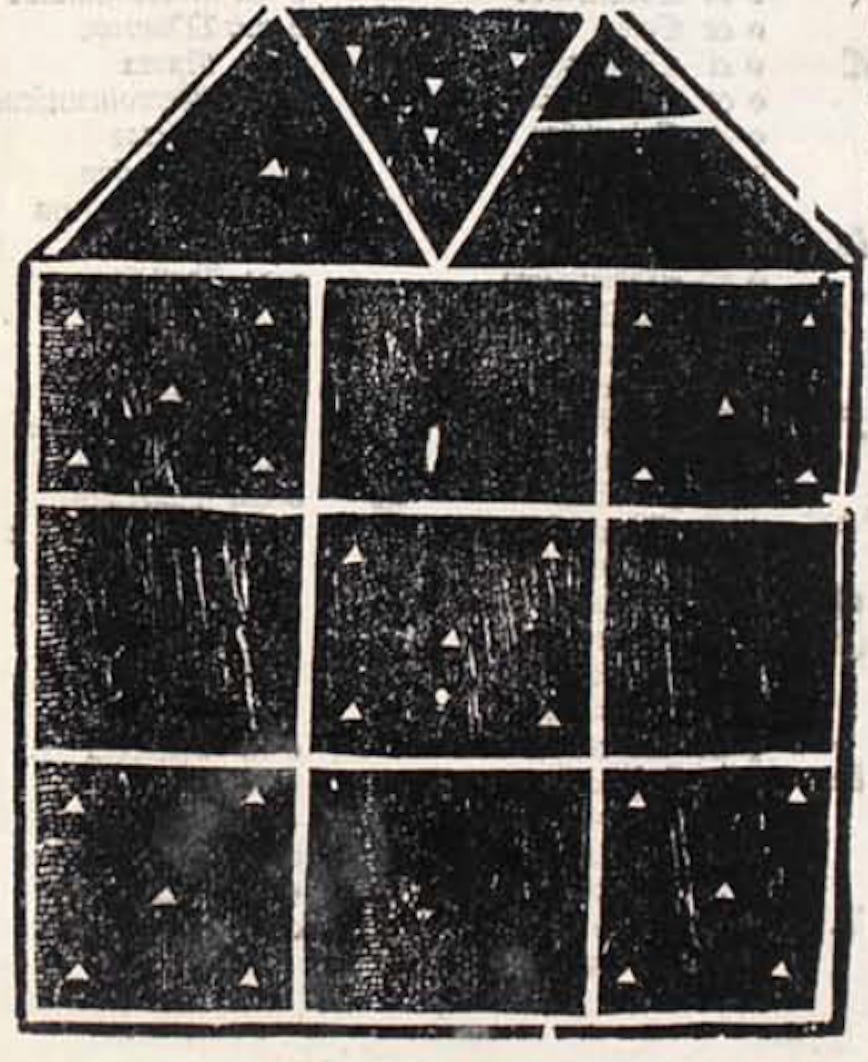
Because those methods are not the main thing being discussed here, they can be passed over for now. Anyone who likes them can use them; I have no objection. So now follows the mental book, in which it will be shown very clearly how places are arranged and multiplied.
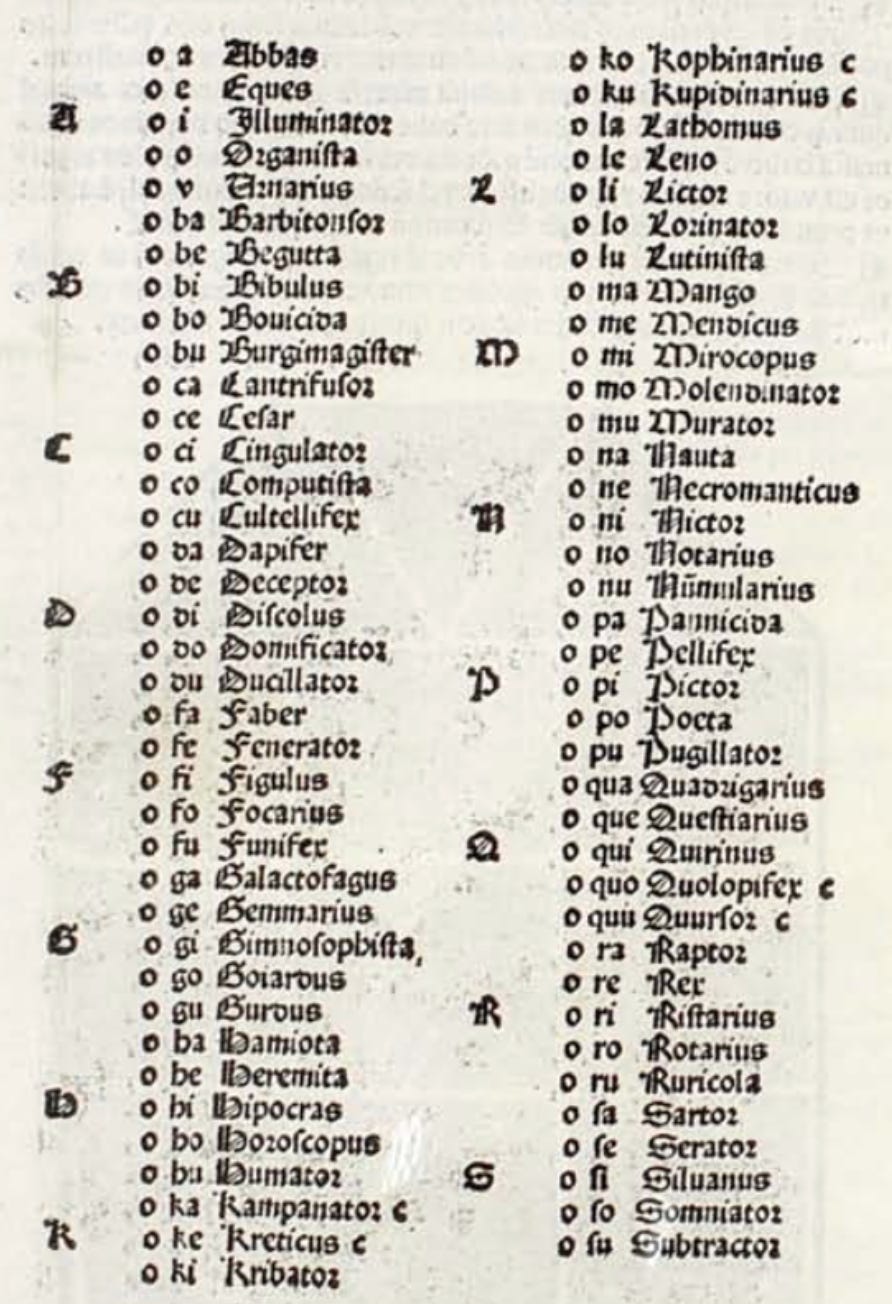
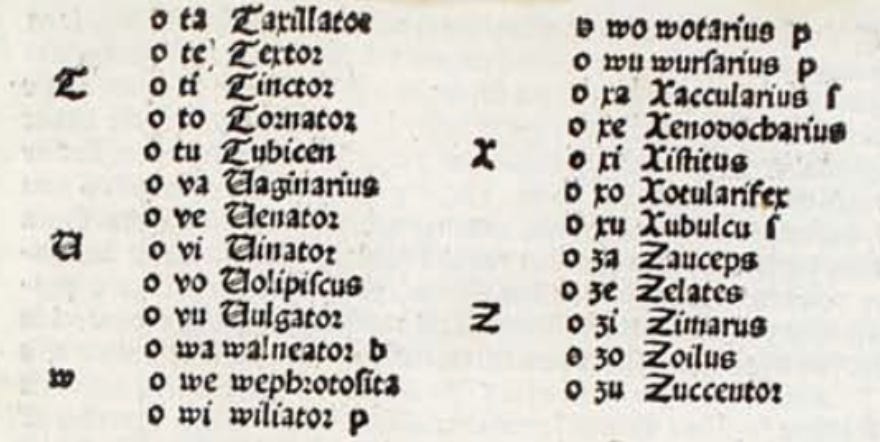
I’ve shared the original syllabary here. If you’d like to see how they work in English, read my introduction to Conrad Celtes Epitome of Both Rhetorics of Cicero.
The mental book
In this mental book four things are laid out, and through those four things the necessary parts of this section are strengthened.
First: in this art, you need to have very large places. In each of them, ten larger places are arranged. And, as was explained above, since we need to know these numbers without having to count them one by one, first the capital letters are assigned, each to a fixed number.
Second: familiar people should be chosen, so that from known things we can arrive at unknown things — that is, at whatever we want to remember. In this art, a familiar person should always be connected in some way with the thing to be remembered: either the thing to be remembered is connected with the familiar person, or with the person’s tool, or with the material around which that person works.
Third: the places chosen earlier must have a reliable order among themselves. So here, syllables are placed in definite locations and follow one another in a definite order. Each syllable corresponds to one major place or chamber. In this way, the order of the places will be just as fixed as the order of the syllables.
Fourth: in this mental book, the names of trades or crafts are placed, and through them the places are multiplied and distinguished, just as their order is marked through the syllables.
More to know
In the first corner of any major place, according to our setup, we place one familiar person who has an office or craft.
So, in the first corner of the first chamber, we put an abbot known to us. But if we do not actually know an abbot, then we assign that office to some man we do know, and call him “our abbot.”
And in the first corner of the second chamber, we set up a knight known to us — assuming we know some knight. Or else we pick anyone we want to be “our knight,” if we do not actually know anyone of knightly rank.
In the first corner of the third chamber, we identify an illuminator known to us.
And so on, following the order of the mental book.
After this, in any familiar person, five places are naturally arranged by using the body. These are:
the head,
the right hand,
the left hand,
the right foot,
and the left foot.
After that, on the chest, three members are specified through the tools of the craft, or through the material that person works with.
Others use the three corners specified earlier; or in each major place they can mark as many corners as they like.
Because a familiar person, taken individually in each chamber, can be connected with the craft in different ways, the sequence goes like this:
In the first place, using the first known person, mark out four people connected with one man. For example, in the first corner of the first chamber, assign four people to an abbot:
the father in the second corner,
the son in the third,
the wife in the fourth,
and the daughter in the middle.
But beyond these, that place may also have some additional notable location, if it happens to be a place where 150 or even 300 familiar people are naturally or artificially arranged.
And each familiar person can be specified by means of a tool, just as with the main person.
The tools, even if they are not always available, can be substituted; and through them, one can place many things in triangles and squares, and so have as many places as one wants within the chamber.
But the names do not have to be determined exactly unless someone is already somewhat skilled in the art.
Beginners, though, should be content with one familiar person in each chamber, with that person’s specifications, until they become more practiced.
This is the second part of the treatise
This part is about images.
Images are forms and signs of the thing we want to remember. Some images are simple; others are composite.
Images are called “marks” because through a single specific image, they mark or represent several things. Images that represent whole sentences are called notae — shorthand signs, basically.
A simple image is made when a single thing is represented by one image or by one mental reasoning. A composite image is made from several things gathered together into one known image.
For a novice, simple images are easier at first. For a more advanced student, composite ones are better.
Images can be “placed” according to location, through boundary markers or some kind of fiction of place. They can also be applied by authority, by arrangement, and by spoken positioning.
Conditions for images
First: every image should be striking, pleasant, horrible, wonderful, ridiculous, cruel, unusual, or strongly emotional. Images like that move the memory more and stick in it more firmly.
Second: the image should not be ordinary. The things we experience every day hardly move us, or not at all. Even if we put ordinary and familiar things into our memory, they leave little trace. Things we do not usually see, though, we remember much better.
Third: images should be appropriate and should represent the thing to be remembered well enough. Not everything can be represented by just anything. So if an image does not quickly remind us of the thing, then we need to strengthen it either by thinking carefully about what it represents, or by giving it some added mark, so that it better fits the intended thing.
Fourth: images should be reviewed often, so that they become more firmly fixed. Because of weakness and imperfection, the memory leaves traces only faintly. So the images are placed so that, once the thing has been remembered, they can be impressed more strongly. Just as places should be reviewed when we return to them, so too the placed images should be reviewed again and again, especially when we need to remember many things.
Fifth: there should not be too many images in one place, because one image gets in the way of another and creates confusion. Still, several things can be put in one place if one image is enough to signify the whole matter — for example, a warlike people through good soldiers. But if the material placed there is more complicated, like a long passage, then the image should be repeated through the rooms, and all the placed images should be cleared away and not repeated afterward.
The third part: the practice of the art
Now we need to know how any material to be remembered is placed.
All material to be remembered is placed either:
by similarity,
by comparison,
by figure,
by description,
by connection,
or by a mixture of these.
On similarity
Through similarity, something is placed together with the image for it, either in a place or with a familiar person. And the similarity may be known or unknown.
If it is unknown, it is placed through a figure or through a description.
If it is known, it signifies either a visible substance or an invisible one.
If it is placed together with its location through a figure or description, this can happen by composition or by justice. But if it signifies a visible thing, that too can be twofold: either it signifies an ensouled substance or a non-ensouled one.
If it signifies an ensouled substance, it is placed with its main subject: for example, a white man, or one clothed in winter clothing, or a black person, or someone holding pitch or charcoal.
If it signifies an invisible substance, then it is placed with something visible. So if it signifies substantial insanity, then let a familiar person do something that clearly suggests madness, or use some tool to make a familiar action, gesture, or expression that is strange, cruel, or pleasant.
For an invisible substance, the subject may be an animal, and this can itself be twofold, because it can be connected with the person or with the thing placed there.
If an image common to a thing signifies the thing by acting it out with the familiar person or that person’s tool, then it is placed more concretely.
Otherwise, it is placed with some known person famous by name: Antonia for wisdom; Claudius for the lame; Peter for the key; Paul for the sword; John for the little chalice; Catherine for the wheel.
On comparison
Comparison is said to happen when we place one thing through some other thing, because of a habit or association that has arisen between them, as with cause and effect.
So the Louvre can be placed through the king. This kind of thing can help you remember something because of an inseparable or habitual connection, since the cause brings to mind the effect, and the effect brings to mind the cause.
For example, if we say that the flower of Venus is the cause of happiness, then among mathematicians it should be believed; therefore the flower of Venus, once placed, will bring that cause to mind.
The effect can also rightly remind us of the cause, since it comes afterward and is better known to us. So if bread is placed in the first place, and a baker in the following place, then we remember the cause. In this way, the effect is placed through the cause.
One opposite can also bring another opposite to mind because of their habitual relationship. So when we want to place the strong through the weak, we can use a symbol: “white” in the feminine sense, “black” in the masculine, or something similar.
A tool can call to mind the person whose memory it is connected with — for example, a pen brings to mind a scribe, a book brings to mind learning, and a circle brings to mind astronomy.
An action can also bring a skilled agent to mind, as when writing reminds us of a scribe, and thinking reminds us of someone who is often occupied in thought. Different actions suit different people: plowing suits the farmer, teaching the learned person, and so on.
A similar thing can also make another similar thing occur to us. If someone thinks of Horace, Virgil easily comes to mind.
A habit can do this too: clothing, form, dignity, office, and similar things are varied among different people, and they indicate different persons, ranks, and duties. Likewise, nationalities vary among people.
Through quality and excess, one thing may be compared to another — for example, something greater to something smaller: a giant to a dwarf, or a slow person to an ass.
Different places also help, because they are full of many different signs. Things carried in various baskets can easily be placed through these.
On figure
We use figure in a proposition when the thing to be remembered does not easily have a proper likeness or a suitable comparison. Then we can fall back on similarity of words, or use a figure to place well-known or unfamiliar phrases, Greek or barbarian words — anything where the sound itself identifies the meaningful parts.
This sort of figuring should be understood not only by outward and perceivable signs, but also by intellectual ones. And where only intellect is involved, such things can be placed through words, or through notae — written or shorthand signs — with their appropriate meanings.
First: when dealing with words, if a thing is unknown or signifies an invisible thing, we place it through some other word that signifies a visible thing, and which is similar in sound to the word being placed.
Second: with respect to syllables, this can happen in two ways.
One way is when the word, or several imagined syllables, is put together from syllables belonging to different words, so that the visible things signified by those different words can be used to stand for the thing being placed.
For example, suppose the word to be placed is iruntione. First, split it into two syllables: iru and ntione. Then imagine something visible that corresponds to each syllable. Or, if the word is unknown and has only one syllable, use that one syllable by itself. Or, if someone has to remember some syllable that keeps coming up repeatedly, he should take that syllable as though it were itself a meaningful word, and imagine some visible thing connected with it.
For example, the syllable ra might be imagined through a frog, or a sword, or some other thing that can be made to fit. Then, whenever that syllable needs to be placed or imagined, the image of the frog is put there.
Third: you can also use similarity of sound with respect to letters. This happens when, for a given letter, we place a known word that begins with that letter.
So for A, use a donkey; for B, an ox; for C, a deer or dog, and so on. And, if we like, we can imagine that first thing being cut or pierced by a sword.
On inscription
Inscription is used when, for the thing being placed, we cannot conveniently find a location, a similarity, a comparison, or even a verbal resemblance.
Then we can invent a notation using letters written on some known object.
This can happen in two ways.
One way is that, in a definite place, we write some of the individual letters of a word, or of several parts of a word that have been separated out.
For example, if the unknown word were charamella, imagine that, in the place where the word should go, the first part chara is written in gold or charcoal. Then imagine the remaining part, separated from the first, written in chalk or something similar.
Another way is by using Greek letters as instruments, because their shapes are different and show us many varied signs.
Every vowel has three instruments, each one assigned its own meaning. The first takes its own shape, as in a for oneself, b for the belly, c for earth, d for the right hand, e for the head, f for the face, and so on.
The second takes its meaning from underneath: g under a, h under e, i under c, and so forth.
The third takes its meaning from some other sign.
Consonants, likewise, each have their own instruments.
The main point is this: according to our setup, the first consonant takes its instrument from its own shape; the second consonant refers to the instrument on its right; and the third consonant refers back to the instrument belonging to the consonant connected with it. So the figures or instruments of the letters can be used in this way.
On connection
Connection — what some people call “chain-linking” — is twofold.
One kind is natural. This is when one thing easily moves us toward another because of a certain connection between them. So earth points us to clay; oxen make us think of cows; and so on.
The other kind is artificial. This is when, according to our own arrangement, one image links itself with another.
For example:
Peter, whip, dog, pig, rubbish, worm, sand.
If we want to remember “oxen,” we imagine Peter striking a dog with a whip. The dog, suffering from pain, hits a pig. The pig, eager to defend itself, stirs up filthy rubbish. Worms are produced from that filth, and they cover the sand so they cannot be seen because of the dirt.
That is the “chain”: each image drags the next one after it.
On placing speeches
A person who has mastered the terms well can place speeches in several different ways, but a difficult speech should be placed by using subject matter.
Every speech, at least every complete one, consists mainly of two parts: the noun and the verb. So first we should divide the whole speech into these two parts.
Then we place the thing signified either as the active subject or as the passive subject, in the way explained above. And when a thing signifies doing or suffering something, or when it comes together with some other thing, we place it through a complete speech.
Once the speech itself has been placed, we should not doubt that the rest of the material in the speech can be recovered from it. The determinations of the verb can easily occur to us from the placed image, provided that the thing being placed is familiar.
The person who first tries to remember everything word for word makes the matter hard for himself.
On placing arguments
The most powerful kind of argumentation is the syllogism.
So the placing of arguments should be considered in a way that suits any kind of argument. A syllogism is made up of a known condition and three propositions, if the proposition that has been accepted is counted as part of the syllogism.
Here is how the syllogism should be arranged:
The subject of the argument is placed in the left location.
The major proposition is placed in the right hand.
The minor proposition is placed on the chest or head.
The conclusion is put on the left hand.
But because the major and minor propositions are usually the whole strength of the syllogism, the subject of the minor proposition is treated as the term from which the whole syllogism is built.
So, with the subject placed, the placing of the argument will easily come to mind, as long as the difficult parts have been marked under it.
On songs or verses
Songs, because they help memory by their meter, can be understood easily once the first word is noted — unless some difficulty prevents it.
Because of that difficulty, they can be placed through similarity. For a verse can often be tied to the thing being placed through a single image, and several verses can be gathered into the same unit.
For example:
The white old man, pale with years, was strengthening his limbs with a staff of sacred wood.
And at sunrise you had to moisten the reeds with dew.
A greedy thief was traveling the empty road.
Remember to sin with a good man and die for your virtue.
Remember to soften the father with unhappy young girls.
Your sweet girlfriend, having come, made pleasant kisses.
The point is not that these lines are profound poetry. The point is that their first images and words can be turned into memory hooks.
On authorities and citations
In citing authorities, the letters of the alphabet stand for the names of authors and books. For example, the author names are represented by the letters assigned to them.
Example:
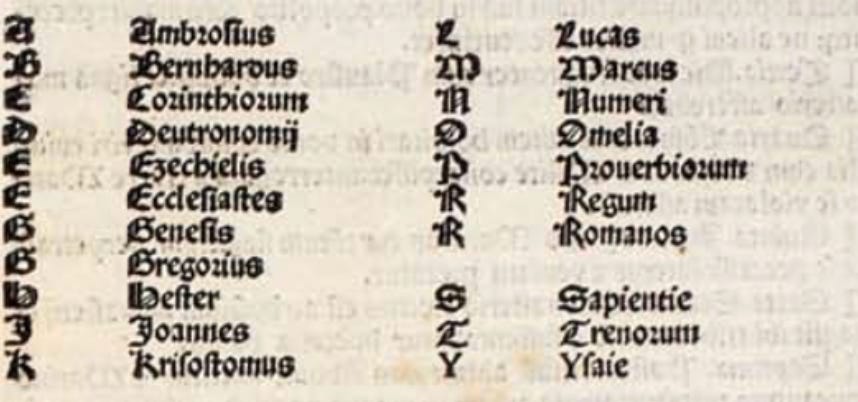
The number of the book, the question, distinction, and chapter are all marked by numbers and forms.
But placing the names of authors themselves is not hard. It is enough to place the authors’ names in the way already taught, and then apply the proper book, chapter, question, and distinction.
The authorities should be placed through a mental image of a compact sentence, using several images if needed, so that the meaning of the authority is conveniently represented to us.
Or, if that is awkward, it can be placed by arrangement, comparison, or notation.
For example, Augustine’s On the Trinity, book 3, chapter 5, could be placed like this:
Put “Augustine,” known to you, in the place required by the order. He should have a comb on his head and, in his right hand, a book, which he is singing or reading. In his right hand or right foot, he should have three horns standing upright, and in their middle he should have a cross. Let gold, silver, and black be placed there, to indicate the highest Trinity and the Catholic faith.
Then place, in the proper location, a sheaf of wheat and a golden thresher. Let something be tied to it on one side and caked with mud on the other.
That gives a concrete image for the citation and its subject.
On placing stories
When you want to place stories, be careful not to note every single word, because that is both difficult and useless.
Sometimes it is useful to place the story once or twice, but most of the time you should place it through a picture. First, divide the story into its main parts. Then place each part with one compact image, so that one image can cover a proposition, and sometimes several images can cover one whole matter.
For example, take the story of Saint Marina the Virgin, which is in the legendary collection. Since it is divided there into twelve parts, it is placed by dividing it into twelve parts.
First: Marina’s father changed his daughter’s clothing and handed her over to the abbot and brothers as though she were his son, so that she could be received into monastic life. Because of her father’s prayers, she was accepted by the monks, and Brother Marinus was honorably received by everyone.
Second: When he was seven years old, his father felt death approaching. He urged his “son” to good conduct and instructed him that he should not reveal that he was a woman.
Third: He often went with a wagon and oxen to bring wood to the monastery.
Fourth: He used to lodge in the house of a certain man, whose daughter had conceived a child by a certain soldier. When questioned, she claimed that Brother Marinus had violated her.
Fifth: The abbot asked Marinus why he had committed such a disgrace. Marinus confessed that he had sinned and begged forgiveness.
Sixth: He was immediately thrown out of the monastery, and for three years he remained before the monastery gate, supported by scraps of bread.
Seventh: Later, the child was weaned and sent to the abbot, then handed over to Marinus to raise. Marinus received the child patiently and, in all things, gave thanks to God.
Eighth: At last, the brothers took pity on him and brought him back into the monastery, adding many harsh duties to his official work.
Ninth: Finally, after finishing his life in good works, he passed on to the Lord.
Tenth: When his body was being washed, the people saw that he was a woman, and everyone was stunned. They sought forgiveness in ignorance and grief.
Eleventh: His body was buried honorably.
Twelfth: The daughter of the householder was seized and harassed by a demon. She came to the tomb, confessed her sin, and was freed. Many other miracles happened there.
On placing sermons
A sermon can be placed either in a simple way or by using more complex divisions, depending on what the preacher prefers.
The preacher should place it in such an order that, at any point, the places connected with that point remain near the authorities and proofs.
He should also be able to place each point together with what comes before and after it, according to what the subject requires.
If he wants the sermon to be abundant in material, he should see that he can divide each part properly.
If he wants it to be brief, he should pass through the material quickly.
If he wants it to be noble or elevated, he should present it with loftier language.
If he wants it to be terrifying, he should introduce frightening material.
If someone is not very well supplied with material, he should make sure that each member of the division can be expanded.
For example, suppose someone is making a sermon. First, he places the words of the theme under the headings of five main parts.
Then, as he discusses or explains each part, he expands those things in the same fivefold way.
When that has been done, he divides the intention and places every member of that division under the beginning of a single fivefold set, according to its order. In this way, the places needed for authorities and for any subdivisions will be clear.
He should proceed in the same way with the second main member and through the whole division.
As the saying goes: more people want to seem good than actually to be good; so that you may grasp more fully, give more fully; just as a mother loves more and gives more.
Around the end of this little work
Just as some conditions for places and images were set out above, so certain conditions should also be observed concerning the end or goal of memory work.
First: this art should not be used in everyday study in such a way that each individual thing someone reads is placed artificially. It is better to have memory through art in difficult and necessary studies, in disputations, responses, conclusions, and arguments.
Someone can commit the contents of certain books to memory by this method, but first he must have a good understanding of them. His subject matter must be well chosen and “digested,” so that he can draw out the highest material from it and see easily what remains.
Second: this art should not be used in a tired state, because too much occupation with external things draws away the natural power.
Third: the memorizer should be gentle and calm. He should not be disturbed by anger or impatience.
Fourth: he should be sober, so that natural power is not lowered by drunkenness. Also, he should not fill the bodily senses with too much excess.
Fifth: the memorizer should have a proper, quiet place. At that time the mind should be free from outside distractions.
Since memory has nature as its foundation
Since memory has nature as its foundation, and receives completion from art, there are also some things that help its natural strength. These are described here briefly, because natural memory gives great support to artificial memory.
First, the author thinks that what Macrobius teaches in his The Dream of Scipio should be granted. These rules are very useful.
First rule: the body should be kept from all impurity and excess. This is done daily by benefit to the belly — meaning regular digestion and evacuation — and it should not be done unnaturally.
Supper should be light: something simple, like a little fish with vegetables. A person should either avoid wine for several days, or use water instead. He should avoid sugar and rich delicacies, as well as legumes and everything overly filling. Spices and highly seasoned food are especially harmful, and so is eating many kinds of meat, as Avicenna says.
Second rule: bugloss and ginger are excellent for memory, especially when taken in the morning, either simply or prepared with the right conditions.
Third rule: myrobalans are good if taken once a month under proper conditions, and they are especially praised by Avicenna.
Fourth rule: a preparation made from anacardi — “marking nuts” or cashew-like medicinal nuts — works wonderfully if mixed with the right amount of zedoary and prepared once a week in autumn. Likewise, there is diambra, following Avicenna.
Fifth rule: oleum philosophorum, according to Mesue, helps wonderfully. If you rub it on the back of the head, it restores memory well. Nothing, however, is healthier or more useful than theriac, mixed with the preserves of certain fruits and wholesome herbs, especially when taken at the beginning of spring. Macrobius backs up the view of all the physicians.
So, in those seasons when you have to endure a harder stretch of study, use these medicines — or other healthy ones — for one week, especially in autumn and spring.
But in summer and winter, use them only once, or not at all, unless it suits you to take them in colder times with a little wine, or in warmer times with rosewater.
You should take two or three ounces of the mixture on an empty stomach, seven hours before eating.
And these things have been set down as a helpful addition to the main topic, so that studious young people may apply them. Anyone who does not need their direction may give glory, with gratitude, to God the creator and patron, and to the ever-glorious Virgin Mary, because the whole company of saints wishes to be associated with her, world without end, and blessed.
Amen.
Colophon
The little treatise on artificial memory ends happily.
Printed in Vienna by Hieronymus Vietor and Johann Singriener, at the expense of the venerable Master Johannes Cusanus, professor of the same art.
In the year of the Lord 1511, on March 26.
Hermannus Trebelius Notianus
Poet laureate, candidate in the imperial laws, to the reader.
The poet asks and wants only a little from you,
reader — and he asks it with a fair mind:
until you have read the book and looked over it properly,
do not run through its skillful syllables
with a few benumbed, half-asleep thoughts.Put aside your sleepiness.
Take up the divine work
of my Cusanus, snatched from Minerva’s own shrine.He has opened a sacred book of art for everyone,
a book you should approach carefully and wisely.For now Simonides, Solon, and famous Clarus
can be read and held onto here.Cyrus can be read here;
Cicero and Horace too;
Cyneas, Scipio, and Caesar are mentioned;
and Mithridates, together with Magio.I see noble minds and the fame of learned people
again being revived by this little work.So, reader, do not be bored or overly annoyed
as you read this.
Read it, and be well.
The end.
Hermannus Busch on the writer of the art of memory
Hermannus Busch wrote these lines on the author of the art of memory:
I envy you, Lachesis, and I confess
that you have snatched such great talents too soon.And you, cruel old woman,
with your iron-colored thumb,
you have spun out threads
almost unknown to those above.You have taken away men of learning,
and with them the arts themselves are carried off.And you forbid peace to lie with virtue.