
From the Vaults: Memory. Addressed to Students.


Table of Contents
Elder’s Notes
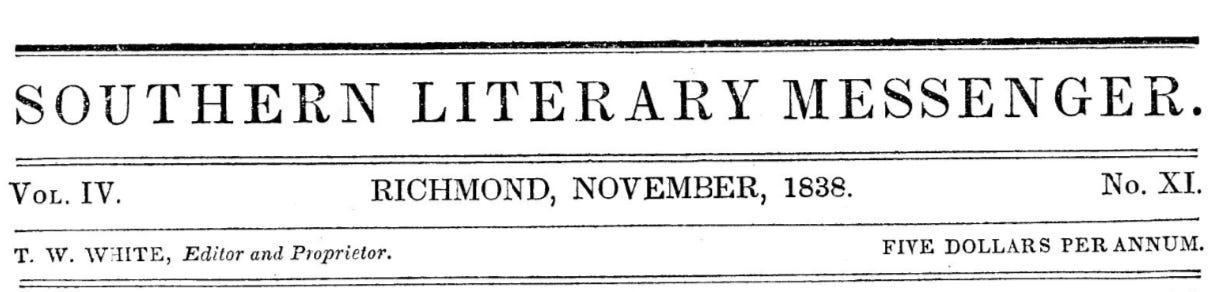
This address was delivered to the students of the University of North Carolina in antebellum America. It was published in 1838 in the Southern Literary Messenger.
This address doesn’t talk about artificial memory, but it does provide us with a glimpse of how memory was viewed at the time in America. There’s one point I found amusing: his discussion of how sensitive people are about intelligence, while being very glib about memory. Intelligence is hard to train; memory isn’t. And yet our society generally treats both as though the inverse were true.
If you enjoy this essay and want to see more like it saved from obscurity, hit subscribe and drop a comment.
Memory.
Addressed to Students.
Memoria excolendo augetur.1
In limine2, we beg of the youthful reader of the Messenger, who for the sake of pleasure rambles through its pages, which like a pleasant parterre are strown with the choicest flowers of literature, not to start back from the perusal of this article under the apprehension that it is to be very analytical or metaphysical; on the contrary, even if we were endowed with the power of analysis, we would, for the sake of utility, make our observations of a practical character.
On Equality of Mind
We are no advocates of a born equality of mind, or rather, in more correct language, as we think, of an equality of mental susceptibility at birth, chiefly because we never yet saw a mother who believed it, and her opinion is entitled to as much weight, as that of the mere speculative philosopher, since she is capable of letting herself down, of becoming herself once more a child, for the purpose of conversing with and amusing the nascent mind of the infant prattler.
The senses are the conductors of ideas to the mind, and without their existence there could be no ideas; but the senses do not act until birth; therefore anterior to birth there is no mind, or rather no ideas as yet impressed upon it, and as the major includes the minor, or the whole the part, of course no memory; but the inference that is sometimes drawn from this, that every infant starts in life with a mental apparatus equally qualified for success, and that with the same system of culture it will always remain the same in every individual, is not a fair inference, for each individual may commence his education with a different degree of susceptibility, and it is immaterial to our purpose whether this difference dates its existence anterior to, at, or subsequent to birth.
Dr. Franklin and others, have compared the mind, before the reception of ideas, to a blank piece of paper; now, it is evident that one individual may have a broader sheet or tablet than another, or, to use the technical language of the printers’ art, one may have a more receptive, another a more tenacious paper.
Again, in farther illustration, take two measures, one a bushel and the other a half bushel measure, both empty; though they be empty, they are nevertheless measures, and no person will say that because they are empty, they have the same capacity.
The Teachableness of Memory
However strong the argument may be against any existence, or at least any exercise of mind before birth, it applies with still stronger force to the memory, for memory relates to things past, and implies experience: how then can there be a memory of that which has been neither heard, seen, touched, tasted nor smelled?
There seems also to be less disparity in the susceptibility or capability of memory, in different individuals, than in any other mental function; this appears probable from its very great degree of teachableness, its quality of receiving mechanical or arbitrary helps, which indicate that it is less dependent on original constitution for excellence, than its sister functions of mind.
It is related of Woodfall, the publisher of the Letters of Junius, that about the last quarter of the eighteenth century, he reported the speeches delivered in the British Parliament, from memory only. Mere auditors have frequently been known to repeat correctly from memory long speeches, some time after they had heard them.
In Germany, a young Jew has brought his memory to such a degree of excellence, that he is now astonishing several of the European capitals by reciting from it the seven folio volumes of the Talmud, from beginning to end, and afterwards from end to beginning.
Indeed, whatever may be the speculations of mankind on this subject, they act as if they believed the truth inferred from the preceding paragraph, for whilst they resent, as an insulting imputation, any reflection on their other mental powers, because it would imply that God had given them less of these qualities than to other men, they not only receive good humoredly any impeachment of their memory, but even sometimes take a delight in railing against it themselves.
We infer from the premises, that if memory do not exist anterior to birth; if the degree of its susceptibility or impressibility be the same or nearly the same in different individuals; if it be docile beyond the other faculties, no person need despair of making his memory all that is desirable.
The Dignity and Importance of Memory
We now proceed to vindicate the dignity and importance of memory in the intellectual system. It is not our intention to resolve all or several of the components of mind into memory, but adopting the admitted truth that all the divisions of the states of which mind is capable, are closely connected with and dependent upon each other, to show that if it be not the foundation stone, or the sustaining arch, it is something more than an embellishment of the mental fabric, and as such cannot be neglected without greatly weakening that reciprocal and blended strength and beauty which the several parts receive from each other.
The prejudice against the importance of memory, and even the belief that a high degree of it is inconsistent with the strength of the kindred faculties, are not confined to the ignorant, but have sometimes made their appearance in books of merit.
The wise ancients thought not thus. They made Mnemosyne, or Memory, the mother of the Nine Muses, or the arts, of which they are the presiding deities--the severe one of history, the stately one of the epic, the laughing one of comedy, and the weeping one of tragedy.
Felicesque vocat pariter studioque locoque
Mnemonidas. Ovid, Lib. V., Fab. IV.3
Memory and Reasoning
Plato seems to make all knowledge consist in remembrance, and Diodorus Siculus ascribes to memory the art of reasoning.
An examination of the process of ratiocination will show that there is some truth as well as poetry in this latter opinion, viz: the reasoner proposes to prove something which is commonly distant from his premises, and to do it by a series of arguments, which, as they are mutually connected and dependent, are compared to the links of a chain.
The danger is, that, in the ardor or confusion of the process, he may omit, transpose, or repeat some of the links; from this nothing can protect him but memory, which sits by, a faithful prompter, and preserves to him the collocation which he has elaborated in his closet, or other circumstances of leisure.
Memory and Oratory
If memory be so necessary to the mathematical or philosophical inquirer, it is still more so to the orator; for, besides its use in eliminating his argument, it has to him still additional and important uses.
Reason, stern and severe, perhaps acts the more important part: she presides at the helm; but memory stands by, a faithful servitor, and hands over to her the stubborn statistics, the apposite quotation, and beautiful allusion; she never deserts her post, not even when he is in the most inflamed state of feeling or highest degree of mental exaltation, of which his mind is capable.
She kindles and strengthens with the orator’s rising ardor, until she seems to embrace upon her chart the whole broad expanse of the past; and, gathering up almost in one moment of inspiration the garnered wisdom of more than six thousand years of experience, she presents it, to be wielded in the cause of truth and justice.
Hence it is evident that of two orators, ceteris paribus4, the one who has the readier and better stored memory, will possess an immense advantage.
Innumerable examples might be adduced illustrative of this position; we will, however, only refer to the case of an ex-president of the United States, who frequently overthrows a finely constructed argument, or breaks the force of an eloquent appeal, by the quotation of a formidable array of authorities and stubborn facts from that inexhaustible treasury—his memory.
Memory and the Past
It is a thought which we do not remember to have seen prominently set forth, and one which may aid us in placing a proper estimate upon this noble faculty, that it snatches from annihilation one third of the domain of time—the past; but for it, we should be left with the unsatisfying present, and the inexplorable future.
It is to this wonderful capability of the human mind, that we are indebted for whatever of wisdom or warning, virtue or valor, is afforded in the history of the past, and which without it would have perished in the very moment of their exertion.
In vain for us, would the inspired bard of “Scio’s rocky isle” have arranged his thoughts in beauty, and uttered them in music--in vain would the noble Socrates, the ken of whose mind almost supplied the want of revelation, have invited us to virtue by his matchless colloquial eloquence, and the sweetly attractive current of his life--in vain for us, would the first Brutus, standing over the corpse of beauty and chastity, for his altar, have uttered the first vow, and struck the first blow for rational and regulated liberty--if tradition, the dependent offspring, or rather another name for memory, had not preserved the recollection of these events, until a writer arose, received the precious charge, and bequeathed it, in perpetuity of possession, to all coming time.
But for this conversion, this reproduction of the past, for the wants of the present, it is evident we should be condemned to a stationary state; but by its help, each succeeding generation stands upon the heads of the preceding, and by the elevation of their station command a more extended horizon, and see as much farther down the stream of time, as the one is higher than the other.
As the means of preserving materials for history, are so abundant at the present day, in exhibiting the connection between tradition and memory, it is not intended to claim for the former, that degree of importance which it had in the infancy of society, when it was the most common and useful source of history.
In tracing out this connection, it is hoped we have avoided the inference of perfect identity of the two. There seem to be several circumstances which distinguish them.
Memory relates to individuals, tradition to the aggregation of mankind into generations—there can be memory without tradition, but no tradition without memory. In nations destitute of the means of preserving records, the memory of one generation, handed down to the succeeding, becomes tradition.
Memory and Experience
Memory assumes no less importance, considered in its connection with experience. Such is the high estimate placed upon this mental possession, that it has been called the mother of wisdom.
We define experience to be the memory of past occurrences, mixed with that power of turning them to advantage, which arises from a careful observation and collation of them.
This power of careful observation and comparison is wanting in many persons--from which it would appear that there may be memory without experience, but no experience without memory.
On Improving the Memory Through Attention
If the young enthusiast after knowledge, has accompanied us thus far, we hope that, like ourselves, he has been impressed with a desire to improve this noble faculty.
Obviously the best mode of improving the memory, is by properly exercising the attention, on which it mainly depends, and the strong or weak exertion of which accounts for the various degrees of memory which we observe in different individuals, rather than any difference of susceptibility at birth.
When we hear that everlasting complaint of the young, “I have a bad memory--I have no inducement to study any thing, for I cannot remember it,” we are apt to inquire into their habits of attention--which inquiry commonly results in the knowledge, that attention is considered as an affection of the mind, that is scarcely worthy of education.
We will now, after the fashion of nostrum venders, give a sovereign recipe for the formation of a good memory, and the cure of a bad one:—Direct the attention upon the beginning, and continue it throughout the delivery of every sermon, speech, lecture, and recitation, made in your presence, however abstruse the subject, or dull and uninteresting its expounder.
It is objected that a discourse of the nature supposed in the apodixis5 of the foregoing sentence, produces an insupportable irksomeness; well, we do from the bottom of our heart pity the luckless wight who is doomed to the merciless infliction of some articulate savage, who redeems his cruelty with no perspicuity of reasoning, no eloquence of diction, no flash of fancy, or sparkling of wit.
But into such bloody hands every one is liable to fall, and is not compliance with the advice just given the best salve? For when the mind is closely engaged in the subject, it cannot suffer greatly, whatever may be the faults of him who handles it; besides, perseverance in the course recommended, gradually diminishes the necessity of painful effort, until it results into habit of attention; and it is to us one of the kindest arrangements of the benevolent Being, that our habits beguile much of our toil and minister to our virtuous pleasures.
Labor ipse voluptas.6
Authorities, no less than reason, sustain the views taken of attention. Many of the luminaries of the world have left it on record for the benefit of youth, that much of the superiority which is attributed to genius, belongs to a proper exercise of the power of attention.
The Power of Attention
The mind of the man who has acquired the power of fixing it at all times and places, and under all circumstances, never flags--it becomes the slave of the possessor; let him will it any particular duty, and the performance easily follows the act of volition.
With such a mind, he can turn his thoughts inward, concentrate his ideas, shut out the external world, or, at least be but little affected by its distractions, marshal his powers for action, and bring them to bear like a Macedonian phalanx upon the positions of his adversary.
There is no error more common or injurious than this of the young student, who supposes that when he has prepared the subject of a recitation or lecture, he has no farther interest in giving his attention to the instructor in his elucidation of it to others.
Hence results the inability in after life to accompany a close piece of reasoning through all its stages, and a wretched imbecility and servile dependence of mind.
It follows from the rule just given, that all translations and nigh cuts to the lesson must be avoided, since these render close and long continued attention unnecessary.
Memory, Conscience, and Gratitude
The connection of several of the states of the mind with memory, and their partial dependence upon it, have been traced. We will now close with a few observations upon the pleasures of memory, and, under this head, its connection with some of the moral emotions will be pointed out.
The exercise of conscience implies a recollection of our past acts, with a feeling of approval or disapproval of them, in proportion as they are conformable or unconformable to the standard of right: how then could there be this review and judgment upon our past acts, if they found no abiding place in the memory?
If they did not, we could not preserve the “mens conscia sibi recti,”7 which, as a good angel, enables a man to bear up under the abandonment of friends and fortune, the impeachment of his motives, and the assault of his character. This is the only reward which thousands of the unappreciated and unrequited virtuous ever obtain.
The bad man considers it a poor remuneration, but it is a richer possession than Alexander or Bonaparte ever knew, since the resulting happiness is extended through this life and renewed in eternity.
It is true, another office of conscience is prospective in its operation, as when we say, “my conscience will not let me do so and so.” But still this enlightenment of conscience, which enables us to decide correctly on the propriety or impropriety of a contemplated action, has been taught or at least improved by the feeling of condemnation or approbation consequent on our past acts: ex. gra.8 a money lender lends a sum for usury, without any conviction of impropriety at the time; but a sense of guilt subsequently arises; and when a proposition is again made to lend money on similar terms, his conscience, as men say, will not let him do it.
In this restraining conscience, nothing more is discerned than a painful recollection of the first transaction acting on his virtuous sensibilities.
Gratitude, the least alloyed of human virtues, equally with conscience, seems to have a dependant connection with memory. Indeed, gratitude has been beautifully called the memory of the heart; but, in more correct language, it is a vivid recollection of past kindness, with an emotion of love to its author, as its consequent.
It is memory, then, which preserves this heavenly, pure feeling--frequently the only requital which the destitute can make to the clother of his nakedness, the feeder of his hunger, and the enlightener of his ignorance.
But for this the recipient might be depressed by an overwhelming sense of the irrepayable weight of his obligation; but with this emotion gushing in perennial streams from the fountains of the heart, he feels that he is not altogether unworthy or destitute of every power of requital.
A good man will never desire any other reward for his alms, and thus it is that charity blesseth him who gives and him who takes.
The Pleasures of Memory
The pleasures of hope have often been analyzed by the philosopher and sung by the poet, whilst the more chastened and unobtrusive pleasures of memory have seldom been a theme; but hope was not the only boon that remained behind in Pandora’s box: the domain of memory--the past--is more emphatically ours, than that of hope--the future.
Who that is contending with a slanderous and envious world, does not feel that it is his purest pleasure to send his mind back along the track which he has thus far described in his pilgrimage?
In this retrospective journey, each retraced step shows more lovely and bright than the position which has just been left; all along the path of retrogression arises some remembered and innocent joy, until the mental traveller arrives at the only elysium known on earth--the virtuous home of childhood.
Here then the weary wrestler has arrived at a point, when love and hatred and ambition had never agitated his breast--nor selfishness and deception poisoned his philanthropy--when he scarcely suspected the existence of vice in the world, because he found none in his own home.
Here he fondly but dimly calls up the beloved forms of the hoary sire--the care-worn mother--the laughing sister, and the fond brother.
None but he who is incapable of such a retrospection dare say, that memory is not a friend to virtue, and, therefore, to happiness.
Even the recollection of those sad events, which have been engraven on our mental tablets with the iron stylus of affliction, is softened and mellowed by the lapse of time, as distance of space takes away from objects their rugged points and revolting features.
Of all our mental faculties, it is probable, that we shall carry memory with us in the greatest perfection into the eternal world.
Hope will be swallowed up in fruition--for, how can there be any hope where such is the fulness of glory and happiness that nothing is left to be desired?
We have imagined that, when this earth shall have been rendered once more without form and void, the beatified spirit will delight, by the help of memory, to revisit the scene of its probation, remembering each drop of water that it put to the parched lip, and each wanderer that it pointed to the road of bliss: — Haec olim meminisse juvabit.9
University of North Carolina.
Memory is increased by cultivation.
At the threshold
And he calls the Mnemonides happy alike in their pursuit and in their place.
Other things being equal.
Full demonstration or showing; absolute and incontrovertible proof.
Labor itself is pleasure.
A mind conscious of its rectitude
short for exempli gratia. For example.
One day it will be pleasing to remember these things.