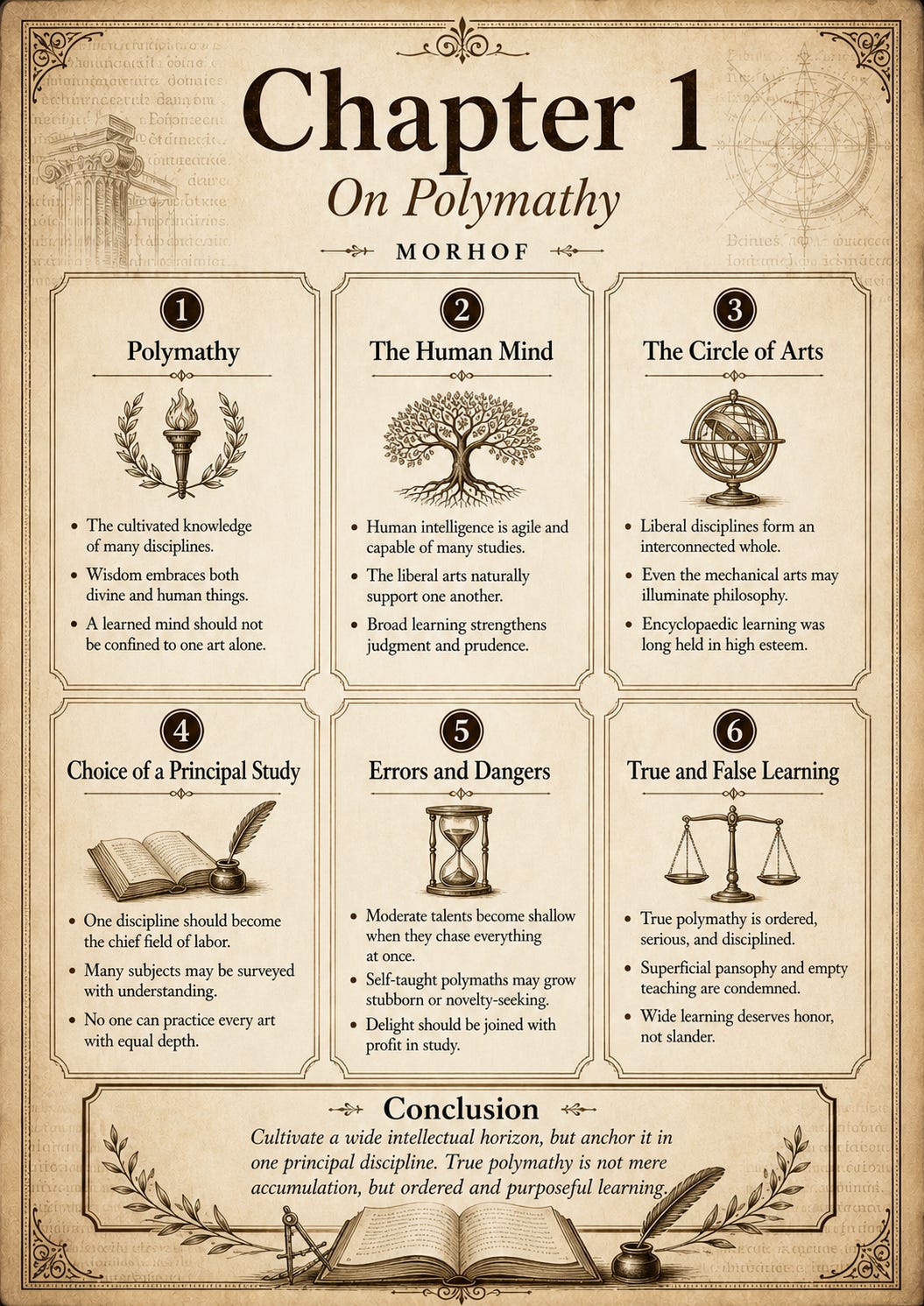
Book 1 of the Literary Polyhistor, Chapter I: On Polymathy

Chapter I
On Polymathy
They used to include among the liberal arts the knowledge of all liberal arts.
This is asserted against Bonneau and Huet, and their objections are answered.
One discipline, to which we devote ourselves before the rest, must be chosen.
Moderate talents abuse themselves through zeal for polymathy.
They seek what is pleasant in the disciplines, that is, what delights rather than what profits.
Their most harmful madness must rightly be restrained by public authority.
1. A prefatory exhortation to polymathy.
Since the whole wisdom of divine and human things has been handed down in the monuments of the ancients and transmitted to posterity, and since our understanding, shaped by their precepts and teaching, gains some knowledge and prudence in these matters, everyone must be diligent here. He must trace out their origins, first authors, and teachers; examine their ages, each distinguished by its own manner of teaching; bring to light what lies hidden in libraries; bring forth similar things, whether suited to his own genius or newly devised by himself; and embrace in his mind a certain complex of sciences, or POLYMATHY.
2. The human mind is capable of polymathy.
Our mind must not be confined within such narrow bounds that it contains only one art. Those who do this are unfair judges, and they do not perceive how much the nature of human intelligence is worth, how quick and agile it is, or that it can do more than one thing, if we listen to Fabius. Those who say otherwise are unskilled men, and they accuse polymathy of being either beyond human ability, useless, or harmful to the conduct of affairs.
3. They used to include among the liberal arts the knowledge of all liberal arts.
Yet there is, of course, a certain knowledge and combination of the sciences, which the Greeks call encyclopaedic learning, so that no one can be called perfect in one thing unless he has attained the others. The case is different with low and sordid workshop arts, among which there is no union; the liberal disciplines are not to be judged by their skill. A craftsman may be ignorant of future things without blame. But in the liberal arts, all breathe together and join hands. We know what Vitruvius required in his architect: there was scarcely any discipline that he did not want him to touch. In orators and poets, at least in the perfect ones, Vitruvius’ architect requires all these same things.
4. The Stoics even brought the mechanical arts under it.
Indeed, the Stoics judged that these sciences and all arts should be gathered into their philosopher in such a way that they did not want him to be ignorant even of mechanical arts. They thought it unworthy of him to use the services of others for the necessities of civil life. For just as he was rich, a king, and noble, so too he was his own tailor, smith, and miller.
5. Hippias knew all the arts.
Apuleius gives an elegant and witty example in Hippias, who, besides an extraordinary knowledge of all the liberal arts, was highly skilled in every kind of workmanship. Whatever he had with him, he had made with his own hand: clothes, shoes, ring, and seal-stone.
6. Bottifanga.
Erythraeus offers a similar, indeed greater, example in Julius Caesar Bottifanga, who, besides singular skill in all the liberal arts, made and sewed trousers and breastplates for himself. He not only lacked no musical instrument and played excellently, but even made such instruments better than any other craftsman. With the painter’s brush, and with the needle in embroidery, he challenged Arachne herself, so that he put to shame the little women who professed that art. We would hardly allow such things to overflow in a wise man of his judgment, and we shall easily excuse him if he did not weary his body by working, since by intelligence he could nevertheless have explored the principles of those operations.
7. Thévenot studied the encyclopaedia of the mechanical arts.
For even the mechanical arts are, as it were, branches of natural science and of the mathematical disciplines. They can be adorned and enlarged by their aid, and all of them were invented by the wisest men. Accurate history and knowledge of them is not unworthy of a philosopher, and it will provide occasion for great and brilliant reflections. Nor have men been lacking who undertook the cultivation of this field also. Thévenot, a man illustrious among the French and most celebrated for his writings on travels, was attempting a vast work on all trades, like a kind of encyclopaedia of nature and art. But fate interrupted these labors.
8. All the liberal arts should be learned.
Let us come to the more elegant disciplines, whose joint cultivation nature itself urges upon us as guide, so that it would at last be shameful for a man to profess competence in only one. The author is not obscure: Joachim Fortius Ringelbergius, in his Encyclopaedia, judges that those who wish to excel in only one art care more for the body than for the mind. “Nothing,” he says, “is so alien from the Muses as those who cannot learn one thing; indeed, I think that magpies could accomplish within twenty years what these monsters of men spend on one pursuit.” He is quite right, for he recalls us from those studies to which care of the body, gain, and the pursuit of wealth summon us. Those who are immersed in these things direct everything to this end and extinguish those small sparks.
When the most learned writer of Pinelli’s life, Gualdus, gives the reason why so many are drawn away from sound and true studies, he praises his own Vincenzo Pinelli, and what a man he was, with immense praises to the sky: one who, scorning all bargaining and empty titles, gave himself wholly to studies, from which immortal glory was obtained for him. It is, of course, what Lactantius notes in book I, chapter 1, of On False Religion: “Men of great and excellent genius, when they have wholly devoted themselves to learning, have despised whatever labor they might have spent on public and private affairs, and have considered the pursuit of truth far more excellent than being entangled in the accumulation of riches or honors.”
9. A universal inclination toward them is given by nature.
It is not doubtful that moderate talents too may succeed here. Moreover, the efforts of many are crushed in the very grass, either by poverty or by envy. Yet there are not a few who raise their shoulders above all those obstacles, driven by a certain natural genius and borne away on their own wings. There is in them that “fiery and winged creature,” which belongs to a great genius and is such as Plato describes in book III of the Republic.
There is a certain impulse of our minds, if I may so speak, by which they are fitted either by nature or by habituation to embrace many things at once, to abstract themselves from particulars, and to lift themselves from that low condition into the sublime. Thus the mind passes into what we may call quick understanding, or the leading discipline of the Stoics, like the region of the spirit; and like a lightning flash it penetrates all things with a certain light.
The Greek interpreter of the Topics, who is commonly held to be Alexander of Aphrodisias, seems to have touched on this universal inclination when in book 8 he calls it a good power. He speaks well, but badly adds that this inclination belongs only to a particular discipline. Huarte, too, in his Examination of Men’s Wits, has something similar, holding that one person has a natural inclination toward one discipline. Yet both reason itself and so many examples of very distinguished men show that there can be people who have equal genius for cultivating all things.
10. This is asserted against Bonneau and Huet, and their objections are answered.
What Franciscus Bonneus gives in his Treatise on the Method of Learning as the reason for that opinion, namely that those who possess that good talent lack the critical faculty, although it is plainly necessary lest they fall into various errors, can easily be shown to be false. For those who hold distinct ideas of things in the mind, properly subordinated and not confused, must not have their critical faculty diminished, but increased, since it results from the union of all the parts. Indeed, critical ability is surely greater in them than in those who are occupied with one separate subject. These, for the most part, when they are ignorant of the nature of the rest, measure all other things by that single subject. So the musician in Cicero, when demonstrating the nature of the soul, used to say that harmony was outside the boundaries of his own art. The example of Origen, which he sets forth to confirm his opinion, proves nothing at all, since the errors springing from his genius did not flow from his sharpness. Certainly it is a great mistake, on Aristotle’s authority in the first book of the Metaphysics, to distinguish between wisdom, which concerns causes, and art, which concerns each single thing, if these are then confused when they must by no means be confused. It very often happens that we believe ourselves fit to judge many matters if perhaps in one or another thing we have exercised genius and industry; or, if we are fitted and born for many things, we think that single matters can be handled well. But in the contemplation of these things a disposition of genius must always be respected; once it has established itself, it is so versed in them that it does not easily fall away from the reason and judgment that result from considering the thing itself.
11. One discipline, to which we devote ourselves before the rest, must be chosen.
Yet I do not mean that someone who has applied himself to every kind of discipline should dwell in all of them at the same time, for time, business, and other impediments keep us from doing this. We shall indeed occupy this whole field with mind, affection, and impulse; but we shall, as it were, mark out by certain limits the part of it most suited to us, cultivate that part, and exercise our industry in it. For if we listen to Plutarch, speaking on the saying “around the paideia,” he says: “It is fine indeed to sail around many cities, but best to inhabit the best one.” There is a companion saying in Nicolaus Damascenus in the Peiresc excerpts, page 416, and in Suidas under the entry Nicolaus of Damascus: “The circle of disciplines,” he says, “is like a journey. For just as those who undertake a long journey, if it happens that they remain in some places for dinner, lodge in others, and spend several days in some places, while they merely look at others in passing and going by, and at last, when they have returned, live in their own homes; so also those who devote effort to letters ought to remain briefly in some studies, longer in others, to learn some of them completely, merely taste others, and at last settle down in one as if returning to their fatherland and household gods.”
12. The narrowness of the human mind allows one to survey all disciplines with understanding, but not to work thoroughly in all of them.
We have seen great men who could have carried off great fruits from one science, but because they pursued all, they were not so devoted even to one that they gained distinguished glory from it. Those act altogether more wisely who, after examining and drawing out single things from the common quiver, aim their arrows at one particular target. The very vastness of the sciences excludes its guests: those who have lived nowhere will nowhere be at home, if they want to live everywhere, or if they touch very many things only in a light run. For since all disciplines are contained in these two things, practice and understanding, the latter can be shared with others; but the former, when engaged in the work itself, claims the whole person for itself. Men of talent can survey all disciplines with understanding; but the narrowness of the human mind does not allow it to work equally in all, since even the most excellent talents have never embraced so many sciences that they were not lacking in some. Tarquinius Galluccius proved this by the examples of M. Varro, Julius Caesar, Pliny, Origen, Clement of Alexandria, Jerome, Augustine, Pico della Mirandola, Matteo Acquaviva, Scaliger, Fracastoro, and Giovanni Battista Mantuano in his very learned oration On Encyclopaedia. All these things will be truer if someone directs his studies to a fixed end, so that they may accord with the necessities of life. For with them, all things have been defined by utility. But if someone has received a happier lot in life, so that he need not look to those necessities, and if that power of genius is active and vigorous enough not to be dulled by a multitude of things, nothing prevents him from turning that force of mind and those free spirits in every direction.
13. Moderate talents abuse themselves through zeal for polymathy.
For moderate talents, and those not born for such great things, I would rather advise that they remain within themselves and not pursue what they cannot attain because of their own weakness. Let them remember that pygmies contend unhappily with giants. For in them an affected polymathy usually turns into empty and foolish talkativeness. About them there is the saying of Benedetto Menzini of Florence, a most learned man, in his little book on the envy of literary men, chapter 6: “If I were to give my opinion about the more recent writers and those who have flourished from the previous century, I would dare to assert that the former knew fewer things but better, while the latter know more things but worse. And I have also found that this is so when new comrades write only miscellanies, which they have learned to varnish over with the name of varied literature. Indeed, they do not truly write so much as scribble; and with Phorcydes before their eyes, they take in impressions by the handful, believing everything to be keenly and perfectly clear, though it is only light’s favor that makes it seem so, like water, which catches brightness unevenly and scatters it as it shines.” To this belongs the complaint of the very distinguished Roland Maresius in epistle 46, book 1, and in the ninth of book 2, where he discusses many things about polymathy with that serious and solid discourse of his. His letters are learned, full of profit, and hand down very useful things about every literary matter.
14. Self-taught polymaths.
It also happens that those who have first devoted themselves to the study of polymathy, if their brains are somewhat more fluid and their opinions are not easily accommodated to another’s advice in learning the arts, commonly prepare for themselves a pathless road. For it happens to them as it does to plants that grow by themselves and pass into a wild nature when they are restrained by no cultivation. Thus, while they scorn the judgments of others, the self-taught seek protection for themselves through obstinate error. I would not wish to deny that there have been some men of such very fortunate genius that, without a guide, they entered on the road to the summit of erudition, just as that Homeric minstrel in Odyssey 22.347 says of himself:
I am self-taught; a god has implanted in my mind songs of every kind.
For Heraclitus of Ephesus, as Plutarch relates, learned all philosophy among the ancients from no teacher; and likewise Augustine boasts of himself that he was a Manlius Equicola. Among more recent men, Cujas in jurisprudence, Budé in humane letters, and Muretus in oratory all reached the highest perfection without the help of a teacher, as Gabriel Naudé reports in his dissertation On Liberal Study; they are almost a miracle. Giovanni Pontano, a great man and both poet and philosopher, narrates about himself that without teachers he learned to make verses and measure the course of the heavens, as Paganino Gaudenzio testifies in his Academic Institution, in the title On Readiness in Professing. We have received that Guillaume Postel also achieved almost every knowledge of languages, and Pierre Ramus did the same in the study of philosophy, without the help of a master. Yet these men were driven by a certain intemperance of their own. Tanaquil Faber, in part 1, epistle 49, complains that he was self-taught in Greek, and that from this he had too scanty a stock of Hellenism.
15. Self-taught men are very often innovators.
Still, for the most part, an empty persuasion is apt to cling to those self-taught men, especially in philosophy, while they have not sufficiently followed the authoritative opinions of the ancients and instead embrace a cloud for Juno.
16. They seek what is pleasant in the disciplines, that is, what delights rather than what profits.
This also often obstructs these studies: because the solid and whole disciplines are troublesome to them as they lead them on, those polymaths have been accustomed to seek only the charms of the disciplines, the things to be sipped from them, as Pliny already called them in his own time. From him the charms of studies are so called: the things that rather adorn and season them than belong to their nature and constitution. Those who cling to these things look in the disciplines rather to what delights than to what profits, although reason itself dictates that these must be joined.
17. Polymathy attacked by unjust slanders.
Let us therefore grant that those are to be blamed who, led by a certain genius of their own, handle these studies of polymathy unsuccessfully. Yet it must not be allowed that barbarous and sluggish people, who display a false and empty appearance of learning in place of true and solid wisdom, freely scratch with their abuse the worshippers of divine and most beautiful study.
Since these men have declared war with a good mind upon the best letters, conscious of their own rudeness they do not look with fair eyes upon those whom they see enriched within by knowledge of various things. Therefore the very name of polymathy is an insult to them, as if it snatched grammarians and men of consummate erudition. They would not do this if they had recognized the treasures of things that lie hidden under those most ample titles.
18. The praise and genius of Wouwer of Hamburg.
The illustrious Johannes Wouwer, a man of the highest and most elegant genius, was attacked by these slanders; he both vindicated his own reputation by his most elegant book On Polymathy and asserted the dignity of this study. There are two things about him on which we must advise, in which learned men have erred. The first is that the two authors of the Antwerp and Hamburg Polymathy are confused under his name. Andreas Schott makes this Belgian in the notes on Greek proverbs, page 68, but falsely. Lipsius, in a letter of 8 November 1599 written to the Antwerp man, clearly distinguishes both: “Janus Wouwer, your namesake, if not your fellow-countryman, what good union of things! An excellent match, nor even from the gods could you have asked more from yourself or by vow. I have always loved modesty and integrity in that young man, and, to state briefly, when he was nine years ago at Hamburg, I praised him to you alone. He lives, grows, and already receives a lamp handed on by us in this course: I gladly and with prudent judgment yield it.” Our man was born at Hamburg, of his father Nicolaus, a refugee from Belgium because of religious persecutions, from that Antwerp family, as Lipsius rightly thinks, which sprang from the illustrious stock of barons. The Antwerp man, however, is the one to whom Lipsius ordered that his library and his writings be left by testament, as long as he was an adolescent heir, as Aubertus Miraeus testifies in his Eulogy of Lipsius.
19. His vindication from the charge of plagiarism.
The second thing that I judged should be noted concerns the suspicion of plagiarism with which this excellent man has been burdened through the greatest injustice and envy by Maussac, a German against a Frenchman. When Maussac was about to publish a book on the same subject, he said that all this labor had been snatched from him by Casaubon; yet Casaubon himself, who would not have hidden an injury done to him, frees him from so great a crime. You may read those testimonies of his innocence in Casaubon’s preface to the repeated edition. Martin Schock, in his Confusion of Babel, part 2, chapter 4, judged that this judgment of Maussac had arisen from envy. Vossius also, after suppressing Wouwer’s name, and Johannes Jonsonius, book 1 of On Writers of the History of Philosophy, chapter 10, page 49, testify that Wouwer took much from Maussac.
20. Budé on polymathy and the study of philology.
Many things could be said here by us about the vastness of polymathy; but since that whole book of Wouwer has been devoted to the matter, we refer the reader to it. Guillaume Budé, an illustrious man, royal counsellor, and master of petitions, can and even ought to be read on this argument in his books On Philology, which he inscribes to Henry of Orleans and Charles of Angoulême, sons of the king.
There he says much about the breadth and dignity of this study, and, in a dialogue arranged as if with the king, exhorts him to undertake the adornment of these studies, since they will bring splendor to his kingdom; to reward men who profess them; and to grant them magistracies, honors, and priesthoods. A fortunate success was not lacking for so eloquent and illustrious a patron, himself the desired master of petitions pleading the cause of philology. For among no nation were those studies ever in a more honorable place, and the examples endure to this day. Hence the best talents were always aroused, and no other nation has given so rich a harvest of them.
21. Cresollius’ insane slander against Melanchthon is refuted. Ludovicus Cresollius
The Jesuit, otherwise a very learned man, treats this cause of polymathy among others in his Act of Thanks for the Restored College of the Society of Jesus, which is appended to the Autumn Vacations; but he treats it in such a way that he spreads an insane slander against Melanchthon as an enemy of polymathy. Nothing more foolish or shameless could be invented, since there is no one among the learned who can be ignorant that Melanchthon was Germany’s teacher and the true parent of polymathy. He calls, on page 46, two standard-bearers of a faction and, as it were, a matched pair of gladiators, Carolostadius and Melanchthon, who first began to whisper in circles and gatherings of adolescents that knowledge of doctrine did more harm than good for preserving religion. From these, he says further, so that the example might be more powerful for persuasion, as if the speech had been suddenly drunk from Circe’s cup, one became a farmer and the other a painter, so that they might be recognized as of the same flour. These are the man’s manifest frenzies about Melanchthon, who, while he lived in the light of Germany, in its most flourishing Academy, with great fame and glory for his name, never gave way to Carolostadius’ party. Who, besides Cresollius, ever dreamed that Melanchthon was a painter? But this is very false, which he adds: that from this there was a great result in many academies, and that nearly all schools were covered with spider-webs and empty, when at that time, through Melanchthon’s doctrine, the schools of Germany began truly to flourish.
22. Writers on encyclopaedic learning.
Some also refer here the writers on encyclopaedic learning. For when they set forth the complex of sciences in one book, they seem able to claim polymathy for themselves even by that title alone. Their books are great laws proceeding from the authors, in which there are as many meanings as principles, orders, and headings. These matters are treated more fully in the Philosophical Polyhistor. Yet even they dwell in a vast realm in what they attempt, and must be kept wholly away from the true glory of polymathy. For just as those who have wandered over seas and lands on wide journeys have far greater experience than those who have inspected them drawn on maps, so those who truly are polymaths are hardly to be compared with those who know nothing except from those little writings.
23. Whether academic pansophists are polymaths.
Much less do those deserve this name who, in the worst custom of the academies, profess pansophy with a title invented to gain profit and deceive youth. They are pansophists, and they want to teach others pansophy, who lead foolish beginners around three or four disciplines by some flitting excursion; for the mathematical sciences, eloquence, poetry, history, and more accurate knowledge of natural things are not included in this reckoning. They think they have exhausted the whole ocean of wisdom with these doctors.
24. Their most harmful madness must rightly be restrained by public authority.
That madness ought to be restrained by public coercive law: by these teachers the broadest road to ignorance is paved; all solid learning is overturned; crude studies are pushed into the chairs and into the forum; instead of philosophers, thin and haggard makers of terminological names; instead of Mercuries, stakes and trunks triumph everywhere, to the infamy of our age.
Summary