
How To Start A Memory Practice

Most people who practice the art of memory don’t use their memories to create art.
In this essay, I’m going to share the rough outline of how to start a memory practice that will empower you creatively.
If you don’t have a contemplative or creative practice, though, you won’t benefit much from having a memory practice.
This is the main reason most people who learn mnemonics go nowhere with it.
Practicing memory without practicing contemplation or engaging in acts of creation is like buying gasoline when you don’t own a car.
Memory is fuel, but it needs an engine to go places.
Preliminaries
Method of Loci
The Method of Loci is the most basic of memory techniques. It involves compositing mental scenes by combining images that evoke meaning with images that order that meaning.
You imagine a house, and then you stick images of objects or people in that house that remind you of the things you want to remember. You then walk through the house and re-examine the images when you want retrieve your memories.
It’s popular for a reason. I no longer use it, but I started with it just like most other mnemonists. You should too.
The Acronym Technique
If you’re absolutely new to the art of memory, I recommend learning Lauren Tothero’s acronym technique. This is probably the easiest mnemonic tool you can learn when you’re first starting out. It is very powerful, and it works right out of the box. The method of loci and other techniques require more practice before you can draw out their full strength.
The Art of Abbreviation
Martin Sommer called chunking the “art of abbreviation”. Aristotle called it “mastering heads”. There have been other terms for it.
You should be able to recall the body by thinking of the head. In my approach to memory, a body entry is an item in a memory palace that belongs to a greater whole, even if it hasn’t been fully connected to it yet. Once connected, though, a head entry will effortlessly evoke its body, leaving you free to prune your palace of its body entries.
Heads & Bodies
We’ll be covering this in more depth later, but not every item you store in a memory palace has the same purpose. Head items have larger cue fans while body items have smaller cue fans. The size of a cue fan is determined by how many associations a memory item has. A head’s cue fan should be the right size to evoke the right material, no more, no less.
Heads are collections of body items. A chapter title might evoke its argument, a model might evoke its parts, a poem title might evoke its verses.
Consider this table:
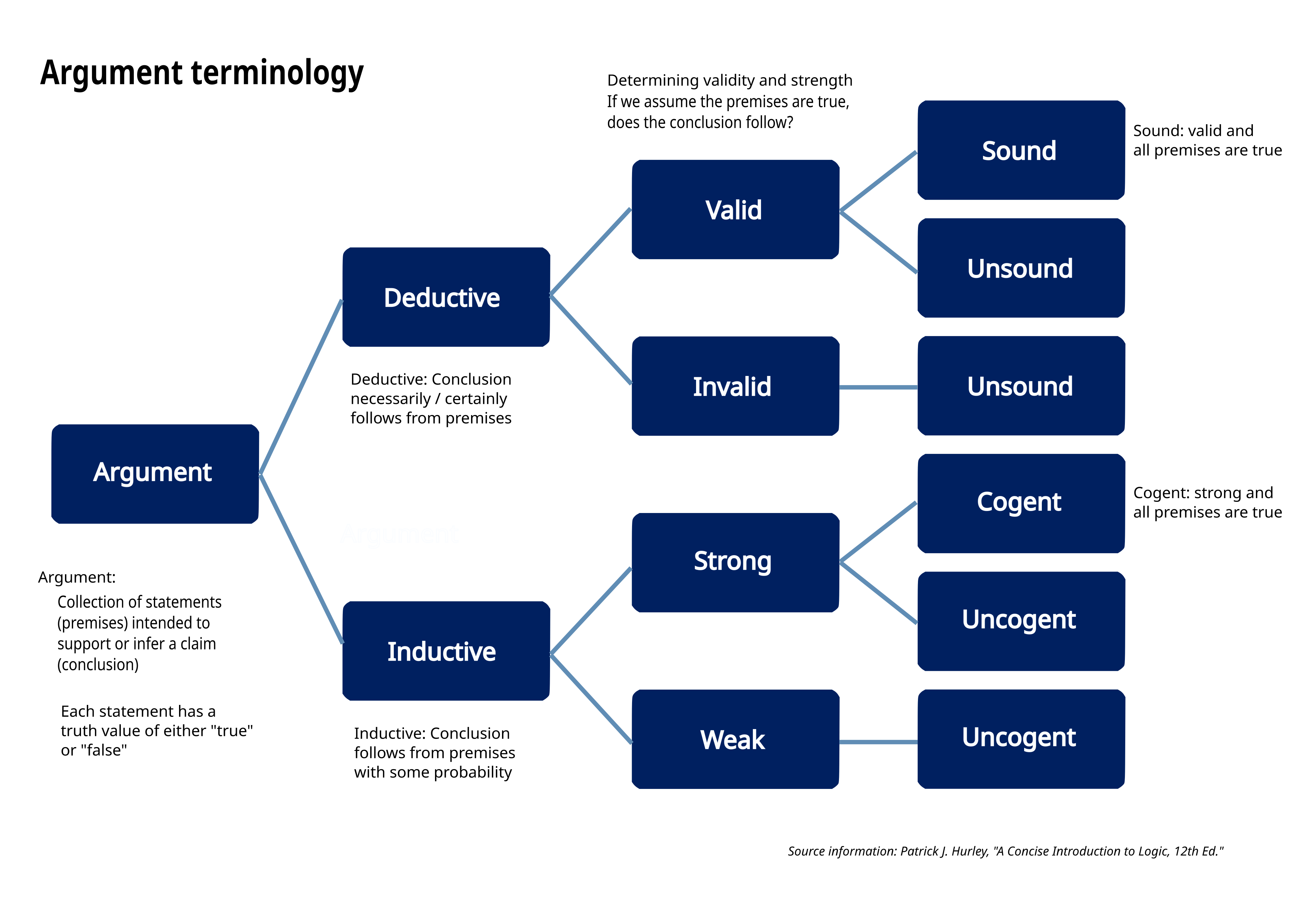
Argument is the head of deductive and inductive, which are the heads of valid and invalid, strong and weak, which are each heads of their own items.
Instead of memorizing each body item, you should aim to build a palace where heads evoke their branches.
Body items join heads. Smaller heads join bigger heads.
You want to add body items to a head’s cue fan, integrating them into semantic memory so that they’re easily retrieved.
Flashcards are about forming cue responses, while memory palaces are about storing cues so that you can intentionally retrieve their responses.
Storing every single cue is a bad use of your time. Instead, you want to work up the tree of knowledge, storing the most important branches instead of every leaf.
If you’re just starting out, I’d consider using the acronym technique for body items, and place based mnemonics for head items.
It’s All Been Done Before
The art of memory is very old.
New memory techniques are just variations of what our ancestors were doing thousands of years ago.
Not only are mnemonic techniques old, they are also quite simple. That brief blurb on the method of loci I wrote in the preliminary section is all you need to start using the art.
Knowing the method of loci and knowing how to use it effectively are two different things, though.
The techniques used by Thomas Aquinas, Albert Magnus, and Giordano Bruno all share the same broad structure of those used by today’s memory athletes, yet the former used the art of memory to craft incredible works of philosophy and theology, while memory athletes use it to memorize cards.
This essay is about the practice of memory, not about memory techniques. How you use mnemonic techniques is more important than the mnemonic techniques themselves.
Those techniques are trivial, and most of them can be learned in an afternoon.
Putting those techniques to use in ways that generate insights and meaningful knowledge is significantly harder.
First, let’s check in on the Ancient Greeks and some of the ways they engaged with memory.
The Ancient Greeks
Pythagoras would end every day by walking through it again in his mind, as William Perkins noted in his Little Book On Memory:
“It will not be foreign to literary studies to follow the custom of Pythagoras, whose habit was to observe more carefully at night, by repeating before sleep, the things he had reflected on with himself throughout the whole day.
That wise man saw, I think, that whatever had been lightly impressed on the mind by the thoughts of the day was sealed more deeply by nighttime repetition for the long duration of memory.”
And from the Golden Verses of Pythagoras:
“Never suffer sleep to close thine eyelids, after thy going to bed,
Till thou hast examined by thy reason all thy actions of the day.
Wherein have I done amiss?What have I done?
What have I omitted that I ought to have done?
If in this examination thou find that thou hast done amiss, reprimand thyself severely for it; And if thou hast done any good, rejoice.”
Let’s follow Pythagoras with a scene featuring Socrates, courtesy of the Symposium :
“Immersed in some problem at dawn, he stood in the same spot considering it, and when he found it a tough one, he would not give it up but stood there trying.
The time drew on to midday, and the men began to notice him, and said to one another in wonder:
‘Socrates has been standing there in a study ever since dawn!’
The end of it was that in the evening some of the Ionians after they had supped—this time it was summer—brought out their mattresses and rugs and took their sleep in the cool, thus they waited to see if he would go on standing all night too.
He stood till dawn came and the sun rose, then walked away, after offering a prayer to the Sun.”
And here’s what Socrates had to say about memory in the Phaedrus, where he criticizes writing:
“This invention will produce forgetfulness in the minds of those who learn to use it, because they will not practice their memory.
Their trust in writing, produced by external characters which are no part of themselves, will discourage the use of their own memory within them.”
We don’t know the exact nature of how Socrates practiced his memory, but I think it probably looked a lot like the scene described in the Symposium.
Next is a passage from Aristotle’s Topics:
It is best to know by heart arguments upon those questions which are of most frequent occurrence, and particularly in regard to those propositions which are ultimate: for in discussing these answerers frequently give up in despair.
Moreover, get a good stock of definitions: and have those of familiar and primary ideas at your fingers’ ends: for it is through these that reasonings are effected.
You should try, moreover, to master the heads under which other arguments mostly tend to fall.
For just as in geometry it is useful to be practised in the elements, and in arithmetic to have the multiplication table up to ten at one’s fingers’ ends – and indeed it makes a great difference in one’s knowledge of the multiples of other numbers too – likewise also in arguments it is a great advantage to be well up in regard to first principles, and to have a thorough knowledge of premisses at the tip of one’s tongue.
For just as in a person with a trained memory, a memory of things themselves is immediately caused by the mere mention of their loci, so these habits too will make a man readier in reasoning, because he has his premisses classified before his mind’s eye, each under its number.
It is better to commit to memory a premiss of general application than an argument: for it is difficult to be even moderately ready with a first principle, or hypothesis.
Memory is a tool, and it can either be used to investigate the world and sit with important problems, or it can be used to memorize cards.
The tool is only as good as the purpose it serves.
The Bad Fit Brambles
You should start by deciding if you even need a memory practice.
You want to match your goals to the tools you use to achieve it.
Mnemonics must fit your purpose.
Some neophyte students pursuing the art of memory think it’s a panacea that will solve all their problems.
These students rarely make their way past the Bad Fit Brambles, an ornery path you need to cross before you can fully learn the art.
The Four Bads below are not the only ones, but they are among the most common .
All of the bad fits are the result of displacement, of people treating a better memory as a macguffin that they think will resolve their actual problem, which usually has nothing to do with memory at all.
Bad Fit 1: Mnemonics will not make you popular.
Jan Szklarek, as far back as 1504, noted that one of the things that dissuaded people from picking up the art of memory was that it might get you bullied for being a nerd:
“Others may discourage someone who wants to hear about the art or who does not yet understand it. They mock him, speak badly of him, and create hostility around him.”
People care about how you make them feel, they don’t care about how smart you are or how much you know, so unless that towering intellect of yours somehow makes their lives better and more rewarding, your memory skills will not make you more popular.
If you want to win friends and influence people, read Dale Carnegie and put away your memory palace.
Bad Fit 2: Mnemonics will not help you win debates.
In the same vein, there are better ways to win arguments than mastering mnemonics.
Again, people don’t usually care about how smart you are, they care about how you make them feel.
Your tone of voice, your manner of speech, the way you hold yourself and respond to your audience, all of these matter more in debates than simply having facts on your side.
There’s a reason Nixon won on radio but lost on TV when he was up against JFK.
Bad Fit 3: Mnemonics is a bad fit for chasing grades.
Mnemonics are also a bad fit if you’re just chasing after better grades.
The art of memory has a much longer time horizon than school exams. It’s a slow art with benefits that are often only fully realized once you’ve put in the time.
That’s not to say that you can’t use mnemonics for your studies, but that you might be better off using more traditional approaches if speed is what you’re after.
If you plan on remembering what you study a year from now, use mnemonics. If all you want to do is ace next week’s exams, there are more appropriate tools for you to use.
Bad Fit 4: Mnemonics is not a shortcut to success.
There’s a certain type of self-help junkie who is happy to waste thousands of dollars on bogus quick-fix schemes.
This is a quote from Morhof’s Literary Polyhistor from the 1600s:
“Not so many years ago a certain peddler of doctrine, indeed an impostor of that sort, passed through this city of ours, who, in order to be able to impose on the hungry crowd quickly, as though with a stroke of a wand, promised full knowledge of the Greek language within the space of three or four days. He found among the gullible and thoroughly ignorant a few adolescents who, if they had grown old in the disciplines and had examined what was worthy in the charlatan, would have despised him with laughter. Yet after the money was paid they were magnificently deceived by the same solemn tricks, like crows gaping, and when they hunted for the flesh, he did not even show them its shadow.”
You will not learn Greek in four days using mnemonics.
You will not develop Kim Peek’s photographic memory using mnemonics.
Mnemonics is not a short cut.
A memory practice is like having a workout regimen. It has more in common with going to the gym three times a week, putting the effort in, and carefully managing your diet, than it does with taking a magic pill that instantly turns you into a super model.
It is a slow practice that, over time, offers real and substantial benefits, including a deep kind of mastery that is rare today.
Finding Your Why
Once you find yourself past the Bad Fit Brambles, you get to dig down and figure out exactly what you want from your memory practice.
Is it a devotional practice, where you commit holy scriptures to memory?
Is it a mastery practice meant to help you carry your studies with you for the long haul?
Do you plan on using it for more short-term reasons, like giving speeches?
Maybe you want to use in your creative practice.
Or maybe you’re just curious and want to see what you’re capable of accomplishing.
The Why behind your memory practice will shape every aspect of it.
Define your Purpose.
I mean that in the capital P sense of the word.
Why are you here, on Earth?
When the dust settles and you’ve left for the great beyond, what do you want to leave behind?
What are you doing with your life and how would an ordered memory help you do it?
What would a daily memory practice look like if you had one and how would that fit in with your purpose?
These are important questions to answer, because a memory practice isn’t a fly by night operation.
It’s something you’re going to be doing regularly, so you should have a good reason for it.
You have a memory practice so you can be a better scientist, a better philosopher, a better artist, a better theologian, a better technologist, a better aesthete, a better whatever.
You want to train your memory for the sake of whatever it is you are on this Earth to accomplish.
Know Your Limits
So you’ve got your Why, or at least the rough outlines of a Why.
You know what you want to do, and you have at least some sense of how memory can help you be better at what it is you want to accomplish .
Next, you need to get a grip on your personal limits.
How much time are you willing to invest in the practice?
The time you put into your memory practice should be a fraction of the time you spend on what the practice serves. If you spend 90 minutes in contemplation, it’s fine to spend 30 minutes with your memory practice, but you shouldn’t spend 30 minutes memorizing things if you only spend 15 minutes in contemplation or acts of creation.
How long are you willing to commit to it?
It takes time for the real benefits of the practice to become obvious.
You should set a timeframe for your initial commitment, I’d suggest 3 months, which is about the same amount of time it takes for you to really start seeing results from going to the gym.
You should have some idea of what results you want to see once you’re on the other side of your commitment.
These results should be reasonable. You wouldn’t expect to put on 30 pounds of muscle after 3 months of working out, and you shouldn’t expect to speak Ancient Greek after three months of mnemonics.
What’s your floor?
You should a have a time floor, or the bare minimum of memory practice you should do daily. If you’re just starting out, 5 minutes is more than enough. My own floor is 15 minutes.
What’s your ceiling?
You should also have a ceiling for how much time you regularly spend with your memory practice.
You will hit a point of diminishing returns if you do too much. Ceilings prevent burn-out, making it much easier for you to keep the practice for the long haul.
What’s a good rate of learning?
You should also have upper and lower limits for how many items you “store” in your memory palaces on a given day. 10-15 items a day is respectable. 5 is a totally fine number to start with.
Yes, some people memorize a ridiculous number of items in a short period of time, but a memory practice should be sustainable as well as practical.
If you memorized 70 body items a day without ever chunking them into heads, that’d be over 25,000 items a year. If you spent just one minute thinking about each of those items, it would take you over 400 hours, or 10 work weeks.
Even 35 items a day, at 1 minute each, is a 200 hour commitment.
Choose realistic targets that will actually help you achieve the things you want to achieve.
Momentum is more important than speed. A little bit every day adds up.
The daily average of items you commit to memory should be reasonable. You will, of course, have days where you memorize entire poems and passages, but the goal should be to have a realistic practice that won’t overwhelm you.
Your real rate of learning isn’t the number of items you store in a memory palace, but the number of items you turn into semantic memory.
There’s a reason some people “learn” 20,000 words in a foreign language yet still aren’t fluent.
Collecting body items without structuring them into meaning is a waste of time.
How will you handle set backs?
You will have zero days. You’ll probably have zero weeks. This is normal. You want to have a plan for handling set backs and getting back on track.
It’s important to be okay with failure, otherwise you might just throw the whole practice out the window once you hit your first rough patch.
How will you handle burst sessions?
Like setbacks, you will also have bursts of activity that are far beyond your usual daily ceiling.
This is fine. You might have a 15 minute daily practice, but then a weekend comes were you spend four hours memorizing something.
Knowing how you’ll handle these burst sessions will help you keep your regular routine.
Treat bursts as a special kind of memory session, one that deviates from the norm, but doesn’t set a new standard.
The standard is the ceiling.
Bursts will often happen following either breakthrough moments, or when you’re experimenting with new methods or techniques.
If you just found a technique that’s very promising, you might spend a a lot of time with it at first. That’s okay.
The key thing is to make sure that the time you spend on your memory practice remains a fraction of whatever it serves when averaged over the month.
How will you minimize interference?
There’s a certain period of time after you’ve learned something where new knowledge is fragile. This is your encoding window. You want to form an intentional relationship with it.
Sometimes the best way to learn something is to not do anything.
After a work out, you need to let your muscles rest in order for them to grow.
Ditto with learning.
You want to get your Wu Wei on, which is a taoist idea that roughly translates to doing-without-doing.
Different people have different encoding windows. You should give yourself at least a few minutes after you’ve learned something for that memory to gel a bit. You shouldn’t just jump into the next memory task without ensuring it’s sufficiently distinct. There’s a reason educators are big on interleaving practice.
I’d wait at least 3 minutes between memory tasks, though you might be better off waiting 15 minutes. Find out what works for you. Use the encoding window to do chores, the dishes, take a nap, whatever.
The point is to be aware that the encoding window exists and to work with it intentionally. Your mind needs time to register the things you’re showing it.
Know Your Defect Rate
You are going to forget things. If you’re like me, you will forget a lot of things.
Forgetting is a good thing.
You don’t want to remember everything. You want your brain to prune things that don’t matter and to consolidate things that do matter.
I think a defective memory attempt rate of 20% is fantastic. Anything lower than 20% is going to be a slog. That last 20% often requires more effort to master than the first 80%. I wouldn’t bother with it unless it’s mission critical.
Most of the time, though, it won’t be.
Remember: the goal isn’t to “memorize everything” but to cultivate a memory that serves a greater purpose.
That purpose should determine how high a defect rate you tolerate. If you’re giving a speech, singing a song, or reciting a poem, you’ll want a lower failure rate, but even then you should be pretty forgiving of mistakes.
Milman Parry studied Balkan poets who recited Homeric poems from memory. Each performance they gave was slightly different, yet the poets were convinced that they were reciting the same thing each time.
They weren’t, and that’s normal.
The art of memory is not about repeating things perfectly.
You are not a Xerox machine.
You are a human bring who is learning how to carry pieces of the past with you wherever you go. Each time you bring those pieces out into the present, you change them a bit.
Size Matters
You are not immortal. You can only spend so much time with the items in your memory palace.
Just as you should have a ceiling for the maximum amount of time you spend on your daily practice, you should also have a ceiling for how many active items you have in your memory palaces at any one time.
Martin Sommer, a famous mnemonist from the 1600s, taught his students how to build a memory palace that could contain over 200,000 items. He also taught them the art of abbreviation, which involved chunking items together so that you didn’t have to memorize so much material.
I think Sommer’s mega palace was a marketing gimmick he used to attract students. I doubt it was something he actively used. You don’t need a 200,000 item memory palace if you know how to chunk items together, which he clearly did.
There’s no one-size-fits-all rule for how big or small a memory palace should be, but smaller is usually better.
Keep It Simple
It’s important that you keep things simple. You do not want to overburden your practice with gimmicks.
I create a map of keywords for each book I read, and I keep that map in the book itself. I pick up the book, I revisit it in my mind, if I can’t remember something, I check the paper, if that doesn’t work, I check the book. I also do something similar for essays or random lists I want to memorize. I print those out, create a key map, and do the same thing. That’s it. That’s my practice.
The point here isn’t that you should mimic my exact method, but that the method I use can be described in a paragraph.
You should be able to describe the core of your method in a few short sentences. The details might take up a lot of space, but the basics shouldn’t.
Separate Heads from Bodies
I separate palaces into 3 kinds:
Body Palaces: these are palaces for items that you should eventually connect to heads. The items on my key lists usually fall into this category.
Head Palaces: these are palaces for headings, titles, various heuristics. Basically, things that have bodies.
Productive Palaces: these are palaces for creative or contemplative aids. The Lullian alphabet, lists of questions and prompts, or full speeches and songs that you plan on performing.
Body palaces should be retired once you’re satisfied with how many entries have connected to their heads.
Head palaces should be kept for as long as they’re useful.
Productive palaces fall somewhere between the two, and their survival should be contingent on how often you use them in your creative and contemplative work.
Avoid keeping more than a thousand active body entries in your various memory palaces. If you have that many, it usually means you either need to do more contemplative work, or slow down your reading.
If you’re just starting out, cap your body entries to a couple hundred items until you get a feel for connecting them to heads.
You know a body has a head when thinking of the head effortlessly retrieves the body.
Example: The Loveliest of Trees, The Cherry Now
Last month, I was experimenting with using poems as memory palaces. The idea was to turn each word of a poem into a room that would store images that I would then arrange using Conrad Celtes syllabary.
The experiment was a bust, but I did end up memorizing the Loveliest of Trees, the Cherry Now by A.E Housman. It’s very short, only 70 words long, so it didn’t take long to memorize.
I initially memorized each word, but now the title alone is enough to retrieve the whole thing. The body of the poem has been successfully connected to the head, so I’ve retired its memory palace.
Your memory practice should aim for a similar goal.
You have limited cognitive resources to spend on orderly retrieval.
This is important.
You should reserve those resources for productive items, head items, and items you are actively trying to connect to heads. The larger your pool of active body items, the fewer cognitive resources those items will get, the harder it’ll be for you to connect them to their heads.
You link bodies to heads through retrieval practice and by engaging body items until they form the right semantic connective tissue.
Separate Orderly Vs. Spontaneous Retrieval
Orderly retrieval is what separates mnemonics from flashcards, which are designed for spontaneous retrieval.
Orderly retrieval is slow. It’s also structured and intentional.
If you’re a professional chef, you want an orderly kitchen.
If you’re a surgeon, you want an orderly operating room.
If you’re a knowledge worker or an artist, you should want an orderly mind where you can find the things that will help you do the things you’re meant to be doing.
Orderly retrieval is slow, but it pairs very well with spontaneous retrieval.
I think of the title of a poem, and suddenly I remember the whole thing.
If I want to hold a hundred poems in a memory palace, I just need to create a tiny palace featuring a 100 head words that effortlessly retrieve those poems. I do not need to store each word of each poem in a giant palace that I then have to actively maintain forevermore.
Orderly retrieval can be used to leverage spontaneous retrieval, allowing you to accomplish things with it that seem super human even though they’re actually quite trivial.
Mnemonics gets a bad rap because most people treat every item of memory as if they’re on equal footing, but they’re not.
Aristotle was right:
You want to master the heads.
A memory palace that consists of heads is much more useful than one that consists of bodies.
Your memory practice will mostly involve managing bodies so that you can connect them to heads during contemplation.
You’re like Victor Frankenstein, arranging body items so that they fuse with heads once the lightning of inspiration strikes.
Example: Psalms.
If you’re memorizing Psalms, you might want to create a palace containing superscriptions, titles, or incipits for each Psalm. You’d then create individual body palaces for the actual Psalm themselves, retiring those palaces once they’re no longer needed.
Example: My Book Palaces
I have 3 kinds of palaces I use for the books I read:
I have a library palace, which collects titles of books I’ve read in autobiographical order, or by order read.
I have chapter palaces, which collects chapter titles & key models.
And I have body palaces, which contain the key lists with terms for each page of the books I’m reading.
I do not use the method of loci for any of these palaces because I don’t want to deal with having to track which book goes with which memory palace.
Instead, the books themselves become chapter palaces. In order to call up the contents of a book, I just have to think of it instead of a random location.
For body palaces, I use a variety of different mnemonic techniques. I’m not planning on keeping these palaces long term, so I’m free to experiment with different methods. Right now, I’m using a mix of embodied mnemonics, like hand palaces and body pegs, as well as Conrad Celtes syllabary system.
All of these techniques are easier to extend than the method of loci and require much less book-keeping, though I would stick with the roman room method if you’re just starting out.
Set The Stage
You know what you want do, you know your limits, and you know how to separate heads from bodies. Now it’s time to set the stage.
That means organizing your memory practice.
French chefs have a practice known as mise en place, where they organize and arrange ingredients before they cook.
You have to do something similar with your memory practice.
Set Time Aside
You want to determine the best time for your memory practice.
Is it the first thing in the morning?
Last thing at night?
Maybe you want to split your practice into multiple sessions.
Schedule your practice the same way you’d schedule working-out.
You want some degree of consistency.
Organize By Intent
Your memory practice serves at least one purpose, probably several.
You should know how long you intend on keeping a memory palace before you build it. You should also have some idea of what you intend on using your palace for.
The work you need to do to memorize a speech will be different than the work you’ll have to do to memorize holy scripture you plan on carrying with you for the rest of your life.
Short-term palaces require more work at first, while you can be a lot more leisurely with long-term palaces.
It’s okay to retire memory palaces that are no longer useful, and it’s also okay to re-use memory palaces.
Gather the Material
I generally recommend against using your computer to memorize things.
Screens make your life harder because they tend to have a lot of cues associated with them, and more cues leads to more interference.
Analog objects are easier to work with and are more enjoyable to use. My own memory practice only took off once I started using it in real life instead of trying to memorize everything on my computer.
A couple pieces of paper, a pen, and a real book is all you need to get started.
I’ve mentioned it before, but in my practice, I capture keywords and chapter headings for the books I read, which I keep on a page stored in the book itself.
You could also just underline keywords in books, though I find having a bird’s eye view of all the keys on a couple pages saves time.
If you want to memorize a song, a list, an essay, a study, I recommend printing it.
You don’t have to, of course, and several of the books I’ve translated feature tutorials on how to memorize speeches in real time, which shows that you don’t need tangible copies of the things you’re memorizing. It makes things easier, though.
Arrange the Material
I have a study shelf where books are sorted into stacks based on when I should review them.
I’ve got stacks for this week, next week, next month, and then stacks for each season.
This is a simple approach, but it works well enough.
You just grab a stack to review at the start of your session. Then, when you’re done, you restack the items.
Work Your Palace
How you work your palace will be shaped by what you want to accomplish.
If you’re just starting out, use a few basic techniques at a time until you get them down.
You should be able to summarize what you’re doing in a paragraph or two. Use that summary as a mission statement. Follow your strategy long enough to see what works and what doesn’t, then write a new statement.
Gym rats keep meticulous logs of their workouts. You should keep logs too, though you don’t have to track everything in extreme detail unless you’re into that sort of thing. You should, however, capture the broad strokes so that you know if you’re going in the right direction or not.
You should write down the techniques you’re using, make reasonable predictions about the results you’ll get, then compare those predictions to how things actually panned out.
You shouldn’t be afraid to experiment either.
Keeping Momentum
Choose momentum over speed.
A little bit, every day, goes a long way.
Don’t overburden yourself.
Your practice should feel light, rewarding, and enjoyable.
Start small.
A great practice to start with would be the one Pythagoras used which I shared earlier, where he set aside time at night to review how he spent his day.
That’s a 5 minute practice that doesn’t require any mnemonics.
Once you’re doing that consistently, you can expand your practice to use more traditional memory techniques.
Use The Mere Exposure Effect
Mere exposure to a thing makes it easier to remember.
Yes, I’m suggesting that sometimes you should just look at things without engaging them.
This is not a substitute for effortful memory practice, instead it’s an easy way to keep the ball in the air on those days where you might not have the energy or time to commit to practice.
All you have to do is spend a brief moment looking over your keyword lists, or browsing the table of contents of your books, or checking your marginalia and highlights.
The goal here isn’t to remember things, but to keep things worth remembering in play.
This is better than having a zero day if you can pull it off.
Think of it as the “touch once” policy, where if you can’t engage with it, you just touch it to remind yourself that it’s there and that you’ll be back.
Use Interstitial Time
Another trick is to use interstitial time. You carry your memory palace with you wherever you go, which means you can consult it while waiting in line at the grocery store, or riding the bus, or waiting at the doctor’s office.
Serve That Purpose
Your memory practice exists to serve a greater purpose.
What that purpose is will depend on who you are and what you want to accomplish with your life.
Your memory practice should be simple, something like:
Encounter something worth remembering. Break it down into heads and bodies. Create keywords. Create signs for the keys, assign keys to addresses or locations in head and body palaces. Schedule memory sessions for key lists. Spend a bit of time everyday revisiting mental representations of your key list. Retire body palaces once they’re connected to head palaces.
However, you need to pair this practice with the real work you’re doing.
Most of that work will involve some form of either contemplation or composition.
I do not consider consulting your memory palace in acts of contemplation or composition to be part of the memory practice itself.
The reason for this separation of concerns is important.
Composition and contemplation are generative acts, while your memory practice is an act of maintenance.
It’s the difference between going to the gym and playing sports.
The gym maintains your health, sports let you enjoy your health.
You are maintaining a mental inventory of experiences and representations which you can use to come up with new ideas, solve interesting problems, create novel works, or to put into practice.
Most people who learn mnemonics fail to sufficiently separate the task of maintaining a memory palace from the act of using one.
These are different tasks.
You don’t go mountain climbing and do bench presses at the same time.
Keep these lanes separate.
Your memory practice maintains your memory, while your creative and contemplative practices use it. Using your memory will also improve it, which is why contemplation can help body entries connect to head entries, but this doesn’t change the fact that contemplation is distinct from the art of memory.
The two are not the same.
Experiment
Mnemonics is an art, which means there is a lot of room for experimentation.
You are your own person, with your own strengths, your own weaknesses, your own likes and dislikes.
Everyone can benefit from a memory practice, but each practice should be tailored to the individual.
There are dozens of mnemonic techniques and even more ways to apply them. Your goal should be to develop an art style that speaks to your purpose.
You should take a deliberate approach to experimentation. Try different techniques in different situations, and see which fit and which don’t.
Do not take mnemonic taboos as inviolable holy rules. The art has thousands of years of history, and if you read the books I’ve been translating, you’ll realize that there is a lot of disagreement among memory artists. Quintillian criticized the Zodiac technique used by Metrodorus, Conrad Celtes was critical of elaborate memory palaces, William Perkins was critical of the use of mental imagery, and on and on it goes.
There’s no one size-fits-all solution.
You should pick a technique, and commit to it for a certain amount of time to see how it feels. Maybe that’s a weekend, maybe it’s a week, you’ll have to figure that out for yourself.
You should also divide your memory practice between training the techniques you use and designing, building, and tending to your palaces.
I’ll be extending this essay over time, adding more sections to it in order to cover some of the gaps. However, there’s enough here to get started.
A Simple 6 Step Memory Practice
Choose your starting techniques. If you’re a beginner, I recommend using he method of loci and Tothero’s acronym method until you get your bearings.
Build your initial palaces. Select what you want to remember and organize what you’re remembering into head and body items. I suggest using the method of loci for heads, and the acronym method for bodies. Organize the bodies into smaller heads if you find yourself struggling with it. In other words, don’t use the acronym to memorize a thousand word poem in a single shot, but break the poem into sections, each with their own heading.
Commit to a study & review schedule. You can use my simple shelf method or any of the many other spacing schedules available to you. You can even come up with your own.
Divide your practice between memory training and tending to your memories.
Track your progress.
Link your memory practice to your creative or contemplative practices.
So for example, a palace of heads being the number and Latin incipit of each psalm, and then acronyms for the body texts of the psalms. I can spend part of my time building the head palace and part of my time building acronyms, with regular review, but I should spend most of my time simply reading and contemplating the psalms for my devotional. I should keep the palace of heads for life, but abandon the acronyms once the text of the psalm is memorized with 80% or greater fidelity.