
Polymemnones and Polyhistors: Memory Diner Digest # 3

Table of Contents
Elder’s Notes
This Week’s Translations
🎨   The Art of Memory By William Leporeus of Avalon
💪   A Short Report Showing How One May Strengthen The Memory Wondrously
       So That Anyone May Become Learned In A Short Time by Laurentius Fries
🐑   The Art of Memory, Or Rather of Recollection, Second Part by John Herd
🏛   Polymemnones, Second Continuation by Michael Richey
💡   The Polyhistor: Preface, by Daniel Georg Morhof
Reprints
🧠 Memory and Absence of Mind, All The Year Round 👨🏫 Memory, Addressed to Students, Southern Literary Journal 👁 Memory, Westminster Review
Elder’s Notes
Welcome to the third edition of the Memory Diner Digest. In this week’s digest, I have five new translations and three reprints from ancient magazines to share with you.
This newsletter is sketching out the history of mnemonics by translating and restoring old works. Every piece shines a light on the different ways that the art of memory was experienced across time and space.
Today’s offering brings us works from 1523, 1604, 1688, 1710, 1838, 1871, and 1888.
In the Art of Memory, which was written in 1523, there’s a testimonial claiming the author was saving mnemonics from obscurity. In Polymemnones, a work from 1710, the author criticizes the mnemonics taught at the time. The Westminster Review essay on Memory, published in 1888, advances some extremely odious “science” in its discussions of mnemonics.
Every era and every place has its own understanding of memory. Some of it’s good, some it’s terrible — looking at you, 1888.
The more classical works on the art of memory that I read, the more convinced I become that there’s never been a golden age for the art. Instead, we can think of the art of memory as a resilient vine that neither withers, nor blooms, but it always survives, carving out a niche for itself in the corners of our society, tended to by a small class of scholars on the one hand, and itinerant teachers on the other.
Seneca was celebrated for his memory, which tells us that his mnemonic feats were uncommon, even in Ancient Rome.
I think the art of memory’s best days are ahead of us.
We need to salvage what we can from the ancients, and then push past them so that we can succeed where they failed.
We shouldn’t settle for simply restoring the art to the heights it once enjoyed, but strive for heights that the ancients never reached.
This Week’s Translations
The Art of Memory By William Leporeus of Avalon
This is my favorite work of the week.
William Leporeus’s Art of Memory fills a specific niche that I haven’t encountered yet: it explicitly teaches the Art of Memory within a Scholastic framework.
The text is divided into four books:
The first book is a guide to scholastic theory that explains the five interior powers of common sense, the imaginative power, the estimative power, the phantastic power, and the memorative power.
The estimative power, of course, is the one responsible for drawing out intentions, a topic I am very interested in. If you’re new here, the scholastic idea of intentions is different from the modern idea of intention being an act of will. In the older definition, intentions were the non-sensed properties of sensible object, the things that gave objects meaning.
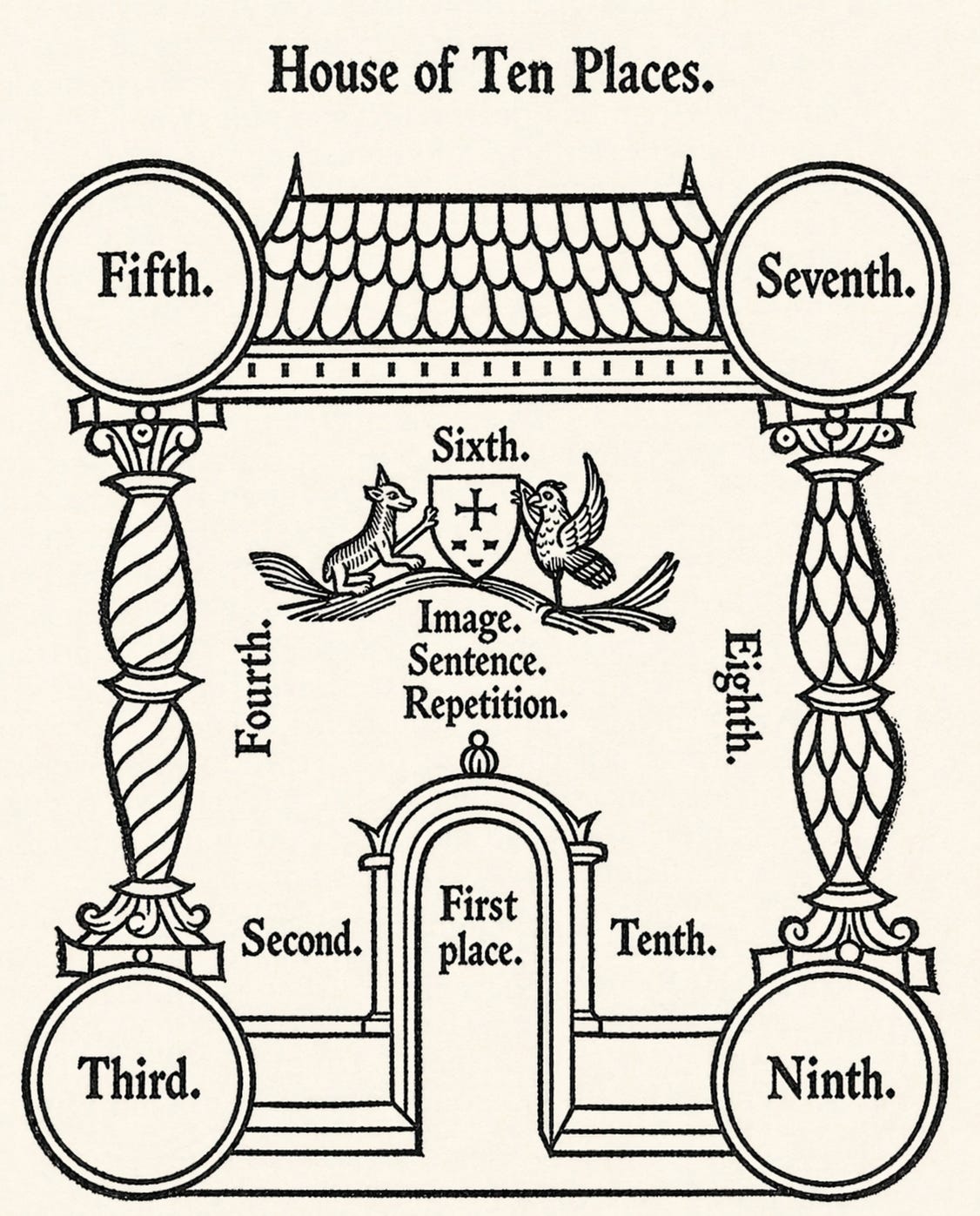
The second book deals with the role of places in the art of memory. There are a couple of fantastic diagrams in here, including one of how Lelievre divides a room, which I’ve shared below:
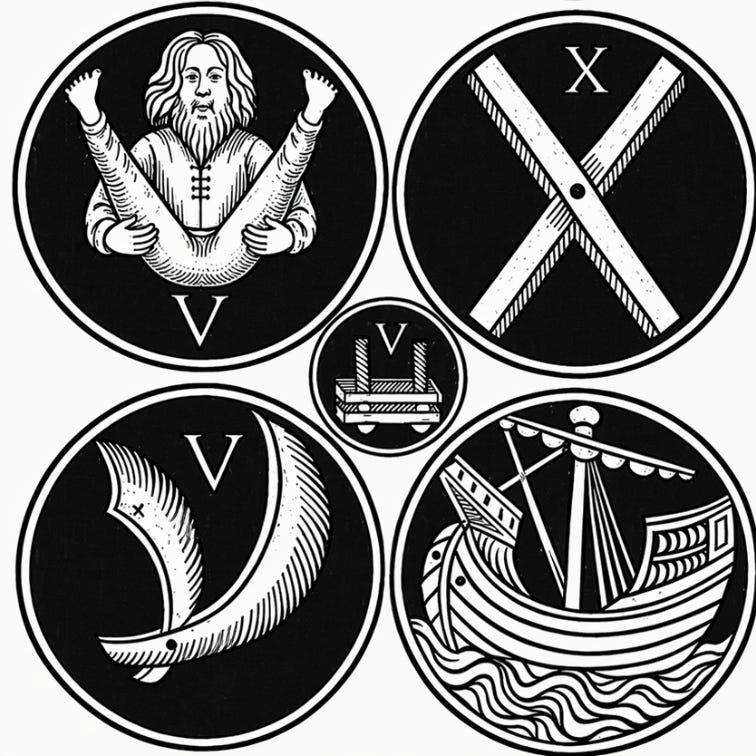
The third book deals with images in the art of memory. In it, Lelievre shares an image peg alphabet that’s credited to Jacobus Publicius. One of the illustrations featured a bearded naked man showing off his family jewels, so I gave him some pants.
The fourth book is nominally about the things that harm memory, but it’s really a journey through medieval ethics.
It offers his advice on sex, booze, and sleeping, and their impacts on memory.
Lelievre’s Art of Memory is a product of its era, and it features a variety of offensive passages. However, as politically incorrect as some of the things he writes are, he always wraps up his ideas in colorful anecdotes and quotes.
It’s a treasure trove of whimsical weirdness. You’ll find stories about how Albanians can see in the dark, or how some people in India are covered in feathers and sustain themselves by sniffing flowers instead of eating. If you’re going to be wrong, you might as well be so incomprehensibly wrong that it’s fascinating. Lelievre read his Pliny, and it makes this book a fun ride.
It’s also a work that was written by a lawyer, though, so a lot of his advice is geared towards helping jurists use the art of memory.
It’s not the easiest read because he frequently cites archaic laws in his work, but it’s worth powering through. There’s always some delightful idea or bizarre aside waiting in the works for you to find.
A Short Report Showing How One May Strengthen The Memory Wondrously So That Anyone May Become Learned In A Short Time by Laurentius Fries
I translated A Short Report after reading the Westminster essay on Memory, which you can find in the Reprints section of this newsletter.
A Short Report was printed in 1523. It’s a twenty page booklet that’s divided in two sections. Fries was a physician, and the first half of his text features the kind of medical magic that was common in that era. Magic is the right word, too: he suggests using astrology to determine the best time to drink your memory potions. I hope you’ve got an ephemeris handy.
His medical advice might be… dated, but his mnemonic ideas are worth checking out. The second half of the book features a simple technique that combines the method of loci with the syllable method used by Conrad Celtus.
I’m still not sure who was the first to invent the syllable method, but Conrad was my initial exposure to it.
It’s a powerful technique for creating pegs using syllables. Each consonant has five vowel pairs, in addition to the first set of pegs which use only the five vowels.
The method taught by Laurentius involves assigning consonant-vowel pairs to digits that are then assigned to locations. This is an English version of the chart he shares in his book:
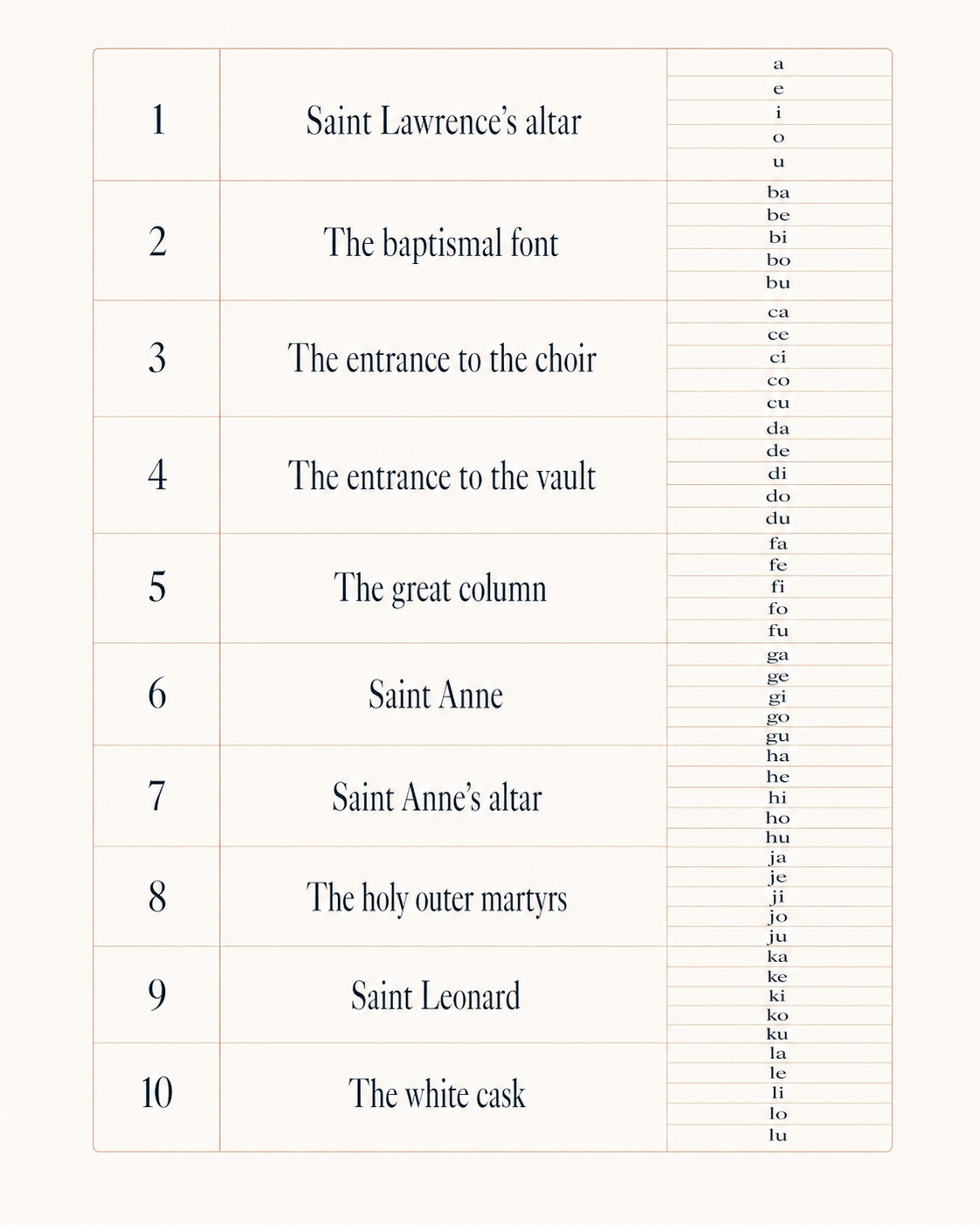
Using the above chart, you would create five seats around Saint Lawrence’s altar, and each seat would then be filled with a peg built using the appropriate syllable. The first seat could be someone named Adam ,the second Eve, the third Isabelle, the fourth Oliver, and the fifth Uma.
The baptismal font, meanwhile, would get five different pegs, so maybe Baby, Beaver, Bike, Book, and Bug.
You want to associate your pegs with what you’re trying to remember, so it helps if the words you come up with directly evoke the thing you want to commit to memory.
The fun thing about the syllable method is just how versatile it is. You can combine it with a variety of other techniques. Celtus combines the syllable method with the alphabet. Fries combines it with the method of loci.
I like the syllable method much more than the major system, which I now only use for remembering numbers.
This is a great little book worth reading for Fries’s take on the syllable method, though you can safely skip the section on potions and astrology.
The Art of Memory, Or Rather of Recollection, Second Part by John Herd
A simple how-to guide written in a question and answer format. I enjoyed the way Herd wrote this book, and I think it’s an underused framing device.
This is a beginner’s guide to mnemonics, so it covers the usual advice on the proper way of creating images and managing places. I do like his 5-part framework for placing memories in palaces via similarity, comparison, figment, inscription, and colligation.
The second half of the book is full of weird wizard potions, so you can skip that unless you’re interested in medieval medicine.
Polymemnones, Second Continuation by Michael Richey
Polymemnones is a fantastic book of short biographies written in 1710. It consists of four parts, and unfortunately only the last two have been digitized.
Polymemnone is the author’s term for people who have amazing memories. It’s the mnemonic equivalent of a polymath. There’s around 40 people listed in the second continuation, and some of the names will be familiar to many of you: Emperor Hadrian, Emperor Julian, and Louis XIII were all practitioners of the mnemonic arts.
The biographies offered up by Michael Richey often include details of the incredible feats accomplished by these polymemnones, which offers us examples of what a cultivated memory can accomplish. Books like this are a great inspiration for new students of the art.
The Polyhistor: Preface, by Daniel Georg Morhof
The Polyhistor is a long book, so I’ll be releasing it in chunks over the next few weeks. A polyhistor is basically someone who mastered the republic of letters: they’ve sketched out a map of human knowledge by wandering through the ruins of the past.
Morhof’s book is a practical guide on becoming a master scholar. It’s never been translated before because it’s a dense work with references to thousands of authors. The preface alone is just one long list of books to read: most of which haven’t been translated yet.
The preface should give you a small taste of just how vast the untranslated treasury of Latin works actually is. Countless books have fallen into obscurity because they’ve never been translated.
The preface of the Polyhistor won’t be of much interest to people who aren’t researchers. The actual meat of the book will have much broader appeal. If you’re interested in classical education, it’ll be an excellent addition to your reading list.
Reprints
Memory and Absence of Mind, All The Year Round
Charles Dicken used to edit the magazine All The Year Round, and Memory and Absence of Mind was an article that he published in it back in 1871.
It offers us a very brief description of 12 people with powerful memories, and then dives into examples of people with various memory problems. The biographies of the people in this article aren’t as in-depth as those in Polymemnones, but it does offer us more examples of powerful (and not so powerful) memories. This is an easy breezy read.
Memory, Addressed to Students, Southern Literary Messenger
This address was given to the students of North Carolina University in antebellum America, and then published by the Southern Literary Messenger in 1838.
It’s a well written tribute to the power of memory.
There’s an argument in the address that I never encountered before which I think deserves a greater hearing: people are very sensitive when it comes to intelligence, which is hard to train, but they’re also very glib about memory, which is easy to train.
There seems also to be less disparity in the susceptibility or capability of memory, in different individuals, than in any other mental function; this appears probable from its very great degree of teachableness, its quality of receiving mechanical or arbitrary helps, which indicate that it is less dependent on original constitution for excellence, than its sister functions of mind.
Nearly everyone can develop a powerful memory. It’s easy to teach, but we don’t even bother trying.
Memory is a low hanging fruit that’s been left out to rot.
Memory, Westminster Review
This essay has some serious flaws.
The first half of the piece, which deals with the “science” of memory, is a perfect example of why I considerer the years between 1850-1970 to be a kind of mnemonic dark ages.
In the opening pages of the essay, we get to “learn” about the role of race in memory and the value of phrenology.
It’s ironic that many of the people who pushed to make mnemonics a science were often in thrall to some of the most unscientific doctrines to have ever polluted society.
The author also argues that Laurence Fries was a pioneer of neuroscience because Fries mentioned the brain’s role in memory in his 1523 tract on artificial memory.
If you read the book, you’ll notice that Fries was just repeating the received doctrine common to physicians of his time. His views on the brain weren’t cutting age, but the product of a long tradition that dated back to Posidonius of Byzantium and Nemesius of Emesa, who both noted the brain’s role in memory in the 5th century.
Westminster Review was not a low brow publication. It was founded by Jeremy Bentham and featured writing by respectable scholars and intellectuals. I call the 1850-1970s a mnemonic dark ages because a great deal of knowledge from the pre-modern era was lost to the intelligentsia when Aristotle and the scholastics were shown the door.
The second half of the essay is much easier to recommend. It’s a defence of Edward Pick, whose mnemonic system was plagiarized by the montebank Marcus Dwight Larrowe, who made some serious loot before his antics were discovered.
Larrowe apparently repackaged Pick’s system and tried to pass it off as his own invention by branding it as the Loisette Method. The Loisette affair is one of the bigger scandals in mnemonic history. It’s not quite up there with Peter Ramus ejecting the art of memory from the five canons of rhetoric, but it’s still a black eye for the art.
The first half of this piece is radioactive, but the section on the Loisette affair will have value for those who are interested in the history of the art.

Thanks for reading this week’s edition of the Memory Digest. I publish this digest once a week every Thursday. If you liked you read and you want to read more, please share this and let others know about it.
"If you’re going to be wrong, you might as well be so incomprehensibly wrong that it’s fascinating" 🤭...