
On Strengthening Memory in Minds of Every Kind by John Michael Albert
Table of Contents
Elder’s Notes
De omnibus ingeniis augendae memoriae is a mnemonic treatise written by Johannes Michael Albertus that was published in 1491.
The first chapter deals with training your memory. There are some very good bits in this section. I enjoyed the precept on finding time to read where the author brings up how Julius Caesar always managed to get some reading in even while he was busy fighting the Mutinan War.
I’ll be throwing that fact in the face of anyone who ever says they don’t have the time to read.
The author teaches a simple beastiary technique which involves assigning an animal to each letter of the alphabet, and then dividing that animal into five parts.
There’s a lot of fun stuff in Chapter 1 that make it worth reading.
Chapter Two, though is harder to recommend.
It offers a Renaissance take on the afflictions of memory and their remedies. It’s interesting as a historical curiosity, and students of medical history might enjoy it, but I would not take any of it’s advice seriously. I certainly wouldn’t concoct any of the ointments, tonics, or nostrums it offers without first talking to a modern doctor.
Give the first chapter a look, but you can skip the second one.
Key Ideas
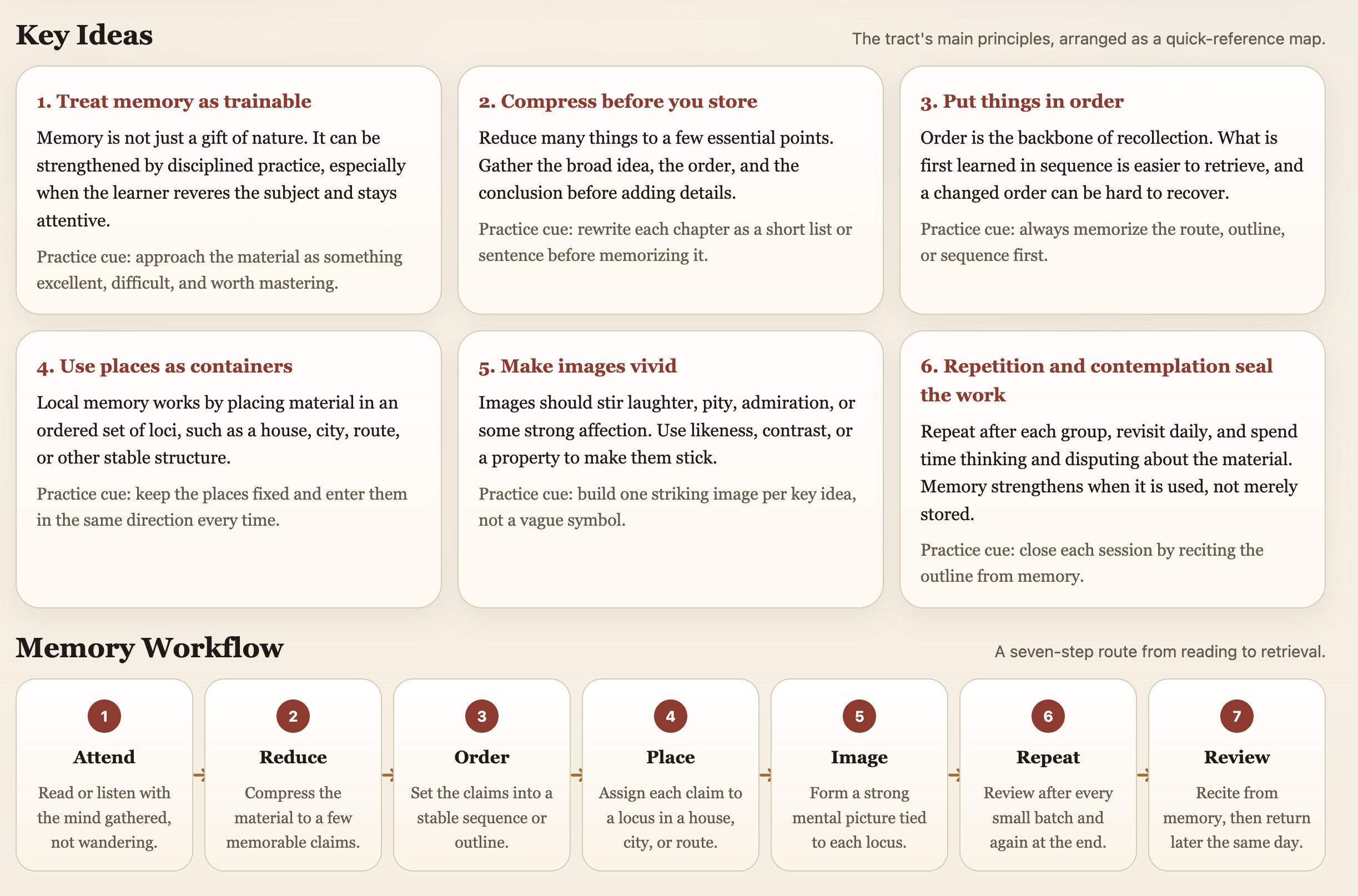
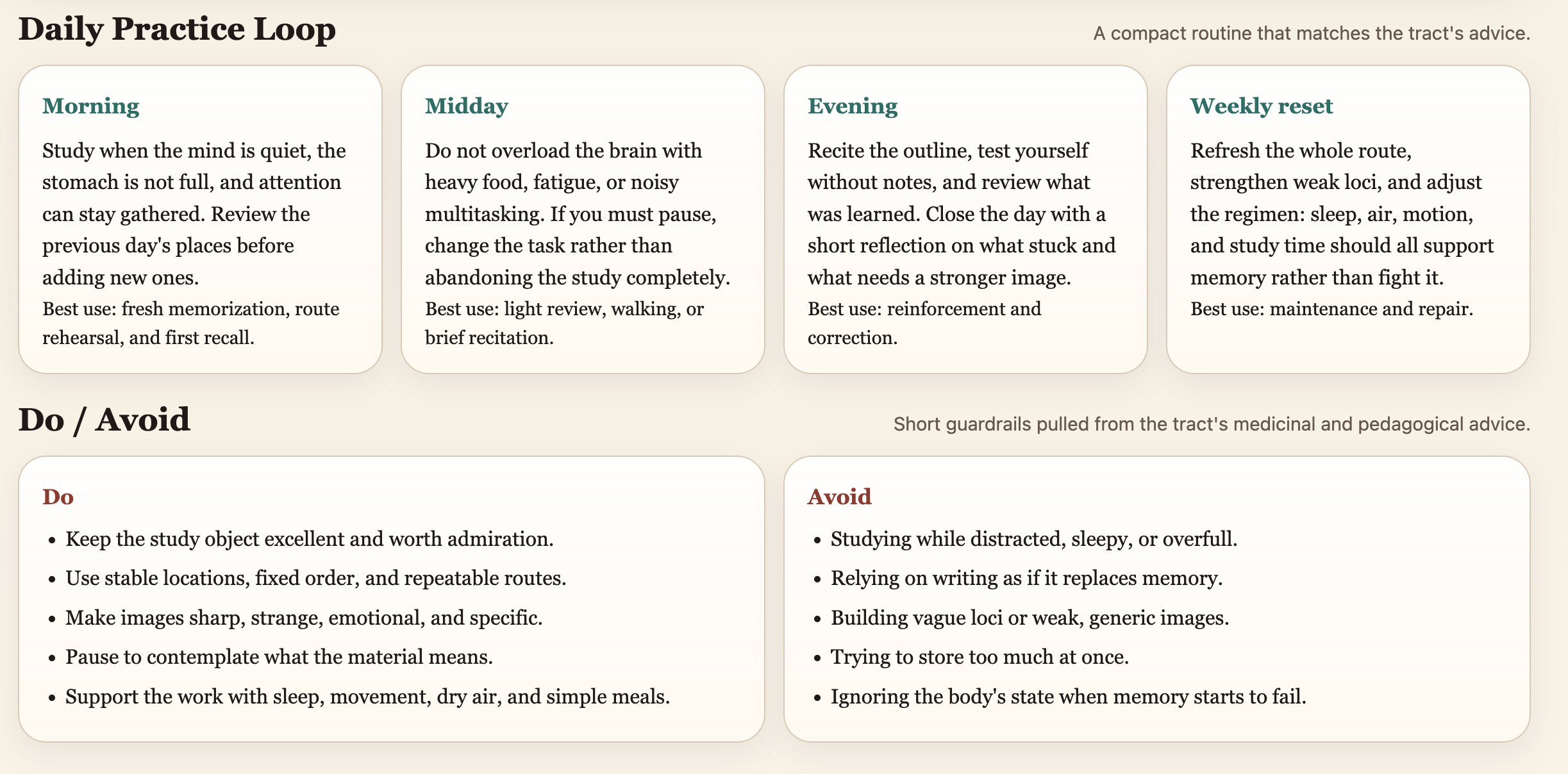
Dedication
Johannes Michael Albertus of Carrara, On Strengthening Memory in Minds of Every Kind: a little book addressed to the most distinguished Aloysius Manens, secretary of the illustrious Senate of Venice, happily begins.
Whatever I owe you, most illustrious Aloysius, please regard kindly. These little gifts of ours will certainly be of no great weight; for to one to whom I owe everything, no payment worthy of the debt can be returned. But if you look at what sort of things they are, if you are willing to consider by whom they are given, you will judge this undertaking not unworthy of your patronage. For I have written a brief little treatise on nourishing the memory, containing, unless I am mistaken, necessary matters; and I have written down the principal aids which other authors have not wished to spread abroad.
This I send to you, though memory, reason, and uprightness are already abundantly present in you. Yet by your favor I publish these things for others. And because you handle the secrets of the Venetian Senate, this book need not therefore be kept secret; rather, it should first be corrected, then afterward circulated to others. Farewell, and remember your Michael of Carrara, you who are accustomed to remember everyone.
Chapter One
The Single Book on Memory
Memory, among the divine endowments of human nature, has claimed the first place for itself, as my Seneca bears witness. For to read much is easy for students; to understand much is not difficult for a good and well-trained intellect. But to gather those things and preserve them in the cabinet of memory so that they do not flow away is necessary, and it is the chief good of human life, as Pliny testifies in book 7, chapter 24.
For who would not admire what Cicero says in the second book of the Rhetoric to Herennius, book 4: to reproduce in the very order what we have read or heard, so that it makes almost no difference whether we begin from the middle, from the end, or from the beginning?
Or who would not admire Carneades, who is said to have recited books from memory in the manner of one reading them? And, lest we envy our own age this gift, Francesco Foscari, the famous Doge of Venice, had so great a memory that whenever the occasion arose he could recall whatever he had done and said throughout the whole time of his reign, and also the names of the people and the times at which those things were done, without any confusion.
Likewise, that most distinguished senator Domenico Giorgio joined a remarkably tenacious memory with very rich wisdom. For in arguing cases he was accustomed to hear many opponents and answer them while preserving the very order of the matters at hand.
Cyrus used to call all his soldiers by name.
Mithridates, king of twenty-two peoples, both listened to them and addressed them in the same number of languages, without an interpreter.
Let us therefore compare Cyrus with Francesco, and Mithridates with Domenico, and we shall find that our own age does have grounds for pride and is not at all inferior to antiquity. Therefore those who do not have such an excellent memory must work in order to acquire it, for without it hardly anyone rises into an excellent man. For it usually happens that the more someone excels in memory, the more he shines also in wisdom, unless he is sleepy and idle. It was not without reason, then, that the poets made Wisdom the daughter of Memory. And Lucius Afranius wrote quite rightly about producing and acquiring wisdom in these verses: “Use begot me; Memory, my mother, bore me. The Greeks call me Sophia; you call me Wisdom.”
Therefore, in this part of our work, let us discuss by what means memory can be acquired and increased. It is agreed that Cicero held memory to contain something artificial, and not to be wholly born from nature. So first we too shall speak of artificial memory, which consists of places and images; afterward we shall teach by what medicinal treatment it can be acquired and made firm. We shall present points that are brief, but clear and thoroughly tested.
Simonides of Ceos is said to have been the first of all to invent local memory. Metrodorus, however, is said to have cultivated it much more carefully after it had been discovered. Now, as Aristotle holds, there are two acts of remembering: memory and reminiscence. Reminiscence regards the things we have forgotten, and it is the office of the estimative power, not principally of the memorative power, as Averroes and Albertus wished in their treatises. This occurs in human beings alone when the object itself is not present. But with the presence of the object it is also found in brute animals, as Aristotle says, and as is sufficiently clear in the hunting dog.
Memory is the retention of images previously perceived by the soul.
Yet it is not useful unless it both retains all of them and gives them back in the order in which it conceived them. This is not a faculty of present or future things, but, as Aristotle says, of things past. Therefore, if we examine more inwardly the opinions of the philosophers, four movements come together for the act of remembering.
The first is the motion of the spirits by which the cogitative power carries forms over to the memorative power.
The second is the painting and fixing of the forms in the memorative power itself.
The third is the bringing-back of those forms by the spirits from the memorative power to the cogitative power.
The fourth is that action by which the cogitative power recognizes them; and this is properly called remembering. If any one of these four things is deficient, remembering must also be deficient.
For this reason Isaac, son of Solomon, defined memory well: it is the apprehension in the soul of things existing there, together with investigation and inquiry. But we shall treat it more fully here when mention is made of medicinal aids.
Twenty Precepts for Learning
For now, as we first set out the art of memory, we shall prescribe what a person who wishes to remember ought to provide from himself. There are twenty precepts.
Precept I
The first is this: whatever studies we intend to pursue, we should judge them to be most excellent and most beautiful, and we should count ourselves fortunate if we have fully attained that discipline.
Nor should we listen to every teacher, but only to an excellent one, such as we are compelled not merely to praise but even to admire. In this matter the plan of Philip of Macedon showed the deepest wisdom: he wanted Alexander to be taught even the first rudiments of letters by Aristotle. For it usually happens that when a student reveres his teacher as the father, so to speak, of his spirit and intellect, then, while he admires the teacher’s weighty sentences, there is aroused in his mind an appetite and thirst for learning, which is commonly called noble envy; and this contributes very greatly to bringing the matter to completion.
Cicero therefore wrote rightly in the second book of the Rhetoric to Herennius that the things we take up in boyhood are rightly remembered, because the mind is moved only by what is new and admirable. The Commentator expressed this in these words: a person often remembers what he did in childhood with good recollection, because that age greatly loves forms and figures and takes much delight in them; therefore they are fixed firmly in it and are difficult to release.
For this reason Aristotle, the best guide of all the wise, at the beginning of his discourse called the science of the soul a good and honorable thing, so that he might stir up the intellect, since good things are customarily desired above all. Therefore parents should beware of handing their sons over to those studies which they know are displeasing to them.
Precept II
The second precept is that they should consider the science difficult and well known to only a very few. But where there are ambiguous opinions, which very few people know how to disentangle, the mind must rise up, and it will be necessary that the mind may penetrate into them. This raising-up of the spirit is very useful for memory.
Precept III
The third precept is this: whether one is listening or reading, one should do it all with such attention, and gather all the powers of the mind together, that one does not allow them to wander in every direction. For the things we have learned more attentively do not easily slip away. This is what Aristotle means when he says that things once heard attentively remain longer in memory than things heard many times carelessly. Therefore Plato rightly wrote at the beginning of the Timaeus that a good listener should make his mind and ears ready in silence. For, as your Cicero bears witness, that person is a teachable listener who is prepared to listen attentively, since it is fitting that the acts of active things should be in a disposed patient. Attention disposes the mind well toward teaching.
Nor can anything be preserved unless it has first been understood. For it was wisely said by Gorgias, and repeated still more wisely by my Terence1: “Where you direct your mind, it has strength.”
Precept IV
The fourth precept is this: the many things we intend to gather should be reduced, as far as possible, to fewness and brevity. For, as is clear, if we have universal propositions of the Topics in memory, it will be easy to form arguments from them for particular matters. Hugo said in the Didascalicon that the person learning proceeds in one way, and the person remembering in another. For the one who learns cuts the genus into species, and those again into others, down to the most specific things. But the one remembering ought to gather the multitude into one, or at least into a few. Every speech has a basis on which it is founded; it is fitting to mark that, and also the conclusion which it has drawn from that basis. Then anyone will easily call to memory the manner of the deduction, if he holds the basis itself and the conclusion. For Galen too says in the first book of the Tegni, chapter one: “All memorable things are easy from the resolution of the terms.”
Precept V
The fifth precept is this: before all else, let one love the order of things. For example, if we are going to gather the third canon, we should know that there are twenty-two sentences and that their order is taken from the very body of man. We shall take the first sentence, cut into treatises; then we shall cut each treatise in turn into chapters, and each chapter into conclusions. Thus we shall construct their order, and the very order of the teaching will give the order, because one thing is ordered before another.
Precept VI
The sixth precept is what has been handed down by Cicero and Marcus Fabius Quintilian: each thing should be repeated often. To stay with the previous example, when after the first chapter we have learned the second, we should repeat the first and second in the mind; when we have learned the third, we shall likewise repeat the first and the second together with the third, and so on thereafter, until we hold the whole treatise.
Precept VII
The seventh precept is this: when we want to embrace many things, we should divide them member by member. For Marcianus says in his Rhetoric that this ought to be done so that a confused multitude does not blunt the memory.
Precept VIII
The eighth precept is what Boethius2 taught in his On Scholastic Discipline: there should be frequent and long-lasting thought and disputation about the same matter. For if in disputing you either catch your opponent or are caught by him, so that you either gain praise or suffer reproach, that very thing will at last be inscribed so deeply in the mind that you could not erase it even if you wished. Things learned especially with disgrace and shame are more fixed; and for this reason the mind is most tenacious of injuries. Great, then, was the praise of Caesar, who forgot nothing except injuries.
It will therefore be useful to spend time with people of similar studies and to dispute with them continually about those studies. For memory loses nothing except that to which it has not often looked back, as Seneca says in the fourth book On Benefits. And Hugo writes that the beginning in reading is consideration, and the confirmation is in meditation. Aristotle also says that meditations preserve memory. To meditate is to contemplate something many times, not as it is in itself, but as the image of something. And in Ptolemy, at the beginning of the Almagest, meditation on truth is called the key.
Precept IX
The ninth precept is what Blessed Thomas commands in the letter to the student brother: that we should not fly about through the things we do not understand, but first understand them, and then run on to what follows. Nor should our concern be to read many things, but to understand many things.
Precept X
The tenth precept is what Quintilian wrote on Plato’s authority in book 11 of the Education of the Orator: that letters should not hinder memory, and that we should not set aside what is written as if it had been placed under guard, nor let it slip away because writing has made us feel secure.
Precept XI
The eleventh precept, likewise from Quintilian, is this: that a good digestion of foods should be procured, so that we avoid the things which harm memory and use the things which help it. We shall treat these, as far as is enough, in their proper place.
Precept XII
The twelfth precept is that we should free the mind from other thoughts as much as possible. Religious people are especially accustomed to remember well, as Gordon thought, because, placed in solitude, the mind is less distracted by various thoughts.
Precept XIII
The thirteenth precept is that, if it can be done, we should not only hear the things that must be held in memory, but also see them. For Aristotle says that those who see something once remember it more than those who hear the same thing many times. For this reason my father Guido used to advise that the simples which we learned by reading should also, if it were possible, be looked at with the eyes. For in this way it usually happens that they do not easily flow away.
Precept XIV
The fourteenth precept is this: when asked about individual things, we should not answer at once and without meditation, but should first search through the little chest of our memory for what should be answered and how it should be answered. For John Damascene, in the second part, fourth aphorism, says: “If, when questioned, you always answer quickly, you are to be doubted.” In his commentary on this Remigius says that a sudden response must be inconsiderate. But no one can be excellent apart from consideration.
Precept XV
The fifteenth precept is this: since, as Quintilian bears witness in book 1, a difference in talents cannot be denied, and no one doubts that one person can do more than another, each person should measure his own powers. As the apostle Paul says, let him test himself, and let him impose on his memory only as much as it can take in and hold. Just as it is useless to load the stomach beyond its powers, and it is fitting to receive only as much as it can digest, so the body of the glutton does not grow fat, because what is eaten does not nourish unless it is digested. In the same way, what is learned does little good unless it is retained. For from the things we have done or seen, we seem to know only what we know from memory.
That verse of Horace could be brought forward: “You who write, take up a subject equal to your strength; consider long what your shoulders refuse to bear and what they can bear.” But if one must err in either direction, with me as adviser it is safer to take in too little than too much. Or, to stay with the comparison of the stomach, if someone cannot retain as much as he ought, let him multiply the number of times and diminish the continuous quantity.
Precept XVI
The sixteenth precept is this: fixed hours should be appointed for study. Especially those hours should be chosen when the stomach is empty, the intellect is not darkened by vapors, and all things keep silence. Therefore let the quiet of evening and the crowing of the morning rooster be chosen, and let us take care that the movement of fortune does not break our plan of times, so that we fail to complete the hours of study we have decided upon. For if Caesar Augustus, in the Mutinan war, was accustomed to read and write every day; if Julius Caesar wrote by night, in stolen hours of lamplight, the things he had done by day when he had pacified the world, and especially with such coherence that he is wonderfully praised by Quintilian in book 10, chapter 1, then what, I ask, what could happen amid the leisure of the city that should draw us away from the study of letters?
Precept XVII
The seventeenth precept is this: let each person review his daily gains, and let him think every day what new thing he has learned, and what he has gained. For this will be of great use for making progress. The wise Cato the Censor used to recall in the evening whatever he had done, read, and said during the day. Socrates too judged that he had lost that time in which he thought he had been of no use to himself or to others. Therefore let us also review our daily labors, so that at last we may be able to be useful to ourselves and to posterity.
Precept XVIII
The eighteenth precept is this: let us begin to exercise memory while still very young. For memory is like a sword: unless it is exercised, it is consumed by rust. This, then, will be the diligence of parents and teachers: that the first age should be exercised. For whatever a new jar has been filled with, it will preserve the scent for a long time. And, as we said above about food, so for children it will be enough to have learned a few things, little by little; then as they grow older, let the amount of learning be increased. Yet, as Quintilian thought, they should not be compelled by whips or blows, but rewards and praises should be set before them according to their merits, and corrections should be brought in at the proper time.
Precept XIX
The nineteenth precept is this: if the mind must be relaxed so that afterward it may rise up more whole and stronger, it should not busy itself with obscene things; rather, this should be done by changing the study. For it is better to relax the mind than to lose it, as Ausonius writes. Therefore one should pass either to other literary studies or to musical exercises, which, as Aemilius Probus bears witness, were held in great honor among the Greeks and are not to be despised among us either.
But there are some who prefer to play games. I could allow this too, if the game is honorable, if it is without fraud, without oath-swearing, and brief; if the prizes proposed are either none or very small, suited more to a token stake than to making anyone rich; and if dice are not involved, nor any other game of this sort, in which the law of fortune has more power than ingenuity. For games too exercise memory.
Scaevola once played the game of the twelve lines, and, after he had made the first move with a piece, he was defeated; while going into the countryside, after recalling the order of the whole contest, he remembered at what point he had made a mistake. He returned to the man with whom he had played, and that man confessed that it had happened just so. Let our young men sometimes do the same. But let that exercise be neither long-lasting nor frequent, nor at the hour that should be given to studies; and when the mind has soon been strengthened, let them fly back to their studies.
Precept XX
The twentieth precept is this: they should not be drawn away from their teachers before they have been taught. Jerome says that he believes many could have turned out to be famous men, had they not been ashamed to be pupils before they began to be wise. Therefore we shall listen to our teacher as long as we understand that we are making progress under that teacher. Thus we shall revere him as the father of our intellect; we shall cling to his side, as Cicero too says, as far as it can be done and is permitted; we shall never leave his side, for by his presence we become more learned, and no stick should be so hard as to drive us away from him. It will nevertheless be useful in turn to teach others what we have learned; it will also be useful to dictate to explain, to question, and to answer. It will not be useless to raise doubts about individual things, provided this is not done without reason; and to desire that each day we hammer out something that is our very own. Nor should that saying of Pliny in his letters escape us: that all our other possessions will have one patron after another, but only these things will remain ours.
And, provided he does not do it harshly, let a friend grow accustomed to correcting us in turn. But in correction a measure must be kept, so that there is no disgrace from rebuke or correction, but correction should be milder, more honorable, and clearer, as far as it can be. Let him understand that you are led by great affection for him when you correct his errors.
These, unless I am mistaken, are the precepts for learning. If they are observed diligently, they will be able to help very many young people, and harm none.
Artificial Memory
Now let us treat artificial memory. We shall do this after first writing down the canons of reminiscence collected from Aristotle. They are five.
Five Canons of Reminiscence
Canon I
The first is order, and the sequence of things to be remembered.
When we have learned something in order, with connection and dependence, if we have forgotten one of the items, we will easily be able to remember it again by repeating the order. For when the antecedent is known, we shall easily know the consequent also, and we shall find what depends upon it. Therefore the Philosopher rightly says: things well ordered with one another are easily remembered; things badly ordered are remembered with difficulty. For in whatever order a thing was first apprehended and considered by the soul, in that order the motions have themselves. This is the impression made by the soul. But the order and sequence of the motions is the cause of remembering: from the first motion we remember the second.
This is clear in children first learning the alphabet: sometimes they know how to repeat it in the order of the letters, but when the order is changed they do not know it. Therefore we are accustomed to instruct them to repeat the beginnings, and from there to descend.
Canon II
The second canon is that from one similar thing we are led to its similar. For instance, if we forget Herodotus, when we recall Titus Livy, the father of Latin history, we shall be led to Herodotus, the father of Greek history.
Canon III
The third is that we think over contraries. For through contraries we are taught in the Topics to remember the things we have forgotten: thus, remembering Hector, we recall Achilles.
Canon IV
The fourth is that we are apt to remember the place where the matter was handled. In this way it happens that we remember the persons also, and the reason why we did the things. Thus, when blessed Augustine wished to think over his sins, he began to review these things. For place, according to Aristotle, is a chief aid in remembering.
Canon V
The fifth is that a thing should be sought again by means of a property. For example, if we want to keep “arrows” in memory, we should think of Dionysius of Syracuse, who, as Justin is the authority, lived by arrows and was ruined by arrows. If we want to recall a horse, we should think of its neighing, or of a headache with which it is often afflicted because of drunkenness, or of some similar thing, from which recollection will easily arise. But since our discussion will turn to images, we shall bring forward more points that pertain to this matter.
Now let us begin on memory.
Places
Artificial memory, as Cicero says in the second book of the Rhetoric For Herennius, consists of places as if of wax or tablets, and of images as if of the forms of letters. In this way it can happen that we give back what we have received as if reading it, and it makes little difference whether we begin from the top or from the bottom. The places themselves must be ordered. For if there is confusion in them, everything must be confused. It is also fitting that they be many, so that many things can be placed by the same exercise.
Cicero judged a hundred places to be enough. Blessed Thomas advised that more should be had. Many people have sought these places by various arts. Metrodorus, in the twelve signs through which the sun passes, found three hundred and sixty places, because that oblique circle is customarily divided by astrologers into that many degrees. But on Quintilian’s authority, these are the vanities and boasting of that philosopher, glorying in his memory by art rather than by nature.
Marcus Cicero imagined a familiar house, divided into many distinct places. It pleased that illustrious man that between each group of five places we should imagine a golden hand or some other sign of distinction, by which one would be separated from another; and that an unchanging order should be kept in them, so that we always enter and leave on the right. For the images can be imagined, and it is not very difficult for them to be fixed in their own places.
My father Guido took his places from animals, and derived their order from the Latin alphabet, so that each letter began the name of one animal, as if the following were signs: ass, basilisk, dog, dragon, elephant, faun, griffin, he-goat, heifer, lion, mule, owl, sheep, panther, quail, rhinoceros, monkey, badger, tiger, bear, Xystus, philosopher, hyena, Zacchaeus.
He divided each one of these into five places: head, front feet, belly, hind feet, and tail. Nature itself has supplied this order, and the mind cannot be confused in numbering them. Thus, having obtained one hundred and fifteen places, he carved in them the images of things to be remembered.
He also taught that many things should be written by the mind on the face of a speaker: in the hair, on the forehead, in the eyes, and so on, descending separately to the feet. But to me it seems very easy to imagine not only a hundred but almost infinite places, if one is acquainted with the layout of some city.
Therefore when the mind enters through the gate and, dividing itself into different regions, considers the streets, then recalls the houses of friends, the churches of the gods, and the public courts, it will obtain a marvelous quantity of places. To this will be added the power of imagining halls in which it will make as great a number of places as it likes, so that whatever one wishes may be inscribed in them. Let this be enough, then, about places.
Images
Now let us discuss images. Their exercise too is completed by seven precepts.
Precept I
The first is this: an image should stir laughter, pity, or admiration. For this even makes girls remember, as Avicenna says in the sixth book of the Naturals, fourth part. An image sought for is easily found when it has moved an affection of the soul. Here is an example. In the mouth of a rabid ass, let me set the head of Antonius; let his bones be almost shattered by its bites; let blood flow; let him seek help and cry out with outstretched hands. It will not be possible, when I wish, for me not to see this Antonius with the eyes of my mind, and to return Antonius to someone who is repeating it.
Precept II
The second precept is that we should form an image either by like from like, or by a contrary, or by a property. An example of the first is this: if I am going to place the name of Avicenna, I write down the name of some famous physician whose authority is equal or only a little weaker. An example of the second is this: if I write down the same name by the name of an ignorant physician, with mockery; or if I mark Thersites for Achilles, the good by the bad, the ugly by the beautiful. An example of the third is this: if I carve Ovid by means of a large nose, Plato by the breadth of his shoulders, Crispus by curled hair, and Cicero by the chickpea of his name. Indeed the very origin of a name, and its very declension, can help one retain something.
Precept III
The third precept is that from our tender years we should become accustomed to placing things, and grow by daily exercise. Although this teaching is also useful to adults, habit will become more effective if whatever they are about to dictate or do, they place in this way, and whatever they hear even in conversation, they paint in this way, carving down manners, gestures, and times. For I know that in a short time they will become most thoroughly exercised. It is also useful for one person to play against another, with the victory going to the one who has reported more things more clearly, more orderly, and more quickly.
Precept IV
The fourth precept is that, after every group of five things marked down, we should repeat from the beginning all the things that have been marked down. For repetition is accustomed to confer very much upon memory.
Precept V
The fifth precept is this: things that are not simple should be set down by likenesses of their components. For example, someone who wishes to remember this statement, “Cicero disputed with Hortensius,” should imagine a chickpea complaining in a garden about the garden’s barrenness. Thus the chickpea represents Cicero, the garden represents Hortensius, and the complaint represents the disputation. In this way the headings of laws too are commonly preserved. For example, if the second law is this, “the trustworthiness of a published testament once made,” we shall imagine a testamentary document lying open, into which someone has thrown a chickpea so that its trustworthiness might be abolished. See: “the trustworthiness of a published testament once made” can be read again.
But these things will be done more easily if doctrine is present, and a full knowledge of the things to be remembered, and if habitual and long-established exercise is not lacking. For a physician will more easily remember medical matters, and a jurist plebiscites.
Precept VI
The sixth precept is that, when we are going to reproduce syllogisms, we should especially grasp the middle term. Once that is known, the mood and figure of the syllogism will bring in the very order of the proper words. Nothing is easier to grasp or hold; because while an opponent states the proposition, assumption, and conclusion, and while he approves them, he will give a longer space for forming an image of the middle term. Once that is noted, if you are not ignorant of the subject matter, if you have understood where they are being carried, and if you know the logical canons, you can in no way go wrong in reproducing it.
Precept VII
The seventh precept is that when we are going to preserve unknown and barbarous names, we should write them down either by something similar or by the syllables themselves.
This will be made clearer by an example. If this expression, “Cimergot aender,” must be preserved, one should first consider whether these terms signify anything in a language known to us; if they do, they will be written more easily. For people say that “Cimergot” among the Germans means “God.” If this is not so, we shall imagine it by another device. In the vernacular, the tops of trees are called “cime”; among the illustrious Venetians “got” represents a cup. Imagine, then, one treetop being plunged into a cup, and the cup being dashed against waves and floating. And lest the final ending be lost, we shall hear both the letter and the clash of the waves. Thus it is very easy to read back “Cimergot aender.”
These are indeed not useless aids for remembering. But I, for my part, truly have some doubt about what Quintilian also wrote: that all these aids preserve only this very thing, namely, if names must be returned in the same order in which they have been received. Simonides did this at banquets whose falling hall had crushed the guests.
These aids also help in reproducing syllogisms; for we too have done this and have seen others doing it. But these things will be less able to help in learning by heart those things that belong to continuous speech. For the sense does not have the same image that the thing itself has, and the order of words can scarcely be preserved; moreover, who could have so many places and so many images? I do not say “have”; he could not even hope to have them, if he trusts himself to mark and reproduce the five books of the second action Against Verres.
The illustrious orator Domenico Giorgio indeed affirms that proper images can be had for individual things: for conjunctive, conditional, rational, and the other particles of speech, proper characters may be assigned; and he most confidently affirms that accents too can be marked.
I would not deny that this is possible. In Avicenna, possibility is a very broad thing. And he himself, perhaps, I mean Domenico, an outstanding orator, does this: he is accustomed to give back what he has read and heard in the very order of the syllables. Certainly I have not yet attained this by exercise, and I now strongly suspect that few men can rise to that height, even if they strive with all their powers.
Others have judged that speech should be divided into little parts, and that these should afterward be fixed in advance. But either every single word must be placed, or one must go wrong in reproducing their order. Therefore, if my judgment is sound, another method of remembering must be devised, one by which we can help more people. For your sake I will write it down and teach publicly what the ancient philosophers preferred to conceal. We shall do this openly, by writing down remedies; and yet we shall not deny that the things written up to this point contribute very much to memory. Some people are accustomed, by these arts, to dictate to many secretaries at once, to mark in what clause they stop when they go on to another, so that they may know how to return and follow on without hesitation.
Julius Caesar was in this kind of display: he used to dictate and listen to letters concerning matters of such weight; he would dictate four letters at once to scribes, and if he himself was writing nothing, seven at once. He did this not by images, but by the goodness of his natural talent. Therefore let us seek this art. For it is foolish not to set before ourselves all the best things for imitation, so that, if we cannot reach them, we may at least approach as closely as possible.
For so great a memory, both the best natural disposition and a most carefully worked-out art are needed. Nor can art bring to perfection a memory which nature has made very defective; yet it will help that memory and make it better. Now, then, let us begin the matter.
Chapter Two
On Medicinal Aids
Where Memory Resides
Memory, according to John Scotus in the second book of the Sentences, distinction 22, is part of the second portion of the soul. For there are two portions of the soul: through one God is known; through the other the neighbor is loved. Of this latter portion there are three parts: memory, intellect, and will. But among the philosophers there was no small controversy over the part of the brain in which memory is located. For Aristotle, in the second book On Animals, thought that good memory arises from a good temperament of the whole brain. But Avicenna, and nearly every most learned Arab, placed common sense in the anterior ventricle of the brain, the estimative power in the middle, and the memorative power in the hindmost cell. Thus it is agreed among very many physicians.
Yet Galen, in the second book of the Tegni, when he sets down the signs of the complexion of the brain by the operations of the interior senses, says: ease in learning is the sign of a flowing, that is, a moist brain; and good memory is the sign of a remaining, that is, a dry brain. Therefore, when setting down the signs, he expressed the complexion not of only the anterior, middle, or posterior cell of the brain, but of the whole brain, as if the memorative power were in the whole brain.
So Aristotle judges that those who learn easily rarely have good memory; and if he had placed memory in the hindmost cell and common sense in the anterior one, that could indeed often happen: the front could be moist and the back dry, since one ventricle is interposed between the two.
Trusianus himself also placed common sense not only in the front cell but in the whole brain. Therefore he would have thought similarly about the other powers as well. Thus there is no agreement over the part of the brain in which memory is; but the common philosophers think it exists in the hindmost part.
Diseases are also accustomed sometimes to remove memory, sometimes to corrupt it, and sometimes to diminish it. For Boethius, in his commentary on the Categories, in the chapter on quality, says that a certain very fluent orator, wasted by a feverish illness, lost all knowledge of letters, though in other matters he was healthy and self-possessed.
Pliny too writes these words in book 7, chapter 24: “Nor is there anything equally fragile in a human being, feeling the injuries of diseases and accidents, and even disturbances, sometimes in part, sometimes altogether.” For a man struck by a stone forgot only letters; another, fallen from a very high roof, began to forget his mother, his relatives, and his neighbors; another sick man forgot his servants too; and the orator Messalla Corvinus forgot even his own name. And so memory often fails, tries, meditates, and even with the body at rest and a strong sound creeping in, it is cut off, so that the empty mind asks where it is.
But Avicenna also, in the first book of the third canon, first treatise, chapter 6, citing Galen’s authority, records that because of corpses in Ethiopia a pestilence once began, which crept as far as the lands of the Greeks, and those who were saved from it suffered forgetfulness of things. It will therefore be clear that memory can be preserved and increased by medicinal art, since it is agreed that by disease it can be diminished and taken away, and can render a person like a foolish infant, as Avicenna says in the first book of the third canon, because it removes the abundance of phantasms. Thus the act of cogitation, discursive thought, and reasoning cannot be carried on properly, just as it does not happen well in infants, in whom images are abolished by excessive moisture.
For the cogitative power can be injured in two ways: either the middle ventricle, in which the cogitative power exists, is thrown into confusion by coldness and moisture; or it lacks the phantasms which ought to be preserved in the memorative power.
Against this, however, seems to stand what Avicenna thinks in the sixth book of the Naturals, fourth part, when he says that the memorative power is more immaterial. But the opposite is more strongly said against him: that the memorative power contains two things.
It both preserves the images it receives from the cogitative power, and this is sufficiently material, since it is assisted by a material instrument, namely, a proportionately dry one; and it recognizes what has been preserved. For if it did not recognize them, it would not give back the things sought from it; and this power is immaterial.
Gentilis wanted this same soul, as recognizing, to be the cogitative power, although it is called memory. Therefore, to complete the matter briefly, memory is partly more material than cogitation, and partly less material.
It happens to memory that it is diminished; it happens that it is taken away; it happens that it is corrupted and reports one thing for another. But corruption is a species of melancholy. For that reason Trusianus, in the second book of the Tegni, when the signs of disease of the brain are set out, mentioned only two harms: diminution and removal. Therefore, because corruption comes from heat and dryness, there will be no discussion of it in this place, but only of removal and diminution. Nor do we think we will do anything unwelcome to readers if we bring care for this matter into this little work of ours, especially since no care is more necessary for the future wise person, and none less known. But I will bring forward the chief and tested points.
Causes and Signs of Harm
There are two chief causes that harm memory. One is coldness; the other is excessive moisture. But Avicenna and Galen think that coldness harms more than moisture, because every natural operation is made by natural heat, while coldness confuses nature and does not enter into its work except as an instrument that is then subordinated, as is clear in the second book of the Colliget, in the first and second chapters of the first book, and in the Conciliator, difference 61, also in the second commentary on the Cantica, comment 95. He calls it the heat of the elements, that is, the heat which is just like the element of nature; and in the third treatise, comment 5. Therefore its contrary, which is coldness, harms very much.
Yet it harms more mediately. Moisture, however, harms more immediately; because, since memory is strengthened by a proportionate dryness, whose function is to retain, as is said in the third book On the Soul, disproportionate moisture therefore confuses it. Coldness also harms all operations universally, while moisture seems to harm the retentive power more properly.
Although this is so, excessive dryness can nevertheless prevent forms from being impressed, and so it seems to harm retention; but properly it harms reception, and only consequently retention, because what has not been received could not be held. But because coldness impedes the movement of the spirits, since its nature is to quiet, just as the nature of heat is to move, as Avicenna says, and Aristotle too in the Problems, section 12, text 2, coldness therefore impedes this motion necessary for remembering, while moisture impedes retention. In this way the ambiguities can cease: whether coldness, whose daughter forgetfulness is, as Paul says in chapter 28, harms more; or moisture, which has been doubted among many.
Because, according to Galen in the little book On Shivering, natural heat is not pure heat but a composite in which there is a proportion of every equality, therefore not every heat makes a good memory, nor every dryness, but only a fixed and proportionate one. Every immoderate dyscrasia casts down the act of its proper power. But if excessive coldness is immoderately joined to dryness, a very bad memory must arise: one indisposed in grasping and dull in recognizing. If heat, however, is joined with dryness, the motion of the spirits will indeed be quick, but the inscription will be difficult. Therefore reception will be difficult, but recollection fairly easy. The whole varied proportion of heat and dryness will vary these things by degree; and the same should be thought in other lapses of dyscrasia.
Therefore let us briefly explain the signs. If dryness dominates, there will be wakefulness and lightness of the head, and the superfluities that are expelled by the nose, palate, and eyes will not abound. But there will be much wax of the ears, which pertains to memory. Present things will be written in with difficulty. Once written in, they will be removed with difficulty. From this it happens that such a person holds better, and gives back better, things that were done long ago than things that are done just recently. We see this in old men: they remember beautifully the things they did in adolescence, but the things they did in the same year he does not retain.
But where moisture dominates, heavy and deep sleep is present; people are sluggish in all their motions; they remember present things well, but things done long ago either not at all or with difficulty. For moisture easily receives an impression and easily loses it. Coldness makes the mind stupid, brings on dizziness, and causes slow recollection. Heat brings speed of motions and of remembrance, and the head is warm to the touch.
Therefore, if two qualities are combined, their signs must also be combined in proportion, and the qualities will vary or be intensified; this will not be difficult to understand from what has been said. These dyscrasias can also be qualities only, without having matter of notable quantity joined to them; or they may be joined to bad humors of like qualities. The presence of matter, however, is easily known from its own signs, which are set out by the doctors in their proper places and have been gathered by me fully enough in the commentaries on the Aphorisms of Hippocrates, in the second aphorism, comment 22, in the great digression.
It must not be ignored that these causes sometimes differ in location. The harmful cause is either in the posterior substance of the brain, in which part memory is located according to Avicenna’s opinion; or it is in the very sense which is contained in the ventricle; or in the vessel, that is, on the surface of the posterior ventricle. For this is how Gentilis explains Avicenna’s words. It can also be understood as being either in the membranes or in the commissures of the brain substance, in which the spirits are contained; or in the vessel, that is, in the cranium.
For although someone may say that Galen, in book 10 of On the Interior Parts, chapter 3, says that there cannot be a suffering in the cranium which removes memory: if this suffering is very great, nevertheless it can diminish memory, if not remove it, as Gentilis thinks. Indeed, matter and every harm in the temples can be communicated to memory and harm it, because there the place is capable of matter, the temporal muscle is sensitive, and the cranium there is thin, as Haly Abbas indicates in the ninth book of the Theorica, in the chapter on the causes of forgetfulness. In this way many other harms in other members could also be communicated and injure memory, though they cannot be enumerated briefly.
Moreover, the matters themselves either produce an abscess, as happens in lethargy, or they do not. As to prognosis: forgetfulness brought from birth is removed with difficulty. A fixed hot and dry cause is also not easily removed. If the body appears healthy in other respects, except that the memory is diminished contrary to custom, then unless help is given, bad illnesses are to be feared: lethargy, epilepsy, apoplexy, paralysis, and the remaining diseases of this kind that can arise from phlegmatic matter multiplied in the brain. So Avicenna thinks; so too Rhazes in the first book of the Continens.
What comes from moisture or coldness is more easily abolished, which indeed usually happens to scholarly gentlemen. For it is now easier to dry and thin, and likewise to warm, than the opposite, especially in the brain, which is a principal member and is cold and moist. A fall into what is similar is therefore not so much to be feared as a fall into what is dissimilar, and we proceed more boldly by warming than by cooling. For we fear more to cool the principal members than to warm them.
Treatment
Now, about to begin the treatment, let us start in this way. If the cause has abscess-forming matter, let the treatment of an abscess be applied to it, just as wise physicians have handed down in their proper places. But if it has matter, though not abscess-forming matter, let that matter be digested and dissolved before anyone dares to apply remedies. For unless the matter is expelled, these remedies can often do harm and never do good. Nor shall I linger over digestives or dissolvents; the books are abundant on these matters, and they are known even to physicians of middling skill. But when the matter has been evacuated, the points we are about to set down should be observed.
In a cold and moist cause there are three intentions of treatment. The first is that, after the body has been evacuated, the head too should be evacuated particularly; and this has six modes.
The Six Modes
Mode I
The first mode is that a pill should be given in whey, such as the pills called Galen’s Yera, strengthened with castoreum and colocynth; they will be stronger if the great Yera is given with nutmeg, or the Theodoric remedy. But I will write down my own pills among the appropriated remedies. Their recipe is this: take male frankincense, chosen myrrh, zibib, each half a dram; powder of hoopoe head, two drams; acorus, two drams; major yera, two drams; castoreum and colocynth, each half a dram. Make it up with turpentine, let it become a paste, and let a few but large pills be given after a light supper when the patient is going down into bed. The dissolving ingredients can also be removed and the pills given not as purgatives.
Mode II
The second mode is to chew ginger in the morning so that much saliva is expelled. Acorus is also useful, and nutmeg, pepper, cubebs, and mastic. For in all remedies those things should be chosen which both serve the intention and strengthen by their special property.
Mode III
The third mode is to draw something like an errhine into the nose, which can be prepared in this way: take juice of marjoram, two ounces; juice of acorus, one ounce; nutmeg, half a dram; two grains of musk. From this, in the morning, let something warm be drawn through the nose before food, while the mouth is full of cold water, which should afterward be expelled. The nose should also be cleansed very often, and we should spit often; for in our age one must preserve the canons well enough against catarrh, which it is more useful to spit out than to swallow, lest it go either into the stomach or into the chest.
Mode IV
The fourth mode is a gargle that draws down phlegm and strengthens the head. It can be made in this way: take acorus, half an ounce; oregano and pennyroyal, each two drams. Let them be boiled in common water, and after straining the decoction, place into two ounces of the strained liquid one and a half ounces of squill oxymel and two ounces of rose honey. Mix, and let him gargle it warm in the morning.
Mode V
The fifth mode is rubbing of the whole body first, then of the head; for this helps the head. Cornelius Celsus says in book 1, chapter 12, that rubbing should begin from the legs, and then the upper parts should gradually be rubbed, so that the matter is turned downward. For this reason such rubbings should by no means be done in a full and cacochymic body. Combing of the head belongs to the same kind; for Cornelius Celsus and Aristotle to Alexander both command it.
Mode VI
The sixth mode is a strong clyster because of the matter, yet not a sharp one. For this evacuates from the lower parts and diverts from the upper parts, as Avicenna says in the fourth book of the first canon.
Regimen
Food, Air, Sleep, Motion
The second intention is a suitable diet. For Galen says in On Prognosis, first mode, and in the Prognostics, chapter 9, that this common error is committed by physicians: they evacuate the offending matters, but neglect to provide that another similar matter not be generated. Therefore let us not neglect this; indeed let us provide for it most diligently. This will be done openly if twelve canons are observed concerning food and drink.
12 Canons
Canon I
The first is that one should avoid any excessive repletion. For among Rabbi Moses the ancients are agreed that it does more harm to eat too much of good foods than a little of bad ones.
Canon II
The second is that they should not eat unless at the time when hunger urges.
Canon III
The third is that everything filling and filling the head should be dismissed, such as legumes, fruits, and cabbages; for they are among the things that send the greatest vapors to the head, as was conceded in the third book, text 13. Yet after a meal they are accustomed to permit cooked pears, or roasted quinces, and in hot conditions sweet pomegranate or seeds of pomegranate, whose kernels should also be chewed.
Canon IV
The fourth is that broths, soups, and everything too moist should be avoided, because it adds to the moisture whose treatment we intend.
Canon V
The fifth is that anything which by its special property harms memory should be dismissed. An onion does this, because it has gross moisture and a certain heat joined to it, which carries the moisture upward and makes it penetrate into places it would not otherwise penetrate. All sharp things too should be avoided, such as onions, garlic, and leeks. There would be a very long discussion here, but for this work we have said enough in the proper little chapters. Therefore let it be sought there; for it is not the plan to repeat everything. Every bad chewing is harmful.
Canon VI
The sixth is that raw foods should be abandoned, even if they are eaten with vinegar.
Canon VII
The seventh is that supper should always be light.
Canon VIII
The eighth is that every meal should be finished with coriander, or with pepper, or with a crust of bread, and he should not drink over it.
Canon IX
The ninth is that he should avoid wine that is too vinous, for it is too vaporous and carries undigested matter to the head and to the other members. And although it is hot, it nevertheless generates cold diseases, as Galen testifies in the second book On Accident; although it is a cause of good digestion and quenches thirst better than water, as Aristotle says in the second book of the Problems, text 4, it nevertheless suffocates the power, especially if drunk immoderately.
Canon X
The tenth is that vinegar should be very sharp and warm in use, in a small amount, with cinnamon; and acorus and pennyroyal should be placed in the little vessel, about which we have spoken in their own chapters in this book.
Canon XI
The eleventh is that all foods which remain long in the stomach should be avoided, such as cheese, all things excessively fatty, and fish, because they generate phlegmatic chyle, and pastes.
Canon XII
The twelfth is that all kernelled fruits are accustomed to do harm, such as walnuts, hazelnuts, chestnuts, and almonds.
Air
The first is that it should be clear and luminous. The second, that it should be dry, as far as possible. The third, that it should not be windy, but in particular let one avoid the south wind and the north wind, as we discussed in the third aphorism, comment 6. The fourth, that the air of the room should be purified so that it is in no way fetid: let the windows be opened, and let bundles of fragrant things be burned, such as juniper, laurel, sage, oregano, and the rest. The fifth, that it should be fumigated with frankincense or with myrrh, and in great men with benzoin.
Sleep
The first is that it should be equal to waking, not in time but in effect: that is, let waking resolve as much as sleep moistens, and a little more. The second, that it should not happen at midday, because, as Avicenna says in the third book of the first canon, it generates moistening illnesses and rheums. The third, that it should not happen soon after supper, but at least two hours should intervene; yet not lying flat on the back, because that makes matter flow into the posterior cell of the brain. The fourth, that it should be done with the head well raised and well covered, but not excessively, because, Bernard of Gordon being witness, too much covering weakens the head by resolving it; Gerard says the same in the gloss on the Viaticum. The fifth, that it should not be under the rays of the moon, nor in a windy place. The sixth, that it should first happen on the right side, then on the left, then again on the right; and it will be useful to keep a piece of nutmeg in the mouth.
Motion
The first is that it should happen before food. The second, that it should be long and laborious according to the strength of the body, so that it resolves well. The third, that it should be through pleasant and dry places. The fourth, that one should not work after food. The fifth, that all parts of the body should be exercised at once, as Galen writes to Epigenes; therefore let him dispute, walk, and move his hands at the same time. The sixth, that the motion should be long and should happen every day.
Repletion
The first is that one should never be filled. The second is that he should expel every superfluity at its own times, either by himself or with help. Thus from every part of the body from which superfluities are accustomed to be sent, let them be emitted.
Sexual Intercourse
The first is that it should be rare, and only when nature spontaneously asks for it. The second is that it should not happen when the stomach is full. The third, that it should not happen at a time of hunger. The fourth, that it should happen at the end of digestion. The fifth, that the superfluities should already have been expelled. The sixth, that it should be with someone loved, not with someone foul or with a woman whom you do not love. The seventh, that after it you should sleep a little. The eighth, that if you seem to yourself to have been made heavier by intercourse, you should abstain from it. The ninth, that it should not happen in the last days of the moon near conjunction.
Accidents of the Soul
The first is that sadness should be avoided. The second, that care over household affairs should be removed as much as possible, as in Claudian: “our hearts do not admit two cares.” The third, that one should be delighted by thought and meditation on the sciences. For according to Aristotle, delight perfects the work.
Strengthening Remedies
External and Internal
The third intention is strengthening, which is done partly by things applied externally and partly by those taken internally.
Applied externally is washing of the head, which should happen at its proper times and has four canons. The first is that it should be rare, say once every eight days. The second, that it should be done in the morning on an empty stomach. The third, that it should be in warm, dry, non-windy air. The fourth, that it should be done with this lye. Let ash be made with laurel, oregano, ivy, juniper, and oak; with this let lye be made with water in which these things have first been boiled: take acorus, one handful, and leaves of laurel, one handful. Afterward let the lye be made, and when it is made add flowers of chamomile, one handful, because it does not withstand cooking. Let the head be washed with this and rubbed with this soap: take Gallic or solid soap, two pounds; acorus, three drams; asphodel and marjoram, each one dram; nutmeg, three drams. Pound all these finely and sift them; then soften them with the soap and make little soap-cakes. It is better, however, that the dregs of the water I have described be placed in the soap and softened well. At the end let the head be well dried by rubbing with bread, not by placing the head near fire, because fire draws vapors into the brain.
Externally too a fragrant pomander is applied. Therefore the common description of an amber pomander will be suitable, though it should be made from hotter things in winter and less hot things in summer; and every stench should be avoided. A vesicatory is also applied externally; if it is made behind the ears with milk of spurge or with cantharides, and kept there for a day, it purges the head of much moisture. Sneezing remedies too are applied externally, and fumigations, which will be useful if they are made in the room.
Internally, these things are especially helpful: rubbed sticados, marjoram, nutmeg, cloves, and bugloss, which helps most beautifully; therefore its little bundles should be placed in wine. Ginger is noble, whether candied, taken two or three times a week on an empty stomach, with a four-hour fast afterward, or uncandied, chewed and swallowed. White male frankincense swallowed whole is excellent. Thus if you swallow ginger and frankincense, each one dram, and sleep over it, it helps very much. Candied chebulic myrobalans are also helpful, if every day in the same way you eat the pulp of one on an empty stomach and fast for four hours afterward. Sisymbrium also helps, and it is a garden herb, and sticados, and ground ivy, which is called gallitrichum; ivy gum also, and pennyroyal, and acorus, which is among the chief remedies. The turtle-dove, the bird, helps wonderfully, and the head of the hoopoe still more wonderfully.
Ointments for anointing are also usually made, and this one is the chief. Take roots of bugloss and fumitory, each three ounces; roots of rue, two ounces; after these have first been dried in the shade, let them be ground most skillfully; juice of gallitrichum, juice of saxifrage, and juice of vervain, each four ounces; marrow of anacardium, one ounce; testicles of a two-year-old castrated ram, one ounce; lignum aloes, two ounces; bear fat and marrow of its right shoulder, or the salt of that dried shoulder-bone. Mix all in a frying-pan and let an ointment be made with which the posterior part of the head and the pulses of the head are anointed three times a year, namely spring, winter, and autumn.
Another ointment: take ivy gum, one ounce; turpentine washed in wine of the decoction of acorus, two pounds; sticados, anthos, sage, and betony, each two and a half drams; flowers of ivy, two ounces; sal gemmae, three drams; aged bear fat, half a pound; marjoram and chamomile, each two ounces. Let all be mixed and distilled, and what is distilled should be kept well sealed in a glass vessel and aromatized with musk; let it be done as with the preceding liniment.
My father Guido described it this way: take oil of the philosophers, oil of very old olives, or, if it is not available, oil sublimated from olive wood, and oil of alchanna, each two pounds; fat of mole, weasel, and hedgehog, each two ounces; castoreum, three drams; juice of acorus, three pounds; juice of anthos and juice of betony, each half a pound; juice of gallitrichum and pear, each four ounces; malvasia, two pounds; mint water, half a pound. Let all boil on a slow fire until some of it is consumed; afterward add these: take labdanum, two and a half drams; nutmeg, half a dram; mace, cloves, euphorbium, and all the peppers, each two drams. Pound everything, add it, and let all digest together in a well-closed vessel for thirty days. Afterward put it in an alembic and distill it. It is observed that what comes out last is stronger and hotter. This ointment is truly effective; with it the temples and the posterior part of the brain are anointed. But it presupposes good evacuation and good regimen. In winter it can be done once a week, when in the morning you wish to wash the head; in summer once a month is enough. I have found that leopard gall is marvelous; but I could not test it, because I could not obtain it.
Taken by mouth, however, the philosophers agree on the anacardine confection, which helps forgetfulness, premature greyness, morphea, and vitiligo. Rhazes, in the book of Divisions, sets down two descriptions. But Mesue, in the third summa, rubric on diminution of memory, describes it this way: take myrobalans chebulic, Indian, belleric, and emblic, each two ounces; pepper, long pepper, olibanum, ginger, dried hyssop, acorus, spikenard, cyperus, and honey of anacardium, each five drams; bee honey as much as is sufficient. The dose according to Rhazes is like a jujube. Mesue, in the Antidotarium, first distinction, varies it greatly. For he adds bdellium, two drams; costus, anacardium, tabarzet sugar, borungi, baccaria, laurel, each six drams; cyperus, four drams; and he doses two drams with water of fennel and celery, and gives it after six months. But the one taking it should beware of labor, anger, and drunkenness. Avicenna sets down an entirely similar description in the fifth canon, first summa, third treatise, chapter 25; Serapion sets down another, translated, as he says, from Solomon; and Rhazes sets down another in the ninth book of the Almansor.
But I would write down something safer and of greater efficacy for memory, with the preceding things prescribed and the canons observed, and it is pleasant to use. Take nutmeg, cloves, ginger, and all the peppers, each three and a half drams; juniper, half an ounce; hypericon, citron peel, flowers of anthos, basil, marjoram, mint, pennyroyal, bay berries, calamint, spikenard, xylaloes, cubebs, cardamom, aromatic calamus, and sticados, each one dram; male frankincense, one ounce; germander, ground-pine, grains of paradise, and mace, each one and a half drams; acorus, one and a half handfuls; oregano, dried hyssop, rue, avens, both aristolochias, peony, cubebs, cassia wood, polypody, squinant, celandine, agrimony, pimpernel, dittany, tormentil, scabious, fennel, anise, cumin, siseli, nasturtium, each half a dram; old theriac, one ounce.
Take eight pounds of aqua vitae glorified according to the art that we wrote in the chapter on aqua vitae3, or at least let it be made from good wine and distilled four times. Put into it all the preceding ingredients, well pounded and sifted; place it in a closed glass vessel and let it ferment for forty days. Afterward let it be poured into a glass alembic, and let the nose be well sealed with the receiver so the odor does not escape; and let it be distilled four times, always returning it upon its dregs, except that in the fourth distillation there should be added myrobalans of every kind and anacardium, each two and a half drams, well pounded and mixed; and let them rest for six days. Afterward let it be distilled, first over a slow fire, then gradually over a stronger one. You will see it change color three times: first it will be like water, afterward somewhat yellow, and lastly, with a very strong fire applied, it will become yellow. Afterward it should be aromatized with amber and musk. The first water will be weaker than the second, and will be for beginners and for summer; the second also will be weaker than the third.
The way of taking it is this: twice a week, take one spoonful in whey, without supper, or in the morning on an empty stomach, and fast afterward for six hours. If you also smear it upon the temples and the cell of memory, it does marvelous things. And although Avicenna, in the first book of the third canon, first treatise, chapter 28, said that epithems should not be placed over that part because of the deprivation of common paths, but rather over the coronal region, nevertheless he was speaking of cold things, which do not penetrate and which harm the nape. But hot and such subtle things penetrate and do not harm the nape; though it should not be denied that they ought also to be placed on the coronal region.
There is also a solemn canon: when the brain has been sufficiently dried, we should stop there, lest we rush headlong into a dry dyscrasia, which is more unfortunate than a moist one. Indeed, it is better to stop short than to dry the brain most exquisitely. Let anyone who uses these things beware of anger, labor, repletion, and sexual intercourse, and also not presume to use them unless sufficient evacuation has first been made.
No one should be afraid of the water itself. No one should doubt its tested property for memory. It also has other properties: it wonderfully strengthens the ruling power of the whole body, and for that reason prolongs life, so that someone, by its use, lived through 150 years unharmed. It produces a good complexion, fights cold diseases, kills the evil pustule, and heals all diseases caused by putrefaction of the humors, and especially quartan fever. It helps paralysis and spasm; it heals those suffering from kidney disease.
Yet with these aids it also has harms, because it must be given cautiously to those who have a hot liver and head. I am accustomed to put things appropriate to various members into it, and to offer it for their diseases, successfully. But in nourishing and increasing memory it is a marvelous thing; yet it should be given with wisdom to choleric people, to those who are exercised, in summer, and in a hot region, so that the liver may be tempered with an epitheme. This, however, should not be an epitheme from plectory, as at text 43; and, as we said in plectory, water should not be given.
Avicenna praised dyambra; others, however, praised both dyamuscum, that is, sweet and bitter. But I am accustomed to arrange it in this way. Take cut roots of acorus, as of radish, two pounds; all the peppers and ginger, each three and a half drams; male frankincense, half an ounce; nutmeg and cloves, each one dram. Pound everything and make it up with bee honey. Let him take two small round cakes every evening before he goes to bed. If, however, you add the species of dyambra, and if you add musk, it will not be useless.
Let these things be enough so far concerning the treatment of that condition which proceeds from coldness and moisture. But the condition which dryness produces is completed by digestion, evacuation, strengthening, and moistening; all these things have indeed been handed down more fully by wise physicians in their books. Nor is there need for them to be written in this place, especially since they are very rare and scarcely found except in an old man. Therefore let the methods we have described be preserved, unless with things proportioned to the case.
Praise be to Christ Jesus our God and to his undefiled mother Mary.
END.
Colophon
The little book On Strengthening Memory in Minds of Every Kind happily ends.
Printed at Bologna by me, Plato de Benedictis, citizen of Bologna, in the reign of the illustrious prince lord Giovanni Bentivoglio, in the year of the Lord’s incarnation 1491, on the 24th day of January.
Ubi intenderis ingenium, valet… Line is used in Caesar’s speech to the senate. Sallust, Bellum Catilinae 51.3. Also quoted also by Thomas Aquinas here.
Now treated as Pseudo-Boethius, some attribute it to Thomas Cantipratensis
“aqua vitae glorificatae secundum artem, qua cap. de aqua vitae scripsimus.” The referenced chapter De aqua vitae is not present in this 1491 memory booklet; Albertus appears to be referring to another medical chapter or to material reused from a larger medical compilation.