
How To Memorize All Of Aristotle - Memory Digest # 1

Table of Contents
Welcome to the memory diner
Translations Of The Week
The Art of Local Memory By Anonymous
An Epitome of Both Rhetorics of Cicero by Conrad Celtes
A Brief Work on Artificial Memory by Jacobi Colinei Campani
On Strengthening Memory in Minds of Every Kind by John Michael Albert
The Phoenix by Lord Pietro of Ravenna, Master of Memory
On the Education of Boys by Philippe of Marnix, Lord of Saint-Aldegonde
Medical Theses on Preserving a Good Memory by Melchior Crunchius
Welcome to the Memory Diner
I’ve recently pivoted the purpose of this newsletter to translating old Latin books that talk about mnemonics.
This choice was the product of a happy coincidence.
A Happy Coincidence
A few weeks ago, I read Gregor von Feinagle’s New Art of Memory (published in 1812), and half of that book consisted of reviews of various Latin texts on mnemonics.
Around the same time that I was working through Feinagle’s book, the bird app (now called X) had begun automatically translating the posts of everyone on the site into a user’s default language.
People from the Americas and Europe are now suddenly able to read what people in Asia or Africa were saying. And these translations are good.
I figured, if the bird app can translate all the languages of the world in a way that feels natural, why not see what AI could do with some old Latin books?
I have a bit of programming knowledge, so I had the robots parse a few of the Latin books mentioned by Feinagle, and the results were… better than I expected.
It’s only been a couple of weeks, and I’ve already learned several new techniques that will change the way I construct and manage my memory palaces.
It’s also nice to see how various thinkers across pre-industrial Europe actually engaged with and thought about memory.
I want to see the art of memory revitalized, so I’m trying to get a map of what worked and what didn’t when the art was actually somewhat popular.
It’s Not 2020 Anymore
AI has improved dramatically over the last few years.
In order to translate these books from Latin using AI, you need to know your way around a terminal and have some coding knowledge. You can’t just give AI a latin book and expect it to work its magic.
Once you have a complete work, you’ll also want to manually edit it to ensure that there aren’t any egregious mistakes.
It helps if you know your way around a photo editor, since you’ll also need to edit any images and illustrations in the book. Having some basic graphic design knowledge will help you re-render whatever tables and diagrams you encounter.
It’s a lot less labour-intensive than manually translating something, but it still requires work. In time, all of this will probably get automated, but we’re not there yet.
That said, we are very close to living in a world where we have English versions of every single Latin book that has been digitally preserved.
It’s inevitable.
Classicists Will Matter More
Classicists need to gird themselves for what this brave new world looks like.
I don’t think it means that they’re out of a job.
I think it means that there’s going to be even more demand for their expertise.
A lot more.
These translations are just good enough.
I compare it to watching a blockbuster movie that hasn’t had the special effects put in.
You’ll see enough to get the idea, but you’re not going to get the full picture.
The biggest drawback that readers of these texts need to understand is that some Latin terms are very culturally specific, so even if we translate them into English in a way that’s technically accurate, those translations might lose out on cultural connotations that only an expert would recognize.
In time, AI will get better at sussing out that kind of context, but even then, I think these books will always benefit from a human touch.
My Prediction
Easy access to good-enough translations of Latin works will cause interest in the classics to explode, which means Classicists who are fluent in Latin and Ancient Greek are going to be more in demand.
Machine-translated books that take off will catch the interest of larger publishing houses, who will then hire Classicists to bring better versions of these books to the public.
Meanwhile, a lot of the more minor works that would never receive a proper translation from a full-time Classicist will now attract their attention.
Classicists are far more likely to correct mistakes they find in these texts than they are to translate them from scratch. There are a lot of boring untranslated works out there, which a lot of Classicists aren’t motivated to translate.
Those texts, though, might contain some hidden gems or passages that can radically transform our understanding of the ancient world. Machine translations will make these texts accessible, and those gems won’t be as hidden anymore. Classicists will then have more reason to retranslate works that seemed minor on the surface but were, in fact, important.
People thought that AI would threaten the jobs of radiologists, but doctors in that field are more in demand than ever, even as artificial intelligence changes how they work.
The same thing will happen with Classicists. AI won’t eliminate the need for their skills, instead it will create a flood of new material that needs expert review and interpretation.
We are about to be inundated with readable versions of tens of thousands of books that have, until now, been beyond the reach of the average reader.
Translations Of The Week
The Art of Local Memory by Anonymous
The highlight of the week is The Art of Local Memory. Most of what I’m working with right now consists of shorter treatises and essays, while The Art of Local Memory is a full-sized book.
I love The Art of Local Memory.
This is not a work that would ever have received a proper human translation because the authors, for reasons I still can’t fathom, decided to use a cypher to mix up the words in the book.
And what a book!
This is currently my favorite how-to book on mnemonics. It’s not the techniques I appreciate, though there are some good ones, but its overall approach to the art of memory that I love.
The authors, who were most likely professors at Leipzig University during the early 1600s, offer readers a framework for using mnemonics in service of the liberal arts.
Most modern mnemonic works just don’t feel like serious books. I don’t care about memorizing card decks, the digits of pi, or the names of people. These techniques have their place in your mnemonic toolkit, but I want to read about how to use mnemonics on things that matter.
The anonymous authors have a section towards the end of the book that explains their approach to memorizing all of Aristotle.
All of it.
Be still, my beating heart.
This book offers the best blueprint for engaging the liberal arts I’ve yet encountered in any mnemonic work.
The section I linked above requires reading part 1 of the Art of Local Memory in order to understand it. The first part of the book deals with mnemonic techniques and principles, and the second part deals with putting those techniques and principles into practice. If you read the whole text, and you use the methods in the Art of Local Memory, you will be able to remember all of Aristotle, or the Bible, or whatever great work interests you.
I want to see a modern version of this book, one that incorporates the best mnemonic techniques with a blueprint for studying both the liberal arts and STEM fields.
An Epitome of Both Rhetorics of Cicero by Conrad Celtes
The Epitome is my second favorite text of the week.
It offers a summary of Cicero, a how-to guide on writing letters in the ancient style, and a quick yet effective mnemonic technique.
I’m a fan of the Celtesian alphabet shared in this book. I’m going to stress-test Celtes technique by memorizing about 1,500 items with it.
I’ll update readers on how my efforts have gone in two or so weeks.
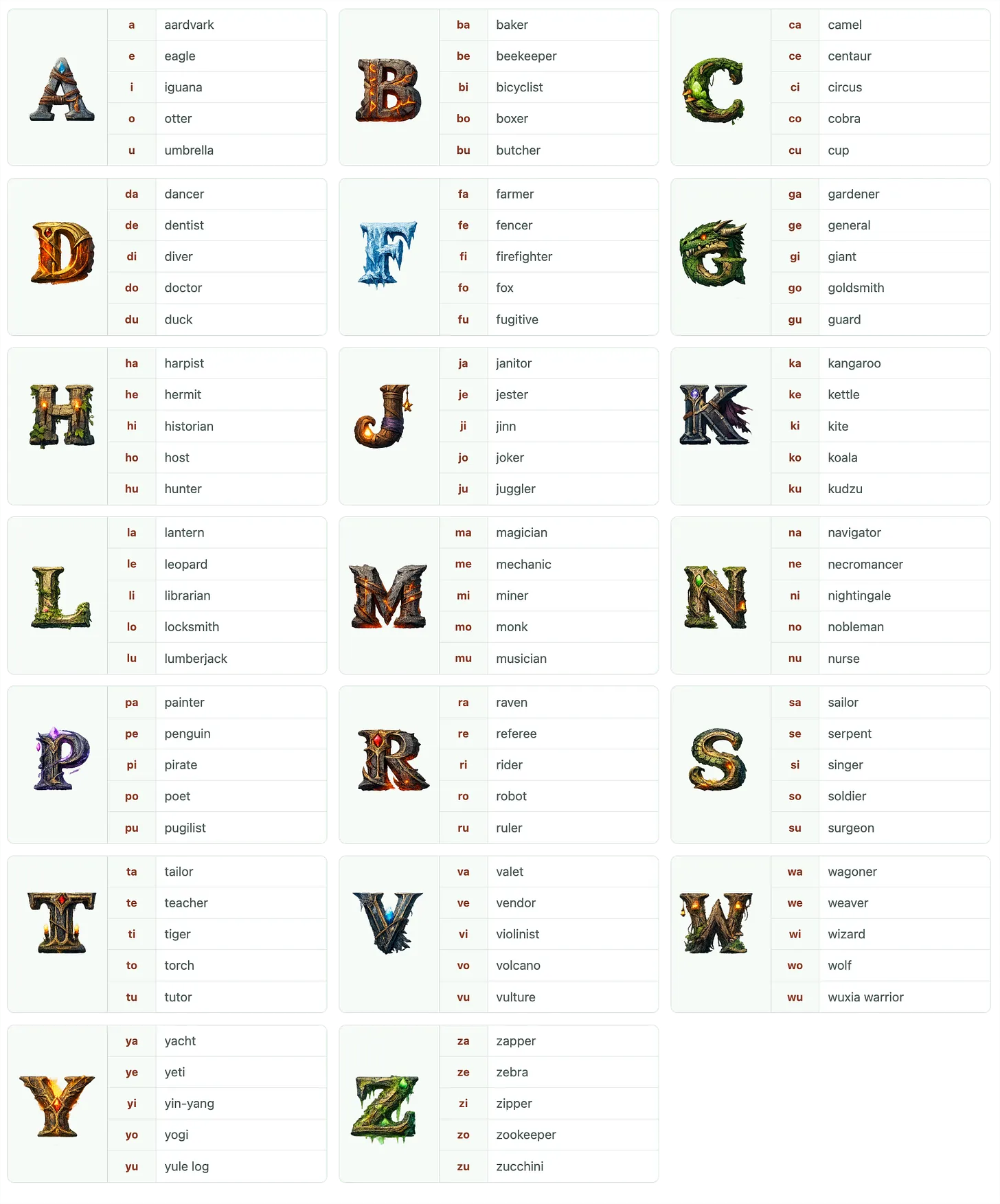
A brief summary of the Celtesian alphabet:
Conrad Celtes uses 20 characters from the Latin alphabet to create a grid-based memory palace.
Each character can store five images. The letter A is used for words that begin with one of the five vowels, while the other letters are formed using consonant-vowel combinations.
So, for B, you get Ba, Be, Bi, Bo, Bu words, and so on.
You then create pegs, or mental images, based on those vowel-consonant combinations, and place those mental images in clockwise order around the letter. Celtes suggests creating new vowel-consonant words for different material, and borrowing words from other languages for difficult pairs (like Wu).
This is a ridiculously simple system. You can teach it to someone in fifteen minutes.
I’ve included an Anglicized version of the Celtesian alphabet in this digest, though I recommend reading the actual Epitome.
A Brief Work on Artificial Memory by Jacobi Colinei Campani
A Brief Work was my first translated essay. It’s a short overview of mnemonics, and the highlight of the work is the 14 rules he gathers, inspired by Quintilian, Cicero, and St. Thomas.
This is basically a beginner’s guide, so if you’re familiar with mnemonics, you’ll already know most of what the author is sharing in his treatise.
However, there are some excellent quotes in there, and it makes for a fun refresher.
It’s also very short, so there’s no harm in reading it when you get the chance.
On Strengthening Memory in Minds of Every Kind by John Michael Albert
On Strengthening Memory in Minds of Every Kind is divided into two parts. I can easily recommend the first part, which covers your usual mnemonic basics in addition to a bestiary technique.
I was never interested in bestiaries before; however, the Celtesian alphabet technique has me revisiting the issue. The bestiary that John Michael Albert recommends has a very similar structure to Celtes’ alphabet: you assign an animal to each letter of the alphabet, and then you divide that animal into five places.
Unlike Celtes’ alphabet, you don’t have the benefit of knowing the first two letters of each peg in the bestiary, but otherwise, both of these are remarkably similar.
I have a nifty idea for how to combine Celtes’ alphabet with Albert’s bestiary, which I’ll share in a month or so if my experiments with the Celtesian alphabet work out.
The first part of this is excellent. The second part is more of a historical curiosity. It’s a medical tract that fits strictly within the humorist tradition. You can safely skip it unless you’re a student of medical history.
The Phoenix by Lord Pietro of Ravenna, Master of Memory
The Phoenix is, without a doubt, the most famous of the mnemonic works I’ve translated. It’s been translated at least twice, once in Old English and once using older machine-learning models.
I think this work has aged badly. There are some interesting techniques in here, but I didn’t realize that Pietro of Ravenna was a lecherous antisemite. It’s nothing too egregious, just some offhand comments here and there, but I do think they detract from the rest of his work.
He offers your usual mnemonic advice on placement, creating images, and body maps.
My biggest issue with The Phoenix, though, is when he brags about storing 100,000 places in his palace when he was a teenager. Ravenna was clearly a good mnemonist, and it’s entirely plausible he built a palace that large. However, the problem is that, in practice, a palace of that size is nearly useless. I’ve written about my experiences with the antipalace. If you have a 100,000-item palace, and you spend just one minute contemplating each item in that palace over the course of a year, and you spend 40 hours a week doing this, it will take you 41 weeks to entertain those items.
I don’t see the value in having a palace that large, since you’ll never actually use most of the material in it.
Given the tone and tenor of The Phoenix, I think Ravenna was a showman who was trying to hype up the art.
It’s an interesting piece with some flaws. It’s definitely not boring, at least. Read it if you want an easy and irreverent overview of basic mnemonics, but it’s not a must-read tract.
On the Education of Boys by Philippe of Marnix, Lord of Saint-Aldegonde
I translated On the Education of Boys because of the critique the author gives on artificial memory. It’s worth reading if you’re a mnemonist, if only to get an understanding of why some older thinkers disapproved of the art.
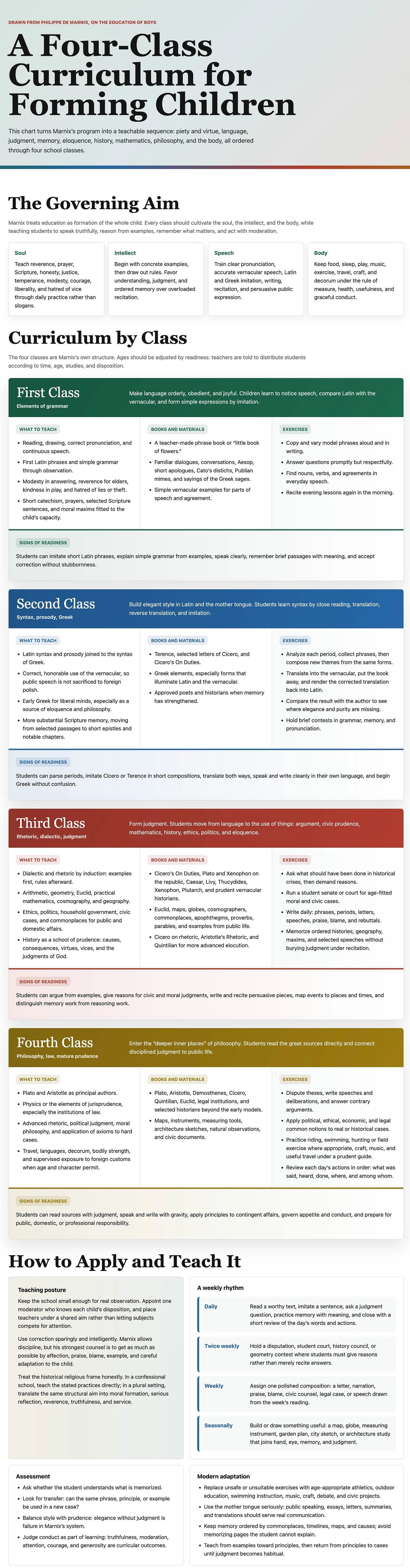
Other than that, the text gives an outline of how to provide a classical education. I created a chart of his curriculum, which I’ve included below.
Medical Theses on Preserving a Good Memory by Melchior Crunchius
My final translation of the week is for the medical theses of Melchior Crunchius. This work will most likely only be of interest to students of medical history.
I do think it’s interesting that he advocates using acorus, borage, and candied ginger to help protect the memory, which all have studies suggesting they may have certain cognitive benefits. I’m generally suspicious of nootropic claims, so I’m not really sure how much weight I give those studies. However, candied ginger is delicious, so I’m fine with adding that to my memory toolkit.
Closing Notes
That’s it for this week. I will be releasing future editions of this digest once a week. Most of my translations are being created as pages, because if I published them as regular posts, it would flood your inbox.
In the future, I’ll be releasing a weekly podcast with my thoughts on the pieces I’m translating, as well as other interesting bits and bobs. I also plan on releasing PDF and EPUB versions of the works I’m translating, which I will share with readers via this digest once they’re ready. This probably won’t be until June or July, though. I actually want the eBook versions of these texts to look nice, and that means coming up with a workflow for designing and packaging them in a way that makes them shine.
I hope you enjoyed reading this, and I really recommend checking out The Art of Local Memory and An Epitome of Both Rhetorics of Cicero by Conrad Celtes, which I consider the highlights of the week.
The former is the best treatment I’ve seen on using mnemonics to study the liberal arts, while the latter offers a simple but powerful memory method that you can teach people in under 15 minutes.
Thank you for reading, and please share this newsletter with people! Many of these books and essays deserve a wide audience.