Creating A Screen Free Future - The Memory Diner Digest # 6

Hello everyone and welcome to the sixth issue of the Memory Diner Digest.
I’m in the middle reworking what I actually want to accomplish with this newsletter, so the formats a bit different this week.
I’m going to share a brief list of the texts I’ve released since the last digest, but the meat of today’s newsletter is the essay I wrote on what the Pims Memory Diner newsletter is really about.
You’ll even learn why it’s called pims.substack.com instead of something else!
Feel the anticipation.
The Latest Translations
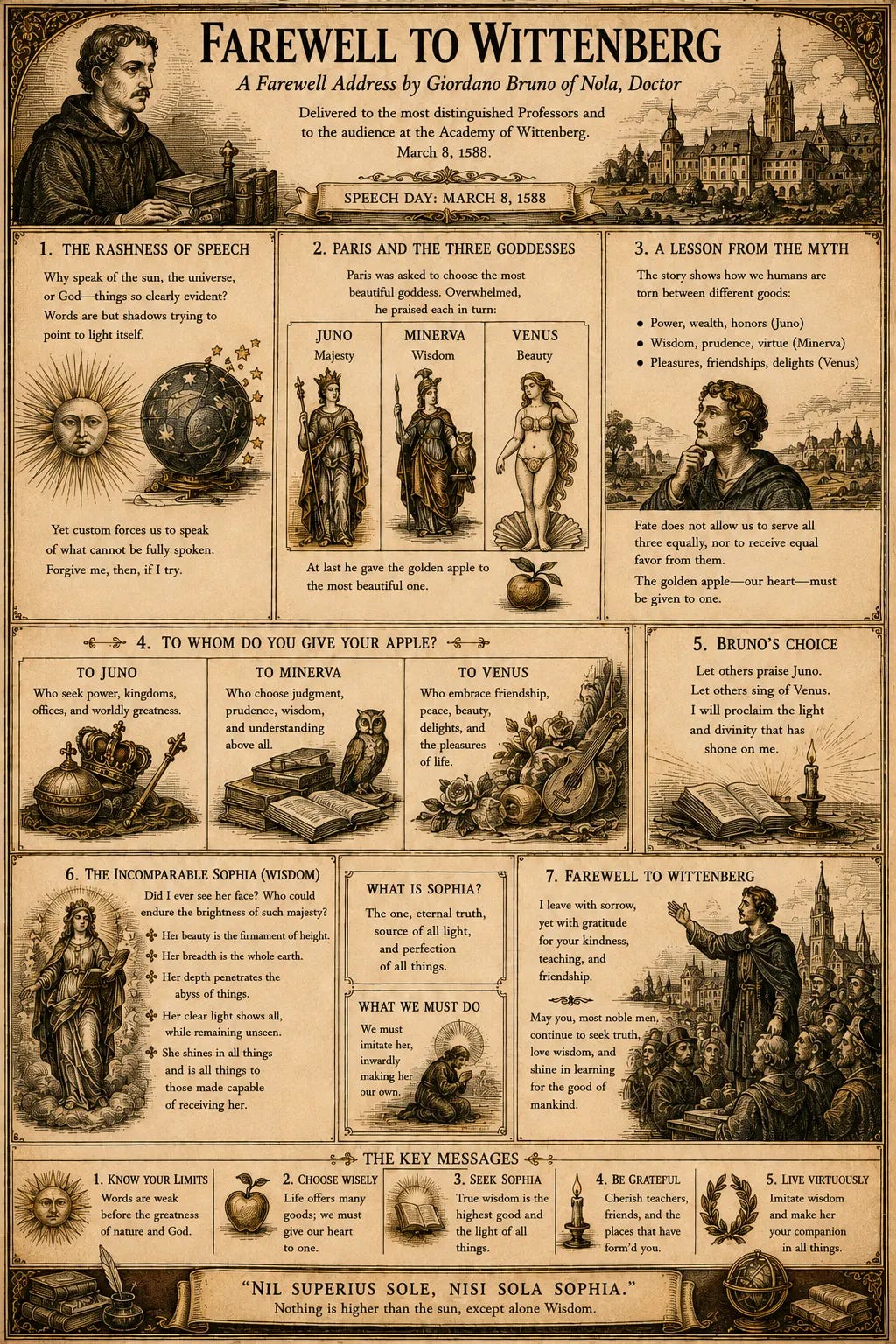
I’ve got three texts by Giordano Bruno for you: his Farewell Address to the University of Wittenberg, his Consolatory Speech for the funeral of the Duke of Brunswick, and the Cambrai Dispute, which caused such an uproar that it led to him fleeing France. The two speeches are quite short and are excellent displays of Bruno’s brilliance, while the Cambrai Dispute pairs well with some of the other anti-Aristotelian works I’ve shared recently. The Ramists had very different beefs with Aristotle than Bruno, so comparing the two sides is enlightening.
Giromalo Marafioto’s excellent Art of Memory, or Reminiscence is now also available in English. Marafioto is famous for his hand-based mnemonics, which are a lot of fun.
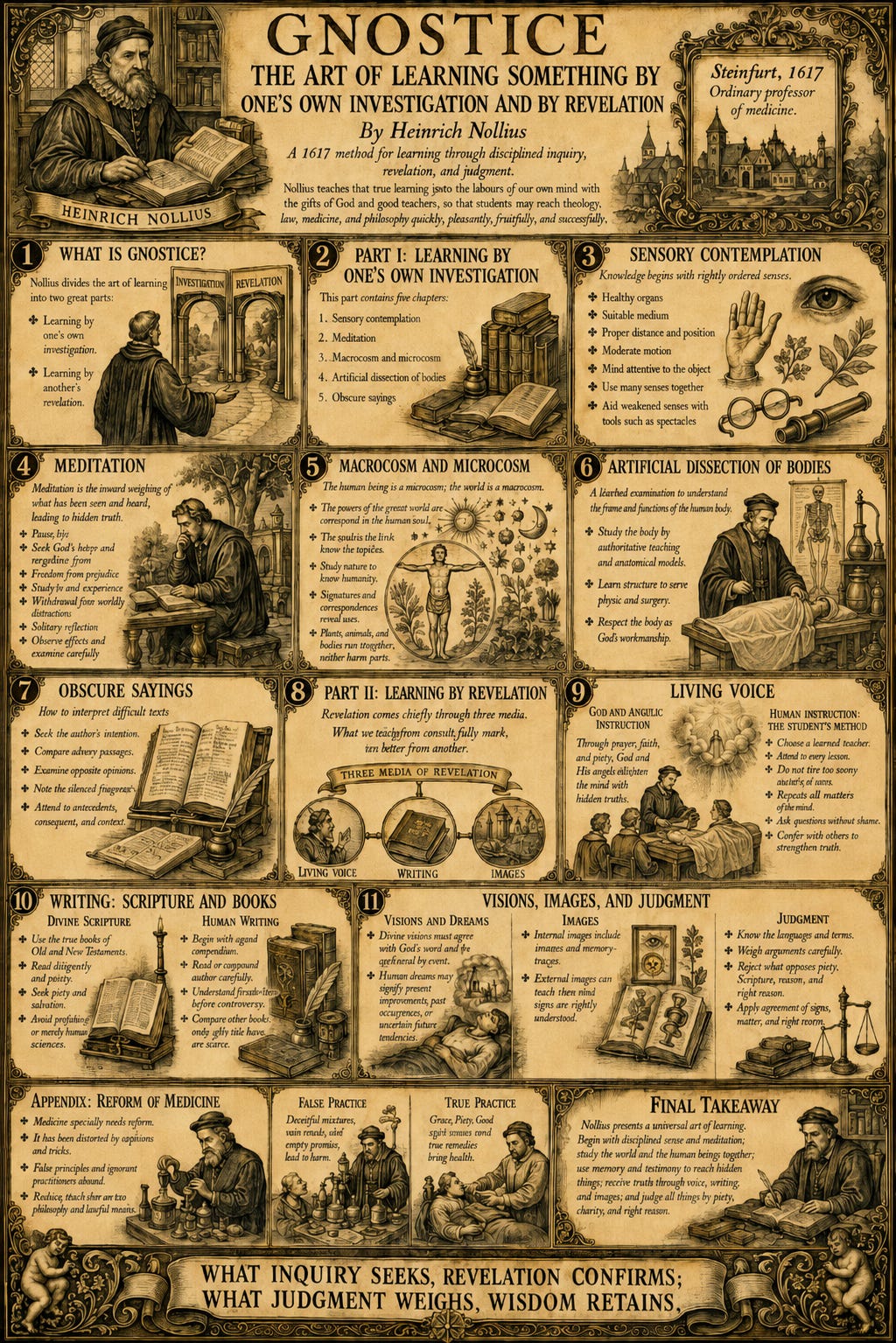
Gnostice: The Art of Learning Something by One’s Own Investigation and by Revelation, by Heinrich Nollius, is a work by an alchemist, hermetic philosopher, and critic of mnemonics.
On Schools: Their Origin, Antiquity, Usefulness, Necessity, Causes, and Against Those Who Oppose Them by Johannes Fortumannus is an excellent speech on the history of schooling, and it offers one of my favorite quotes from any of the translations I’ve shared so far:
“In this last age of the world, and especially in our own most corrupt century, everyone sees how much contempt there is for studies and the liberal arts”
These words were uttered in the year 1600. 💖
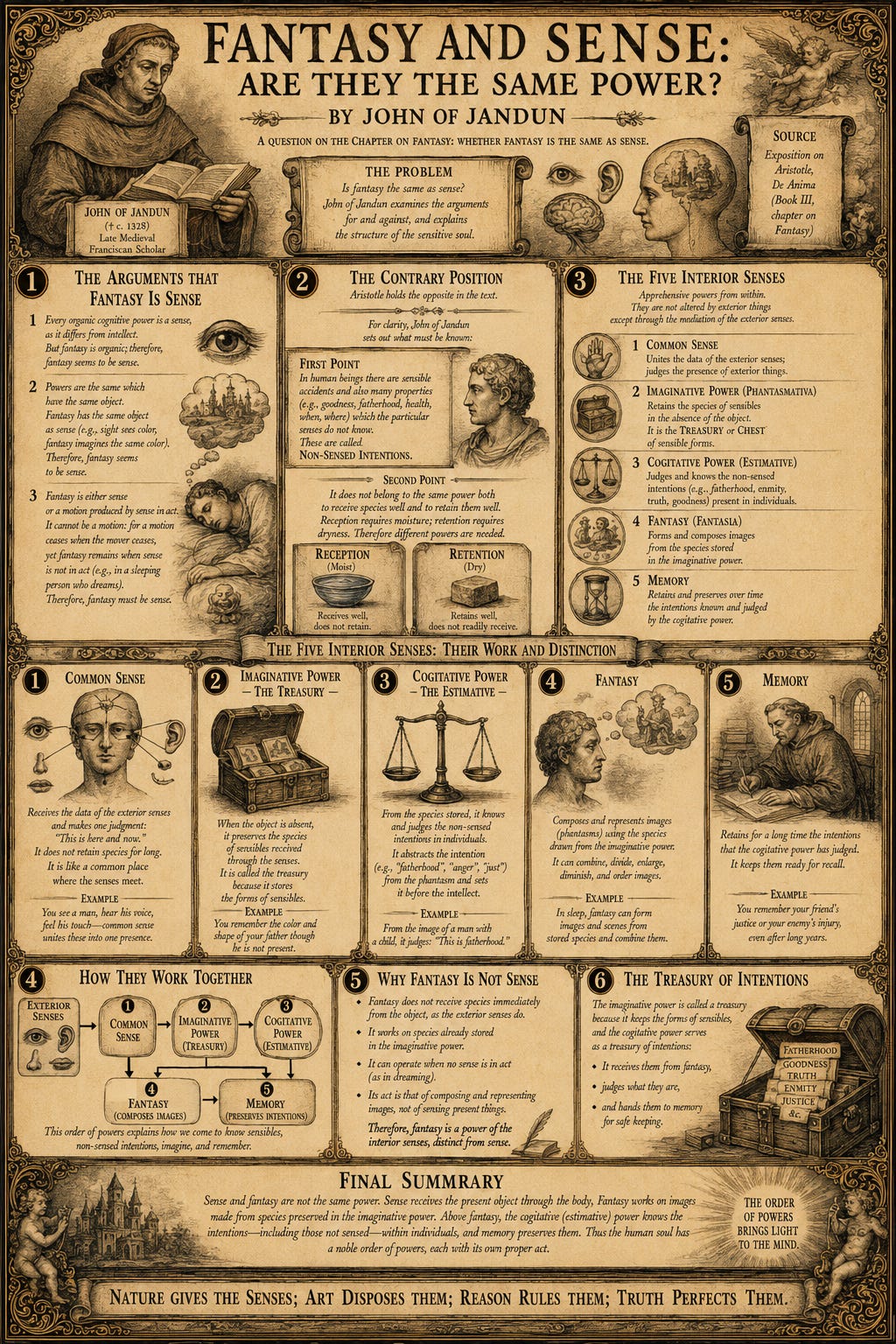
Fantasy and Sense: Are They the Same Power? by John of Jandun explores the scholastic framework of the five interior powers. It’s a chapter from a larger work that I wanted to share since it was my first introduction to the concept of the “treasury of intentions,” an idea that has deeply shaped my memory practice.
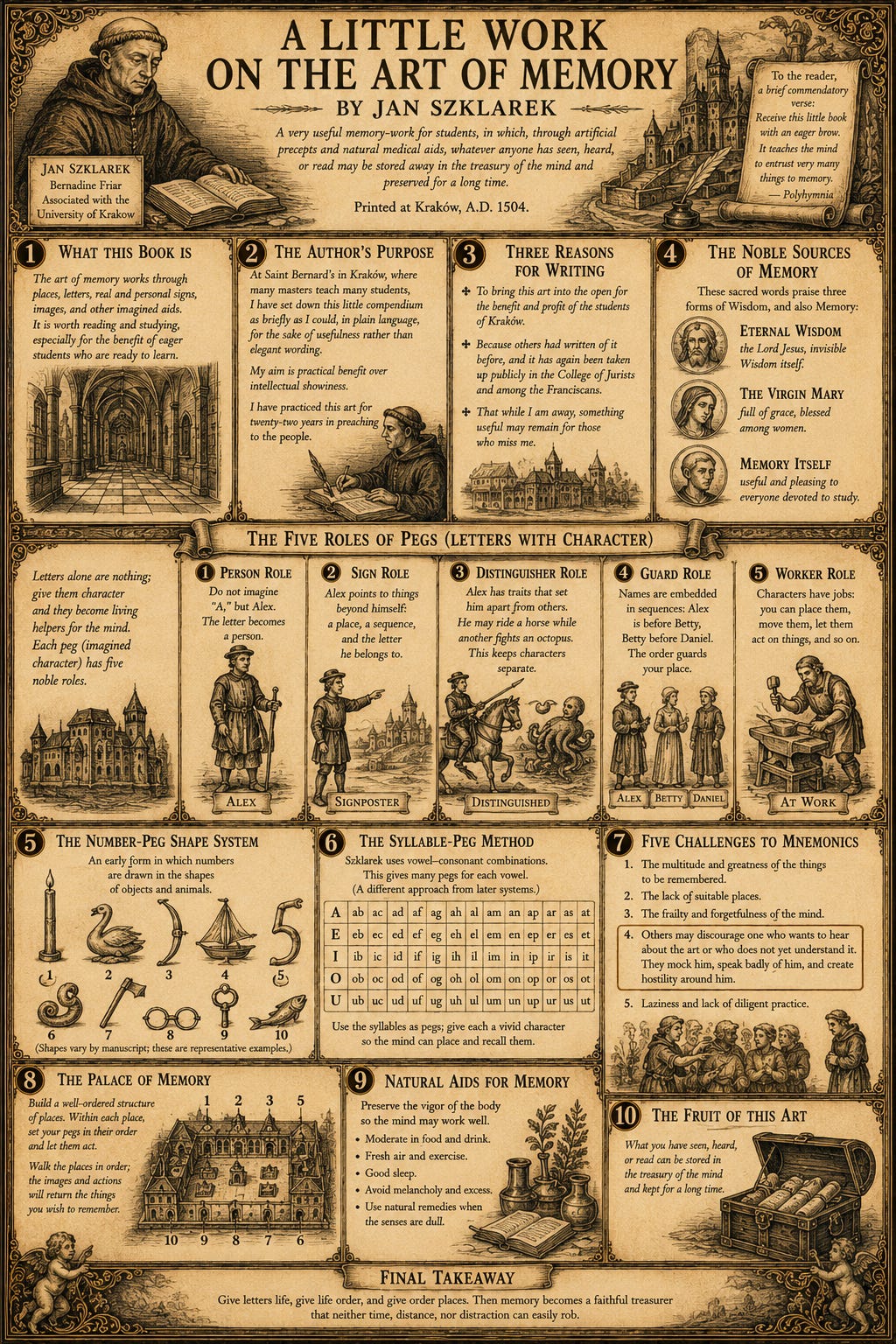
A Little Work on the Art of Memory by Jan Szklarek offers us a variety of interesting techniques, including an early syllabary method that I find messier than the ones used by Conrad Celtes and Laurence. In Szklarek’s system, each vowel is paired with every consonant instead of having each consonant paired with every vowel, so Ab/Ac/Ad instead of Ba/Be/Bi. Sets of five pegs are easier to work with than sets of twenty!
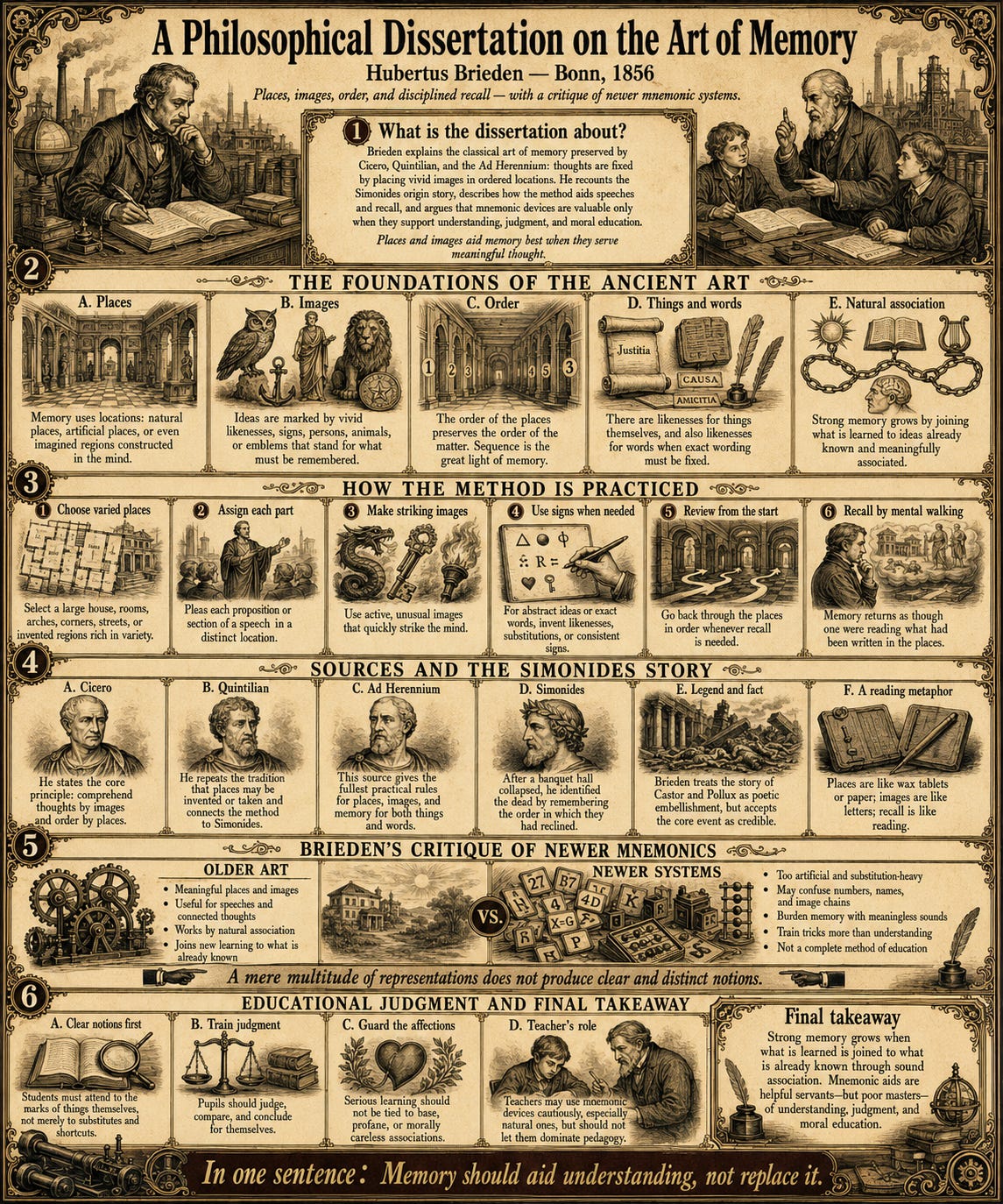
Humbertus Brieden’s 1856 dissertation on the art of memory features a critique of the mnemonics of Otto Reventlow and Hermann Kothe, which were popular at the time in Germany. The best part of the dissertation is his treatment of pedagogy, which I think aged fairly well compared to the section on mnemonics.
Finally, I’ve released 12 more chapters from the first book of Morhof’s Literary Polyhistor. I won’t give a per-chapter treatment in this digest, but there’s some great stuff in here. I think the chapter on learned conversation is my favorite of the bunch.
This Newsletter Is Actually About Creating A Screen Free Future
I mentioned a couple of weeks ago in a reply to one of my readers that I was planning on sharing how I use mnemonics with AI.
I’m not going to give away my whole toolkit until I have enough supporters to warrant it, because…

However, I am going to share why I’m serious about combining mnemonics with artificial intelligence:
It lets you use a computer without staring into a computer screen.
There are dozens of novel mnemonic-based interfaces I’ve experimented with, and some of them are revolutionary.
This scene from Back to the Future captures what I mean.
Using mnemonics, you can use a computer without using your hands or even looking at a monitor.
A few years ago, I built a toy app for the Nextmind BCI that allowed users to interact with a computer using items stored in a memory palace. It wasn’t very useful, though. I’ll see if I can find the code, or at least rebuild it, so I can open-source it for other brave explorers.
Besides brain-controlled interfaces, mnemonics can be used to power a variety of other technologies, each of which can replace different aspects of the dispiriting screen-first internet that is currently turning the world into a such drag.
Voxel technology, humanoid robots, drones, e-ink screens, and other pared-back, almost-analog displays can all be combined with mnemonics to replace certain tasks that we currently use digital screens to accomplish.
I dream of a world where I never have to look into a computer screen ever again.
The PIMS Failure
The reason this newsletter is called PIMS is that it originally stood for “personal ignorance management system.”
PIMS was the software I was building to power my antipalace, a massive memory palace that would have stored over 150,000 items had I finished it.
I never built the full PIMS app, though, because it turns out that memorizing 150,000 items is stupid.
I eventually realized that I would never have the time to engage everything in a palace that large, so I threw the software out even though it did some neat things.
Automating memory palace construction is cool!
It’s just not that useful.
If you’re not trying to memorize a ridiculous amount of stuff, you’re better off building palaces incrementally as you engage with the material you want to remember, and retiring palaces once they serve their purpose.
Memory palaces that hold more than 10,000 items are not that useful. I think 5,000 items is a much more reasonable ceiling.
After I shuttered the PIMS project, I was left wondering what to rename this newsletter.
Eventually, I realized that PIMS could also stand for…
Prompting Is My Superpower
Yep.
That’s why this newsletter is still called Pims.
It now refers to the tools and techniques I’ve developed for engaging artificial intelligence using the art of memory, all in service of eventually building screen-free alternatives to the tasks we currently need computer screens to accomplish.
AI is still controversial in the West, and not without some justification. However, the technology isn’t going away, and we need to learn how to engage it in a way that doesn’t undermine our own wellbeing or our future prosperity.
Mnemonics allow you to engage with the robots in a more mindful, deliberate manner.
Using the art of memory, you can create workflows that end up enhancing your understanding of the world instead of delegating your thinking to the robots.
You can use the art of memory to become an expert investigator.
You can build tables of questions, like those used by the disciples of Raymond Lull, to question any topic. You can also combine facts and questions using the ars combinatoria.
Or, my favorite, you can even feed the robot public domain books that you’ve read and then debate each page of the book from memory.
“Let’s argue about the arguments on page 35. This is my position, and now I want you to argue against it from the perspective of a 1930s detective from Chicago who absolutely hates the author.”
Sure, you could try doing that by holding a copy of the book in your hand, but relying on your working memory to discuss a book is qualitatively different from relying on your long-term memory.
It’s the difference between someone reading a speech from index cards and hearing someone speak from the heart. Mnemonics let you speak from the heart without having to rummage through your notes.
That kind of freedom is a big deal when dealing with robots. You’ll be faster on your feet, you’ll have access to more cognitive bandwidth, and you’re more likely to lead the conversation instead of being led by it.
I’ll Just Google It
The art of memory, in its purest form, is also the art of asking questions.
Yes, you can “just Google it” without having a trained memory, but your questions will be impoverished compared to the ones asked by people who actually know things.
A doctor can ask better medical questions than a barber, and a barber can ask better questions about hairstyles than a florist.
In the same way, knowing facts about stuff lets you ask better questions about the facts you know. You want to ask better questions about the moon? Then remember facts about the moon.
Mnemonics are a force multiplier when it comes to asking questions. Each experience that you remember, each fact that you can recall, each idea that you can retrieve, is a seed that can grow into a thousand questions with proper tending.
The art of investigation is built on a foundation of knowledge. If you don’t know things about the world, then your questions about the world will suck.
The ability to ask good questions is going to be increasingly valuable in the era of artificial intelligence.
Flashcards, PKMS, and other study methods cannot match the inquisitive power of a trained memory.
At all.
Mnemonics and the Goldilocks Zone
A trained memory opens up new ways to engage with technology.
My memory method was designed around the idea of enabling new computer interfaces, preferably an interface that would allow me to throw every digital screen in my house into a lake or a volcano.
AI will eventually allow me to accomplish important tasks without having to touch an actual computer.
I am thrilled at the prospect.
My techniques are unlike anything out there because my goal was always very different from the ones pursued by other memory artists.
I initially wanted to build a stupidly large memory palace so that I could sit with the notes I had taken over the years. It quickly dawned on me that the act of asking questions was much more important than the size of my memory palace, and that a bigger palace wasn’t always better.
There’s a point where you hit diminishing returns, where the size of a palace requires more upkeep than it’s worth.
However, the “Just Google It” bros make the opposite mistake by assuming they don’t need to memorize anything.
There’s a happy middle between memorizing too much and memorizing too little.
In order to become a master prompter, you need to remember the right amount of the right things, and then you need to cultivate a practice of contemplation and investigation so you actually turn the memories you’ve stored into creative fuel.
At some point while I was sussing out the role of questions in the art of memory, I realized that I could use mnemonics to enable a variety of screen-free computing alternatives. The antipalace eventually gave birth to my anti-screen creed, so as far as failures go, I think that was a good one.
Not everyone wants to learn mnemonics, but a lot of people share my dream of throwing their computers into a fiery pit. My argument is that mnemonics can help you do exactly that!
Screen-Free Nirvana
So now you know why this newsletter is called Pims and what my long-term goal for this project is actually about: minimizing our need for computer screens.
I know, I know, a lot of people hate the robots, but in my view, if the robots make it possible for us to never have to look at a computer screen ever again, then short of Skynet coming online and wiping us all out, all the downsides of AI will have been worth it.
Pims is about giving people the mnemonic skills necessary to make this screen-free nirvana possible.
Simply put, if you don’t have a trained memory, you will struggle to use AI in a way that lets you throw your monitor out the window.
Now, of course, there are some technologies that will need to be invented in order to make this future a reality, but I consider mnemonics one of the key instruments that can enable a high-tech, screen-free civilization.
Even if the end goal of the Pims Memory Diner isn’t translating old books, that’s something I’ll keep doing since I enjoy it. However, the reason I’m translating mnemonic texts is to find techniques that I can put to use in achieving my actual goal of creating screen-free computing alternatives.