
Memory Retrieval Vs. Traversal + A Small Script To Help You Practice Mnemonics

I’ve built a small javascript toy for retrieval practice. It lets you test your memory of the items you’ve stored in a structured memory palace.
I’m using structured here to mean a palace where the items are stored in predictable locations.
In the methods I use, items in a memory palace have a fixed address, like a unit in an apartment complex. It’s easy to know the number of an item based on it’s location, because locations follow certain architectural rules.
There are many ways of arranging addresses. I tend to use base units of either 5 or 10 addresses per location or “building”. Usually, I prefer 5 address arrangements, but I also work with base-10 for certain things.
I don’t use more idiosyncratic address arrangements, where different rooms have different numbers of items. It’s harder to calculate addresses when items aren’t organized in a systemic manner.
An orderly memory palace makes finding items predictable, and predictability has benefits I value over the upsides of more personalized arrangements.
You can grab the script over at github. Simply download it and load it in your web browser of choice. If you’re unfamiliar with github, just navigate to the little download button across from the pencil icon.

The toy script is simple to use:
Choose an address range by setting a ceiling & floor number.
Setting the range will load an address.
If you get the address right, it’ll pop out of the list, if you don’t, it’ll keep the address and pick a new one for you.
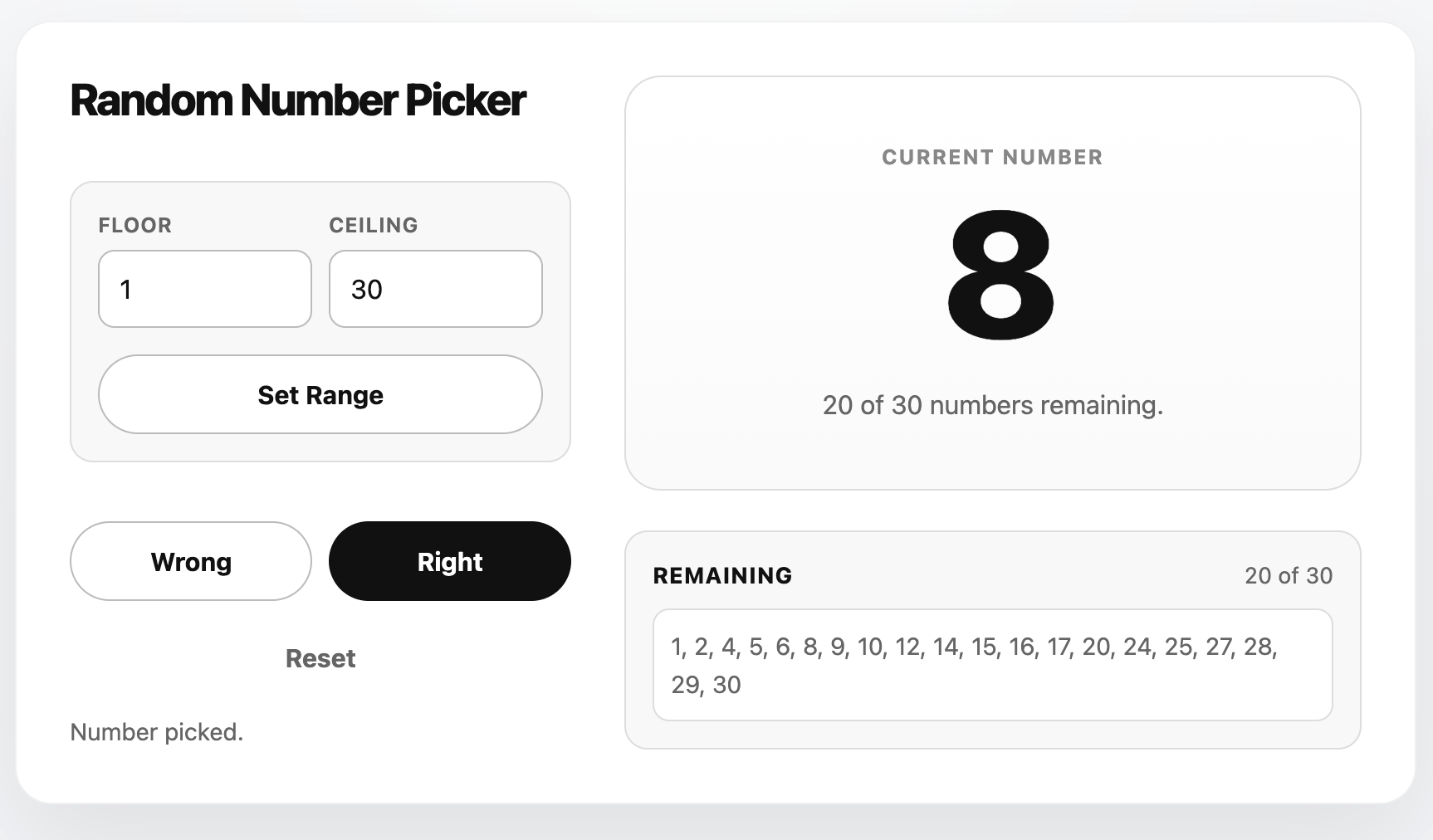
This is just a simple tool for checking to see if you know what item is stored at which address. I built it to help memorize the Sabian symbols. I’m working on a more elaborate app that uses FSRS (a spaced repetition algorithm) and tracks your answers, which I may share later.
Getting Started: Arranging Locations
In order to use the toy script, you’ll need to be able to identify the address of the items in your memory palace.
This is easy to do if you use predictable address locations, like those I mentioned earlier.
One of the most common patterns used by early-modern mnemonists is the M-5 pattern. The M-10 pattern was less common (and not nearly as elegant).
There are multiple ways you can divide a room using the M-5 pattern, the simplest is by using the corners (1,2,4,5) and middle (3) of the room. A more elaborate version involves using the walls of the room.
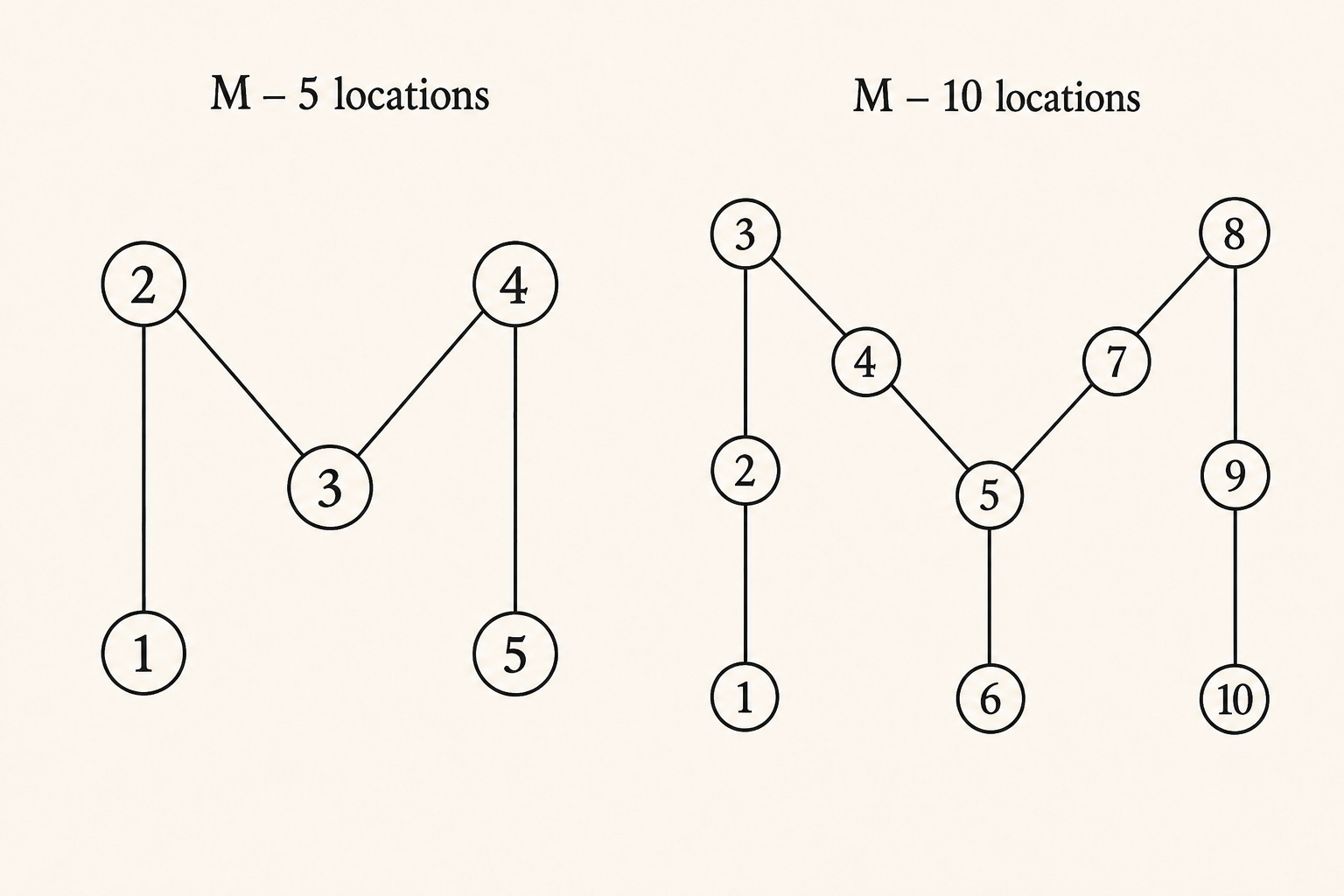
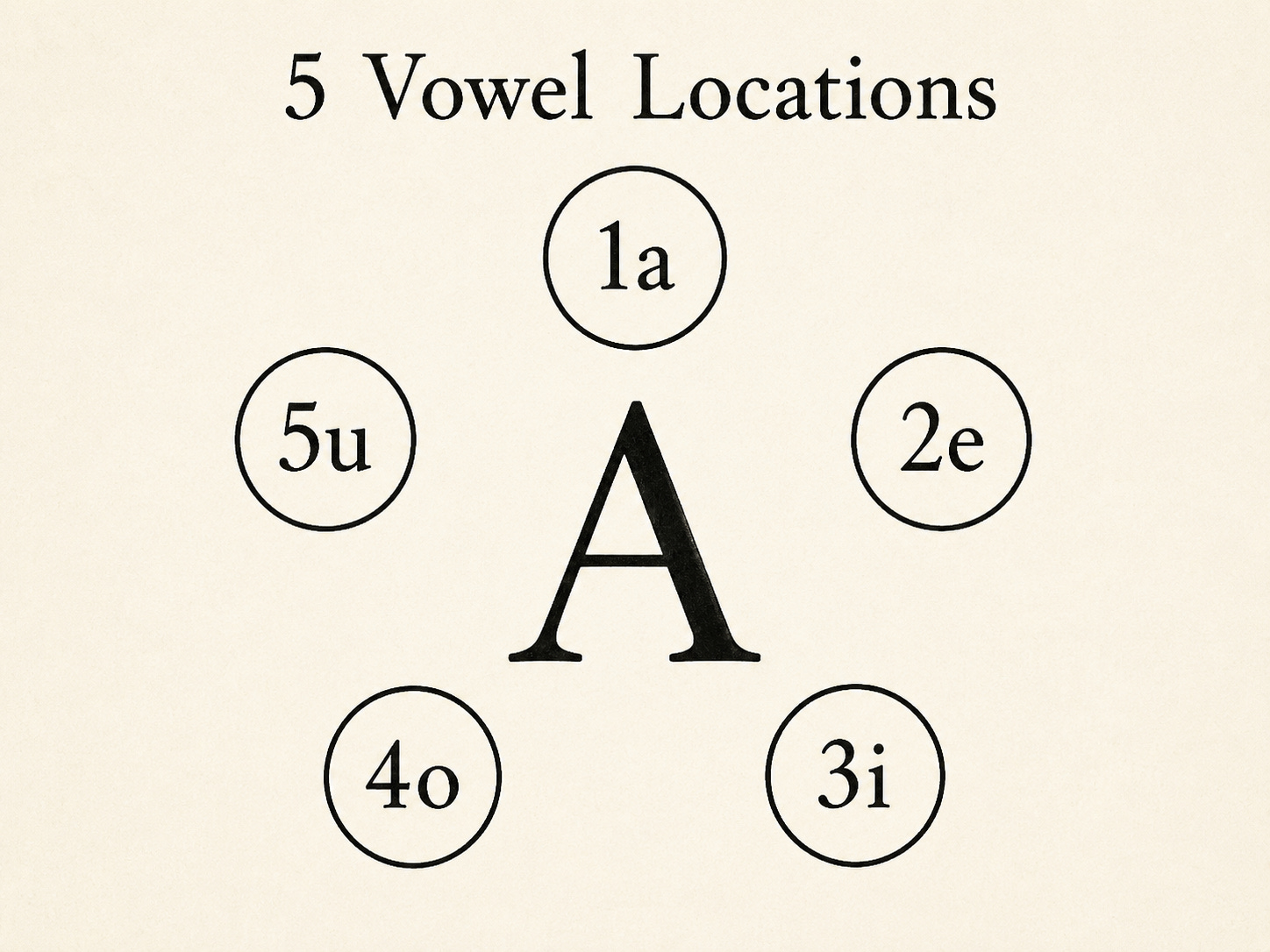
My syllabary addresses look like this:
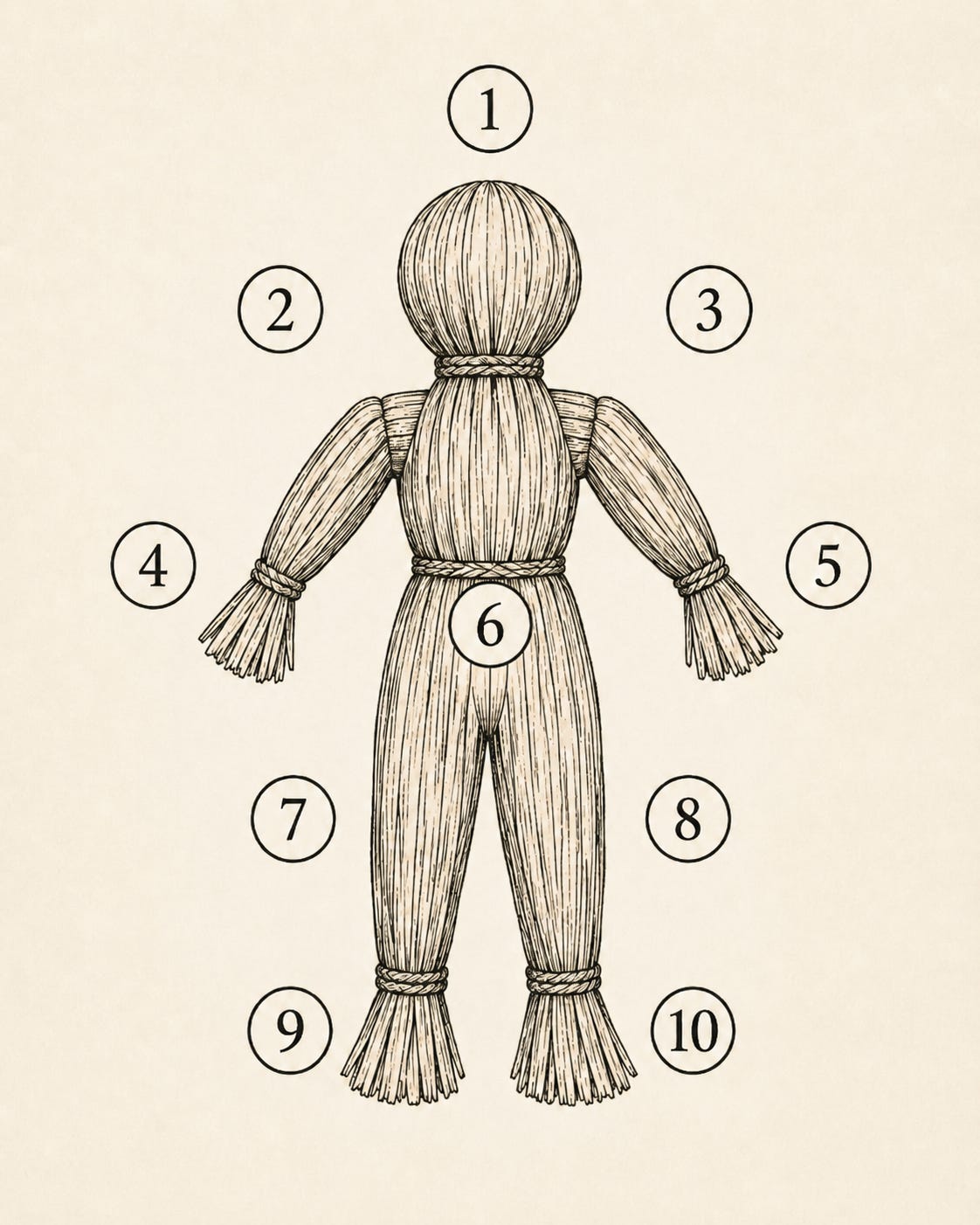
If you use body pegs, it might look like this:
Feel free to experiment with other patterns.
Traversal Order
You need to know the room traversal order for your palace.
Let’s say you divide a room into four walls, each with items organized using the M5 pattern, that gives you 20 locations per room.
Using that pattern, the first room on your journey has addresses 1-20, the next room 21-40, the room after that 41-60, etc.
If you’re using the syllabary method, A has the addresses 1-5, B has 6-10, C has 11-15, and so on for the remaining letters. I use 20 character in my syllabary, which gives me 100 addresses per route.
If you’re using body pegs, each person would be a “building”, so the first person in your palace is 1-10, the second is 11-20.
Your traversal order gives you the multiple value you’ll need to calculate a memory item’s address. With practice, you won’t need to do any mental calculations, you’ll just know the address based on the location.
The Major System
The major system works quite well with address based retrieval practice. You can easily modify any mental images you’ve stored by adding a number peg to it. For example, the 9th Sabian Symbol of Aries features a woman looking into a glass crystal. You can have her looking at an Ape, which is a common major system image for the number 9.
Retrieval Vs. Traversal Practice
Retrieval practice is what powers flashcards.
It’s the simple act of retrieving an item from memory with the help of a prompt.
Retrieval practice builds speed and helps memory consolidation.
Address based retrieval is a more powerful version of flashcard retrieval, since an address prompt offers significantly less context than the questions used in flashcards.
Traversal practice is not the same as retrieval practice.
Retrieval practice is fast, traversal practice is slow.
Retrieval practice grabs a response from a cue, while traversal practice involves mentally navigating heuristic maps of cue-responses. Instead of retrieving a single cue, traversal retrieves a network of associations which you then travel across.
I consider traversal a form of lateral retrieval, where you move through a network of cues, while traditional retrieval practice is more vertical, since you’re only interested in retrieving a single response from a single cue.
Traversal practice requires mentally organizing the things you know in a way that allows you to mentally revisit them so that you can engage with them on your own terms.
Retrieval practice guarantees that a response is associated with a cue, while traversal practice structures cues so you can engage with them deliberately instead of reactively.
Traversal practice greatly benefits from retrieval practice.
Many mnemonists and flashcard enthusiasts think it’s an either/or proposition: either you do mnemonics, or you do flashcards. It’s better if you do both.
Some Caveats
As I’ve mentioned in How To Start A Memory Practice, your memory practice should be used in service of your creative or contemplative goals. Some people get addicted to growing the size of their flashcard decks, which is a poor use of their time.
You should set a hard limit to how many active memory items your keeping in a memory palace at any one time. You should also actively chunk items into larger collections. Martin Sommer’s lesson on the art of abbreviation is worth reading.
It’s easier to remember 12 collections of 30 items than a single set of 360 items. A memory hamlet is better than a memory skyscraper.
Sanity-test your palaces. Keep them reasonably sized. If you’re trying to memorize a large list, have a good reason for it, and break the list into coherent groups. Chew your memory items or you’ll get mental indigestion.
Sabian Example
Let’s take the Sabian symbols, which are a collection of 360 scenes used in astrology to read horoscopes. You can also use them in divination as a kind of large tarot deck.
If you only focus on traversal practice, you’ll have a hard time using the Sabian symbols on the fly, since you’ll need to walk through your palace and find each image stored at each address.
Retrieval practice let’s you quickly load the right image just by thinking of the degree number.
Let’s say you have a 12 sided dice (for choosing a zodiac sign) and a 30 sided dice (for choosing the degrees of a zodiac sign), and you throw them and get 3-15.
If you only practice traversal, you’ll have to walk through your memory palace for the third zodiac sign and then check each address.
Using retrieval practice, you’ll instantly know that the image is of two Dutch children talking with each other.
Traversal and retrieval practice both have their places, but serve different roles.
I’m still working out the best way to combine the two of them, which I think is context-sensitive, and requires different approaches for different study goals.
It’s worth noting that most of what I’m sharing in this newsletter is part of my own research into the art, and not a definitive guide to best practices. These are experiments and explorations.